
PTE Score: Sections, CEFR Levels and Requirements for 2026
Scores and Results
You've picked a university or a visa, and now you need one number to aim for. Your PTE score gives you five: an overall score plus four scores for the communicative skills of Speaking, Writing, Reading and Listening, each on a 10-90 scale graded against the Global Scale of English.
Pearson owns and scores PTE Academic, so every range below comes from Pearson's website or its PTE Academic Score Guide, and every requirement belongs to the university or government that sets it. PTE Academic UKVI uses the same Score Report with one extra number for UK visas. PTE Core maps to CLB for Canada and has its own page.
Table of Contents
What Is a PTE Score?
A PTE score is a number from 10 to 90, reported once overall and once each for Speaking, Writing, Reading and Listening, graded against the Global Scale of English (GSE). Ninety is the highest possible score on that 10-90 scale. Unlike IELTS, PTE reports a score on that scale, never a band. Pearson produces every score centrally, not the center where you sat the test.
PTE Academic UKVI uses the same scale and the same Score Report content as PTE Academic.
What Is the PTE Score Range Breakdown by Section?
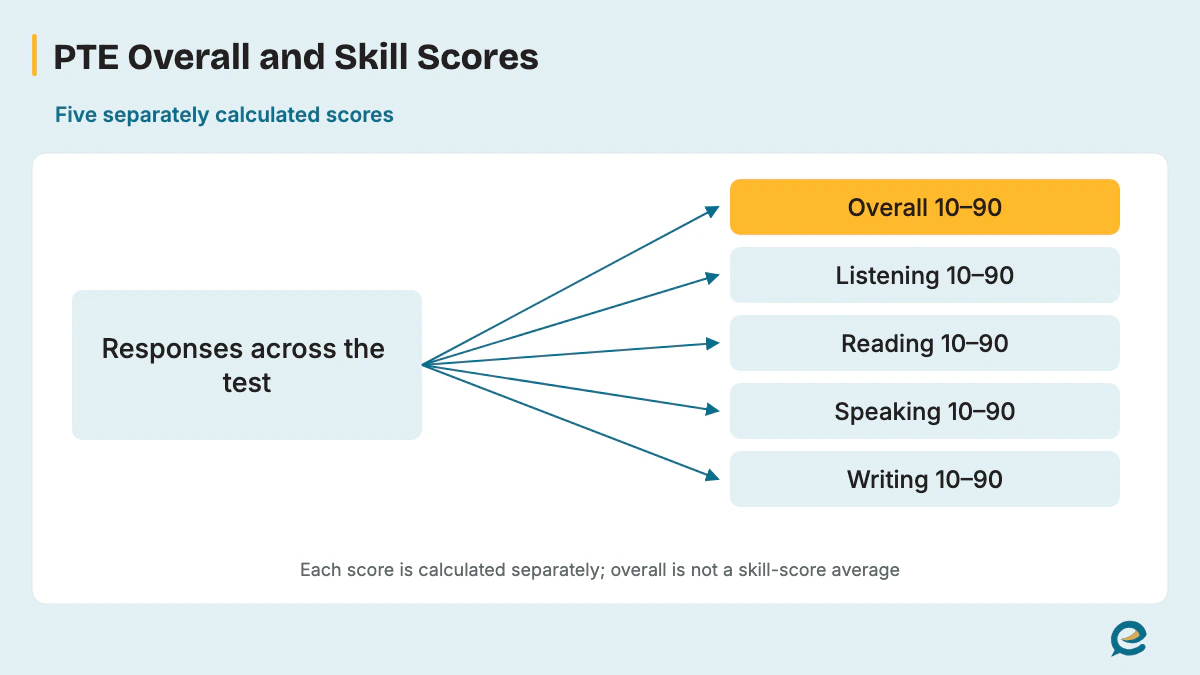
Every section uses the same 10-90 range, and the Score Report shows an overall score plus individual scores for Speaking, Writing, Reading and Listening. Pearson's Score Guide adds that the overall score is not an average of the four skill scores. Most skill scores also collect points from tasks outside their own part.
| Score | Range | Where it comes from |
|---|---|---|
| Overall score | 10-90 | Every one of the 65-75 questions across all 22 question types. |
| Speaking score | 10-90 | Part 1 speaking tasks, from Read Aloud to Summarize Group Discussion. |
| Writing score | 10-90 | Part 1 writing tasks plus Summarize Spoken Text and Write from Dictation. |
| Reading score | 10-90 | Part 2, plus Summarize Written Text, Highlight Correct Summary and Highlight Incorrect Words. |
| Listening score | 10-90 | Part 3, plus Part 1 tasks such as Repeat Sentence and Answer Short Question. |
Of the three test parts, Part 1, Speaking & Writing, runs about 76-84 minutes with 9 question types. Part 2, Reading, takes about 23-30 minutes with 5, and Part 3, Listening, takes about 31-39 minutes with 8, for about 2 hours in total.
Pearson calls the tasks that test two skills at once integrated skills questions: Listening and Speaking, Reading and Writing, Listening and Writing, or Listening and Reading. Their points count toward both skills, so your Listening score isn't the score of Part 3 alone. That overlap is also why nobody can rebuild your overall score from the four skill scores.
Which Communicative Skills Does Each PTE Task Score?
Pearson's Score Guide lists, for every one of the 22 question types, which communicative skills it scores, so you can see exactly where each skill score comes from. Questions per test are Pearson's published ranges, because different test versions are balanced for total length.
| Part | Question type | Skills scored | Scoring | Questions per test |
|---|---|---|---|---|
| 1 | Read Aloud | Speaking | Partial credit | 6-7 |
| 1 | Repeat Sentence | Listening and Speaking | Partial credit | 10-12 |
| 1 | Describe Image | Speaking | Partial credit | 5-6 |
| 1 | Retell Lecture | Listening and Speaking | Partial credit | 2-3 |
| 1 | Answer Short Question | Listening | Correct/incorrect | 5-6 |
| 1 | Summarize Group Discussion | Listening and Speaking | Partial credit | 2-3 |
| 1 | Respond to a Situation | Speaking | Partial credit | 2-3 |
| 1 | Summarize Written Text | Reading and Writing | Partial credit | 2 |
| 1 | Write Essay | Writing | Partial credit | 1 |
| 2 | Reading & Writing: Fill in the Blanks (Dropdown) | Reading | Partial credit per blank | 5-6 |
| 2 | Multiple Choice, Multiple Answers | Reading | Partial credit, minus 1 per wrong option | 2-3 |
| 2 | Reorder Paragraphs | Reading | Partial credit per correct adjacent pair | 2-3 |
| 2 | Fill in the Blanks (Drag and Drop) | Reading | Partial credit per blank | 4-5 |
| 2 | Multiple Choice, Single Answer | Reading | Correct/incorrect | 2-3 |
| 3 | Summarize Spoken Text | Listening and Writing | Partial credit | 1 |
| 3 | Multiple Choice, Multiple Answers | Listening | Partial credit, minus 1 per wrong option | 2-3 |
| 3 | Fill in the Blanks (Type In) | Listening | 1 point per correctly spelled word | 2-3 |
| 3 | Highlight Correct Summary | Listening and Reading | Correct/incorrect | 2-3 |
| 3 | Multiple Choice, Single Answer | Listening | Correct/incorrect | 2-3 |
| 3 | Select Missing Word | Listening | Correct/incorrect | 1-2 |
| 3 | Highlight Incorrect Words | Listening and Reading | Partial credit, minus 1 per wrong word | 2-3 |
| 3 | Write from Dictation | Listening and Writing | 1 point per correctly spelled word | 3-4 |
Personal Introduction opens the test and carries no score. Pearson's task web pages say Read Aloud also affects reading, but its Score Guide scores Read Aloud for Speaking only, and the table follows the Score Guide.
Put your practice hours where one task moves two scores: Repeat Sentence, Retell Lecture, Summarize Group Discussion, Summarize Written Text, Summarize Spoken Text, Highlight Correct Summary, Highlight Incorrect Words and Write from Dictation. Repeat Sentence alone appears 10-12 times, more than any other task. The full format of each one is in our guide to PTE question types.
How Is PTE Academic Scored?
PTE Academic relies on AI scoring that human experts trained by rating responses to every Speaking and Writing question, so the engine copies their standards. Each response then earns points in one of two ways, correct/incorrect or partial credit. Some tasks also get a human expert review of Content before the score is final.
- Correct/incorrect items earn 1 point for a right answer and 0 for a wrong one.
- Partial-credit items earn full points if correct, some if partly correct and none if wrong.
- Speaking and Writing tasks are scored on Content first, and a Content score of 0 means no points for that response.
- Writing tasks also carry Form, so an essay under 120 words scores 0 on Form and earns nothing.
- Memorized or pre-prepared material counts as an irrelevant response and scores 0 for Content.
- Human experts review Content on Describe Image, Retell Lecture, Respond to a Situation, Summarize Group Discussion, Summarize Written Text, Write Essay and Summarize Spoken Text.
- A second human makes the final call when the AI and the first human disagree on Content.
- Pronunciation and Oral Fluency are AI-scored only, each on a 0-5 scale: Pronunciation runs from Non-English to Highly proficient, Oral Fluency from Disfluent to Highly proficient.
- Every result is reported on the Global Scale of English.
The traits Pearson scores across tasks are Content, Oral Fluency, Pronunciation, Form, Development, Structure and Coherence, Grammar, General Linguistic Range, and Vocabulary. Write Essay also gets a human review of Development, Structure and Coherence and of General Linguistic Range.
How Does Negative Marking Work in the PTE Scoring System?
Three question types take a point off for each wrong choice: Reading Multiple Choice, Multiple Answers, Listening Multiple Choice, Multiple Answers, and Highlight Incorrect Words, with a minimum score of 0 per question. Pearson deducts nothing on any other task, so a guess on Select Missing Word or Highlight Correct Summary costs nothing.
On the three negative-marking types, select only the options you're confident in. The full list of traps is in our guide to PTE negative marking.
Can a PTE Score Calculator Work Out Your Overall Score?
An average of four skill scores cannot reconstruct the official overall score. Pearson calculates the overall and each skill separately, using question performance, difficulty and weighting. Its published explanation is useful for understanding the model; it does not turn four reported skill scores into the underlying task results.
What Is the Interpretation of PTE Scores in CEFR Levels?
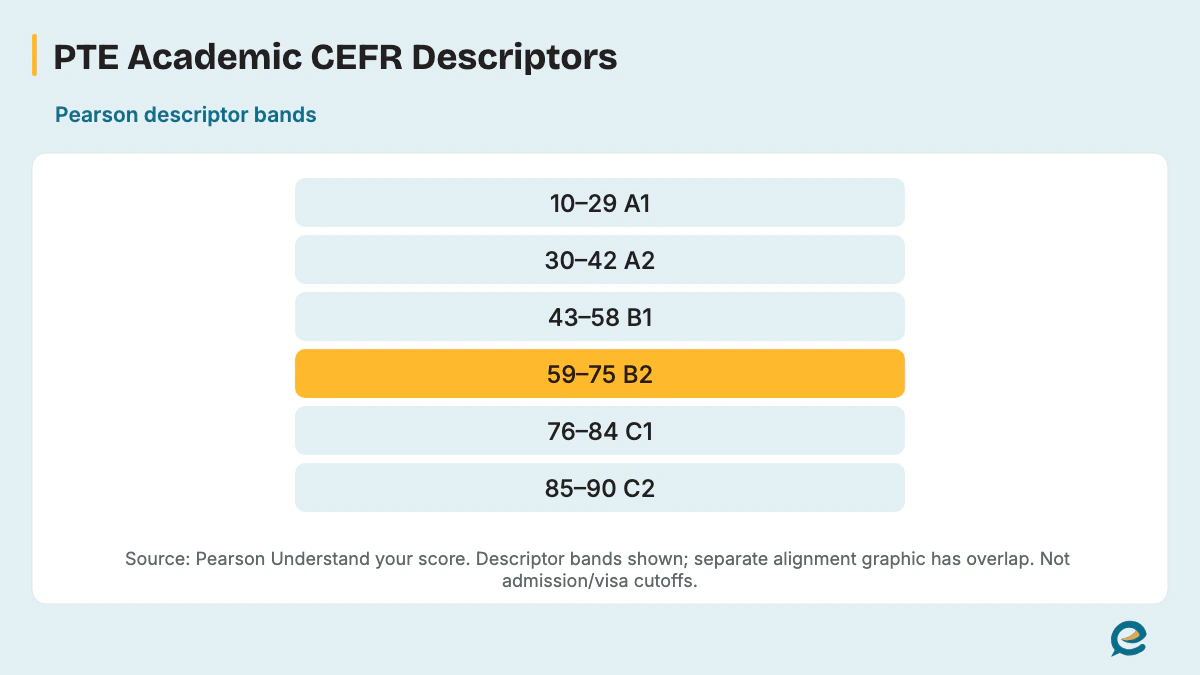
Pearson maps 85-90 to C2, 76-84 to C1, 59-75 to B2, 43-58 to B1, 30-42 to A2 and 10-29 to A1. On its understand your score page, each CEFR level carries a score descriptor of what you can do in English.
| PTE score range | CEFR level | What a test taker at this level can do |
|---|---|---|
| 85-90 | C2 | Understands almost everything they hear or read with ease. |
| 76-84 | C1 | Speaks fluently without much searching for words. |
| 59-75 | B2 | Grasps the main ideas of complex text, concrete or abstract. |
| 43-58 | B1 | Handles most situations in a place where English is spoken. |
| 30-42 | A2 | Manages simple, routine tasks that need a direct exchange. |
| 10-29 | A1 | Introduces themselves and answers questions about personal details. |
Pearson's scoring page and Score Guide also show a chart of approximate ranges that overlap: A2 30-42, B1 36-58, B2 50-75, C1 59-82 and C2 76-90. The overlap marks scores that predict some performance at the next level, which is how a 59 sits in both the B2 and C1 ranges of that chart. Read a single score against the six-range table, where a 65 is a clear B2 level and a 78 is a clear C1 level.
Pearson presents both descriptor bands and an overlapping CEFR alignment graphic. Read them in their stated context; the graphic is not a mistaken version of the descriptor table. CEFR descriptions do not replace an institution’s or visa route’s own score requirement.
What Is on the PTE Score Report?
Your Score Report shows your overall score and your four communicative skills scores, for Listening, Reading, Speaking and Writing, and Pearson adds a personalized Skills Profile that only you can see. The report also carries a Score Report Code (SRC), unique to each test you take, which institutions use to look up your result. A PTE Academic UKVI Score Report has identical content plus a SELT URN in its top banner for UK visa applications.
The PTE score card is this same Score Report in myPTE; Pearson issues no separate certificate.
The Skills Profile replaced the old enabling-skills section in November 2021 and is never shared with institutions. It shows a performance bar for eight skill categories, each with recommendations tied to GSE learning objectives:
- Open Response Speaking and Writing
- Reproducing Spoken and Written Language
- Extended Writing
- Short Writing
- Extended Speaking
- Short Speaking
- Multiple-skills Comprehension
- Single-skill Comprehension
What Are Enabling Skills in PTE?
Enabling skills were six extra scores (Grammar, Oral Fluency, Pronunciation, Spelling, Vocabulary and Written Discourse) that the PTE Academic Score Report showed before November 2021. Pearson removed that section and replaced it with the Skills Profile.
Today's Score Report shows only the overall score and the four communicative skills scores, so any report or chart listing enabling-skill scores describes the pre-2021 format. Feedback on fluency, pronunciation, grammar and vocabulary now comes from the trait scores inside each task and from your Skills Profile.
How Do You Access and Share Your PTE Scores?
Pearson emails you when your scores are ready, typically within two business days and sometimes up to five, and you view them in your myPTE account. You can share digital scores with as many institutions as you like, free, and scores stay valid for two years from the test date.
- Sign in to your myPTE account after the results email arrives.
- Click "My activity" in the menu.
- On the card for your test, click "Share results".
- Type the institution's name and click "Search".
- Tick each institution you want, up to seven at a time.
- Review your details, click "Select Programmes", then "Next" to confirm.
The second route is to give an institution your Score Report Code on an application form or by email. Institutions don't accept paper or PDF score reports; they verify digital scores through Pearson's secure portal, and Pearson's help center says an institution can see a score about two days after you send it.
If you ticked DHA (Australia) or INZ (New Zealand) when booking, your score was already shared automatically. A PTE Academic UKVI score goes to the UK Government automatically, and you enter the SELT URN on your visa form.
How Long Does Getting Your PTE Results Take?
Pearson says most test takers get PTE Academic results within two business days, and in some cases up to five business days; an email notice arrives and the scores appear in myPTE. Pearson's help center adds that some results flagged for extra review take longer than five working days. Book with that buffer if a deadline is close; our guide to PTE results covers what to do while you wait.
How Long Is a PTE Score Valid?
Pearson's score report is valid for two years from the test date. The body you apply to can set its own window: Australia's Home Affairs accepts results from the 3 years before your application for most English levels but only 12 months for Functional English. Check the exact rule in our guide to PTE score validity.
Can You Send Your PTE Score to Multiple Universities for Free?
Yes, you can share your digital PTE scores through myPTE with as many institutions as you like, for free. Pearson places no cap on the total, so free score sending reaches unlimited institutions; the only limit is that you select up to seven recipients at a time, then repeat the steps. Free sending is one of the benefits of PTE when you apply to several universities in one cycle.
What PTE Scores Do You Need for Studying Abroad?
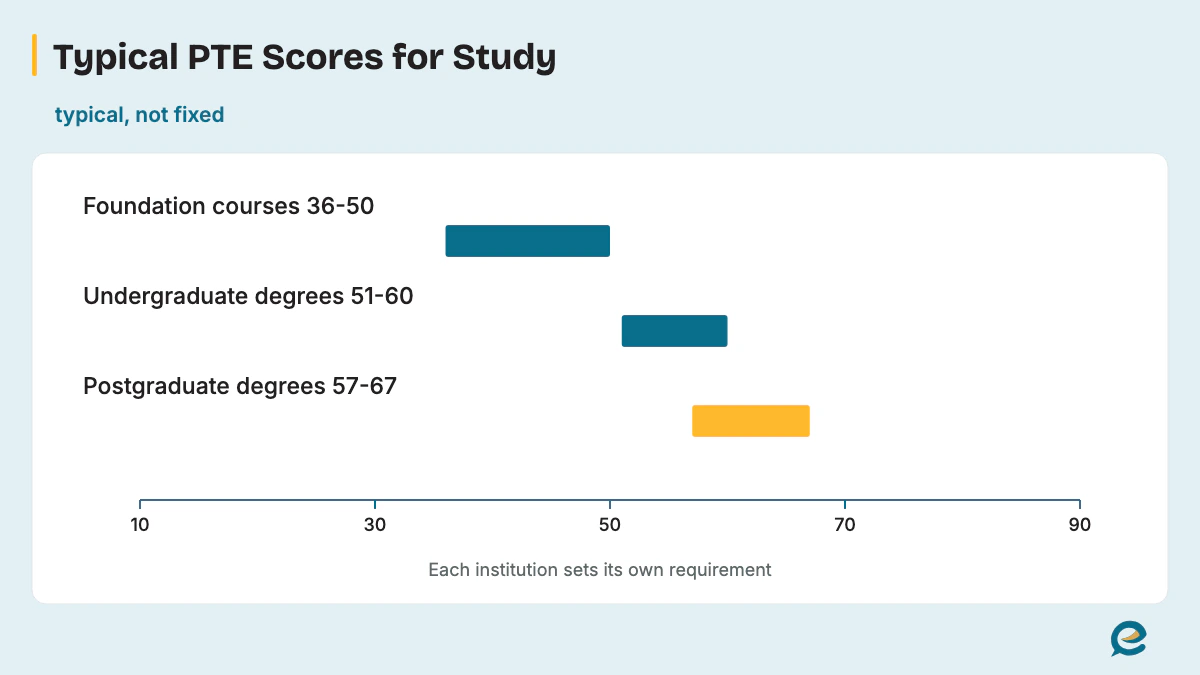
Each university sets its own requirement, and Pearson's typical minimums are 36-50 for foundation courses, 51-60 for undergraduate degrees and 57-67 for postgraduate degrees. On Pearson's CEFR descriptors, those ranges stretch from A2 up into B2.
| Study level | Typical minimum PTE score | CEFR range it overlaps |
|---|---|---|
| Foundation courses | 36-50 | A2-B1 |
| Undergraduate degrees | 51-60 | B1-B2 |
| Postgraduate degrees | 57-67 | B1-B2 |
Pearson's Score Guide names three ways a university requirement can work. It can set an overall minimum alone or add a higher minimum section score in the skill that matters most for the program. It can also pair the overall minimum with a lower minimum in one skill. Read both numbers on the course page, because a missed skill minimum fails the requirement even when the overall clears it.
Use the current English-language page for your specific university and course. Record the required test variant, overall minimum, each skill minimum and any intake-specific condition; a general university example cannot establish your programme’s requirement.
What PTE Scores Do You Need for Visa Applications?
The government that issues the visa sets each visa requirement, and Pearson's scoring page gives no fixed numbers; it notes that Australian Department of Home Affairs requirements recently changed. Home Affairs, Pearson's UK visas page and Immigration New Zealand publish these minimums, with skill splits in Listening (L), Reading (R), Writing (W) and Speaking (S) order.
| Country and requirement | PTE score needed | Set by |
|---|---|---|
| Australia, Functional English | 24 overall, test in the last 12 months | Home Affairs |
| Australia, Vocational English | L33, R36, W29, S24 | Home Affairs |
| Australia, Competent English | L47, R48, W51, S54 | Home Affairs |
| Australia, Proficient English | L58, R59, W69, S76 | Home Affairs |
| Australia, Superior English | L69, R70, W85, S88 | Home Affairs |
| UK, Skilled Worker English-test route (PTE Academic UKVI) | B2: 59 in each skill; pre-8 January 2026 holders extending/updating have separate B1/proof rules | Pearson score mapping; GOV.UK route rules |
| UK, Student visa below degree level (PTE Academic UKVI) | 43 in each skill (B1) | Pearson UK visas page |
The Australian English-level figures shown here apply to tests taken on or after 7 August 2025. Earlier accepted tests use separate tables and validity rules. Student visa scores depend on pathway, exemptions and test date; UK and New Zealand routes also have their own conditions. These figures describe language evidence only, not visa eligibility. Check the linked country guide and current government route before booking.
What PTE Score Do You Need for Australia?
For an Australian visa, the score depends on the English level your visa names, from Functional English (24 overall) to Superior English (69 Listening, 70 Reading, 85 Writing, 88 Speaking) for tests on or after 7 August 2025. The per-skill minimums aren't equal, and Speaking and Writing sit highest at every level from Competent up. Our guide to PTE requirements for Australia lists each visa subclass.
What PTE Score Do You Need for UK Visa Applications?
Where a UK visa route requires a four-skill SELT, check whether PTE Academic UKVI is accepted for that route. Pearson lists B2 as 59 in each skill and B1 as 43 in each skill. The current Skilled Worker English-test route requires B2. GOV.UK says holders who had this visa before 8 January 2026 and are extending or updating it need B1 and do not need to prove English again; switching from a different visa generally requires B2, with separate Health and Care Worker provisions. Check the evidence route and exemptions as well as the score. Degree-level Student sponsors may assess English themselves; not every UK visa requires this test.
How Do PTE Scores Compare With IELTS?
On Pearson's score concordance, updated from July 2025 research, PTE 63 lines up with IELTS 7.0, PTE 55 with 6.5 and PTE 47 with 6.0. Pearson's website prints the lowest PTE point for each IELTS score, and its Score Guide gives each full PTE to IELTS range.
| IELTS Academic score | PTE Academic overall score |
|---|---|
| 4.5 | 24-30 |
| 5.0 | 31-38 |
| 5.5 | 39-46 |
| 6.0 | 47-54 |
| 6.5 | 55-62 |
| 7.0 | 63-70 |
| 7.5 | 71-78 |
| 8.0 | 79-85 |
| 8.5 | 86-89 |
| 9.0 | 90 |
Pearson's disclaimer says the table compares scores and doesn't state any university or visa requirement. Older tables that put IELTS 7 at 65-71 or 64-72 predate the July 2025 update. Our PTE vs IELTS and three-test comparison pages cover which test is easier and how TOEFL fits.
How Do PTE Section Scores Compare With IELTS?
Pearson's Score Guide also gives a per-skill concordance, with a separate PTE range for each skill that differs from the overall ones.
| IELTS | PTE Listening | PTE Reading | PTE Speaking | PTE Writing |
|---|---|---|---|---|
| 4.5 | 26-32 | 29-35 | 14-23 | 17-28 |
| 5.0 | 33-39 | 36-41 | 24-38 | 29-40 |
| 5.5 | 40-46 | 42-47 | 39-53 | 41-50 |
| 6.0 | 47-52 | 48-53 | 54-65 | 51-59 |
| 6.5 | 53-57 | 54-58 | 66-75 | 60-68 |
| 7.0 | 58-63 | 59-64 | 76-82 | 69-76 |
| 7.5 | 64-68 | 65-69 | 83-87 | 77-84 |
| 8.0 | 69-74 | 70-74 | 88-89 | 85-89 |
| 8.5 | 75-80 | 75-80 | 90 | 90 |
| 9.0 | 81-90 | 81-90 | - | - |
IELTS 7.0 in Speaking needs 76 in PTE Speaking, while in Listening it needs only 58. Australia's Competent and Proficient minimums are exactly the lower ends of the IELTS 6.0 and 7.0 rows.
What Is a Good PTE Score?
A good PTE score is one that clears your target score in every skill the requirement names, with a margin. Read any single score against two yardsticks: Pearson's CEFR range for that number and the score requirement of the university or visa you want. Answers that call "65+" or "70-85" good are rules of thumb, not Pearson statements.
Check each skill score against the requirement as well as the overall, because one skill below a per-skill minimum fails the whole requirement. A score margin of a few points in your weakest skill protects you if that skill dips on test day.
Is 70 a Good PTE Score?
Yes, 70 sits inside Pearson's 59-75 range, a B2 level score, and above the 57-67 range Pearson gives as typical for a postgraduate degree. On the score concordance, 70 is the top of the 63-70 overall range for IELTS 7.0, one point below 71 (IELTS 7.5). The PTE score chart shows where 70 sits section by section.
Is 65 in PTE Equal to 7 in IELTS?
Yes for the overall score: Pearson's July 2025 concordance puts IELTS 7.0 at PTE 63-70, so an overall 65 lines up with 7.0. Per skill the score concordance differs, because 65 in Speaking matches IELTS 6.0 (54-65) while 65 in Reading matches 7.5 (65-69). A requirement that names its own PTE equivalent beats any concordance; the PTE vs IELTS score conversion guide covers the full comparison.
Is 50 in PTE Equal to 6 in IELTS?
Yes for the overall score: Pearson's score concordance puts IELTS 6.0 at PTE 47-54, so an overall 50 lines up with 6.0. Separately, on Pearson's CEFR descriptors, 50 falls in the 43-58 range, which is B1 level.
How Much Is 7 Each in PTE?
"Seven each" in PTE is not one number: on Pearson's per-skill concordance, IELTS 7.0 starts at 58 Listening, 59 Reading, 76 Speaking and 69 Writing, and Australia's Proficient English uses exactly those minimums for tests from 7 August 2025. The old flat "65 each" applied to tests on or before 6 August 2025. Reading "seven each" as 63 in every skill would fail the Speaking and Writing minimums, so treat each per-skill minimum as its own target.
How Do You Reach a Score of 90 in PTE?
A score of 90 is the top of the scale overall and in every skill, so the work is section by section: find the tasks where each skill still loses points. Start with the integrated tasks in the map above, since a point gained there counts toward two skills.
The full section-by-section method is in our guide on how to score 90 in PTE, and you can create a free account to try timed practice sets.
Practice PTE Online on EasyEnglish
Try Speaking, Writing, Reading and Listening tasks in a timed, computer-based format.
Try speaking practice without signing up. A free account is required for full mock tests. Practice scores are estimates, not official Pearson scores.
Written by
EasyEnglish Team
The team behind EasyEnglish's PTE practice and mock tests
We build the PTE practice tasks, mock tests and scoring on EasyEnglish, and we oversee every guide on this site. Our guides draw on official test and government sources where applicable. Requirements can change; use the linked source and check the rules for your exact test, course or route. Practice examples are independent learning material. EasyEnglish is not affiliated with Pearson.
Editorial review completed .