PTE Exam Pattern 2026: Format, Sections, Timing and Scoring
Understanding PTE
Before you book PTE Academic, you need the exact shape of the test. The PTE exam pattern splits one 2-hour, computer-based test into three parts, Speaking & Writing, Reading and Listening, with 22 scored question types (9, 5 and 8) reported on a 10-90 scale. The PTE syllabus and the PTE modules are the same thing: these three parts and their question types.
Pearson owns and designs PTE, so every timing below comes from Pearson's own format pages. Its 2025 update kept the original 20 question types and added two, which is why the part pages total 22. Some prep sites still quote Reading as 29-30 or 32-41 minutes, Listening as 29-36, 30-43 or 45-57, and 300-word Reading passages; Pearson's format pages now give 23-30 minutes, 31-39 minutes and passages of 80 to 350 words. PTE Academic UKVI shares this pattern exactly.
Table of Contents
What Is the Format of the PTE Exam?
The PTE exam format is the fixed order of parts, timings and question types in one PTE Academic sitting: Speaking & Writing (76-84 minutes), Reading (23-30 minutes) and Listening (31-39 minutes), which Pearson calls a 2-hour test.
Check the exact application route with the receiving authority before booking: IRCC Express Entry, Canadian PGWP requirements, Australian competent-English guidance or UK SELT guidance. Confirm accepted test version, delivery, test date and per-skill requirement. English-language evidence alone does not establish visa or immigration eligibility.
Pearson combines AI scoring with human expertise to mark responses. Some tasks are integrated, so one answer can count toward two skills: Repeat Sentence, for example, feeds both listening and speaking.
How Is the PTE Exam Pattern Structured in 2026?
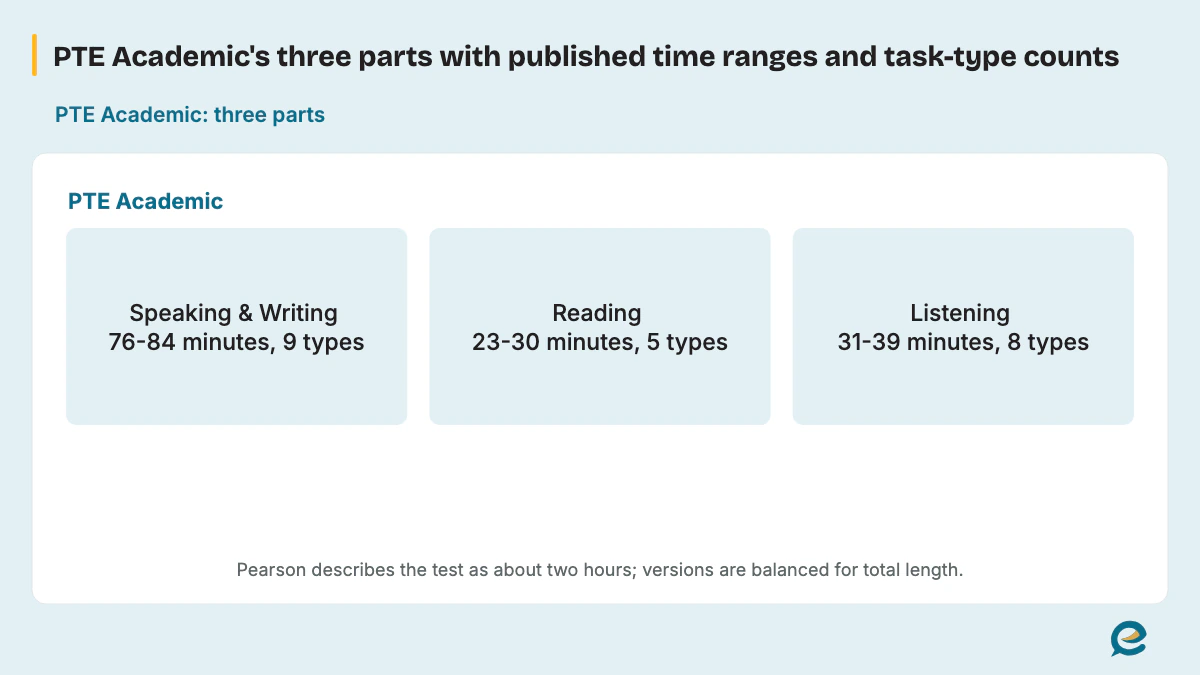
The exam pattern 2026 runs Part 1 Speaking & Writing in 76-84 minutes with 9 question types, Part 2 Reading in 23-30 minutes with 5, and Part 3 Listening in 31-39 minutes with 8, which Pearson describes as about 2 hours. The skills column shows why the part names undersell what each part scores.
| Part | Time | Number of question types | Skills scored |
|---|---|---|---|
| Part 1: Speaking & Writing | 76-84 minutes | 9 | Speaking and writing, plus listening and reading through integrated tasks. |
| Part 2: Reading | 23-30 minutes | 5 | Reading. |
| Part 3: Listening | 31-39 minutes | 8 | Listening, plus writing and reading through integrated tasks. |
Part 1 also opens with an unscored Personal Introduction, which isn't counted in the 9. In Part 1, Repeat Sentence, Retell Lecture, Answer Short Question and Summarize Group Discussion score listening, and Summarize Written Text scores reading. In Part 3, Summarize Spoken Text and Write from Dictation score writing, while Highlight Correct Summary and Highlight Incorrect Words score reading.
Pearson describes the test as about two hours. Its Score Guide explains that test versions are balanced for total length, so adding independent section extremes does not predict a sitting. Pearson's test pages list no scheduled break. The number of items per task varies by test version, and Pearson's PTE Academic Score Guide (2025) gives the range for each one, such as 10-12 Repeat Sentence items; the tables below include those ranges.
What Does PTE Part 1 Speaking & Writing Include?
Part 1 includes Read Aloud, Repeat Sentence, Describe Image, Retell Lecture, Answer Short Question, Summarize Group Discussion, Respond to a Situation, Summarize Written Text and Write Essay, after an unscored Personal Introduction. Task timings follow Pearson’s Speaking & Writing page; item counts, skill credit and trait rules follow the current Academic Score Guide.
| Question type | Items per test | What you do | Timing | Skills assessed | Scoring |
|---|---|---|---|---|---|
| Personal Introduction | 1 (unscored) | Introduce yourself from an on-screen prompt. | 25 s to prepare, 30 s to record. | None; it's unscored. | Doesn't count. |
| Read Aloud | 6-7 | Read a text of up to 60 words aloud. | 30-40 s to prepare. | Speaking in the Academic Score Guide (task notes also list reading; PTE Core credits reading and speaking). | Content, pronunciation and oral fluency. |
| Repeat Sentence | 10-12 | Repeat a sentence word for word. | 3-9 s prompt, 15 s to answer. | Listening and speaking. | Partial credit. |
| Describe Image | 5-6 | Describe a graph, chart, map or picture. | 25 s to study, 40 s to answer. | Speaking. | Partial credit. |
| Retell Lecture | 2-3 | Retell a lecture in your own words. | Up to 90 s audio, 10 s to prepare, 40 s to speak. | Listening and speaking. | Partial credit. |
| Answer Short Question | 5-6 | Answer a spoken question in a word or a few words. | 3-9 s prompt, 10 s to answer. | Listening. | Correct or incorrect. |
| Summarize Group Discussion | 2-3 | Summarize a discussion between 3 people. | Up to 3 min audio, 10 s to prepare, 2 min to speak. | Listening and speaking. | Partial credit. |
| Respond to a Situation | 2-3 | Speak a reply to a situation of up to 60 words. | 10 s to prepare, 40 s to speak. | Speaking. | Partial credit. |
| Summarize Written Text | 2 | Write one sentence of 5-75 words on a text of up to 300 words. | 10 minutes. | Reading and writing. | Content, form, grammar and vocabulary. |
| Write Essay | 1 | Write 200-300 words on a 2-3 sentence prompt. | 20 minutes. | Writing. | Partial credit across seven traits. |
Every scored speaking task except Answer Short Question is marked on three traits: content, pronunciation and oral fluency. Pronunciation and oral fluency run 0-5. Content runs 0-6 on Describe Image, Retell Lecture, Summarize Group Discussion and Respond to a Situation; Repeat Sentence Content runs 0-3, while Read Aloud Content depends on prompt length and word errors. Answer Short Question is scored correct or incorrect on vocabulary. Write Essay is marked on seven: content; development, structure and coherence; form; general linguistic range; grammar usage and mechanics; vocabulary range; and spelling.
Word limits shape the written scores. A summary under 5 or over 75 words earns nothing. An essay under 200 or over 300 words loses marks, and one under 120 or over 380 words scores zero on all seven traits. Pearson also gives no credit for an unoriginal response in Describe Image, Retell Lecture and Summarize Group Discussion, so memorized answers don't help.
What Does PTE Part 2 Reading Include?
Before paying, confirm the current minimum age and parent or guardian consent process for your exact test with Pearson support. Check Pearson's identification policy for the test and country; do not infer eligibility from a rule omitted here.
| Question type | Items per test | Text length | What you do | Scoring |
|---|---|---|---|---|
| Fill in the Blanks (Dropdown) | 5-6 | Up to 200 words. | Pick a word for each gap from the dropdown blanks. | Partial credit. |
| Multiple Choice, Multiple Answers | 2-3 | Up to 350 words. | Select every option the passage supports. | Points lost for wrong options. |
| Reorder Paragraph | 2-3 | Up to 110 words. | Restore the order by dragging boxes or using the arrow buttons. | Partial credit. |
| Fill in the Blanks (Drag and Drop) | 4-5 | Up to 80 words. | Drag words from the box into the drag-and-drop blanks; the box holds more words than gaps. | Partial credit. |
| Multiple Choice, Single Answer | 2-3 | Up to 110 words. | Pick the one correct option. | Correct or incorrect. |
No Reading task has its own timer. Pearson lists "time to answer: not applicable" on every task, so the 23-30 minutes is one shared clock you manage yourself.
Use the current Academic Score Guide for skill credit: the Reading dropdown task scores Reading only. Core’s similarly named Reading and Writing gap task scores both skills.
What Does PTE Part 3 Listening Include?
Part 3 Listening runs 31-39 minutes with eight question types, and every clip plays once, automatically. Pearson's audio lengths, skills and scoring rules for the eight tasks sit side by side here.
| Question type | Items per test | Audio length | What you do | Skills assessed | Scoring |
|---|---|---|---|---|---|
| Summarize Spoken Text | 1 | 60-90 s. | Write a 50-70 word summary in 10 minutes. | Listening and writing. | Partial credit. |
| Multiple Choice, Multiple Answers | 2-3 | 80-120 s, with 7 s to read first. | Select every correct option. | Listening. | Partial credit, minus one per wrong option (minimum 0). |
| Fill in the Blanks (Type In) | 2-3 | 30-60 s, with 7 s to skim. | Type the missing words in the transcript. | Listening only (Academic Score Guide). | One point per correct, correctly spelled word. |
| Highlight Correct Summary | 2-3 | 30-90 s. | Pick the paragraph that best summarizes the recording. | Listening and reading. | Correct or incorrect. |
| Multiple Choice, Single Answer | 2-3 | 30-60 s, with 5 s to read. | Pick the one correct option. | Listening. | Correct or incorrect. |
| Select Missing Word | 1-2 | 20-70 s. | Choose from 3-5 options the word or words the beep replaces. | Listening. | Correct or incorrect. |
| Highlight Incorrect Words | 2-3 | 15-50 s, with 10 s to skim. | Click the transcript words that differ from the audio. | Listening and reading. | Plus one per correct word, minus one per wrong click (minimum 0). |
| Write from Dictation | 3-4 | 3-5 s. | Type the sentence exactly as you hear it. | Listening and writing. | One point per correct, correctly spelled word. |
You take notes on an erasable noteboard, and Pearson accepts US, UK, Australian and Canadian spellings if you stick to one. The Multiple Choice, Multiple Answers recording runs 80-120 seconds, longer than any other Part 3 clip.
How Is the PTE Exam Pattern Different in 2026?
For any test taken after 7 August 2025, Pearson added two new question types to PTE Academic and PTE Academic UKVI, Summarize Group Discussion and Respond to a Situation, and kept the original 20. Pearson's update page says the test now has slightly more questions but is still approximately two hours long, with the time per question unchanged.
The August 2025 update also changed scoring: Pearson enhanced the criteria for some tasks and has humans part-score some responses, though humans never score pronunciation or fluency. PTE Core and PTE Home didn't change.
The updated Academic test includes Summarize Group Discussion and Respond to a Situation. A plan that omits them uses the older task set. Pearson describes the sitting as about two hours; its current Score Guide also discusses total length, so do not derive a new duration by adding separate section endpoints.
Check the exact application route with the receiving authority before booking: IRCC Express Entry, Canadian PGWP requirements, Australian competent-English guidance or UK SELT guidance. Confirm accepted test version, delivery, test date and per-skill requirement. English-language evidence alone does not establish visa or immigration eligibility.
How Does the PTE Scoring System Work?
PTE Academic scores English on a 10-90 scale using the Global Scale of English, with AI scoring combined with human expertise. Your score report shows an overall score plus separate speaking, writing, reading and listening scores. Most results arrive within two business days, and some take up to five.
Each task type uses one of three scoring methods.
- Correct or incorrect: Answer Short Question, both Multiple Choice, Single Answer tasks, Highlight Correct Summary and Select Missing Word.
- Partial credit: most other tasks, where each correct word, blank, pair or trait earns points.
- Partial credit with deductions: Multiple Choice, Multiple Answers in both Reading and Listening, and Highlight Incorrect Words, where a wrong choice costs a point down to a minimum of 0.
In Pearson's words, Highlight Incorrect Words is "the third of three question types where you can lose points" for a wrong pick, so pick only options you're sure of.
A human expert reviews Content in Describe Image, Retell Lecture, Summarize Group Discussion, Respond to a Situation, Summarize Written Text and Summarize Spoken Text before the score is confirmed. In Write Essay, the expert also reviews content, development, structure and coherence, and general linguistic range.
Check the exact application route with the receiving authority before booking: IRCC Express Entry, Canadian PGWP requirements, Australian competent-English guidance or UK SELT guidance. Confirm accepted test version, delivery, test date and per-skill requirement. English-language evidence alone does not establish visa or immigration eligibility.
How Does the PTE Academic Exam Pattern Compare With PTE Core?
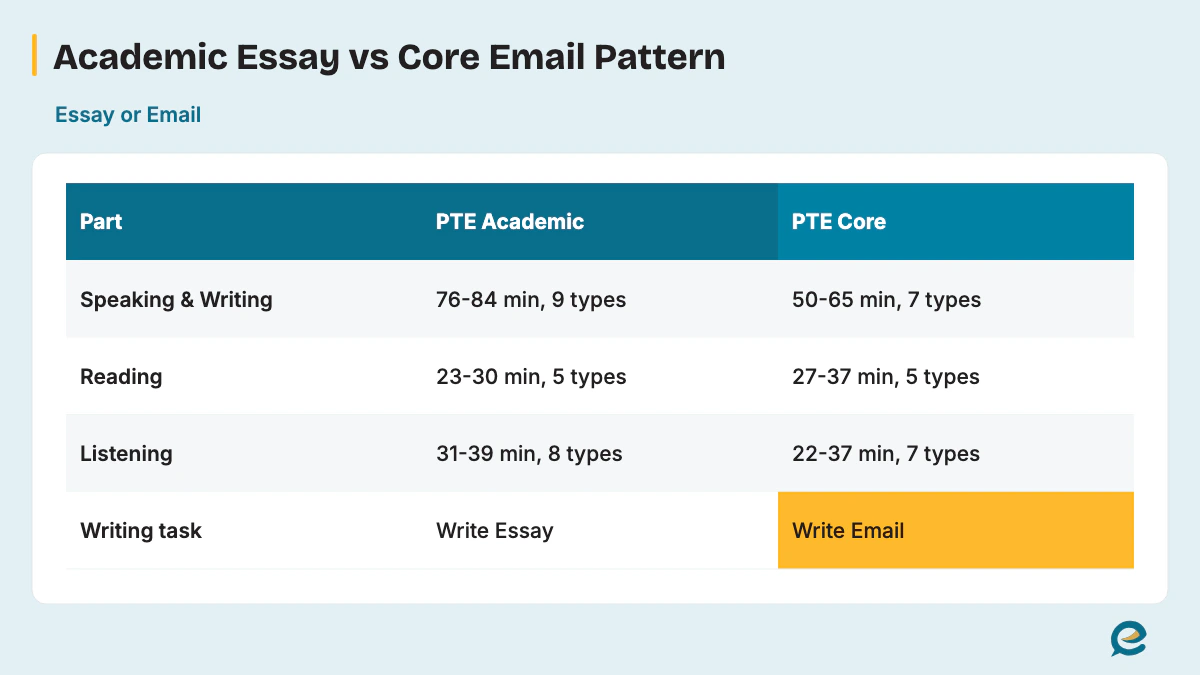
PTE Core runs Speaking & Writing in 50-65 minutes with 7 types and Write Email instead of Write Essay, Reading in 27-37 minutes and Listening in 22-37 minutes. This pattern comparison sets the two tests part by part.
| Part | PTE Academic | PTE Core |
|---|---|---|
| Speaking & Writing | 76-84 minutes, 9 types. | 50-65 minutes, 7 types. |
| Reading | 23-30 minutes, 5 types. | 27-37 minutes, 5 types. |
| Listening | 31-39 minutes, 8 types. | 22-37 minutes, 7 types. |
| Writing task | Write Essay. | Write Email. |
Core drops Retell Lecture, Summarize Group Discussion and Highlight Correct Summary, and its Respond to a Situation gives 20 seconds to prepare instead of 10.
What Preparation Strategies Work for the PTE Exam Pattern?
The preparation strategy that fits this pattern is part by part against Pearson's timings: fluency and timing for Part 1, reading speed for Part 2, note-taking for Part 3, then a full mock test. Timed practice matters because the computer closes each recording window on schedule, ready or not.
How Do You Prepare for the PTE Speaking & Writing Section?
Practice each Part 1 task inside Pearson's timings, starting with the ones that give the least time, such as Describe Image's 25 seconds to study and 40 seconds to respond. Set the task timing on every Speaking & Writing drill to match Pearson's prep and answer time.
- Start speaking right after the tone; anything said before the microphone opens isn't recorded.
- Don't go silent for 3 seconds: in Answer Short Question the recording then stops, and Pearson adds that "this also applies to speaking item types Read aloud, Repeat Sentence, Describe Image and Re-tell Lecture."
- Keep talking steadily in Summarize Group Discussion and Respond to a Situation too; Pearson doesn't name them under that rule, but hesitations cost oral fluency in every speaking task.
- Record yourself on Summarize Group Discussion and check that you covered all three speakers.
- Build your own phrasing instead of templates; Pearson's Describe Image guidance says templated sentences can score 0 for content.
Our PTE speaking format guide sets out every task.
How Do You Prepare for the PTE Reading Section?
Train for five question types in 23-30 minutes, so reading speed and quick elimination matter more than rereading. Pearson's clock covers the whole Reading section, not each item.
- Practice the on-screen controls: dropdown menus, dragging from the word box and the Reorder Paragraph arrow buttons.
- Expect spare words in drag-and-drop and rule them out by grammar first.
- In Reorder Paragraph, find the sentence that needs no earlier context and place it first.
- In Multiple Choice, Multiple Answers, select only options you can point to in the text, since each wrong pick costs a point.
The PTE reading format page covers each task.
How Do You Prepare for the PTE Listening Section?
Build note-taking for Summarize Spoken Text (10 minutes for a 50-70 word summary) and accurate typing for Write from Dictation. The Listening section plays each recording once, so your notes carry the answer.
- Use the 7 seconds before Fill in the Blanks and Multiple Choice, Multiple Answers audio to read the screen.
- Check spelling before you move on, since only correctly spelled words score.
- In Highlight Incorrect Words, click only the words you heard differently.
- Practice Listening at the end of a full timed run, because it's the last part of the sitting.
Our PTE listening format guide covers the eight tasks.
How Do You Prepare for the PTE Writing Tasks?
The two writing tasks sit inside Part 1, so practice Summarize Written Text as one sentence of 5-75 words in 10 minutes and Write Essay as 200-300 words in 20 minutes. Keep a word count in view, since the word limit is strict: the summary scores nothing outside 5-75 words, and the essay loses marks outside 200-300 and scores zero under 120 or over 380 words.
Plan each essay as an introduction, two body paragraphs and a conclusion, then save two minutes to proofread spelling and punctuation. Our PTE writing guide breaks down both tasks.
How Do You Build Stamina for the Full 2-Hour PTE Test?
Take several full, timed mock tests in one sitting, in Pearson's order, so Listening at the end gets the same focus as Read Aloud at the start. Each full mock test builds the stamina that timed practice on single tasks can't.
Run them at the time of day you booked, and review each one for where your accuracy drops, not only the total. Use the unscored Personal Introduction to settle your microphone distance and pace. To run timed mocks on our platform, create a free account, and if nerves build up near test day, read our PTE exam anxiety guide.
Is PTE Harder Than IELTS?
Neither test is officially harder; PTE packs its three parts into one 2-hour computer-based sitting, so the pattern suits test takers who work well at a screen under time pressure. Difficulty depends more on that fit than on the content. Our PTE vs IELTS page has the full comparison.
How should I use this Format guide?
Use the task guidance and authored practice examples, then check Pearson’s current instructions for your exact test. Confirm any application, fee, age or ID requirement directly with its owner before booking. Practice estimates are not official scores.
Practice PTE Online on EasyEnglish
Try Speaking, Writing, Reading and Listening tasks in a timed, computer-based format.
Try speaking practice without signing up. A free account is required for full mock tests. Practice scores are estimates, not official Pearson scores.
Written by
EasyEnglish Team
The team behind EasyEnglish's PTE practice and mock tests
We build the PTE practice tasks, mock tests and scoring on EasyEnglish, and we oversee every guide on this site. We use official test and government guidance where available, identify authored practice examples and review consequential claims before publication. EasyEnglish is not affiliated with Pearson.
Editorial review completed .