
PTE Writing: Test Format, Scoring, Question Types, Answers and Tips
PTE Writing
PTE Writing happens inside Part 1 Speaking & Writing, where you type a one-sentence summary and a 200-300 word essay in PTE Academic, or a short summary and an email in PTE Core. Pearson owns and scores PTE, and every word limit, time, item count and trait scale here comes from Pearson's format pages and its two Score Guides. Your Writing score also collects points from listening and reading tasks: four tasks feed it in PTE Academic and six in PTE Core.
Write Essay belongs to PTE Academic (and UKVI) only, while PTE Core swaps it for Write Email. All three writing tasks below come with an original worked model you can check against Pearson's rules.
Table of Contents
What Is the PTE Writing Section?
PTE Writing is the set of typed tasks inside Part 1 (Speaking & Writing), not a separate timed part. PTE Academic pairs Summarize Written Text with Write Essay, and PTE Core pairs it with Write Email. Part 1, speaking included, lasts about 76-84 minutes in PTE Academic and 50-65 minutes in PTE Core. Pearson's Score Guides call tasks that test two skills integrated skills questions, with points counting toward both. So the Writing score, reported on the 10-90 scale, also moves with listening and reading answers.
What Is the PTE Writing Format?
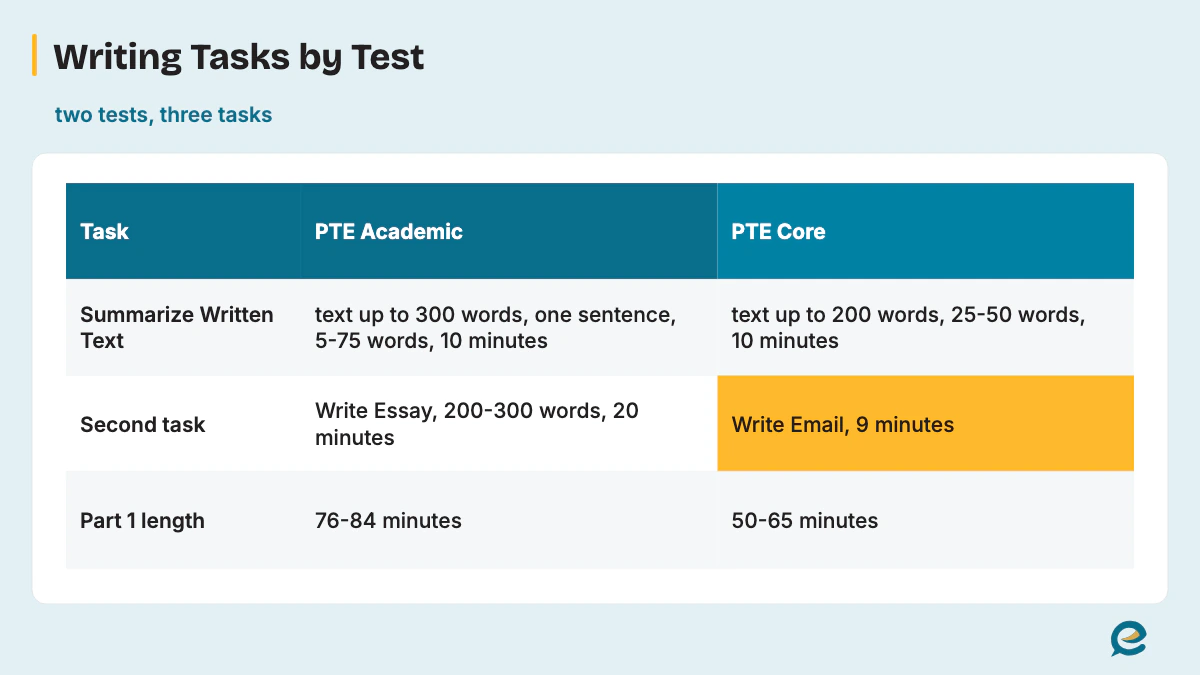
PTE Academic has two writing tasks in Part 1: Summarize Written Text (10 minutes, 2 items) and Write Essay (20 minutes, 1 item). PTE Core pairs Summarize Written Text (10 minutes, 1-2 items) with Write Email (9 minutes, 2-3 items). The word limits differ by test, as the side-by-side rows show.
| Feature | PTE Academic and UKVI | PTE Core |
|---|---|---|
| Summarize Written Text source | Up to 300 words. | Up to 200 words. |
| Summarize Written Text answer | One sentence, 5-75 words. | 25-50 words, one or more sentences. |
| Summarize Written Text time | 10 minutes. | 10 minutes. |
| Summarize Written Text items | 2. | 1-2. |
| Second task | Write Essay, 200-300 words, 20 minutes. | Write Email, 80-120 words asked, 9 minutes. |
| Second task items | 1. | 2-3. |
| Part 1 length | About 76-84 minutes. | 50-65 minutes. |
The item counts come from Pearson's PTE Academic Test Taker Score Guide (2025) and PTE Core Score Guide (January 2026).
Every writing box shows a live word count under your answer and has Cut, Copy and Paste buttons, so you can move a clause without retyping it. For Write Email, Pearson's Core page asks for "between 80 and 120 words", while the Form trait gives full credit from 50 to 120 words; aim for 80-120 and you meet both. PTE has no "Task 1" or "Task 2" labels: people who use them usually mean Summarize Written Text and Write Essay.
What Are the PTE Writing Question Types?
Three writing question types exist across the two tests: Summarize Written Text (both), Write Essay (PTE Academic only) and Write Email (PTE Core only). For each one you get the length rule, the item count, the skills it scores and a worked model, with the full method on its task page.
What Is Summarize Written Text?
Summarize Written Text gives you 10 minutes to write a one-sentence summary of 5-75 words for a text of up to 300 words (PTE Academic). PTE Core asks for 25-50 words, in one or more sentences, from a text of up to 200 words. It scores reading and writing on Content, Form, Grammar and Vocabulary, with 2 items in PTE Academic and 1-2 in PTE Core.
Its Form rule zeroes an Academic summary under 5 or over 75 words on every trait. The full method sits on the PTE Summarize Written Text page.
Pearson's tips article says a good summary sentence is 20-35 words and leaves out examples. It starts with a capital letter and ends with one full stop, and an answer typed all in capitals or all in lower case scores zero. Its format page adds that "the best responses usually consist of a main clause and subordinate clause." So write one main clause for the central point. Then attach one or two supporting points with these joining words.
- Contrast clauses: although, whereas, while. Use despite before a noun phrase or an -ing form.
- Cause clauses: because, since. Use as a result of before a noun phrase or an -ing form.
- Addition: and, as well as, along with.
- Relative clause: which, who, where.
Here is a 110-word practice passage to try before reading the models.
Across many towns, residents are borrowing drills, ladders and sewing machines from tool libraries instead of buying them. A tool library works much like a book library: members pay a small yearly fee or volunteer a few hours, then borrow equipment for a week at a time. Supporters argue that most household tools sit unused for years, so sharing them saves money and cuts the waste created when cheap tools break and are thrown away.
Many tool libraries also run repair workshops, where volunteers teach basic skills. However, the model depends on reliable volunteers and on members returning items on time, and some libraries have closed when either condition failed.
PTE Academic model, 32 words in one sentence:
"Tool libraries let members borrow household equipment cheaply, which saves money and reduces waste from discarded tools, although the model only survives when volunteers stay reliable and members return items on time."
PTE Core model, 43 words in three sentences:
"Tool libraries lend household equipment to members for a small fee or volunteer hours. Sharing saves money and reduces waste from broken, discarded tools, and many libraries teach repair skills. However, they depend on reliable volunteers and on members returning items on time."
Both models open with the passage's own claim, keep the risk from the last sentence and drop the examples (drills, ladders).
What Is Write Essay?
Write Essay gives you a prompt of 2-3 sentences and 20 minutes to write a 200-300 word argumentative essay; it appears in PTE Academic and PTE Academic UKVI only, as 1 item per test. Full Form credit needs 200-300 words.
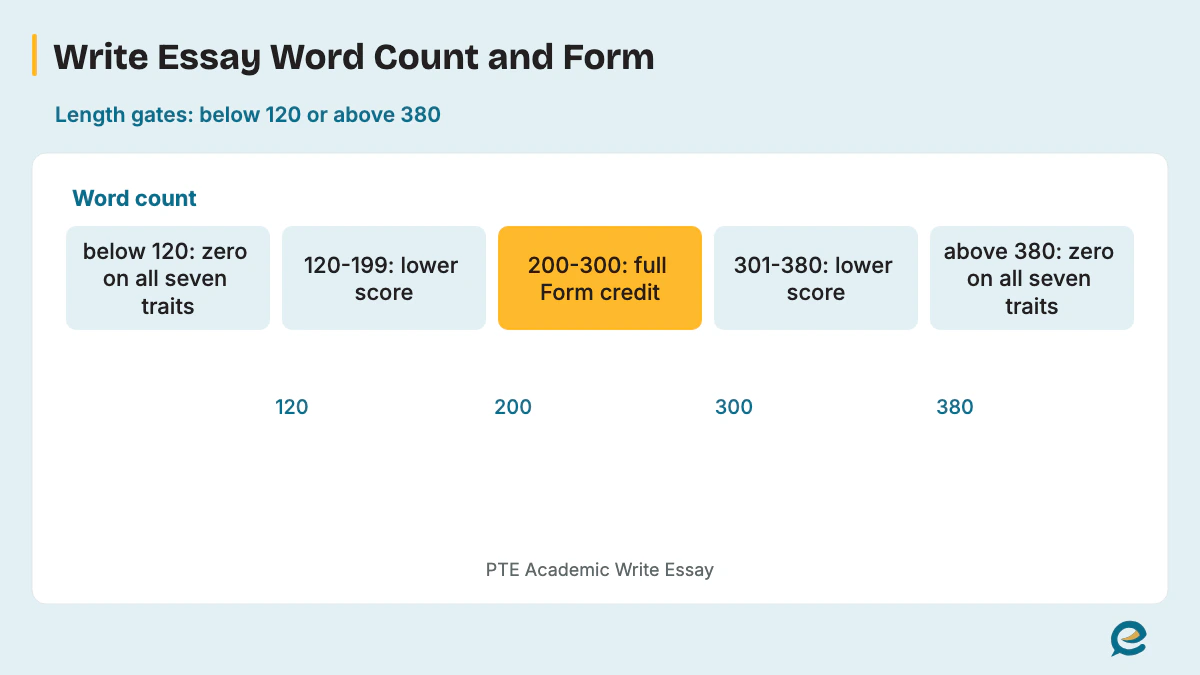
Pearson scores seven traits: Content; Development, structure and coherence; Form; General linguistic range; Grammar usage and mechanics; Vocabulary range; and Spelling. An essay under 120 or over 380 words, or one that doesn't address the topic, scores zero on all seven. Pearson's page shows two prompt styles: agree or disagree with a statement, or consider how different groups might feel. The PTE Write Essay task page has the full method.
What Is Write Email in PTE Core Writing?
Write Email gives you a prompt of up to 100 words and 9 minutes to write an email that covers three bullet points; it appears in PTE Core only, with 2-3 items per test. Aim for 80-120 words: the Form trait gives full credit at 50-120, partial credit at 30-49 or 121-140, and zero under 30 or over 140 words.
Pearson scores seven factors (Content, Email conventions, Form, Organization, Grammar usage and mechanics, Vocabulary range and Spelling), and its email conventions are a salutation, an introduction, a conclusion and a farewell. The PTE Core Write Email page has more models.
Practice prompt: You joined a Saturday photography course at a community center, but the class time has changed to a time you can't attend. Write to the course organizer. In your email: explain why you joined the course; describe the problem with the new time; suggest a solution.
Dear Ms. Patel,
I'm writing about the Saturday photography course I joined last month. I signed up because I've just bought my first camera and want to learn how to use its manual settings.
Unfortunately, the class has moved from 10 a.m. to 3 p.m., and I work at a bakery every Saturday afternoon, so I can no longer attend.
Would it be possible to move me to the Sunday morning group instead? If that group is full, I'd be grateful for a refund for the remaining six sessions.
Thank you for your help, and I look forward to hearing from you.
Best regards, Daniel Brooks
The model runs to 106 words, answers the three bullets in order (reason, problem, solution) and includes all four conventions.
Which Other Tasks Count Toward the PTE Writing Score?
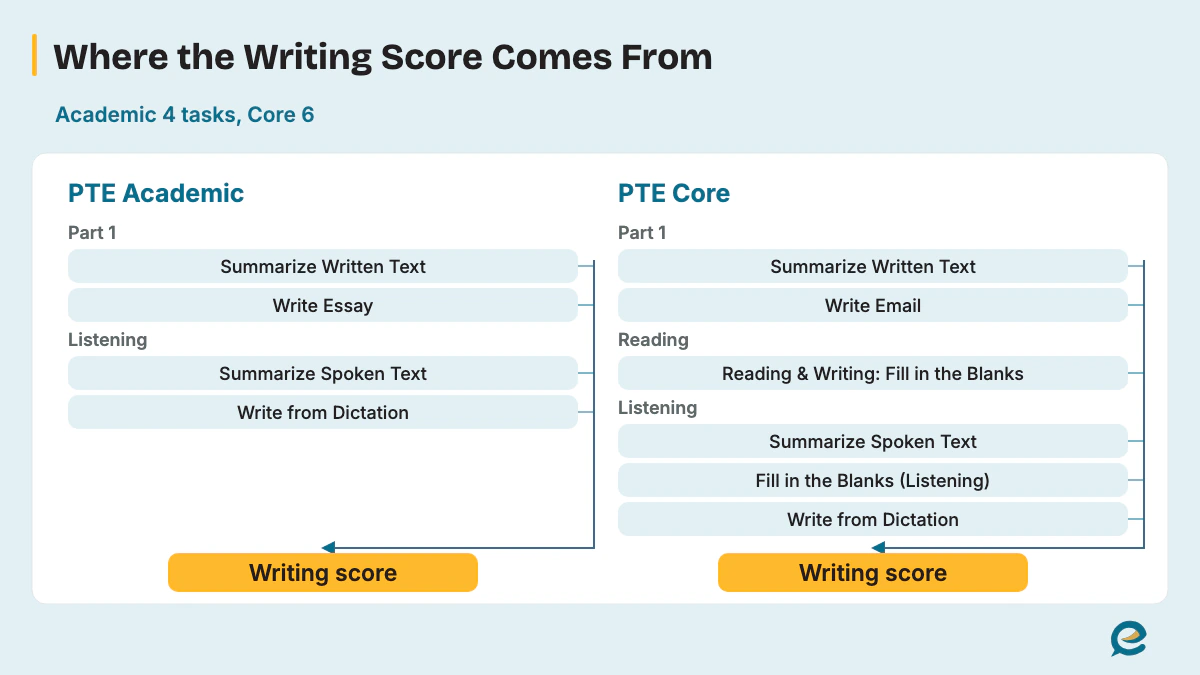
Pearson's Score Guides credit the PTE Academic Writing score from four tasks and the PTE Core Writing score from six. Academic counts Summarize Written Text, Write Essay, Summarize Spoken Text and Write from Dictation. Core counts Summarize Written Text, Write Email, Reading & Writing: Fill in the Blanks, Summarize Spoken Text, Fill in the Blanks in Listening and Write from Dictation. These integrated skills tasks outside Part 1 split by test like this.
| Task | Part | PTE Academic | PTE Core |
|---|---|---|---|
| Summarize Spoken Text | Listening | Listening and writing; 1 item; 50-70 words. | Listening and writing; 1-2 items; 20-30 words. |
| Write from Dictation | Listening | Listening and writing; 3-4 items. | Listening and writing; 3-4 items. |
| Fill in the Blanks (typed) | Listening | Listening only; 2-3 items. | Listening and writing; 2-3 items. |
| Drop-down Fill in the Blanks | Reading | Reading only; 5-6 items. | Reading and writing; 5-6 items. |
Write from Dictation gives 1 point for each correct word spelled correctly, so every spelling slip there costs Writing points too.
On two PTE Academic tasks, Pearson's web pages and its Score Guide disagree. The Reading page intro says the drop-down blanks task also assesses writing, and the Listening task notes say Fill in the Blanks affects listening and writing. The Academic Score Guide credits them to reading and to listening only. So the Writing "section" is two tasks only in the sense of Part 1; the Writing score is wider.
How Is PTE Writing Marked?
For the PTE Academic summary and essay, AI scoring marks every trait, and a Form score of zero stops further scoring. A human expert also reviews Content in Summarize Written Text, Write Essay and Summarize Spoken Text, plus Development, structure and coherence and General linguistic range in the essay. The scales below are the Score Guide points for each trait.
| Task | Traits and Score Guide scale | Form rule that zeroes it |
|---|---|---|
| Summarize Written Text, Academic | Content 0-4, Form 0-1, Grammar 0-2, Vocabulary 0-2. | Under 5 or over 75 words (Form 0 also covers more than one sentence or all capitals). |
| Summarize Written Text, Core | Content 0-2, Form 0-2, Grammar 0-2, Vocabulary 0-2. | Web page: under 25 or over 50 words; Score Guide: under 5 or over 60. |
| Write Essay | Content 0-6, Form 0-2, Development, structure and coherence 0-6, Grammar 0-2, General linguistic range 0-6, Vocabulary range 0-2, Spelling 0-2. | Under 120 or over 380 words, or off-topic (Form 0 also covers all capitals, no punctuation or bullet points). |
| Write Email | Content 0-3, Email conventions 0-2, Form 0-2, Organization 0-2, Vocabulary 0-2, Grammar 0-2, Spelling 0-2. | Under 30 or over 140 words, all capitals or no punctuation, or Content 0. |
For the PTE Core summary, the Score Guide still gives 1 Form point at 5-24 or 51-60 words, but the web page says those answers aren't scored, so stay inside 25-50. Pearson describes what each essay trait rewards, summarized here in plain terms.
- Content: every part of the prompt answered, with relevant details, examples and explanations.
- Development, structure and coherence: an introduction, body and conclusion, with paragraphs linked by clear transitions.
- General linguistic range: language that states ideas precisely, with complex structures used correctly.
- Grammar usage and mechanics: correct sentence structure, punctuation and capitalization.
- Vocabulary range: varied words that fit an academic setting, with synonyms instead of repetition.
- Spelling: one spelling convention; more than one error scores 0 on this trait.
An essay of 200-300 words earns 2 Form points, and 120-199 or 301-380 words earns 1 without zeroing the essay.
Some prep sites still quote "under 200 words scores zero"; Pearson's current page and Score Guide put the zero line at 120 words, with 380 as the upper cut-off. Pearson accepts US, UK, Australian and Canadian spelling, as long as one spelling convention runs through the whole response. Its Core Score Guide gives Content 0 to an email built on pre-prepared or memorized material, and the Academic guide's scoring overview classes such material as an irrelevant response.
How Do You Get 90 in PTE Writing?
To work toward a high Writing score, meet the task requirements, answer the prompt and use language accurately. The seven habits below support preparation; no checklist guarantees 90.
- Keep every response inside its Form limits, because a broken word count can zero a whole response.
- Answer each part of the prompt, since an off-topic essay or email scores zero on every trait.
- Paraphrase the source in your own words; Content descriptors reward reformulation, not copied excerpts.
- Write complex sentences you can control, with a main clause and at least one subordinate clause.
- Allow zero or one spelling error per essay, as two errors take the Spelling trait to 0.
- Spell every Write from Dictation word correctly, plus PTE Core's typed listening blanks, since those count toward Writing.
- Save two or three minutes to check articles, verb tenses and the word counter before moving on.
The same rules apply whether your target is 70, 85 or 90; no fixed number of correct items equals a score. A question like "How much is 7 in writing PTE?" comes from IELTS, while PTE reports each skill on its 10-90 scale.
What Are Common Mistakes in PTE Writing?
These nine mistakes can lose points under the task criteria; each has a practical fix.
| Mistake | Rule it breaks | Fix |
|---|---|---|
| Ignoring word limits | Form rule in every task. | Check the counter after each paragraph. |
| Two sentences in an Academic summary | One-sentence rule. | Join the second idea with which or although. |
| Summary over 75 words | Academic Form limit. | Cut examples and merge two points into one clause. |
| Off-topic essay | Content 0 zeroes all seven traits. | Underline each part of the prompt before planning; a half-answered prompt still loses Content points. |
| Essay of 120-199 words | Form drops to 1 point; below 120 words, Form is 0 and the response earns no points. | Add one explanation or example per body paragraph. |
| Memorized template frames | No credit for an unoriginal response. | Write openings about the actual topic. |
| Mixed US and UK spelling | One spelling convention per response. | Pick one convention and keep it all test. |
| The same noun repeated | Vocabulary range trait. | Keep topic word sets with two or three synonyms. |
| No time left for proofreading | Grammar and Spelling traits. | Stop writing with two minutes left. |
How Do You Prepare for PTE Writing?
Writing practice works when each task runs under its real time limits with the word counter visible, followed by proofreading.
A daily routine covers one timed Summarize Written Text and one essay (PTE Academic) or one email (PTE Core). Once a week, add a Write from Dictation set and review your scored responses trait by trait, so you know whether Content, Form or Grammar is costing points. To get scored feedback on each trait, create a free account on our practice app.
What Are the Best PTE Writing Tips?
Start with Form rules and grammar in the summary, essay and email tasks. Dictation and typed listening blanks use per-word scoring. Before typing, note the key words of the prompt so the plan can't drift off-topic. After each paragraph, look at the counter, and before clicking Next, run Pearson's own checklist: articles, prepositions, tenses, plurals and subject-verb agreement. More task-by-task habits are in the full list of PTE writing tips.
How Should You Split Your Time in PTE Writing?
Pearson sets the total time for each writing task (10 minutes, 20 minutes and 9 minutes) but no split inside it, so set your own and rehearse it. The time split below is our suggestion, and each row adds up to the task's full time.
| Task | Read and plan | Write | Check time |
|---|---|---|---|
| Summarize Written Text | About 3 minutes. | About 4 minutes. | About 3 minutes. |
| Write Essay | About 3 minutes. | About 14 minutes (introduction 2, two body paragraphs 5 each, conclusion 2). | About 3 minutes. |
| Write Email | About 1 minute. | About 6 minutes. | About 2 minutes. |
How Do You Improve PTE Essay Writing?
Essay writing improves when you plan from the prompt's key words, keep four clear paragraphs and leave a couple of minutes to proofread. Pearson's tips article recommends four paragraphs (an introduction, two body paragraphs that each develop one idea, and a short conclusion) and writing just over 200 words to leave checking time.
Use the planning minutes to pick your position and one example per body paragraph. Build each body paragraph as point, reason, example, then a link back to your position. The PTE essay writing tips page goes further.
Practice prompt: Employers should be required to offer staff the option of a four-day working week. To what extent do you agree or disagree?
Opening paragraph (44 words): "A shorter working week sounds attractive, but forcing every employer to offer one would ignore how differently businesses operate. I disagree with a legal requirement, mainly because many services need staff every day and because smaller firms would struggle to absorb the extra cost."
Body paragraph (72 words): "The first problem is coverage. Hospitals, shops and transport networks run seven days a week, so a four-day option for every employee means hiring extra staff to fill the missing shifts. A small pharmacy with three pharmacists, for example, could not open on Fridays if two of them chose the shorter week. For businesses like this, a rule meant to improve working life would instead cut the service that customers depend on."
Conclusion paragraph (44 words): "A four-day week can suit some firms, but a law that forces it on all of them goes too far. Since daily services would lose cover and small employers would carry heavy extra costs, the decision should stay with each business and its staff."
The opening states the position and both reasons, and the body paragraph gives the point, the reason, one concrete example and a closing link. The conclusion restates the position in new words, joins both reasons in one sentence and ends with a recommendation. Body paragraph two would follow the same shape for the cost argument, taking the essay to about 230 words.
Joining phrases help only when they carry a real idea, so keep a small set for each job and vary them.
| Purpose | Phrases to adapt |
|---|---|
| Stating your position | I would argue that; My view is that; On this question, I side with. |
| Giving a reason | The main reason is that; This happens largely because; What drives this is. |
| Adding a point | A second concern is; Beyond this; Just as important. |
| Giving an example | A clear case is; Take, for instance; This is visible in. |
| Conceding a point | It is true that X, yet; Even though; Some would object that. |
| Showing a result | As a result; This means that; The outcome is. |
| Closing the essay | Overall; On balance; Taken together. |
Should You Use PTE Writing Templates?
Pearson gives no credit for an unoriginal essay response ("You must use your own words"), so use a structure, not memorized sentences. Its Score Guide adds a human review of Content in the summary and essay tasks. Both Score Guides also treat pre-prepared or memorized material as an irrelevant response.
An unoriginal response scores nothing, so the line matters. A joining phrase that introduces a real claim is ordinary academic English, while a whole sentence that would fit any topic is a template. Test each one: delete the phrase, and if the sentence still says the same thing, the phrase was filler. See PTE essay templates and structure for a structure that adapts to any prompt.
- Real claim: "This shortage stems from low pay in rural clinics, which pushes newly qualified nurses toward city hospitals."
- Filler: "This is a debated issue that has many sides and affects people in different ways."
What Are Common PTE Essay Topics?
PTE essay prompts tend to ask whether you agree or disagree, or how different groups feel about an issue, on general academic themes. Pearson names those two styles; the other two below are common essay question shapes, not Pearson labels, so practice all four. Browse more PTE essay topics.
- Agree or disagree: "Online learning will eventually replace classroom teaching at universities. Do you agree or disagree?"
- Agree or disagree: "Advertising aimed at children should be banned. To what extent do you agree?"
- Advantages and disadvantages: "More people now work from home for part of the week. What are the advantages and disadvantages of this trend?"
- Advantages and disadvantages: "Many countries are building high-speed rail lines. Discuss the advantages and disadvantages."
- Problems and solutions: "Many young graduates struggle to find their first job. What causes this, and how could the problem be solved?"
- Problems and solutions: "Households throw away a large share of the food they buy. What problems does this cause, and how could it be reduced?"
- Discuss both views: "Some people think governments should fund the arts, while others believe the money is better spent on health care. Discuss both sides and give your own view."
- Discuss both views: "Some say tourism helps local communities, while others say it harms them. Discuss both sides and give your own view."
How Do You Improve Grammar for PTE Writing?
Grammar is a separate trait in summaries, Write Essay and Write Email; dictation and typed listening blanks score correct words. In Write Essay Pearson's best responses contain high proportions of grammatically correct complex sentences. Practice one structure per day until you can write it correctly without checking, and watch the punctuation each one needs. The PTE grammar guide covers each structure in depth.
- Relative clause: "Solar panels have become cheaper. More households install them." becomes "Solar panels, which have become cheaper, are now installed by more households."
- Concession: "Remote work saves commuting time. It can make teamwork harder." becomes "Although remote work saves commuting time, it can make teamwork harder."
- Cause: "Many towns lack public transport. Young people leave for cities." becomes "Because many towns lack public transport, young people often leave for cities."
How Do You Build Vocabulary for PTE Writing?
Vocabulary range rewards precise, academically appropriate words used correctly, not rare words dropped in for show. Pearson's essay page says the best responses "use precise academic terms" and avoid repetition through synonyms and idioms. So learn academic words in topic sets and test your word choice in your own sentences. For example, "a lot of people lose their jobs" becomes "unemployment rises." Build wider sets with the PTE vocabulary lists.
- Work: workforce, productivity, flexible hours, job security, burnout.
- Environment: emissions, renewable energy, biodiversity, conservation, pollutant.
- Education: curriculum, tuition, literacy, assessment, enrollment.
Practice PTE Writing on EasyEnglish
Try Writing tasks in a timed, computer-based format like the real test.
Try speaking practice without signing up. A free account is required for full mock tests. Practice scores are estimates, not official Pearson scores.
Written by
EasyEnglish Team
The team behind EasyEnglish's PTE practice and mock tests
EasyEnglish provides independent PTE practice and estimated scores. EasyEnglish is not affiliated with or endorsed by Pearson. Contact support@inverseai.com.
Format and scoring sources checked on 26 October 2026: Academic Speaking & Writing; Core Speaking & Writing; Academic Score Guide; Core Score Guide (January 2026). Academic and Academic UKVI details use the format introduced on 7 August 2025; Core details use its January 2026 Score Guide. Where a task page and Score Guide differ, the distinction is identified in the text; use the Guide for scoring criteria. Practice passages, names, figures, prompts and model answers are authored examples supplied with this guide, not authentic exam items or independently verified research findings. Suggested practice schedules and time splits are coaching advice, not Pearson requirements or score guarantees.
Editorial review completed .