
PTE Listening Fill in the Blanks: Rules, Examples and Tips
PTE Listening
You hear the recording once and then type the missing words, so this listening gap-fill task rewards fast ears and careful spelling. Fill in the Blanks shows a transcript with gaps, gives you 7 seconds to skim it, plays a 30-60 second recording once, and scores each correctly spelled word you type into a gap.
Pearson runs this task in Academic/UKVI and Core, with 2-3 items per test. The seven-second preview described here is verified for Academic; follow the on-screen countdown in Core. This is the Listening typing task, not the Reading drop-down task.
Table of Contents
What Is Fill in the Blanks in PTE Listening?
Listening Fill in the Blanks is a PTE Listening task in which you type the missing words into a transcript of a recording you hear once. It shows a transcript with gaps, plays a 30-60 second recording once, and asks you to type the missing word in each gap. In PTE Academic it's task 3 of 8 in the Listening section, and Pearson's full name for it there is Fill in the Blanks (Type In).
PTE Core keeps the task and calls it simply "Fill in the Blanks". It's a typing task, unlike the Reading Fill in the Blanks, where you choose words from drop-down menus.
What Are the PTE Listening Fill in the Blanks Format and Rules?
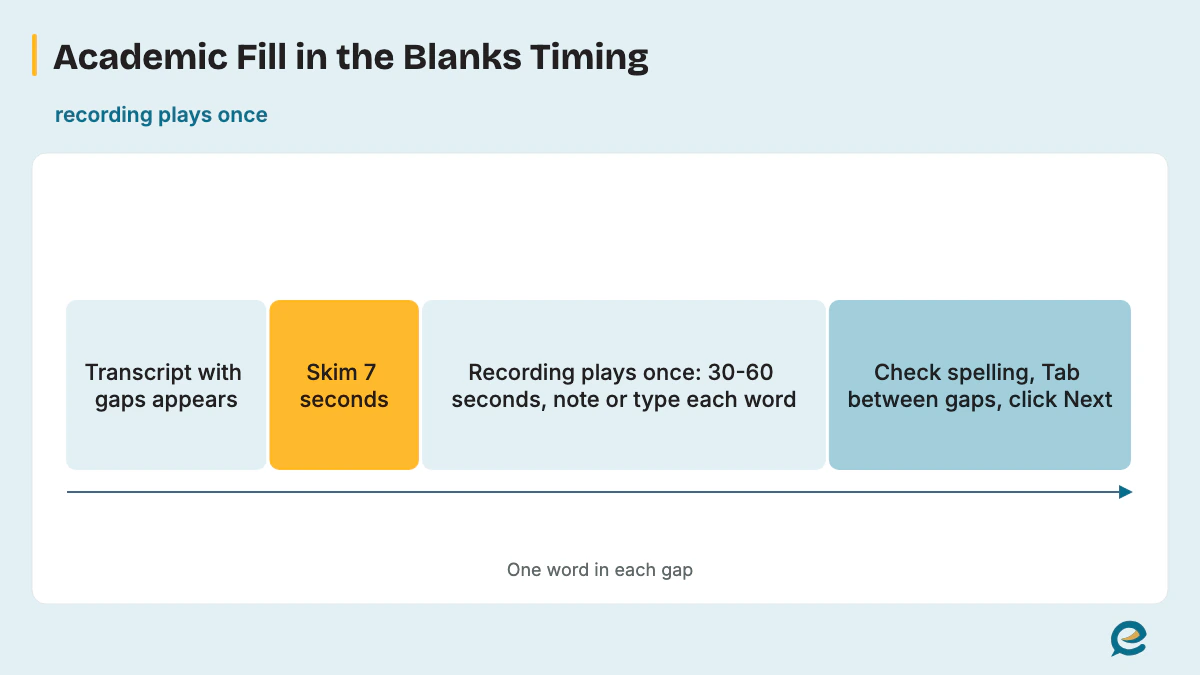
The task runs on a short clock: 7 seconds to skim the transcript, then a recording of 30-60 seconds that plays once while you note or type one missing word in each gap. One item moves through seven stages, from the transcript appearing to the next screen.
| Stage | What happens | Time or rule |
|---|---|---|
| Transcript appears | A transcript with several gaps shows on screen. | Same text you will hear. |
| Skim time | You skim the text and ignore the gaps. | 7 seconds skim before the audio. |
| Recording plays | The audio starts automatically. | 30-60 seconds; it plays once. |
| Typing or noting | You note each missing word or type it into its gap. | One word per gap. |
| Moving between gaps | You click a gap or press the Tab key. | Tab jumps to the next gap. |
| Checking spelling | You fix spelling and endings. | Only correct spelling scores. |
| Moving on | You click Next when ready. | The next item waits for Next. |
Pearson's Score Guides set the item count at 2-3 Fill in the Blanks items in PTE Academic and 2-3 in PTE Core. Pearson's task page only says the transcript has "several gaps", so no fixed number of gaps per transcript is official.
Neither Pearson's Listening page nor its Score Guide mentions number formats or capitalization for this task, so treat any rule you read about them as advice. PTE Academic recognizes US, UK, Australian and Canadian spelling conventions, and Pearson's advice is to keep to one convention within a response.
How Is PTE Listening Fill in the Blanks Scored?
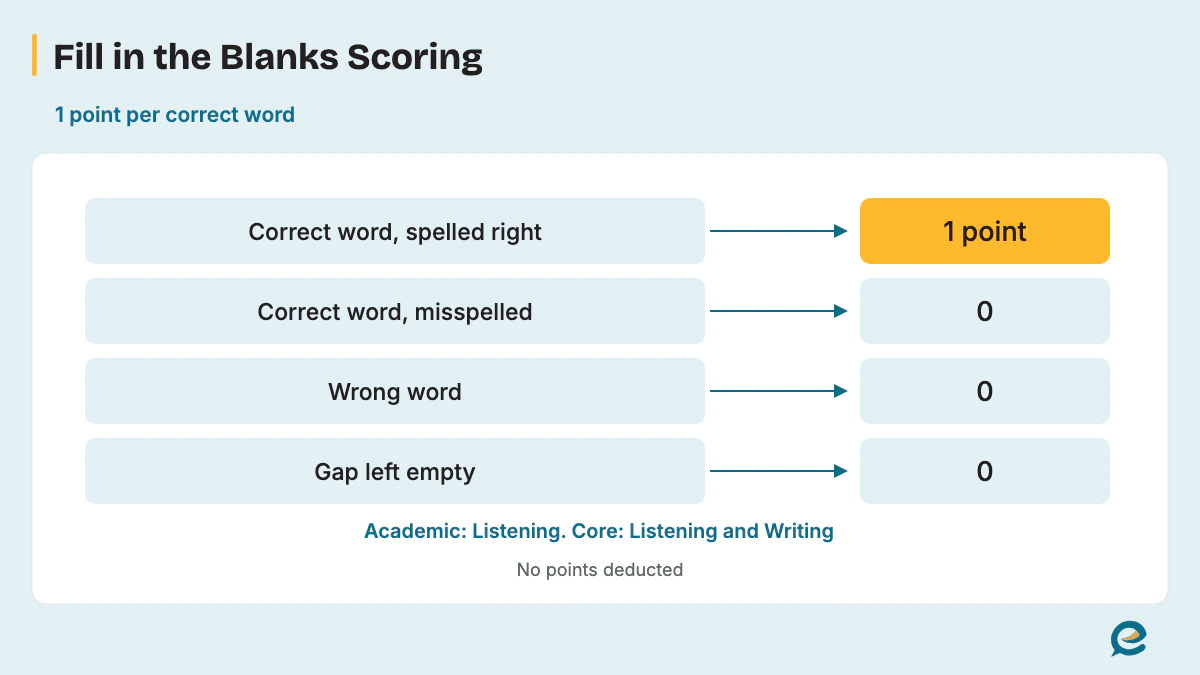
Pearson gives one point per word spelled correctly, with partial credit, and a wrong or misspelled word simply scores zero for that gap. Nothing is deducted, so each gap either earns a point or earns nothing, and each answer must contain the correct word with correct spelling.
| What you type | Result |
|---|---|
| Correct word, correct spelling | 1 point |
| Correct word, misspelled word | 0 for that gap |
| Wrong word | 0 |
| Gap left empty | 0 |
| Consistent US or UK spelling | Accepted |
| Mixed conventions in one response | Avoid |
Fill in the Blanks isn't one of the three question types Pearson names as able to lose points, so it has no negative marking and every gap deserves an answer. Skill credit depends on the test. The PTE Academic Score Guide credits the task to Listening only, while the PTE Core Score Guide credits it to Listening and Writing.
Is Fill in the Blanks Important in PTE?
Yes, you meet 2-3 of these items in each test, and with per-gap scoring every correct word adds to your Listening score, so careful spelling turns directly into points. In PTE Core the same words also count toward your Writing score.
For PTE Academic, the Score Guide and the task header list Listening only, although the Notes line on the same Pearson page says the task affects listening and writing. Pearson uses question weighting when calculating scores, so raw gap-points should not be read as fixed reported-score increments.
What Does a PTE Listening Fill in the Blanks Example Look Like?
Preparing a class exhibition
Listen and type one word in each gap.
Recording voice: UK English.
Original practice recording.
Our class is preparing a small exhibition in the entrance hall. Each group must a short description of its work by Monday. The descriptions will be beside the displays, so visitors can read them without asking for help. We have a separate table for unfinished projects. Students will explain how their ideas and what they plan to change. Before the exhibition opens, two volunteers will check the and make sure the walking route is .
Transcript
Our class is preparing a small exhibition in the entrance hall. Each group must submit a short description of its work by Monday. The descriptions will be printed beside the displays, so visitors can read them without asking for help. We have reserved a separate table for unfinished projects. Students will explain how their ideas developed and what they plan to change. Before the exhibition opens, two volunteers will check the labels and make sure the walking route is clear.
Answer and explanation
- submit — Use the base verb after must.
- printed — Keep the ed ending.
- reserved — The completed action uses reserved.
- developed — Keep the past tense ending.
- labels — More than one label is being checked.
- clear — The adjective describes the walking route.
Complete the gaps with the words in the recording. Check each ending and spelling against the key.
Original learning exercise; practice only, not an official Pearson test item or score.
What Are Some PTE Listening Fill in the Blanks Practice Questions With Answers?
Four more original practice passages follow, each with six gaps and a linked answer key. They use fictional workshops and group projects. Listen to the complete spoken version while filling the gaps in the displayed version.
A materials cupboard
Listen and type one word in each gap.
Recording voice: US English.
Original practice recording.
The workshop cupboard used to contain several boxes with no names on them. Our team has now the contents and given each box a label. Small tools belong in the upper , while larger materials remain on the shelves. A paper list beside the door shows the of each item. Anyone borrowing equipment should their name and return date. We will review the arrangement after two sessions and make if people still have finding things.
Transcript
The workshop cupboard used to contain several boxes with no names on them. Our team has now sorted the contents and given each box a label. Small tools belong in the upper drawer, while larger materials remain on the shelves. A paper list beside the door shows the location of each item. Anyone borrowing equipment should record their name and return date. We will review the arrangement after two sessions and make changes if people still have difficulty finding things.
Answer and explanation
- sorted — Keep the ed ending.
- drawer — Drawer is the storage compartment.
- location — The noun follows the.
- record — Use the base verb after should.
- changes — The plural names possible adjustments.
- difficulty — Difficulty is the noun after have.
Complete the gaps with the words in the recording. Check each ending and spelling against the key.
Original learning exercise; practice only, not an official Pearson test item or score.
Collecting event feedback
Listen and type one word in each gap.
Recording voice: UK English.
Original practice recording.
After our open evening, we asked visitors to complete a short . The first question concerned the welcome desk, and the second asked whether the directions were . We left a space for comments rather than offering a long list of possible problems. The replies will help us the next event. However, we will also ask the volunteers for their , because they saw parts of the evening that visitors may not have .
Transcript
After our open evening, we asked visitors to complete a short questionnaire. The first question concerned the welcome desk, and the second asked whether the directions were helpful. We left a space for additional comments rather than offering a long list of possible problems. The replies will help us prepare the next event. However, we will also ask the volunteers for their observations, because they saw parts of the evening that visitors may not have noticed.
Answer and explanation
- questionnaire — Questionnaire has double n.
- helpful — The adjective describes the directions.
- additional — Additional means extra here.
- prepare — Use the base verb after help us.
- observations — The plural noun belongs after their.
- noticed — The participle follows have.
Complete the gaps with the words in the recording. Check each ending and spelling against the key.
Original learning exercise; practice only, not an official Pearson test item or score.
A rehearsal schedule
Listen and type one word in each gap.
Recording voice: US English.
Original practice recording.
Our presentation group has agreed on a rehearsal for the coming week. The first session will focus on the opening, while the next will questions from classmates. Each speaker should bring a copy of their notes so the others can follow the sequence. We have allowed extra time for the final , which still needs work. If anyone cannot attend, they should tell the organiser the session rather than sending a message .
Transcript
Our presentation group has agreed on a rehearsal schedule for the coming week. The first session will focus on the opening, while the next will include questions from classmates. Each speaker should bring a printed copy of their notes so the others can follow the sequence. We have allowed extra time for the final section, which still needs work. If anyone cannot attend, they should tell the organiser before the session rather than sending a message afterwards.
Answer and explanation
- schedule — Schedule names the timetable.
- include — Use the base verb after will.
- printed — Printed describes the copy.
- section — Section is singular after final.
- before — Before contrasts with afterwards.
- afterwards — Afterwards is one word.
Complete the gaps with the words in the recording. Check each ending and spelling against the key.
Original learning exercise; practice only, not an official Pearson test item or score.
Choosing a group project
Listen and type one word in each gap.
Recording voice: UK English.
Original practice recording.
At our first meeting, everyone suggested a possible project. We wrote each idea on a card and placed the cards on the table. Before voting, we discussed the each proposal would need. One idea required equipment that was not , so its author suggested a simpler version. We finally chose a project with clear for every member. Our next step is to the tasks and agree when we will check our .
Transcript
At our first meeting, everyone suggested a possible project. We wrote each idea on a separate card and placed the cards on the table. Before voting, we discussed the resources each proposal would need. One idea required equipment that was not available, so its author suggested a simpler version. We finally chose a project with clear responsibilities for every member. Our next step is to organise the tasks and agree when we will check our progress.
Answer and explanation
- separate — Separate has a in its middle.
- resources — Resources is plural.
- available — Available ends in able.
- responsibilities — Responsibilities changes y to ies.
- organise (also: organize) — This pack uses organise; organize is an accepted spelling variant for this practice key.
- progress — Progress is uncountable here.
Complete the gaps with the words in the recording. Check each ending and spelling against the key.
Original learning exercise; practice only, not an official Pearson test item or score.
How Do You Answer PTE Listening Fill in the Blanks Step by Step?
The short version is skim for names in the 7 seconds, note each missing word as you hear it, skip any you miss, and check spelling before you click Next. Eight steps turn that into a routine.
- Read ahead in the skim time: ignore the gaps, find the topic, and look for proper nouns and repeated nouns, which is Pearson's own tip.
- Predict the word class from the words around each gap: "the" before a gap points to a noun, "to" often to a verb, and a common pairing such as "reach the ___" narrows it further.
- Follow the transcript with your eyes as the audio plays, so you always know which gap is next.
- Write each missing word on the erasable noteboard, which is Pearson's method, or type as you hear it if you type quickly and accurately.
- If you miss a word, move on and fill it later from context clues and grammar.
- After the recording, decide the spelling from your notes and type each word, pressing the Tab key to jump between gaps.
- Check every plural, -ed and -ing ending, and fill every gap, because a blank can't score and a guess might.
- Click Next when you're done: the next item waits for you, but there's no timer per item and the whole Listening section runs on one clock, so don't over-check one transcript.
How Do You Improve Fill in the Blanks in PTE?
Improvement comes from daily practice on short transcripts, a missed-word list, and enough typing speed to keep your eyes on the text. A simple practice loop works well, even for beginners. Do one timed item and check it against the transcript, then add each missed word to your spelling list and repeat the same item a day later.
For a do-it-yourself drill, take the transcript of a short lecture, ask a study partner to delete six words, listen once and fill the gaps. Add five minutes of typing practice with academic words, and create a free account to practice with scored Listening items.
How Do You Improve Spelling for Listening Fill in the Blanks?
Spelling improves fastest when you practice the exact words you have already misspelled, because one wrong letter turns a correct answer into zero. Keep your misspelled words in one list and retest them each week, so no word costs you a zero-point gap twice. Our list of the most repeated spelling words in PTE listening is a good starting set.
Which Words Come Up in PTE Listening Fill in the Blanks?
This guide’s word lists are authored practice sets, but the gaps usually fall on academic content words, the same words that appear in dictation practice. Learning common academic words and their spellings covers both tasks. Our page of PTE dictation words groups them by topic.
Is There Negative Marking in Listening Fill in the Blanks?
No, a wrong word scores zero for that gap but takes no points away, so always type your best guess. The Listening tasks that do carry a deduction are Highlight Incorrect Words and Multiple Choice, Multiple Answers. Our page on PTE negative marking explains their rules.
Is Listening Fill in the Blanks the Same in PTE Core?
Yes, PTE Core uses the same task shape with a 30-60 second recording, 2-3 items and scoring for listening and writing, but its page calls it "Fill in the Blanks" without "Type In". Only the task name and the skill credit differ. Read more about the PTE Core test.
How Does Fill in the Blanks Fit Into PTE Listening?
It's the third of eight question types in PTE Academic Listening and the third of seven in PTE Core, straight after Multiple Choice, Multiple Answers. Pearson scores it like Write from Dictation, one point for each word spelled correctly, and both tasks sit inside a Listening section of 31-39 minutes in PTE Academic. Our PTE Listening section guide walks through all eight tasks.
How Do You Improve Your PTE Listening Score?
Fill in the Blanks is one of the eight tasks in PTE Academic Listening, so a higher Listening score also needs accurate Write from Dictation and careful Highlight Incorrect Words. Spelling decides your points in the two typing tasks, and confident clicking protects them in the task with deductions. Our PTE listening tips cover each task.
Frequently Asked Questions
How Many Fill in the Blanks Items Are in PTE Listening?
Pearson's Score Guides list 2-3 Listening Fill in the Blanks items in PTE Academic and 2-3 in PTE Core.
Practice PTE Listening on EasyEnglish
Try Listening tasks in a timed, computer-based format like the real test.
Try speaking practice without signing up. A free account is required for full mock tests. Practice scores are estimates, not official Pearson scores.
Written by
EasyEnglish Team
The team behind EasyEnglish's PTE practice and mock tests
We build EasyEnglish PTE practice tasks and mock tests. Official test rules are checked against Pearson guidance; exercises are authored examples, not official or predicted exam questions. Practice scores are estimates. EasyEnglish is not affiliated with or endorsed by Pearson. Contact support@inverseai.com.
Editorial review completed .