
PTE Listening Multiple Choice Multiple Answer: Rules & Tips
PTE Listening
Early in PTE Listening you hear a short academic talk once, then pick from a list where several options are right. Multiple Choice Multiple Answer asks about the recording's content or the speaker's tone. Every option you select is scored: +1 when it's right, -1 when it's wrong, with 0 as the floor for the item. Those numbers come from Pearson's PTE Academic and PTE Core Score Guides.
That -1 penalty is why the safest method selects only what your notes can prove. The recording runs 80-120 seconds in PTE Academic and 50-90 seconds in PTE Core, and it plays once.
Table of Contents
What Is Multiple Choice Multiple Answer in PTE Listening?
Multiple Choice Multiple Answer in PTE Listening is a task that plays a recording once and asks you to select every option that answers a question about its content or tone. Pearson's wording is that you answer "by selecting more than one response". It's task 2 of Part 3 Listening in PTE Academic and task 2 in PTE Core Listening, right after Summarize Spoken Text. Pearson scores it for listening only.
A different Multiple Choice Multiple Answer task sits in the Reading section, where you work from a written passage instead of a recording.
What Are the Listening Multiple Choice Multiple Answer Format and Timing Rules?
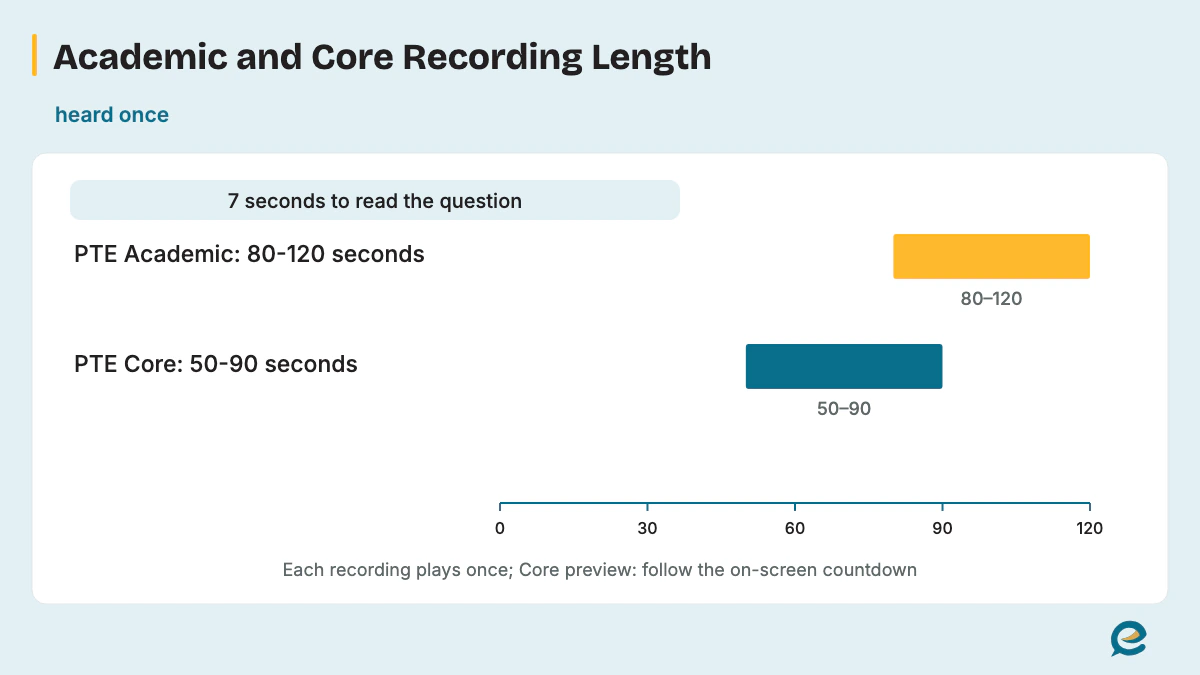
In PTE Academic you get seven seconds to read the question, then an 80-120 second recording plays once; in PTE Core the recording runs 50-90 seconds. Academic tests carry 2-3 of these items and Core tests 1-2, according to Pearson's Score Guides. Academic and Core differ only in recording length, item count and the name of the note surface.
| Stage | PTE Academic | PTE Core |
|---|---|---|
| Items per test | 2-3, per the Academic Score Guide. | 1-2, per the Core Score Guide 2026. |
| Before the audio | Seven seconds to read the question. | Read before playback; follow the on-screen countdown. |
| Recording | Audio or video, 80-120 seconds. | Audio or video, 50-90 seconds. |
| Plays | Heard once, starting automatically. | Heard once, starting automatically. |
| Time to answer | No item timer; time comes from the 31-39 minute Listening part. | No item timer; time comes from the 22-37 minute Listening part. |
| Selecting | Chosen options turn yellow; click again to deselect. | Click to select; click again to deselect. |
| Notes | An erasable noteboard booklet. | An erasable whiteboard. |
Pearson lists the time to answer as "Not applicable", so the clock you're racing is the Listening part as a whole. A sensible budget, our suggestion rather than a Pearson rule, is about one minute after the audio ends before you click Next. Some prep sites still quote 40-90 seconds for this recording; Pearson's current PTE Academic page says 80-120 seconds.
What Types of Questions Appear in Listening Multiple Choice Multiple Answer?
Pearson says the question asks about the content of the recording or the speaker's tone, and it warns that several options reuse words from the recording without matching its meaning. The recording itself is what Pearson calls "a brief audio or video recording on an academic subject". Each question focus changes what belongs in your notes.
| Question asks about | What to listen for | Example stem |
|---|---|---|
| Main points | The claims the whole talk is built around. | Which points does the speaker make about city water supplies? |
| Specific details | Names, causes, results and examples. | Which factors does the lecturer connect to the drop in ticket sales? |
| Inference | What the speaker implies but doesn't say outright. | What does the speaker imply about the new library hours? |
| Speaker's purpose | Why an example or story is mentioned. | Why does the speaker describe the failed bridge design? |
| Tone or attitude | Words that show doubt, approval or criticism. | Which describe the speaker's view of online exams? |
Pearson names the inference and purpose focuses in its question tips on the same Listening page, printed under Multiple Choice, Single Answer, and they fit this task's content questions just as well.
Content questions reward accurate notes on what was said, while tone questions need you to hear how it was said. Stems also come in two shapes: a direct question, or a sentence-completion stem that ends in a blank, such as "The speaker's main aims are to ___". Read the question stem first so you know which focus to note.
How Is Listening Multiple Choice Multiple Answer Scored?
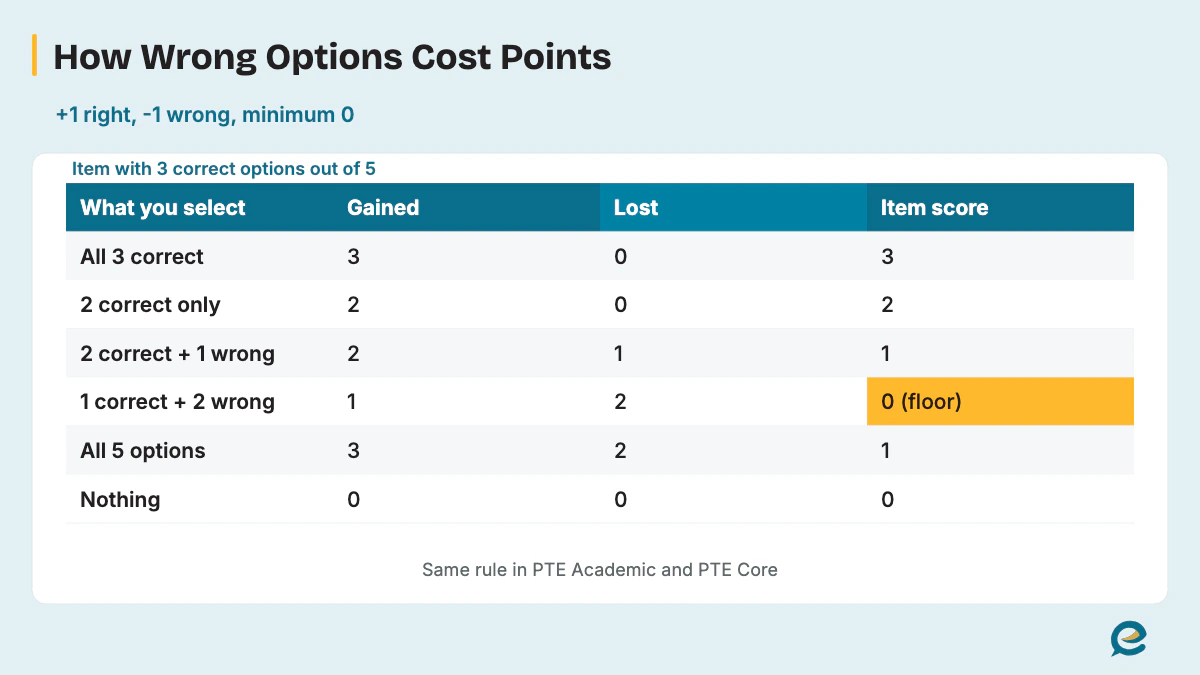
Pearson's Score Guides apply negative marking: +1 for every correct option you click, -1 for each of the incorrect options you pick, and a minimum score of 0. The rule holds in both PTE Academic and PTE Core. The result feeds your Listening score and no other skill. Here is how that arithmetic plays out on an item with three correct options among five.
| What you select | Points gained | Points lost | Item score |
|---|---|---|---|
| All three correct options | 3 | 0 | 3 |
| Two correct options only | 2 | 0 | 2 |
| Two correct plus one wrong | 2 | 1 | 1 |
| One correct plus two wrong | 1 | 2 | 0 (floor) |
| All five options | 3 | 2 | 1 |
| Nothing | 0 | 0 | 0 |
Pearson's Academic Listening page describes the same rule in softer words: all options correct earns the maximum, and partial credit applies otherwise. Its Core page is blunter, warning that clicking every option because you don't know the answer loses you points.
The Academic page also calls Highlight Incorrect Words "the third of three question types where you can lose points"; the other two are the Reading and Listening versions of this task. That makes every doubtful option an even trade of +1 or -1, so it earns a click only when your notes back it up.
What Does a Listening Multiple Choice Multiple Answer Sample Question Look Like?
An equipment collection desk
Which benefits does the speaker expect from the collection desk?
Recording voice: UK English.
Original practice recording.
Transcript
Our workshop used to hand out equipment from several cupboards. Participants queued in the corridor while volunteers searched for the items each person needed. For our next session, we will prepare labelled sets at one collection desk. We expect this to reduce the time spent searching and make it easier to notice whether a set is incomplete before someone carries it away. Preparing the sets will take extra time before the session, so we have asked two volunteers to arrive early. We are not buying new equipment, and participants will still return everything at the end. If a set has a missing item, a volunteer will check the reserve box rather than sending the participant around the building. We will review the arrangement afterwards to see whether the expected benefits actually occurred.
Answer and explanation
Correct options: A, B
- A: Sets will be prepared in one place, reducing searches.
- B: The speaker explicitly expects missing items to be noticed before collection.
- C: Preparing sets takes extra time.
- D: The speaker says no new equipment is being bought.
- E: Everything must be returned.
Select the supported options only; every choice has its own explanation.
Original learning exercise; practice only, not an official Pearson test item or score.
What Are Some Listening Multiple Choice Multiple Answer Practice Questions With Answers?
These original practice questions add purpose, attitude, inference and detail items to the worked sample, and each answer key explains why the distractors fail. Read the transcript aloud to a partner, or record yourself reading it, so you hear it once instead of reading it.
A guide to the rehearsal room
The speaker’s aims are to…
Recording voice: US English.
Original practice recording.
Transcript
I want to explain why our drama group is preparing a short room guide and point out what the guide cannot do. New members often ask where costumes belong, how to book a rehearsal and whom to contact about a missing key. Experienced members know the answers, but repeating them during every rehearsal interrupts the work. A guide can put those routine answers in one place. We will keep it beside the booking sheet and send a copy to new members. However, we should not assume that a page of instructions will make every newcomer feel welcome. Someone still needs to introduce them to the group and invite their questions. I am not proposing fewer personal conversations. I am proposing that those conversations spend less time repeating cupboard locations and more time helping people join in.
Answer and explanation
Correct options: A, B
- A: Routine questions repeatedly interrupt rehearsals.
- B: A guide does not replace a personal welcome.
- C: The speaker explicitly rejects fewer personal conversations.
- D: No prices are compared.
- E: The room remains in use.
Select the supported options only; every choice has its own explanation.
Original learning exercise; practice only, not an official Pearson test item or score.
A booking trial
Which statements describe the speaker’s attitude?
Recording voice: UK English.
Original practice recording.
Transcript
Our club is testing an online booking form. I can see why people like it: they can request a place without waiting for the office to open, and the organiser can read the requests in one list. But I am cautious about calling the trial a success already. Several members have told me that they cannot tell whether submitting a request means their place is confirmed. That uncertainty needs to be fixed. I would keep the form, add a clearer confirmation message and leave a telephone option for anyone who needs help. I would not make online booking the only method yet. After another month, we can ask whether people understand the messages and whether the organiser is spending less time answering the same question. That would be a better basis for deciding what happens next.
Answer and explanation
Correct options: A, B, E
- A: The speaker says it is too early to call the trial a success.
- B: A clearer confirmation message is proposed.
- C: A telephone option should remain.
- D: Convenience and a combined request list are acknowledged.
- E: The speaker would keep and improve the form before reviewing it.
Select the supported options only; every choice has its own explanation.
Original learning exercise; practice only, not an official Pearson test item or score.
Editing a visitor guide
What does the talk suggest about preparing the guide?
Recording voice: US English.
Original practice recording.
Transcript
We expected taking photographs to be the slowest part of making our visitor guide. In fact, that work was finished within an afternoon. Writing the directions took much longer. People who knew the building kept using names for corridors that did not appear on any sign. When we asked a new volunteer to follow the draft, she stopped at several junctions because the written names meant nothing to her. We replaced those names with descriptions of visible signs and doors. Her next attempt went more smoothly, although we have only tested one route so far. We will ask other newcomers to try the remaining routes before printing. A guide that is obvious to its authors may still confuse the people it is meant to help; that is the lesson we are taking from this first trial.
Answer and explanation
Correct options: A, C
- A: Photos were finished quickly; directions took much longer.
- B: Only one route has been tested.
- C: Familiar writers used names unfamiliar to new visitors.
- D: Nothing says she designed signs.
- E: Further testing will happen before printing.
Select the supported options only; every choice has its own explanation.
Original learning exercise; practice only, not an official Pearson test item or score.
Problems with separate sign-up sheets
Which problems does the speaker identify with the separate sheets?
Recording voice: UK English.
Original practice recording.
Transcript
Our community club kept a separate sign-up sheet for each activity. That seemed simple until members began moving between activities. A person could change a choice on one sheet while still appearing on another. Sometimes the organiser counted the same person twice. Volunteers also found it difficult to tell whether an empty space represented an available place or a cancellation that had not been recorded properly. Finally, the sheets were kept in different rooms, so checking an answer meant walking between them. We have decided to try one central list with a separate column for each activity. This is a local trial, not a requirement for other clubs. We will keep the old sheets as a record, but new changes will go only on the central list so that volunteers have a single version to consult.
Answer and explanation
Correct options: A, B, C
- A: A changed choice could leave the member on two sheets.
- B: An empty space might reflect an unrecorded cancellation.
- C: The sheets were stored in separate rooms.
- D: No charges are mentioned.
- E: No such requirement existed or is proposed.
Select the supported options only; every choice has its own explanation.
Original learning exercise; practice only, not an official Pearson test item or score.
Across the five items there are 12 correct options and 13 traps. If you scored below the maximum, check whether the lost points came from a wrong pick (-1) or a missed right one (0), because the fix for each differs.
How Do You Answer Listening Multiple Choice Multiple Answer Step by Step?
Read the question in the seven seconds before the audio, take notes on main points while it plays instead of clicking, then click just the options your notes can back up. The method rests on Pearson's own two tips, note-taking over clicking while you listen and meaning over matching words. The numbered method moves from the question stem to the final selection.
- Read the question stem and note whether it asks about content, inference, purpose or tone.
- Skim the options if time allows, without deciding anything yet.
- Write short notes of main points and details on the noteboard while listening, since the information may come in a different order from the options.
- After the audio, run an option check, testing each option against your notes and expecting right answers to use different words from the speaker's.
- Reject unsupported options, but retain an inference clearly supported by the recording even when it is not stated word for word.
- Select only the options that pass a meaning match with your notes.
- Leave any doubtful option unselected, then click Next and move on.
Correct options are usually paraphrased: "absorb rain" becomes "reduce flooding", and "I'm not sure" becomes "doubtful". An option that copies the speaker's exact wording deserves a second look before you click it.
What Are Common Listening Multiple Choice Multiple Answer Mistakes?
The costly mistakes are picking options because they repeat the speaker's words, selecting too many options, and clicking while the recording still plays. Each one either triggers a wrong option penalty or hides information you needed. Each habit in this list carries a specific cost in points.
- Word matching: choosing an option because it shares a word with the talk costs a point when the meaning differs.
- Fixed counts: assuming there are always two or three correct options pushes you into an extra wrong pick.
- Over-selecting: selecting every option loses points, as Pearson's PTE Core page states.
- Clicking during the audio: you miss later information that changes which options fit.
- Overstated options: an option that says "always" or "all" when the speaker was cautious is wrong.
- Single Answer habit: always answering is safe in Multiple Choice Single Answer, but here a wrong extra pick costs a point.
How Do You Practice Listening Multiple Choice Multiple Answer?
Effective Multiple Choice Multiple Answer practice uses full-length recordings played once, notes, a selection, then a check of every wrong pick against the word in the option that misled you. A simple practice loop builds that habit. Play the talk once, take notes and select your options. Check the answers, then add one line to an error log saying why each wrong option looked right.
How Does Multiple Choice Multiple Answer Fit Into PTE Listening?
It's the second of eight question types in PTE Academic Listening (second of seven in PTE Core), straight after Summarize Spoken Text, and one of two Listening items that can lose points for wrong picks. Pearson applies the same deduction to Highlight Incorrect Words, and both sit inside a Listening part of 31-39 minutes in PTE Academic. Our PTE Listening section guide walks through all eight.
How Is Listening Multiple Choice Different from Reading Multiple Choice?
Both tasks ask you to select more than one correct option, but the Listening version works from a recording heard once and the Reading version from a passage on screen. That recording versus passage split changes the skill, though the +1/-1 scoring is the same, and the timings above belong to the Listening version only. For the written task, see Reading Multiple Choice Multiple Answer.
How Is Multiple Answer Different from Single Answer in PTE Listening?
Multiple Choice Single Answer has one correct option and is scored correct or incorrect, while Multiple Answer has several correct options and costs points for wrong ones. That's why you always answer Single Answer but leave doubtful options unselected here. The Listening Multiple Choice Single Answer page sets out its rules.
What Is the Trick for Multiple Choice Questions in PTE Listening?
The only reliable trick is restraint: click an option only if your notes back it up, because a wrong selection costs points. A shared word neither proves nor disproves an option; compare its full meaning with the recording. Our page on how PTE negative marking works shows where else this applies.
How Can You Improve Your Listening in PTE for Multiple Choice?
Your listening for this task gets sharper when you practice summarizing a talk's main points in a few words while it plays. Spend ten minutes a day on daily listening to academic talks, each heard once, and write a one-line summary that captures each talk's main points. Our PTE listening tips suggest material for it.
Practice PTE Listening on EasyEnglish
Try Listening tasks in a timed, computer-based format like the real test.
Try speaking practice without signing up. A free account is required for full mock tests. Practice scores are estimates, not official Pearson scores.
Written by
EasyEnglish Team
The team behind EasyEnglish's PTE practice and mock tests
We build EasyEnglish PTE practice tasks and mock tests. Official test rules are checked against Pearson guidance; exercises are authored examples, not official or predicted exam questions. Practice scores are estimates. EasyEnglish is not affiliated with or endorsed by Pearson. Contact support@inverseai.com.
Editorial review completed .