
PTE Listening Highlight Correct Summary: Questions with Answers
PTE Listening
You hear the talk once; Pearson recommends comparing the summaries after it ends, so this task rewards clear notes more than fast reading. Highlight Correct Summary plays a 30-90 second recording, shows several summary paragraph options, and gives you 1 point for picking the one that best summarizes what you heard. It appears in PTE Academic and PTE Academic UKVI only, 2-3 times per test according to Pearson's Score Guide, and never in PTE Core.
Pearson's own tip is to listen and take notes first, then read the options. The wrong options follow six repeatable trap patterns, and the eleven original items further down label every one of them, so you can learn to spot each trap by name.
Table of Contents
What Is the Highlight Correct Summary in PTE?
Highlight Correct Summary is a PTE Academic Listening task in which you hear a recording and select the paragraph that best summarizes it. It plays a 30-90 second recording once, shows several summary paragraphs, and asks you to select one. The task sits at task 4 of 8 in Part 3, between Fill in the Blanks and Multiple Choice, Single Answer, and it's not in PTE Core. Pearson judges your ability to understand a recording, pull its ideas together and recognize the most accurate summary. Because you read the options to answer, Pearson's task page and Score Guide both count the result toward Listening and Reading.
What Is the Highlight Correct Summary Task Format?
The format is one 30-90 second recording, several options with one correct answer, a single click, and 2-3 items per test. Pearson's task page and the 2025 Score Guide supply every detail in this table.
| Element | Detail |
|---|---|
| Test variant | PTE Academic and UKVI only |
| Task position | Task 4 of 8 in Part 3 Listening |
| Items per test | 2-3 |
| Recording length | 30-90 seconds, starts automatically, plays once |
| Options | Several options, one correct answer |
| Time to answer | No separate timer; part of the 31-39 minute Listening part |
| How to select | Left-click an option; click again to deselect |
| Selected option | Highlighted in yellow |
| Skills scored | Listening and reading |
| Notes | Erasable noteboard booklet |
Pearson doesn't fix the number of options, so expect "several". To change your answer, click the chosen paragraph again or click a different one, and the new choice is highlighted in yellow. The practice items below use four options each.
How Is Highlight Correct Summary Scored?
Pearson scores the task as correct or incorrect: the right paragraph earns 1 point, and a wrong choice or no choice earns 0. The Score Guide lists no deduction for this task, so there's no negative marking here, and you should always answer, even when unsure. That sets it apart from two other Listening tasks, Multiple Choice, Multiple Answers and Highlight Incorrect Words, where the Score Guide takes 1 point off for each wrong option, down to a minimum of 0. Each point you earn counts toward Listening and Reading, and Pearson uses question weighting when calculating scores; this item’s raw point is not a fixed number of points on the 10–90 scale.
Why Are the Wrong Answers So Hard to Spot?
The trap options are hard to spot because they borrow the speaker's words and then change something: the point, the scope, the strength, the logic or the attitude. The correct option usually does the opposite: it keeps the meaning and rewrites it as a paraphrase. So an option that sounds like the recording earns no extra trust over one that sounds different. These six labels are our own practice checklist, not Pearson's terms, and each comes with the clue that gives it away.
- Outside information: a fact, number, example or recommendation the speaker never gave, often one that sounds sensible.
- Changed conclusion: familiar wording with the meaning turned, so the option ends where the speaker did not.
- Partial summary: one part of the talk, or a single example, presented as if it were the whole message.
- Overstatement: the speaker's "some", "often" or "may" turned into "all", "always" or "never".
- Reversed cause and effect: the speaker says A leads to B, and the option says B leads to A.
- Wrong attitude: the option misstates the speaker's attitude, for example making a cautious speaker enthusiastic or a balanced speaker hostile.
What Does a Highlight Correct Summary Example Look Like?
A shared project checklist
Choose the summary that best represents the whole recording.
Recording voice: UK English.
Original practice recording.
Transcript
Our student group used to keep project instructions in separate messages. Whenever someone missed a message, we spent part of the next meeting explaining the same task again. We have now moved the agreed instructions into one shared checklist. Each task has an owner and a completion date, and changes are recorded beside it. This has made our meetings shorter because we no longer begin by reconstructing earlier decisions. However, a checklist cannot settle a disagreement about what the project should achieve. Those decisions still need a conversation. Our plan is therefore to keep using the checklist for agreed actions while reserving meeting time for questions that genuinely require discussion.
Answer and explanation
Correct option: B
- A: This describes the layout but omits the problem, result and continuing need for discussion.
- B: This covers the initial situation, the change, its limitation and the speaker’s conclusion.
- C: Meetings remain necessary for unresolved decisions.
- D: No requirement for other groups is mentioned.
A student group replaced scattered instructions with a shared checklist, reducing repeated explanations in meetings. The checklist records agreed tasks, owners and dates, but disagreements about the project still require discussion, so meetings will focus on those decisions.
Original learning exercise; practice only, not an official Pearson test item or score.
How Do You Answer Highlight Correct Summary Step by Step?
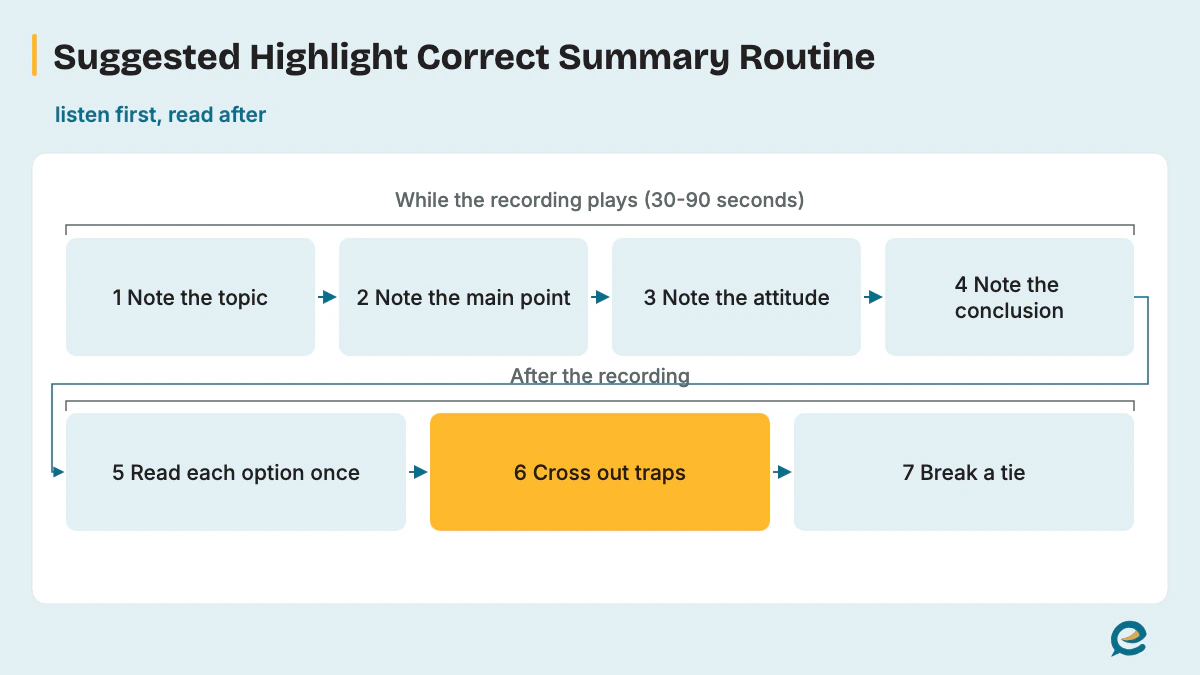
Pearson's tip is to listen first, note the key ideas, then read the options and pick the one closest in detail to your notes. Pearson names what to write down: key words and phrases, numbers, names, dates, and anything the speaker highlights through stress and intonation. Steps 1-4 below put that tip into practice; steps 5-7 are our own elimination and tie-break routine, built on top of it.
- Note the topic from the opening sentences, in two or three words.
- Note the main point, plus any shift word such as "but", "yet" or "so" that turns the talk in a new direction.
- Note the speaker's attitude: neutral and explaining, critical, supportive, or comparing two sides.
- Note the conclusion, since the last sentence or two often carries it, and give it extra weight when you compare.
- Once the recording ends, read each option once, fully, and drop first any option that contradicts the conclusion.
- Use elimination on what's left: cross out any option with outside information, a changed conclusion, a partial summary, an overstatement, a reversed cause or the wrong attitude.
- Break a tie by reading the last two options side by side and finding the single mismatch, such as a changed date, an effect presented as the cause, or "every" where the speaker said "many". If none appears, choose the closest match to your notes on key points, conclusion and tone, then move on.
Some prep sites still quote advice to skim the options before the audio starts. Pearson's current page says don't read the options before or while you listen, because there is too much to read and it distracts you.
What Are Common Mistakes in Highlight Correct Summary?
The common mistakes are keyword matching, rejecting the reworded answer, reading during the audio, choosing detail over the main idea, ignoring the ending and leaving a blank. Each habit has a direct fix.
- Keyword matching: an option that repeats the speaker's words can still change the meaning, so check it against your notes.
- Rejecting the paraphrased option: the correct summary usually rewords the talk, so judge meaning, not familiar phrases.
- Reading while listening: the options pull your attention from the audio, so keep your eyes on the noteboard until the recording ends.
- Choosing detail-heavy options: an option packed with one example's specifics can miss the main idea, so ask whether it covers the whole talk.
- Trusting absolute words: an option with "all", "always" or "never" fails unless the speaker used that strength, so compare it with the qualifiers in your notes.
- Ignoring the ending: an option that fits the first half but not the conclusion is wrong, so compare every option with your last note.
- Leaving a blank answer: a blank earns 0, the same as a wrong guess, so always select the closest option.
What Highlight Correct Summary Practice Questions Can You Try With Answers?
Ten more original practice talks follow, each with four summary options and an explanation of every choice. The situations are fictional. Listen without reading the transcript, then choose the best summary and review the key.
Borrowing display materials
Choose the summary that best represents the whole recording.
Recording voice: US English.
Original practice recording.
Transcript
In our design class, each group originally bought its own display materials. At the end of the first project, we found several unopened packs in different cupboards. For the next project, we set up a shared supply shelf. Groups check the shelf before ordering anything and record what they take. The system has reduced duplicate purchases in our class, but it has also created a new responsibility. Someone must check that the record matches what is actually on the shelf. We tried leaving that job to whoever had spare time, and it was often missed. We now assign it to a different group each week, so sharing materials depends on a clear routine as well as a common storage space.
Answer and explanation
Correct option: C
- A: Unused supplies prompted the shelf; checks were introduced afterwards.
- B: The record problem and rotating responsibility are omitted.
- C: This covers the initial situation, the change, its limitation and the speaker’s conclusion.
- D: No college budget decision is described.
A design class introduced a shared shelf after discovering unused supplies. It reduced duplicate purchases, but accurate stock records required regular checks, so responsibility now rotates between groups rather than being left to whoever has time.
Original learning exercise; practice only, not an official Pearson test item or score.
A rehearsal with visitors
Choose the summary that best represents the whole recording.
Recording voice: UK English.
Original practice recording.
Transcript
For our first public presentation, we rehearsed in an empty room and thought the directions were clear. On the day, visitors hesitated because the welcome desk could not be seen from the entrance. Before the next event, we invited three classmates who had not helped with the planning to try the visitor route. We asked them to find the desk without giving spoken directions. Their mistakes showed us where signs were missing. We moved one sign and turned the desk towards the doorway. This small rehearsal did not predict every difficulty that a busy event might bring, but it exposed a problem we had overlooked because we already knew where everything was.
Answer and explanation
Correct option: A
- A: This covers the initial situation, the change, its limitation and the speaker’s conclusion.
- B: The speaker explicitly says not every difficulty was predicted.
- C: It omits why the change was needed and what the trial demonstrated.
- D: Earlier confusion led to the later test and changes.
After visitors struggled to find a welcome desk, organisers tested the route with unfamiliar classmates. Watching their mistakes led to clearer signs and a repositioned desk, showing the value of an outside perspective while leaving some event difficulties untested.
Original learning exercise; practice only, not an official Pearson test item or score.
Recording workshop questions
Choose the summary that best represents the whole recording.
Recording voice: US English.
Original practice recording.
Transcript
I coordinate a small writing workshop. At first, I answered every question as soon as it was asked. That felt helpful, but short explanations repeatedly interrupted people who were concentrating on their drafts. We now separate urgent questions from points that can wait. If someone cannot continue without an answer, I respond immediately. Other questions go on a board, and we discuss them during a planned break. Participants say the longer quiet periods are useful, although a few initially worried that their questions would be forgotten. To address that concern, we review every entry before finishing. The aim is to protect time for writing while still making sure that everyone receives a response.
Answer and explanation
Correct option: D
- A: The speaker wants all questions addressed, with different timing.
- B: This omits urgency, quiet periods and the closing review.
- C: No paid tutor or automatic sending is described.
- D: This covers the initial situation, the change, its limitation and the speaker’s conclusion.
The workshop now answers urgent questions immediately and saves other questions for a scheduled break. This gives writers longer quiet periods, while checking every board entry before the session ends reassures participants that their questions will be addressed.
Original learning exercise; practice only, not an official Pearson test item or score.
Two ways to welcome new members
Choose the summary that best represents the whole recording.
Recording voice: UK English.
Original practice recording.
Transcript
Our reading club tried sending new members a long welcome message. It included the meeting location, book choices, discussion rules and a history of the club. Several newcomers told us they could not quickly find the time of their first meeting. We have replaced that message with a short invitation containing the immediate arrangements and a link to a separate guide. The guide still explains how discussions work and how books are chosen. New members can read it when they need that detail. We will ask the next group whether this is easier to use. The change is intended to make essential information easier to find; we do not yet know whether it will improve attendance.
Answer and explanation
Correct option: B
- A: The old problem, shorter invitation and uncertainty are omitted.
- B: This covers the initial situation, the change, its limitation and the speaker’s conclusion.
- C: Attendance effects are not yet known.
- D: No charge is mentioned.
The reading club split its long welcome message into a brief invitation and a separate guide because newcomers struggled to find immediate arrangements. It will seek feedback on clarity, and any effect on attendance remains unknown.
Original learning exercise; practice only, not an official Pearson test item or score.
A display that can change
Choose the summary that best represents the whole recording.
Recording voice: US English.
Original practice recording.
Transcript
Our course exhibition used to place every project behind a fixed sheet of clear plastic. The display looked tidy, but correcting a label meant dismantling a whole panel. This term, we tried smaller holders that can be opened separately. Students can now correct one label without disturbing the others. However, the holders are not all the same size, so fitting the exhibition together takes more planning. We have kept the new arrangement because the projects change several times before opening day. For a display that never changes, the old panels might still be simpler. Our choice reflects how we use this particular exhibition space, rather than a rule that one kind of display is always better.
Answer and explanation
Correct option: C
- A: Planning increases, and the preference depends on use.
- B: The planning cost and conditional conclusion are missing.
- C: This covers the initial situation, the change, its limitation and the speaker’s conclusion.
- D: Changing projects motivated the choice of holders.
Separate label holders make corrections easier in a frequently changing course exhibition, although arranging them takes more planning. The organisers prefer them for this use but recognise that fixed panels may suit a display that stays unchanged.
Original learning exercise; practice only, not an official Pearson test item or score.
Choosing a meeting time
Choose the summary that best represents the whole recording.
Recording voice: UK English.
Original practice recording.
Transcript
When our volunteer group chose its meeting time, the people already attending simply voted during a meeting. The result suited most people in the room, but several absent volunteers later said they could never attend at that hour. For the next review, we sent the possible times to every member and allowed replies over several days. We also asked people to mark times they could manage, rather than choosing only a favourite. That gave us a clearer picture of overlapping availability. It still did not produce a time that suited everyone. We therefore kept a written record of decisions and invited comments afterwards, so those who missed a meeting could still contribute.
Answer and explanation
Correct option: D
- A: No single time suits everyone, so written follow-up remains useful.
- B: It leaves out exclusion, the remaining limitation and follow-up.
- C: The speaker describes broadening participation.
- D: This covers the initial situation, the change, its limitation and the speaker’s conclusion.
An in-person vote overlooked absent volunteers, so the group collected everyone’s available times over several days. No time suited all members, leading it to share written decisions and accept later comments as well as improving the scheduling process.
Original learning exercise; practice only, not an official Pearson test item or score.
Keeping a useful project archive
Choose the summary that best represents the whole recording.
Recording voice: US English.
Original practice recording.
Transcript
Our class saved every project file in one folder. Months later, when we wanted to reuse a poster layout, we found five versions with nearly identical names. None told us which version had actually been printed. We have now agreed on a simple archive routine. The final version goes into a clearly marked folder with a short note explaining what it was used for. Drafts remain elsewhere because they can show how an idea developed. This takes a little time when a project ends, and it will only help if everyone follows the routine. The aim is not to save fewer ideas, but to make the status of each saved file easier to understand.
Answer and explanation
Correct option: A
- A: This covers the initial situation, the change, its limitation and the speaker’s conclusion.
- B: Drafts are retained precisely because they show development.
- C: It gives the problem without the response or limitation.
- D: The routine is manual; no specialist software is mentioned.
A class introduced a routine for marking final files and recording their use after similar filenames caused confusion. Drafts remain available separately, and the system requires consistent effort to make saved material easier to interpret.
Original learning exercise; practice only, not an official Pearson test item or score.
An optional practice session
Choose the summary that best represents the whole recording.
Recording voice: UK English.
Original practice recording.
Transcript
I offered an extra practice session before our group presentations. The first invitation said only that extra help would be available. A few students came, but others later explained that they did not know what would happen or whether they needed a finished presentation. For the next session, I described three activities: testing an opening, checking a visual and practising an ending. Students could bring unfinished work and choose one activity. More people attended that session, but the date had also changed, so I cannot attribute the difference entirely to the clearer invitation. I plan to keep the description and ask students directly which information helped them decide whether to come.
Answer and explanation
Correct option: B
- A: It omits the communication problem, uncertainty and feedback plan.
- B: This covers the initial situation, the change, its limitation and the speaker’s conclusion.
- C: The changed date is explicitly identified as another possible influence.
- D: Unfinished work was welcome.
A vague invitation to extra practice was replaced with a description of three optional activities for unfinished work. Attendance rose, but a changed date prevents a firm explanation, so the organiser will retain the detail and seek feedback.
Original learning exercise; practice only, not an official Pearson test item or score.
Using a shared room fairly
Choose the summary that best represents the whole recording.
Recording voice: US English.
Original practice recording.
Transcript
Two student clubs share our activity room. One usually needs open floor space, while the other uses tables for drawing. At first, each group left the room arranged for its own next meeting. That meant the following group spent its opening minutes moving furniture. We considered keeping the room permanently empty, but then both groups would need to set up every time. Instead, the clubs agreed to check the next booking and leave a basic layout for that activity. A simple diagram beside the door explains each layout. This arrangement depends on the bookings being accurate, so the person changing a booking must also update the note on the door.
Answer and explanation
Correct option: D
- A: A permanently empty room was considered and rejected.
- B: This describes different needs without the agreement or condition.
- C: Sharing and incompatible layouts prompted the diagrams.
- D: This covers the initial situation, the change, its limitation and the speaker’s conclusion.
Two clubs reduced repeated furniture changes by leaving their shared room in a basic layout for the next booking. Diagrams guide the setup, but the arrangement depends on keeping the booking information and door note current.
Original learning exercise; practice only, not an official Pearson test item or score.
A trial delivery route
Choose the summary that best represents the whole recording.
Recording voice: UK English.
Original practice recording.
Transcript
For our community event, volunteers deliver invitations to nearby buildings. Last time, each volunteer chose a route independently, and two people visited the same entrance while another entrance was missed. This time, we marked entrances on a simple plan and divided them between named volunteers. Before using it for the event, we tried one short route. The trial revealed that a passage shown on the plan was locked, so we corrected the route. The plan should make responsibilities clearer, but it cannot tell us about every change on the day. Volunteers will still report unexpected access problems so we can update the shared copy as the work continues.
Answer and explanation
Correct option: C
- A: Unexpected access problems still require reports.
- B: The initial problem, assignment process and continuing reporting are absent.
- C: This covers the initial situation, the change, its limitation and the speaker’s conclusion.
- D: No advertising or abandonment of invitations is mentioned.
After overlapping deliveries and a missed entrance, volunteers assigned entrances on a shared plan. A trial exposed a locked passage, and ongoing reports will still be needed because clearer routes cannot anticipate every access change.
Original learning exercise; practice only, not an official Pearson test item or score.
How Do You Practice Highlight Correct Summary in PTE?
The most useful habit is to write a one-sentence summary of each talk before you look at any options, then compare it with the correct option. A practice loop built on that habit has four parts. Listen once to one of several short lectures, write your one-sentence summary, choose an option, then name the trap in each wrong one as a self-check.
Two practice tips help the loop carry over to the test. Use academic talks from radio, podcasts or university lectures, and mix speakers with different accents so that no voice in the exam sounds unfamiliar. Closer to test day, do these items inside a timed Listening practice section, not one at a time, so your notes hold up at test speed.
How Do You Take Notes for Highlight Correct Summary?
Short notes work best: the topic, the speaker's main point, two or three support words, any shift word and the conclusion, in a few words each on the noteboard. Pearson suggests writing key words and phrases, numbers, names, dates, and anything the speaker stresses. Arrows and short forms keep you writing at the speaker's pace, and marker phrases such as "what matters most", "to sum up", "on the other hand" and "this means" tell you when to write. One layout fits on five short lines.
- T: topic in two or three words
- MP: the main point
- S: two or three keywords that support it
- Shift: the "but" or "however" that turns the talk
- C: the conclusion, with an arrow from the main point
Our PTE listening tips cover note-taking for every task.
How Do You Get 79 in PTE Listening?
A 79 in Listening comes from every item that scores listening, the eight tasks in Part 3 and integrated Part 1 tasks such as Retell Lecture, so Highlight Correct Summary is one piece of it. There is no simple raw-answer total that guarantees 79: Pearson considers question scores, difficulty and weighting. Our overview of the PTE listening section explains how the score builds across all eight tasks.
How Is Highlight Correct Summary Different From Highlight Incorrect Words?
Highlight Correct Summary asks for one best paragraph and deducts nothing, while Highlight Incorrect Words asks you to click words that differ from the audio and takes a point away for each wrong click. It isn't the only Listening task where wrong clicks cost points, because Multiple Choice, Multiple Answers also loses a point for each wrong option, down to a minimum of 0. Our page on PTE highlight incorrect words explains its rules.
Is Highlight Correct Summary in PTE Core?
No, PTE Core Listening uses seven question types and leaves out Highlight Correct Summary, so this task matters only for PTE Academic and PTE Academic UKVI. The other Core Listening tasks match Academic ones, from Summarize Spoken Text to Write from Dictation. Our comparison of PTE Academic vs PTE Core covers the other differences.
To practice these items with timing, create a free account in the practice app.
Practice PTE Listening on EasyEnglish
Try Listening tasks in a timed, computer-based format like the real test.
Try speaking practice without signing up. A free account is required for full mock tests. Practice scores are estimates, not official Pearson scores.
Written by
EasyEnglish Team
The team behind EasyEnglish's PTE practice and mock tests
We build EasyEnglish PTE practice tasks and mock tests. Official test rules are checked against Pearson guidance; exercises are authored examples, not official or predicted exam questions. Practice scores are estimates. EasyEnglish is not affiliated with or endorsed by Pearson. Contact support@inverseai.com.
Editorial review completed .