PTE Exam Day Dos and Don'ts: Check-In, Rules and Checklist
Understanding PTE
On PTE exam day you arrive at least 30 minutes early, and the Test Administrator checks your ID, normally your passport, and takes a photo, a signature and a palm vein scan. A locker then holds everything you brought, and a partitioned test booth holds you for about two hours with no scheduled break.
Pearson owns and runs PTE and writes the test center rules. Breaking them can mean no test, a lost fee, revoked scores or a ban. This routine applies to PTE Academic, PTE Academic UKVI and PTE Core, each a two-hour test at a test center. PTE Home is also taken at a test center, but it lasts 30 minutes and is open only to over-18s.
Table of Contents
What Should You Expect on PTE Test Day?
On test day you arrive at least 30 minutes early, check in with your ID, put everything in a locker, and take a two-hour test in a partitioned booth. Around 10-15 other test takers share the room, and there's no scheduled break. Pearson's rules don't let late arrivals sit the test, and the fee is lost. Once the test starts, the screen guides you through an equipment check of your headphones and microphone.
You'll hear neighbors speaking during their Speaking tasks, but Pearson says your microphone won't pick up their voices. The test runs on a QWERTY keyboard, so the typing tasks assume that layout. Test centers use CCTV, and video and audio are recorded for the whole sitting.
What Are the Final 24-Hour Do's and Don'ts Before PTE?
Use Pearson’s current booking guide and check the available appointments in myPTE. Confirm test product, accepted ID, appointment details and payment status. For account corrections or accommodations, contact Pearson before paying rather than rely on an unverified deadline.
Dos
- Before booking, confirm this requirement with the official test provider or receiving authority. On test day, follow your administrator’s instructions and any approved arrangements.
- Do get a full night's sleep, because timed speaking tasks need a clear voice and a quick start.
Don'ts
- Don't try a new strategy or template the night before.
- Don't sit more than one full mock, since a second one only drains energy.
- Don't cram late into the night.
- Don't leave the ID check until the morning of the test.
- Don't pack items you'll only have to lock away, such as a laptop or study notes.
Put your ID in your bag the night before, next to the printed or saved confirmation email.
What Happens in the PTE Admissions Process?
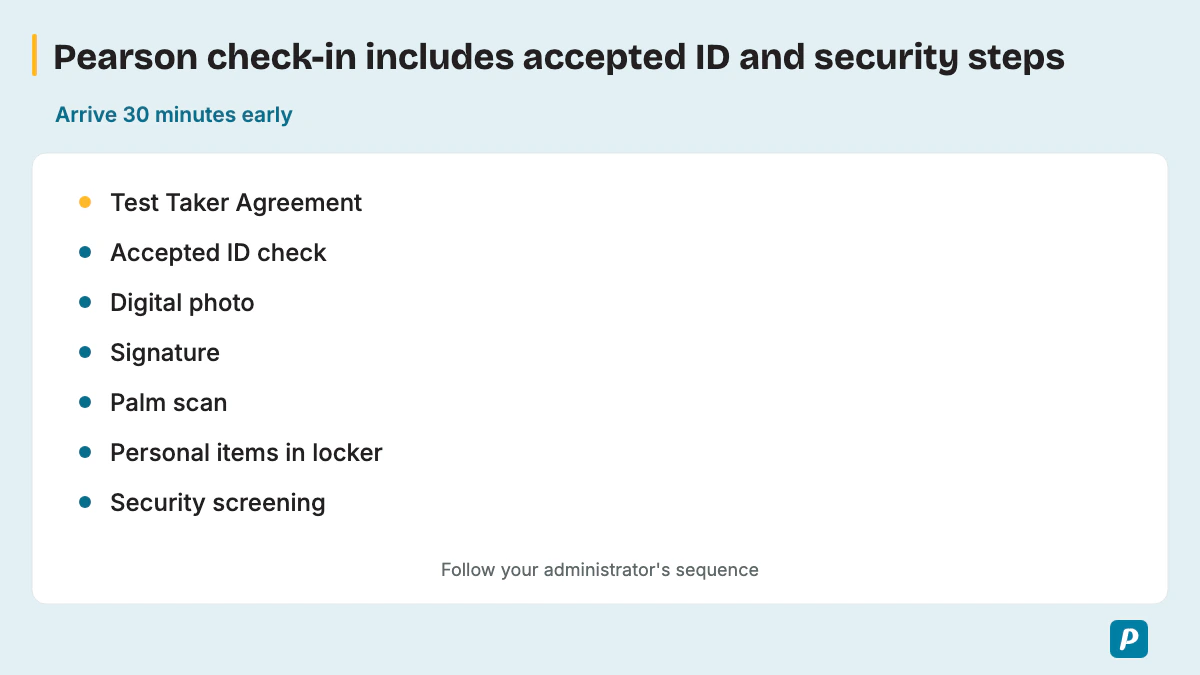
After you sign in and agree to the Test Taker Agreement, the Test Administrator checks your ID, takes a digital photograph, your signature and a palm vein scan, and runs security checks. Your belongings go to a locker first, and the full check-in runs in this order.
- You sign in at the test center reception at least 30 minutes before your test.
- You read and agree to the Test Taker Agreement.
- The Test Administrator checks that your ID matches your booking details.
- The administrator takes a digital photograph.
- You give your signature.
- A palm vein scan records your biometric identity.
- All personal items go into a locker, with phones and devices switched off.
- Security checks follow: you empty your pockets, roll up your sleeves, and may get a handheld wand check.
Your electronic signature on the Test Taker Agreement counts as legal acceptance of Pearson's rules, so read it rather than clicking through. If your ID doesn't match the booking at step 3, the process stops: no test, and the fee is lost.
Open the exact institution, course or professional regulator’s current requirements page. Confirm the accepted test version, overall and per-skill minimums, test-age window and verification method before booking. A provider’s recognition total or a concordance does not establish your own admission or registration requirements.
What Happens Inside the PTE Testing Room?
You sit in a partitioned booth with a computer, keyboard, audio headset and chair, plus note materials the center supplies, and you are monitored throughout, with video and audio recording running for the whole test. Pearson requires you to stay in your seat. Around 10-15 people test in the same room, so speaking nearby is audible, but it doesn't reach your microphone. Pearson's handbook recommends keeping the headset on for the entire test.
Pearson names the note materials in more than one way. Its on-test-day page says notepad and pencil, the PTE Academic format pages say erasable noteboard booklet, and the PTE Academic Test Taker Handbook says an erasable whiteboard and two pens. Whatever the name, you can't bring your own, you can't write on it before the test begins, and it never leaves the room; raise your hand when it's full and you'll get a new one.
Pearson's handbook states that there are no scheduled breaks. You can ask the Test Administrator for an unscheduled break, but the test clock doesn't stop, and during it you can't open your locker, speak to other test takers or leave the building.
Use Pearson’s current booking guide and check the available appointments in myPTE. Confirm test product, accepted ID, appointment details and payment status. For account corrections or accommodations, contact Pearson before paying rather than rely on an unverified deadline.
The test opens with an unscored Personal Introduction, with 25 seconds to prepare, 30 seconds to record and one attempt. It's the first time you speak into the microphone, so use it to settle your volume and pace before the scored items begin.
What Are the Dos During the PTE Examination?
The dos during the test come down to staying seated, running the microphone check, speaking after the tone at a normal volume without long pauses, and raising your hand the moment equipment fails.
- Stay in your seat for the whole test, as Pearson's rules require.
- Run the microphone check when the test offers it, and adjust the headset until it sits comfortably.
- Keep the headset on between tasks so you never miss the start of an audio clip.
- Start speaking after the short tone, because speech before the microphone opens isn't recorded.
- Finish before the progress bar ends in Read Aloud, Describe Image, Retell Lecture, Summarize Group Discussion and Respond to a Situation.
- Speak at a normal volume and a steady pace, the way you would across a small table.
- Keep talking without stopping for three seconds, and finish each sentence instead of restarting it.
- Cut fillers such as "um" and "you know", because Pearson's tips for Retell Lecture and Respond to a Situation say repeating, self-correcting or hesitating wastes speaking time.
- Use standard English rather than slang, and match formal or informal register to the situation in Respond to a Situation.
- Organize Describe Image answers as main idea, then details, then a conclusion, as Pearson's Describe Image tip advises.
- Use the note booklet for Describe Image, Retell Lecture and Listening, but skip it in Repeat Sentence, where Pearson advises against notes.
- Raise your hand for a faulty headset, microphone or keyboard, a full note booklet, or a logistics question.
- Watch the on-screen timer, because the clock keeps running in every part.
Pearson states the three-second recording rule in Answer Short Question and also names Read Aloud, Repeat Sentence, Describe Image and Retell Lecture. Follow the on-screen timing for every task; do not assume the same cutoff for the two newer speaking types. Report a fault to the Test Administrator instead of working around it, because an unreported problem can't be fixed.
What Are the Don'ts During the PTE Examination?
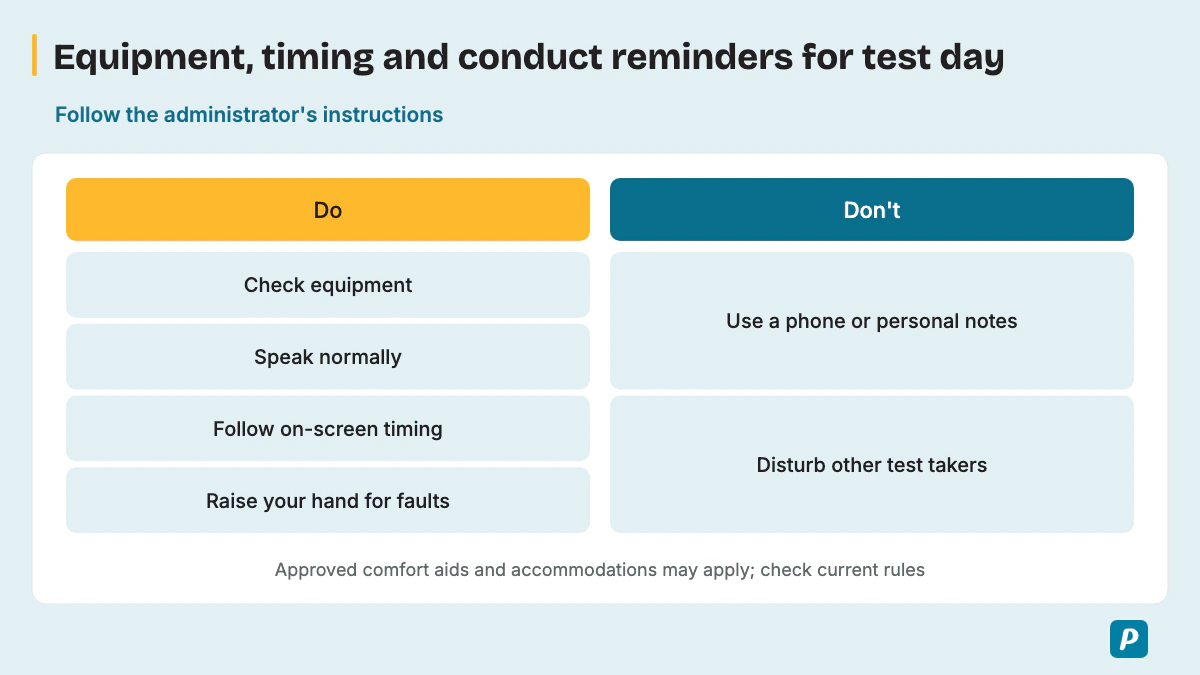
The don'ts are no phones, devices, watches, wallets, hats, coats, books or notes in the room, no food, drink or gum, no talking, no leaving early, and no locker access before the end. Pearson's test center rules and handbook set these prohibited items and behaviors.
- Don't bring a phone or any other electronic device into the room.
- Don't wear watches: the test center rules page names digital watches, and the handbook lists watches with no qualifier, so lock any watch away.
- Before booking, confirm this requirement with the official test provider or receiving authority. On test day, follow your administrator’s instructions and any approved arrangements.
- Don't carry a wallet or purse, a hat or a coat into the booth.
- Don't keep keys or anything else in your pockets, since security checks require them empty.
- Don't bring books or notes of your own.
- Don't eat, drink, chew gum or smoke.
- Don't chat with or disturb other test takers.
- Don't write on the note booklet before the test begins.
- Don't take the note booklet or pens out of the room.
- Don't ask the Test Administrator about test content, because they can't answer it.
- Don't leave before the test finishes, or you lose the fee and get no scores.
- Don't go to your locker mid-test, since Pearson allows no locker access until the test is over.
The consequences are serious. Malpractice or abusive behavior leads to a ban from future tests and possible legal action, and rule-breakers can have their scores revoked.
Some comfort aids are allowed once the administrator checks them. Pearson's list covers tissues, unwrapped cough drops, a pillow for neck or back support, a sweater, sweatshirt or blazer with empty pockets, eyeglasses and hearing aids, neck braces or collars, and an insulin pump. You must bring your own comfort aids, and medication stays in the locker until you tell the administrator about it before the test starts.
What Comes Next After Finishing the PTE Exam?
After the test you raise your hand, get escorted out, pass an electronic ID check, receive a completion email, and collect your belongings, and results usually follow within two business days. Pearson's handbook sets out the exit in this order.
- Raise your hand when the last item is done.
- The Test Administrator comes to your workstation and confirms the test ended properly.
- You're escorted out, leaving the note booklet and pens behind.
- Your ID is checked electronically, and you get a completion email confirming you finished the test.
- You collect your belongings from the locker and leave the test center.
Pearson's handbook says it aims to provide results within five business days and that they're typically available in two days. An email tells you when they're ready, and you view them in myPTE. Scores can still be revoked if a rule was broken during the test, so the rules hold right up to the exit.
When Will You Get Your PTE Results?
Most PTE Academic test takers get PTE results within two business days, sometimes up to five, according to Pearson's PTE Academic FAQ. Pearson emails you when the Score Report is ready in myPTE, and its PTE Core and PTE Academic UKVI pages give the same two-to-five-day timing. Our guide on when PTE results come out covers delays and how to read the report.
What Is the PTE Exam Day Checklist?
The test day checklist comes down to a valid ID that matches your booking, usually a valid passport, an arrival time 30 minutes early, only checked comfort aids, and a plan for the speaking rules. The table pairs each do with the matching don't.
Use Pearson's test- and country-specific ID policy before booking. Bring the accepted document selected for your appointment, with personal details matching the booking. Check the policy’s alternative-document and UK SELT eVisa exceptions rather than assuming every candidate must use the same document.
What Should You Carry on PTE Exam Day?
Use Pearson's test- and country-specific ID policy before booking. Bring the accepted document selected for your appointment, with personal details matching the booking. Check the policy’s alternative-document and UK SELT eVisa exceptions rather than assuming every candidate must use the same document.
What Is the 3-Second Rule in PTE?
In Answer Short Question the recording stops if you wait more than three seconds to start, and a three-second silence while you speak also stops it. Pearson applies the same 3-second rule to Read Aloud, Repeat Sentence, Describe Image and Retell Lecture, so those tasks also require you to keep talking. Our guide to the 3-second rule in PTE speaking shows how to train for it.
What Are the New Rules for PTE?
Pearson's newest change targets the test itself: PTE Academic now includes Respond to a Situation and Summarize Group Discussion in its Speaking and Writing part, added in August 2025.
Australia's Department of Home Affairs treats tests taken on or after 7 August 2025 as the updated PTE Academic, while the new rules for test day itself sit in Pearson's test center rules and July 2025 handbook. Our PTE exam format guide lists every question type in the current test format.
How Do You Calm PTE Exam Day Nerves?
Settle exam nerves with a fixed routine: arrive early, use the equipment check and Personal Introduction to find your volume, and repeat one practiced breathing technique between tasks. Voices from nearby booths are part of every sitting, and they don't reach your microphone. Our guide to managing PTE exam anxiety covers the weeks before the test as well.
How Do You Prepare for the PTE Exam at Home?
Rehearse the test-day conditions at home: a headset, a QWERTY keyboard, timed sections with no break, and no pauses longer than three seconds when you speak. A full timed mock test is the closest home practice for the two-hour sitting, and you can create a free account to sit one with section scores. Our guide on how to prepare for the PTE exam sets out a full plan.
How should I use this Exam Day guide?
Use the task guidance and authored practice examples, then check Pearson’s current instructions for your exact test. Confirm any application, fee, age or ID requirement directly with its owner before booking. Practice estimates are not official scores.
Practice PTE Online on PTE Practice
Try Speaking, Writing, Reading and Listening tasks in a timed, computer-based format.
Try speaking practice without signing up. A free account is required for full mock tests. Practice scores are estimates, not official Pearson scores.
Written by
PTE Practice Team
The team behind PTE Practice's PTE practice and mock tests
We build the PTE practice tasks, mock tests and scoring on PTE Practice, and we oversee every guide on this site. We use official test and government guidance where available, identify authored practice examples and review consequential claims before publication. PTE Practice is not affiliated with Pearson.
Editorial review completed .