PTE Headphones: Importance, Selection and User Guide
Understanding PTE
You won't bring or choose headphones for PTE. Every current PTE test, including PTE Academic, runs at a Pearson test center, and the center hands you a PTE headset with a boom microphone. That headset plays every audio prompt and records every spoken answer, and Pearson assesses only what reaches its microphone.
Use the current Pearson scoring guidance and the exact test’s task instructions. Follow the on-screen timing and use your own relevant answer. Practice examples on this page are authored exercises, not actual exam items or guarantees of a score.
Table of Contents
Which Headphones Are Used in PTE?
PTE uses the audio headset with a microphone that the center supplies in each test center booth, so you don't pick or pack headphones for test day. Pearson lists the audio headset as standard booth equipment, next to the computer and keyboard. Pearson names no headset model or brand on its test-day or test-tip pages, so any headset model quoted in videos or social posts is unconfirmed.
Phones and other electronic devices aren't allowed in the test room, which is also why a personal headset can't come in with you.
Why Is a Good Headset Important in a PTE Test?
Pearson assesses you only on the responses that go into your headset microphone. A headset that sits right and blocks background noise protects your Speaking answers and helps you catch Listening prompts that play once. Three of these reasons come straight from Pearson's guidance, and the fourth is simple preparation.
- It captures your words: Pearson scores only the Speaking answers your headset microphone records.
- It shuts out the room: other test takers speak at the same time, and closed ear cups lower their voices.
- It stays on for the whole test: Pearson tells you to keep the headset on from start to finish.
- It keeps the setup familiar: practicing on a similar headset means nothing about test day feels new.
Pearson also says its microphones won't pick up neighbors' speech, so you don't need to talk over the person in the next booth.
What PTE Academic Test Equipment Do You Get at the Test Center?
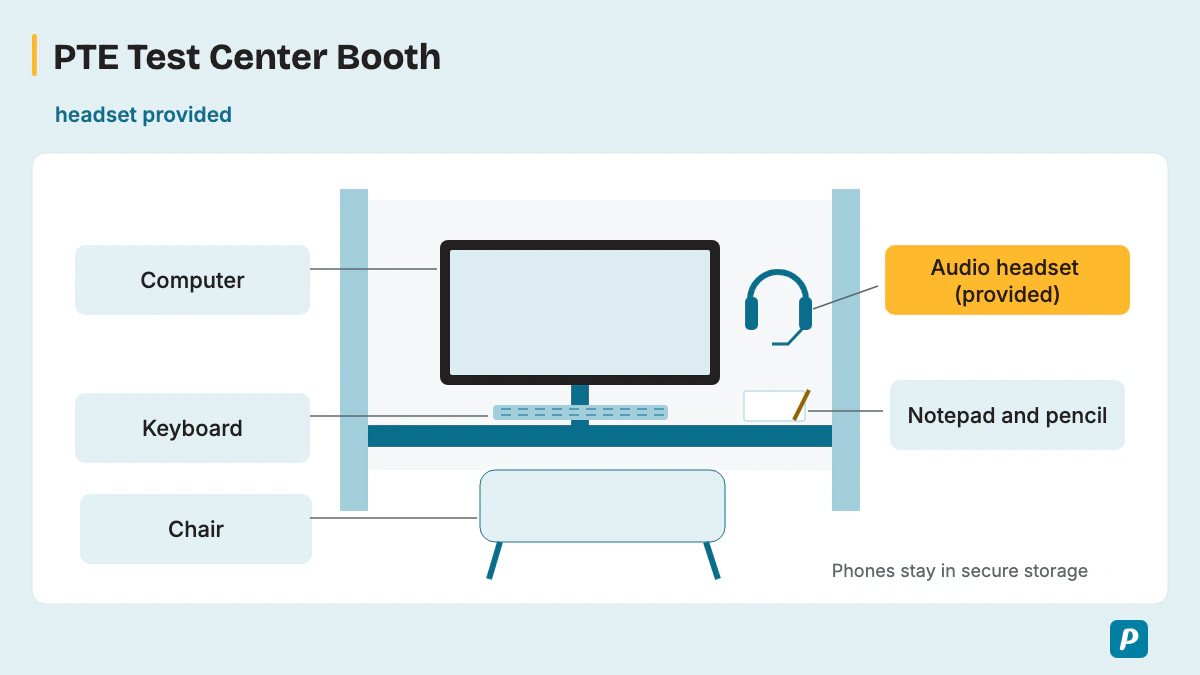
Each partitioned booth holds a computer, a keyboard, an audio headset, a chair, and a notepad and pencil. Before the test starts, you run an equipment check to confirm your headphones and microphone work. The table pairs each booth item with its job and the Pearson detail attached to it.
| Item | What it is for | Pearson rule |
|---|---|---|
| Computer | Shows every item and records your answers. | It sits in your own partitioned booth. |
| Keyboard | Types your written answers. | It uses a QWERTY layout. |
| Audio headset | Plays audio and records your speech. | You keep it on throughout the test. |
| Notepad and pencil | Holds notes while you listen or read. | The center supplies both in the booth. |
| Equipment check | Confirms the headphones and microphone work. | You run it before the test starts. |
Use the equipment check to identify faults before starting, and raise your hand immediately if a fault occurs later. Say a full sentence, play it back, and listen. If the mic doesn't pick up your voice, the sound is crackly, or one ear cup is silent, raise your hand and tell the invigilator before you start. Pearson's test-day guide says to raise your hand whenever you need assistance, so report a problem as soon as you notice it and follow the administrator's instructions.
Background noise, including other test takers, is normal in the room. Hearing aids are a permitted comfort aid once the Test Administrator checks them, and the hearing-aid question below has the detail.
How Do You Set the Mic in the PTE Exam?
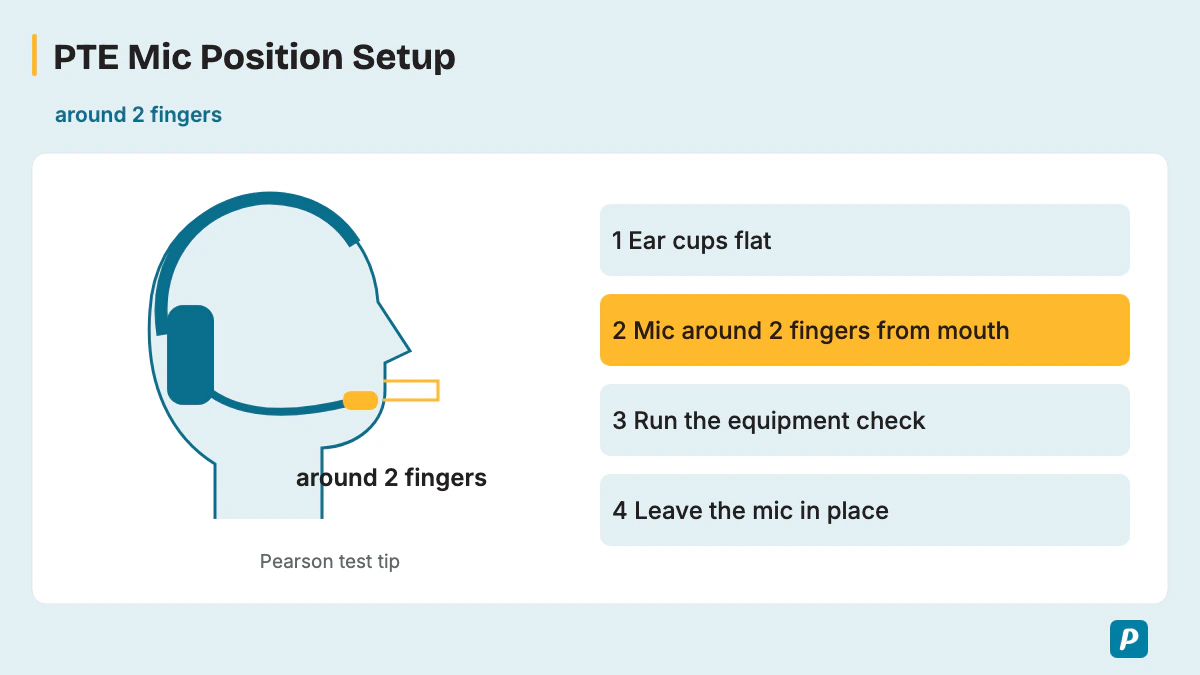
Set the microphone position at around 2 fingers' distance from your mouth, keep it there for the whole test, and confirm it in the equipment check before the first item. Four steps get the boom microphone ready.
- Put the headset on so both ear cups sit flat and even over your ears.
- Bring the boom microphone to around 2 fingers from your mouth, just off the line of your breath.
- Run the equipment check, record a sentence, and listen to the playback.
- Leave the microphone in place and stop adjusting it once the test starts.
The 2-finger distance is Pearson's rule; the angle is technique. Breath that hits the mic head-on makes P and B sounds pop, S sounds hiss, and your voice sound airy. Keep the mic at the same distance but slightly to one side of your mouth, or level with or just below your lower lip, so the air stream passes it.
Some prep sites still quote 2-3 fingers, 3-4 cm or 1-1.5 inches; Pearson's current page says around 2 fingers. Ignore advice to raise the mic above your nose, because that moves it well past Pearson's distance.
What Are the Right Speaking Levels for the PTE Microphone?
Your speaking level should be clear speech at a regular pace with natural pauses, without shouting or whispering. Pearson adds that there's no need to speak slowly or loudly.
Volume matters because the microphone only has what you give it. A voice that's too soft can lose the first and last sounds of words, and a voice that's too loud can clip, which cuts off or flattens parts of the recording. The people around you aren't assessed, so their noise isn't a reason to raise your voice.
Aim for the volume you'd use across a small table. Pronunciation and oral fluency each have their own guide, and the oral-fluency question below links to it.
Which Is Better for PTE Practice, Bluetooth or Wired Headphones?
A wired headset with a boom microphone is the closer match to the test-center setup, so it's the better choice for practice; the test itself uses the center's own headset. The two types differ on five points.
| Feature | Wired headset | Bluetooth headphones |
|---|---|---|
| Connection | Plugs in by a 3.5 mm jack or as a USB headset. | Pairs wirelessly and can drop the connection. |
| Microphone position | A boom arm holds the mic near your mouth. | The mic often sits in the ear cup, farther away. |
| Audio delay | Sound arrives with no wireless lag. | Wireless audio can add a short audio delay. |
| Battery | Needs no battery. | Can run flat during a two-hour mock test. |
| Closeness to the test-center headset | Same type: wired, overhead band, boom mic. | Different type, so practice feels different. |
Use the current Pearson scoring guidance and the exact test’s task instructions. Follow the on-screen timing and use your own relevant answer. Practice examples on this page are authored exercises, not actual exam items or guarantees of a score.
Open the exact institution, course or professional regulator’s current requirements page. Confirm the accepted test version, overall and per-skill minimums, test-age window and verification method before booking. A provider’s recognition total or a concordance does not establish your own admission or registration requirements.
How Do You Choose a Good Headset for PTE Practice?
The right practice headset is a wired, over-ear headset with an adjustable boom microphone that sits where the test-center microphone sits. Pearson's own spec for its former online test makes a clean shopping target: wired by USB or 3.5 mm jack, an overhead band, a separate adjustable boom mic, and no Bluetooth or in-line-mic earbuds.
Phone earphones with an in-line mic are a poor substitute, because the mic hangs on the cable well away from your mouth. Check these five features before you buy.
- A stable wired connection, checked with a short recording before practice.
- An over-ear headset whose cups give real noise blocking against room sound.
- An adjustable boom microphone you can fix at around 2 fingers from your mouth.
- A noise-cancelling, sensitive mic that picks up a normal voice without hiss.
- Comfort through two hours of wear, the length Pearson gives for PTE Academic.
Test comfort by wearing the practice headset through a full two-hour mock test on a few different days. Pearson endorses no practice headset, so headset price and brand matter less than the spec: try a short recording and a longer practice session before deciding whether a headset suits you.
What Are Common Mistakes When Using Headphones and Microphones in PTE?
Seven habits cost marks: wrong volume, rushing, mid-phrase pauses, a mic too close, handling it, taking the headset off, and speaking too early. Six of them go against Pearson's own guidance, and the seventh, handling the mic, simply adds noise to the recording.
- Speaking too softly or too loudly: Pearson asks for clear speech, not a whisper or a shout.
- Rushing or long pauses: keep a regular pace with natural pauses between ideas.
- Pausing mid-phrase: pause only at the end of a sentence or at a comma.
- Microphone too close: keep it around 2 fingers from your mouth, off the breath line.
- Microphone handling during an answer: touching it adds scratching noise, so leave it alone.
- Taking the headset off: Pearson says to keep your headset on throughout the test.
- Speaking before the microphone opens: Pearson says that speech isn't recorded, so start after the tone.
Do every adjustment during the equipment check, then keep your hands in your lap through the Speaking items.
How Do You Practice With a Headset Before PTE Test Day?
The routine is simple: answer every Speaking and Listening item on a wired headset, record yourself, and run a playback check before test day. Self-recording is the core drill: record a Read Aloud, listen back, fix the mic or the volume, and record again. Run your PTE practice in a quiet room first, then with some background noise, because the test room isn't silent.
Keep the headset on through a full mock test at least once so two hours of headset practice feels normal by test day.
How Do You Test Your Headset at Home?
Record a short answer with the microphone around 2 fingers from your mouth, then use playback to listen for pops, hiss, breath noise or a voice that's too quiet. Read these eight sentences as your microphone check, because each one targets a sound that a badly placed mic distorts.
- "Peter packed a paper plate for the picnic." (P pops)
- "Bob bought a big blue bag at the bus stop." (B pops)
- "Sixty students sat silently in the science class." (S hiss)
- "She sells fresh fish at the seaside shop." (S and SH hiss)
- "The guests asked for desks near the west exit." (soft word endings)
- "Thirty thin threads were tied together." (quiet TH sounds)
- "Paul's puppy played in the park past the pond." (P pops at speed)
- "The tests ended, and the students left fast." (final T and D sounds)
If a P or B pops, move the mic slightly to the side; if endings vanish, speak up a little. Repeat this headset test whenever you change the headset or the room. Our PTE speaking tips cover what else to listen for in your recordings.
Do Quality Headphones Improve Your PTE Listening Score?
Headphones don't raise a score by themselves. Practicing on a headset like the test-center one gives you a familiar setup, so the audio on test day sounds the way you expect. Each audio prompt plays once, so hearing it cleanly matters more than volume for your Listening score. Our PTE listening tips show how to use that single play well.
What Headset Do You Need for PTE Home?
Check the exact application route with the receiving authority before booking: IRCC Express Entry, Canadian PGWP requirements, Australian competent-English guidance or UK SELT guidance. Confirm accepted test version, delivery, test date and per-skill requirement. English-language evidence alone does not establish visa or immigration eligibility.
Can You Use Hearing Aids in the PTE Test?
Yes, Pearson lists hearing aids as a permitted comfort aid, provided the Test Administrator checks them, and you bring your own. The other test-room rules are on our PTE exam day rules page.
How Do Speaking Levels Affect Oral Fluency?
A steady, normal voice protects oral fluency because it keeps an even pace, while dropping to a whisper on hard words invites hesitations. Smooth, even speech scores better, so hold one volume from the first word to the last and pause only where punctuation would. Our guide to oral fluency in PTE explains how that skill is judged.
How should I use this Headphones guide?
Use the task guidance and authored practice examples, then check Pearson’s current instructions for your exact test. Confirm any application, fee, age or ID requirement directly with its owner before booking. Practice estimates are not official scores.
Practice PTE Online on PTE Practice
Try Speaking, Writing, Reading and Listening tasks in a timed, computer-based format.
Try speaking practice without signing up. A free account is required for full mock tests. Practice scores are estimates, not official Pearson scores.
Written by
PTE Practice Team
The team behind PTE Practice's PTE practice and mock tests
We build the PTE practice tasks, mock tests and scoring on PTE Practice, and we oversee every guide on this site. We use official test and government guidance where available, identify authored practice examples and review consequential claims before publication. PTE Practice is not affiliated with Pearson.
Editorial review completed .