
8 Best Tips and Strategies for PTE Speaking to Achieve a Good Score
PTE Speaking
Your test date is close and your PTE Speaking score has to move fast. The quickest gains come from the habits Pearson scores in almost every task: Content, Pronunciation and Oral Fluency. Fix those three first, then add one habit per task on top.
Table of Contents
How Can You Improve Your PTE Speaking Score Quickly?
The fastest route is working on the shared traits Pearson scores in nearly every task, Pronunciation and Oral Fluency, alongside Content. Speak at a steady pace, keep going past mistakes, start as soon as the microphone opens, and practice with recordings you replay.
That's quicker than drilling one task at a time, because the same traits repeat across Read Aloud, Repeat Sentence, Describe Image, Retell Lecture, Summarize Group Discussion and Respond to a Situation. Quick improvement still takes practice, since no shortcut or template guarantees a speaking score.
How Is PTE Speaking Scored?
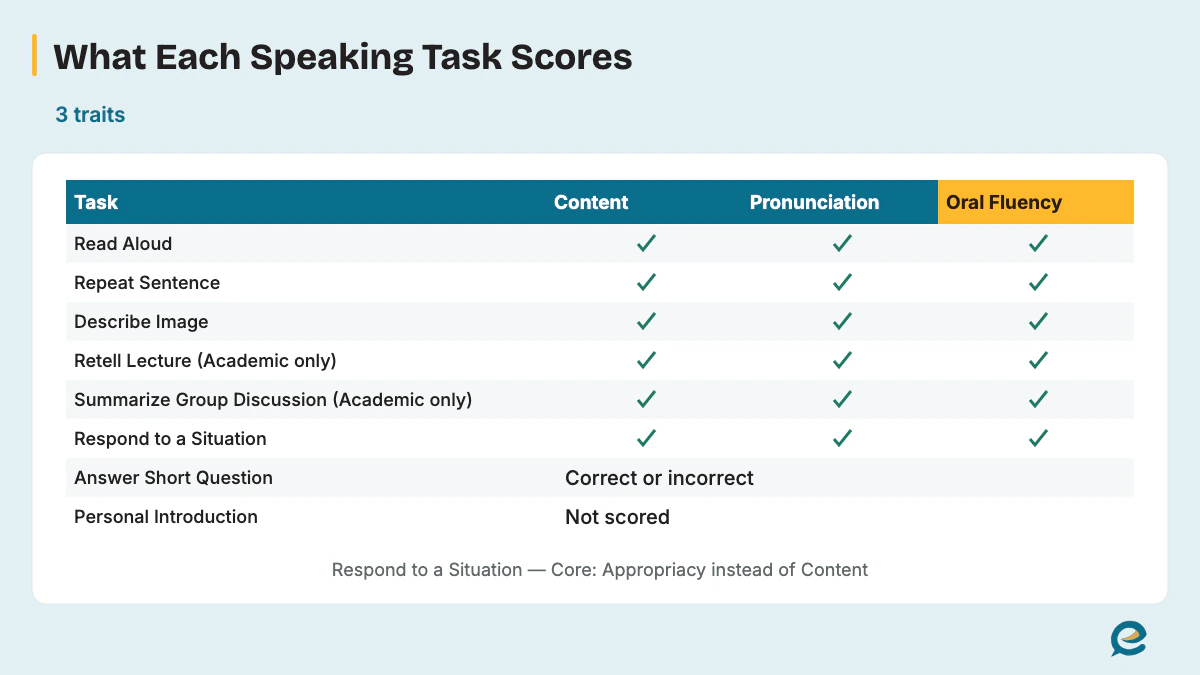
Pearson scores most speaking tasks on Content, Pronunciation and Oral Fluency. Answer Short Question is scored correct or incorrect, PTE Core's Respond to a Situation uses Appropriacy instead of Content, and Personal Introduction isn't scored. The three main traits break down like this.
| Trait | What Pearson looks for | What lowers it |
|---|---|---|
| Content | The task's target: correct words, word sequences or the right ideas in your own words. | Replaced, missing or added words, or unoriginal answers. |
| Pronunciation | Speech most regular speakers understand easily. | Unclear vowels, consonants or word stress. |
| Oral Fluency | A constant, natural rate with appropriate phrasing. | Hesitations, repetitions and false starts. |
Pearson recognizes regional and national varieties of English that most regular speakers understand, and it scores only what you say, so a regional accent isn't a penalty. Scores are reported on the 10-90 scale.
1. Understand the PTE Speaking Format First
Before you practice, check which tasks your test actually has. PTE Academic Part 1 holds seven scored speaking tasks plus an unscored Personal Introduction. PTE Core has five scored speaking tasks and no Retell Lecture or Summarize Group Discussion, so check the speaking format and task list for your test before you plan.
Summarize Group Discussion and Respond to a Situation joined PTE Academic for tests taken after 7 August 2025, so older tip lists that stop at Answer Short Question are out of date.
2. Improve Oral Fluency With a Steady Pace
Aim for a constant, natural rate with pauses at phrase boundaries, which is what Pearson's Oral Fluency trait rewards. Fast speech with sudden stops scores worse than a steady pace, because each stop reads as hesitation. Breathing at commas and full stops keeps the rhythm even.
Drill: read a short paragraph aloud while marking where you breathe, then record it twice at the same pace.
3. Focus on Clear Speaking, Not a Native Accent
Pearson scores pronunciation on whether most regular speakers can understand you, and it recognizes regional varieties of English, so clear speech matters and a borrowed accent doesn't. Clear word endings, correct word stress and full short words do more than any accent change. Pearson's Read Aloud wording asks for vowels and consonants "in a native-like way", while other blocks say "fluent-like". Keep a steady, normal volume, neither whispering nor shouting, and the same microphone distance, so the recording catches every word.
Drill: record ten words you often mispronounce, then check the stress against a dictionary's audio.
4. Keep Speaking Through Mistakes Instead of Self-Correcting
When you slip, keep talking. Pearson's tip for Retell Lecture and Summarize Group Discussion is to "keep talking and ignore any mistakes that you make", and in Read Aloud a self-correction "will be counted as added words". Repeating or correcting costs Oral Fluency and uses up time you need for content. Restarts also break the rhythm the trait measures.
Drill: record a one-minute answer and ban yourself from restarting any sentence.
5. Cut Fillers and False Starts From Your Speaking
"Um", "uh" and restarted sentences are the hesitations, repetitions and false starts Pearson says negatively affect your score. Some prep sites still advise using fillers, but Pearson's Oral Fluency wording counts them against you. When you need a second to think, use a short planned linking phrase such as "another point is" instead. Use a linking phrase only when it connects relevant ideas; it does not guarantee that recording continues.
6. Start Speaking When the Microphone Opens
Begin when Recording appears, after the tone on tasks that have one. Pearson's system doesn't record speech before the microphone opens, and in Answer Short Question waiting more than three seconds stops the recording. Pearson writes that rule in the Answer Short Question block and says "This also applies to" Read Aloud, Repeat Sentence, Describe Image and Re-tell Lecture.
It doesn't name Summarize Group Discussion or Respond to a Situation, so some prep sites overstate the rule when they apply it to every task. A planned first sentence lowers the risk of a late start.
7. Record and Listen to Your Own Speaking
Self-recording turns practice into a playback review against the three speaking traits: did you say the right content, could a stranger understand every word, and did you keep a steady rate? Keep a short error log of repeated slips, such as one sound, one stress pattern or one pause habit. Then practice those slips directly instead of whole tasks at random.
Drill: replay yesterday's recording before today's session and fix one logged slip.
8. Train With a PTE Speaking Mock Test
Once single tasks feel steady, take timed sections in a mock test so the order, timers and microphone behavior feel familiar on test day. Pearson notes that around 10-15 people may test together and you may hear neighbors speak, though microphones won't pick up what they say. Practice with some background noise so test-day noise doesn't throw you. Pearson sells official Scored Practice Tests marked by its own scoring engine; practice scores from any other app, ours included, are estimates and not official Pearson scores.
What Are the Task-Specific Tips for PTE Speaking?
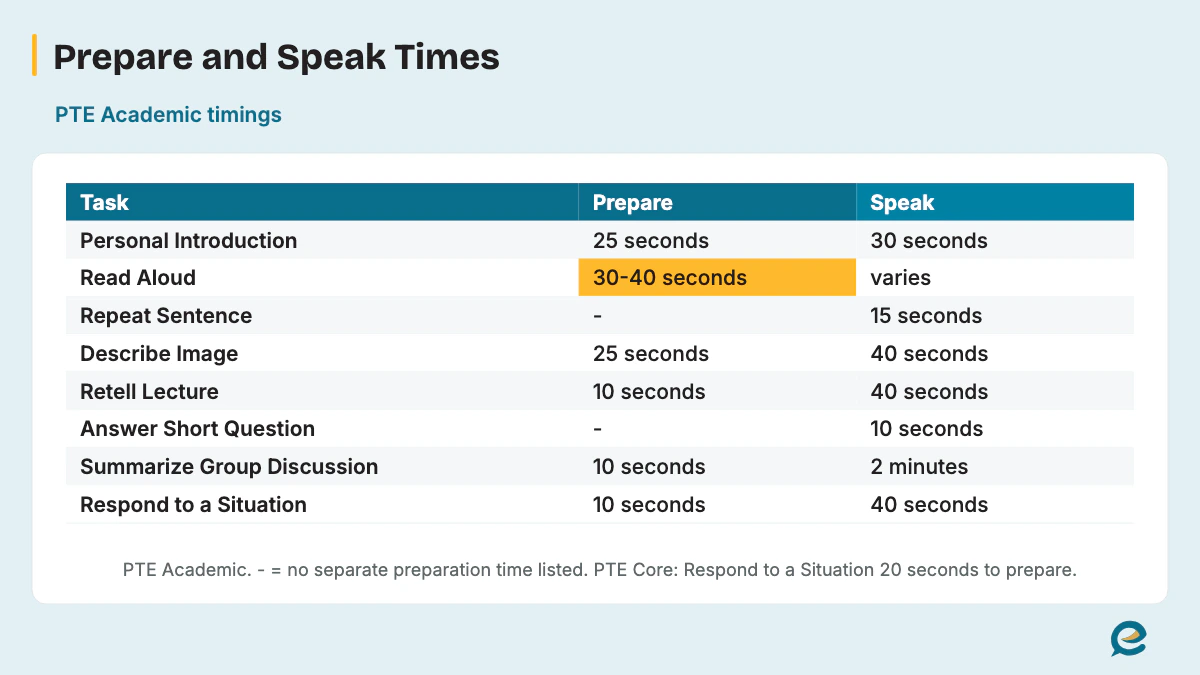
These task-specific tips give one habit per task, the one that matters most, plus a link to the task page with the full method. Retell Lecture and Summarize Group Discussion are PTE Academic only, and the figure shows Pearson's PTE Academic prepare and speak times.
What Are the Best Tips for Personal Introduction?
Personal Introduction gives you 25 seconds to prepare and 30 seconds to speak, and it does not count toward your score, so use it as a calm warm-up and a microphone check. The unscored task still records your voice, so speak at test volume. See PTE Personal Introduction.
What Are the Best Tips for Read Aloud?
Read Aloud gives you 30-40 seconds to look at the text before the microphone opens. Use them to find the punctuation pauses and the hard words, because replaced, missing or added words lower Content. If a word is unfamiliar, say your best guess once and keep reading, because Pearson counts a correction as added words.
Pearson also suggests letting your intonation go up a little as a chunk begins and fall a little as it ends. Some prep sites say 30-35 seconds; Pearson's page says 30-40. More on PTE Read Aloud.
How Do You Improve Repeat Sentence?
In Repeat Sentence, listen to the phrasing and copy the stress and intonation, then say the words in the same order; Content counts correct word sequences. Pearson's tip is to leave the noteboard alone and hold the sentence in your head by its meaning, anchored on the nouns and verbs.
If you're unsure of a word, say what you think you heard. Pearson sets no percentage rule, so ignore advice to say only the first 60-70%. See PTE Repeat Sentence.
What Are the Best Tips for Describe Image?
In Describe Image, use the 25 seconds to find the main trend or feature, open with a general statement, then give the main features in your own words within 40 seconds. Name the extremes, such as the highest and lowest values or the biggest gap, and link points with connectors like also, however, as or besides, as Pearson suggests.
Pearson warns that memorized responses or templated sentences can lead to a score of 0 for Content, and then fluency and pronunciation aren't scored either. Read PTE Describe Image.
What Are the Best Tips for Retell Lecture?
In Retell Lecture (PTE Academic only), take short notes while the lecture plays and retell the main points and how they connect, in your own words, within 40 seconds. Pearson scores Content on how accurately and thoroughly you convey the situation, characters, aspects, actions and developments in the lecture. Use the 3 seconds Pearson gives you to look at the image before the audio to predict the topic and vocabulary. Its own article suggests note symbols such as -, =, &, + and arrows, so build your shorthand before test day. See PTE Retell Lecture.
What Are the Best Speaking Tips for Answer Short Question?
Answer Short Question has no short tone and is scored correct or incorrect, so give the answer in one or a few words straight away; extra words earn nothing. Catch the question word (who, what, where, how many) before anything else. Build everyday general-knowledge words on science, the body, time and places, since the Score Guides also rate word choice as a Vocabulary trait, so short answers with the right word win. See PTE Answer Short Question.
What Are the Best Tips for Summarize Group Discussion?
In Summarize Group Discussion (PTE Academic only), split your notes by speaker and say who said what, because Pearson says just retelling the discussion without paraphrasing lowers your score. Speaker notes also let you show where the speakers agree or disagree, since Pearson's top Content level rewards exploring the relationships between points of view. Read PTE Summarize Group Discussion.
What Are the Best Speaking Tips for Respond to a Situation?
In Respond to a Situation, pick the right register (formal or informal) for the person in the situation prompt before you speak, and deal with the main concern the prompt names. Rehearse by role-playing everyday situations aloud. PTE Academic gives 10 seconds to prepare and PTE Core gives 20, with 40 seconds to answer in both. PTE Core scores Appropriacy where PTE Academic scores Content. See PTE Respond to a Situation.
How Do You Practice PTE Speaking Every Day?
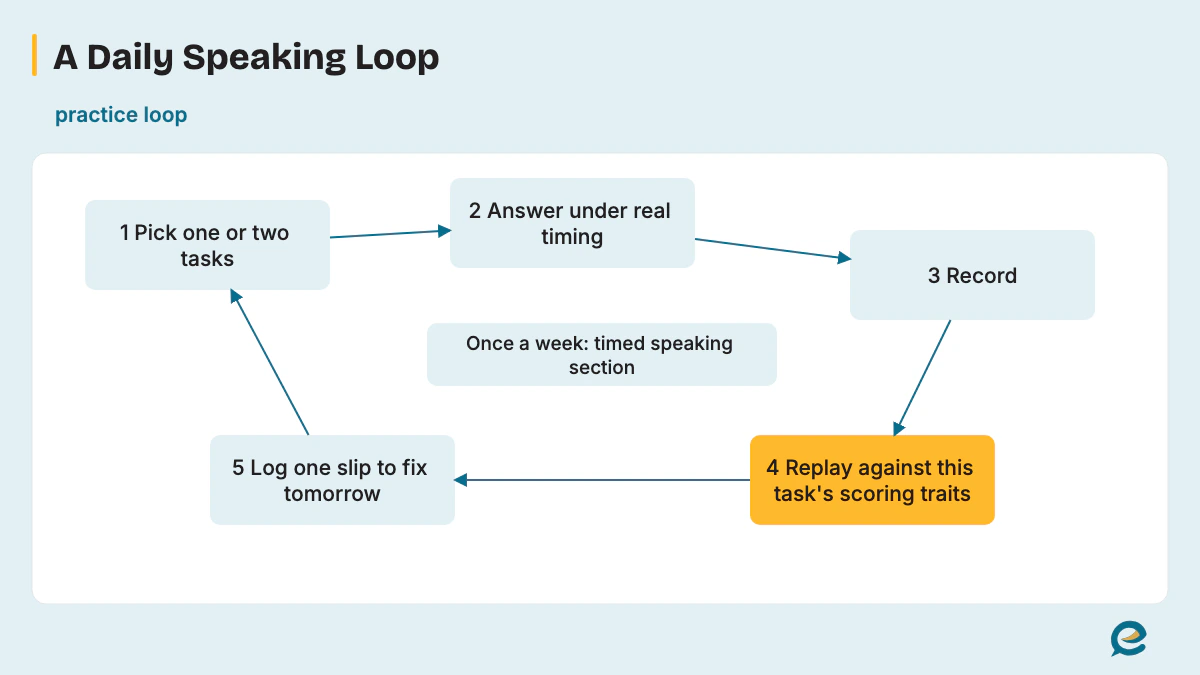
Daily practice works best as short practice sets: one or two tasks under real timing, a recording, a replay against the three traits, and one slip added to your slip log.
Rotate the tasks: Read Aloud and Repeat Sentence one day, Describe Image and Retell Lecture the next, then Answer Short Question and the newer tasks. Add a one-minute recorded talk on an unfamiliar topic to train idea-finding under pressure. Pearson's confidence advice also suggests a language exchange partner and speech-recognition practice apps, and once a week you should take a full weekly section of speaking tasks under timed conditions.
What Does the PTE Speaking Section Include?
The speaking tasks sit in Part 1 (Speaking & Writing) alongside the writing tasks, and the hub page sets out every task, the timings and how they feed your scores. See the PTE speaking section guide.
What Is the 3-Second Rule in PTE?
Pearson's 3-second rule means the recording stops if you wait more than three seconds to start or stop for three seconds mid-answer. Pearson sets it out for Answer Short Question. It then says the rule "also applies" to Read Aloud, Repeat Sentence, Describe Image and Re-tell Lecture. Read the 3-second rule in PTE speaking for Pearson's full wording.
Should You Use a PTE Speaking Template?
No, Pearson gives no credit for an unoriginal response in Describe Image, Retell Lecture and Summarize Group Discussion, and warns that memorized or templated sentences can score 0 for Content. An answer structure (what to say first, next and last) is safe; a fixed template isn't. See Describe Image strategies without templates.
How Do You Improve Oral Fluency in PTE Speaking?
Oral fluency improves when you practice whole phrases at a steady rate and stop restarting sentences, which is exactly what Pearson's Oral Fluency wording describes. The trait measures rhythm, phrasing and stress, so fewer restarts mean fewer hesitations to penalize. More in oral fluency in PTE.
How Do You Improve Pronunciation for PTE Speaking?
Pronunciation improves fastest when you fix the few sounds and word stress patterns that make a word hard to understand, rather than trying to change your accent. Understandable speech is Pearson's test. See PTE pronunciation rules.
How Do You Get 90 in PTE Speaking?
No method guarantees 90, but complete answers delivered clearly and smoothly in every task, with no restarts or missed starts, are what Pearson's Content, Pronunciation and Oral Fluency wording rewards. The same habits apply if your target is 76, and no fixed number of correct items equals a score of 90 in Speaking. Read what a PTE score of 90 takes.
What Are the Common PTE Speaking Challenges?
The main speaking challenges are time management, fluency, pronunciation, Repeat Sentence memory load, nerves and template reliance, and each has a fix tied to a Pearson rule. Freezing at the start and test-day nerves both ease when your first sentence is planned in the preparation time. See PTE speaking challenges for the rest.
Practice PTE Speaking on EasyEnglish
Try Speaking tasks in a timed, computer-based format like the real test.
Try speaking practice without signing up. A free account is required for full mock tests. Practice scores are estimates, not official Pearson scores.
Written by
EasyEnglish Team
The team behind EasyEnglish's PTE practice and mock tests
EasyEnglish provides PTE practice and independent preparation guides. Official test rules are checked against the sources identified in each guide; practice examples are illustrative, not real exam questions. Practice scores are estimates. Questions or corrections: support@inverseai.com. EasyEnglish is not affiliated with or endorsed by Pearson.
Editorial review completed .