
PTE Summarize Spoken Text: Word Limit, Structure and Tips
PTE Listening
You hear a short lecture once, and then you have to write its point in your own words before the timer runs out. That's Summarize Spoken Text, the task that opens PTE Listening. The word limit is the number to learn first: 50-70 words in PTE Academic and 20-30 words in PTE Core. Go below 40 or above 100 words in Academic, or below 5 or above 40 in Core, and the whole summary scores zero.
Pearson's current Score Guides also score Content out of 4 in PTE Academic but out of 2 in PTE Core. Pearson also gives no credit for an unoriginal response, so a memorized template is a risk, while a fixed order of topic sentence, supporting points and conclusion is not.
Table of Contents
What Is Summarize Spoken Text in PTE Listening?
Summarize Spoken Text is the first PTE Listening task, in which you hear a recording once and write a short summary of it. In PTE Academic the recording runs 60-90 seconds and your summary must be 50-70 words. It's task 1 of 8 in Part 3 Listening for PTE Academic and task 1 of 7 in PTE Core Listening. Your listening and writing scores both draw on it.
Pearson assesses your understanding of the lecture, how well you connect its ideas, and how clearly your summary presents the key points.
What Are the Summarize Spoken Text Format and Timing Rules?
The recording plays once, and one timer covers listening and writing: 10 minutes in PTE Academic and 8 minutes in PTE Core. Pearson's Listening pages and its two Score Guides set out the stages for each test like this.
| Stage | PTE Academic | PTE Core |
|---|---|---|
| Recording length | 60-90 seconds. | 45-75 seconds. |
| Plays | Once, starting automatically. | Once, starting automatically. |
| Time to listen and write | 10 minutes. | 8 minutes. |
| On-screen tools | Cut, copy and paste buttons and a word count. | Cut, copy and paste buttons and a word count. |
| Notes | An erasable noteboard booklet. | An erasable whiteboard. |
| Items per test | 1. | 1-2. |
The item counts come from Pearson's Score Guides, not from the task web pages. Some prep pages describe a "50-70 word audio"; 50-70 is the Academic summary length, and the recording itself runs 60-90 seconds. Pearson's Core page carries a note saying the task affects reading and writing, but its own task header lists listening and writing, which matches the Score Guide.
What Is the Summarize Spoken Text Word Limit?
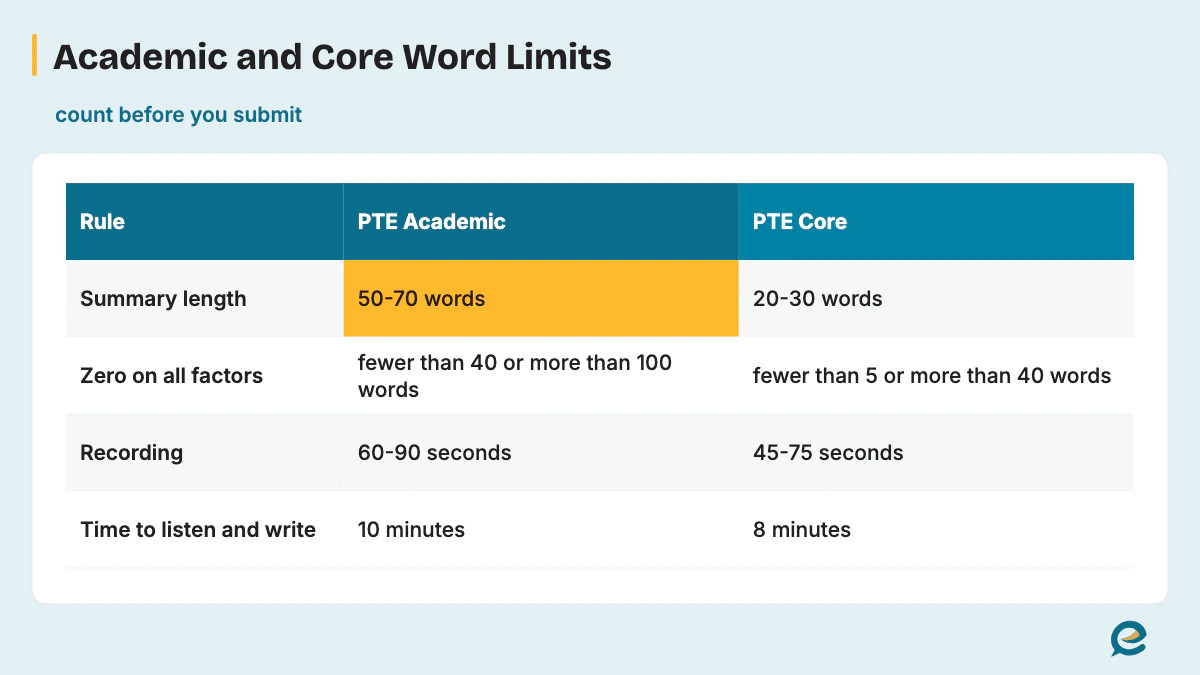
Write 50-70 words in PTE Academic and 20-30 words in PTE Core. The word limit drives the Form score, and each test sets a floor and a ceiling where the whole summary drops to a zero score.
| Form rule | PTE Academic | PTE Core |
|---|---|---|
| Full credit, 2 points | 50-70 words. | 20-30 words. |
| Partial credit, 1 point | 40-49 or 71-100 words. | 5-19 or 31-40 words. |
| Zero on all five factors | Fewer than 40 or more than 100 words. | Fewer than 5 or more than 40 words. |
Length isn't the only way to lose Form. Both Score Guides give 0 for Form when a summary is written in capital letters, has no punctuation, or consists only of bullet points or very short sentences. Pearson also gives zero on all five factors if you misinterpret the topic or purpose of the recording. The Score Guide states the rule plainly: a 0 for Content or Form means no score points for the response.
How Is Summarize Spoken Text Scored?
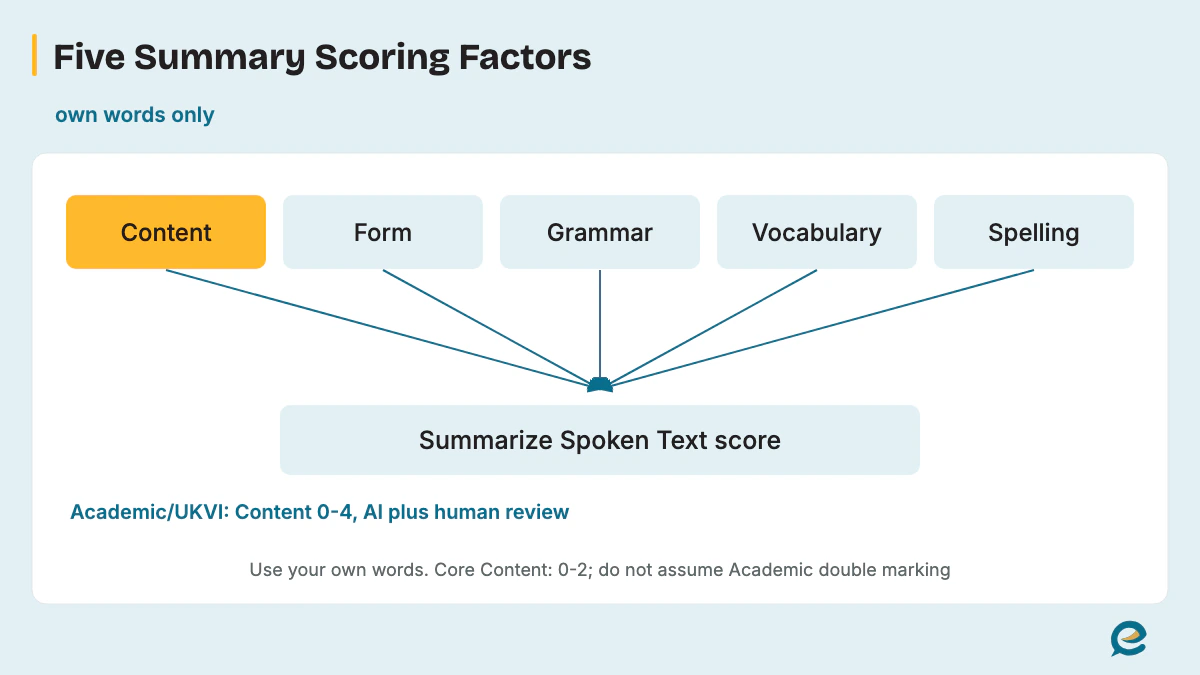
Pearson scores Summarize Spoken Text on five factors: Content, Form, Grammar, Vocabulary and Spelling, with partial credit. The table pairs Pearson's description of each factor with its points from the PTE Academic Score Guide (2025) and the PTE Core Score Guide (2026).
| Factor | What Pearson checks | Academic points | Core points |
|---|---|---|---|
| Content | All key points, without misrepresenting the purpose or topic, with essential supporting points condensed. | 0-4. | 0-2. |
| Form | Word count: full credit inside the limit, reduced outside it. | 0-2. | 0-2. |
| Grammar | Correct basic sentence structure, in concise sentences that communicate the meaning clearly. | 0-2. | 0-2. |
| Vocabulary | Words relevant to the lecture, suited to an academic setting, with effective synonyms. | 0-2. | 0-2. |
| Spelling | One spelling convention used consistently. | 2 if correct, 1 for one error, 0 for more. | 2 for one spelling or typing error, 1 for two or three, 0 for more than three. |
The Academic Content scale rewards synthesis, not recall. A 4 needs a summary that paraphrases well, removes extraneous details, identifies and combines every main idea, and uses varied connectives. A 2 describes a response that can't separate main points from peripheral detail and leans on repeated excerpts from the recording. A 1 is disconnected ideas or excerpts, and a 0 shows no comprehension.
Some prep sites still quote Content out of 2 for PTE Academic; Pearson's current Academic Score Guide scores it 0-4, while Core stays at 0-2.
Two separate rules sit on top of the scale. The five traits are machine-scored. In Academic/UKVI, Content also receives human review before confirmation; the Core guide describes machine scoring and human training of the engine, not the same mandatory double-marking rule. Separately, Pearson gives no credit for no response, an irrelevant response or an unoriginal response.
Does a Summarize Spoken Text Template Work?
A memorized fill-in template is risky, because Pearson gives no credit for an unoriginal response and in Academic/UKVI a human expert reviews Content. A structure that you fill with the speaker's own points in your own words is the safer choice, because it keeps your summary relevant to the particular recording. The next section sets out that repeatable order of sentences.
Stock phrases that could fit any recording add words without adding content, and they use up a tight word limit. The Academic Content scale also places responses that repeat excerpts, instead of reformulating ideas in your own words, at a Content score of 2 out of 4. No structure guarantees a score, so keep the order fixed and make the content new each time.
What Structure Should a Summarize Spoken Text Answer Follow?
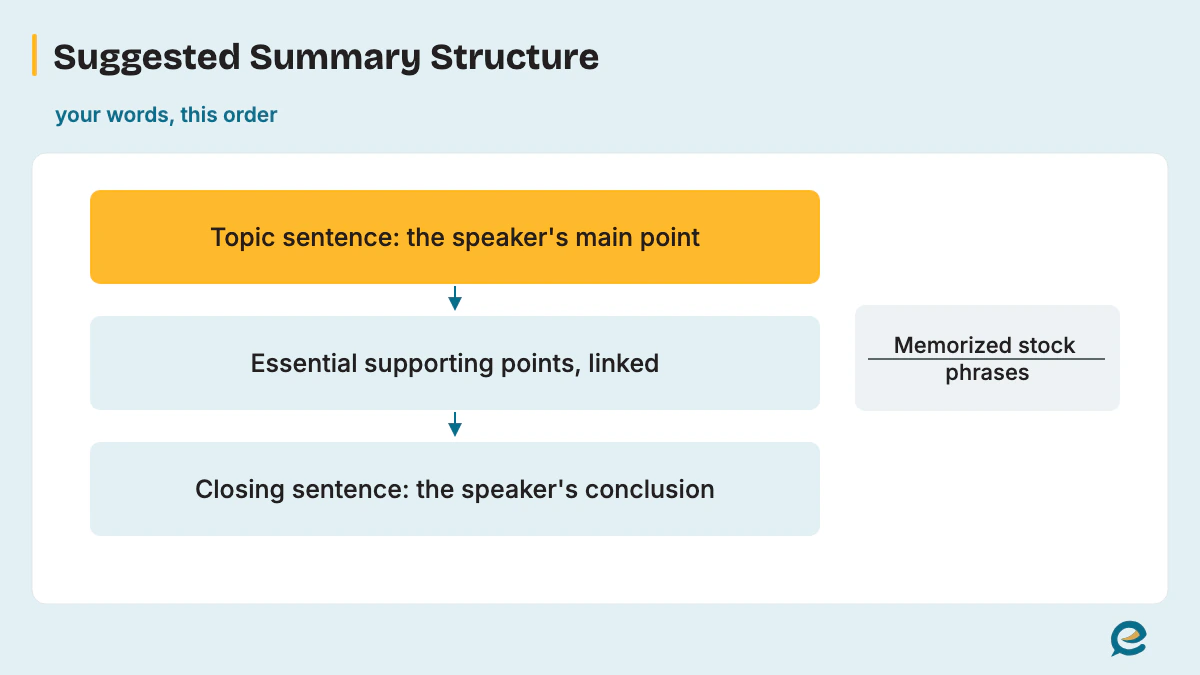
Open with one sentence naming the main point, add two or three supporting points in linked sentences, and close with the speaker's conclusion, all in your own words. This three-part order fits almost any lecture, because a talk builds from a point, through support, to an ending.
- Topic sentence: state the speaker's main point, and skip any opening story or greeting.
- Supporting points: add two or three, joined with linking words such as "because", "however" or "as a result". Keep an example only when the speaker uses it as essential support, and leave out minor numbers, names and asides.
- Closing sentence: give the conclusion or recommendation the speaker draws, without adding your own opinion.
Merge related notes into a single sentence rather than giving each point its own line. For PTE Core, compress the same order into one or two sentences to stay within 20-30 words.
How Do You Summarize Each Type of Spoken Text?
The talk type determines what your topic sentence and supporting points should be, so name the type as you listen. These four types are a practical way to organize notes, not categories Pearson publishes.
| Talk type | What the speaker does | What your summary must include |
|---|---|---|
| Informative lecture | Explains a topic, process or theory. | The main theme and the key explanations. |
| Problem-solution | States a problem, then proposes fixes. | The problem and the main solutions. |
| Opinion or argument | Takes a position and supports it. | The position and its strongest reasons, reported neutrally. |
| Cause and effect | Traces the reasons behind an event and its results. | The main causes linked to the main effects. |
For an opinion talk, report the view with verbs such as "argues" or "claims" rather than agreeing with it. For a cause and effect talk, link each cause to its result with words such as "because" and "as a result". Naming the talk type helps in speaking too, and our Retell Lecture tips show how note-taking with symbols carries the key points into a spoken summary.
What Does a Summarize Spoken Text Sample Answer Look Like?
Making workshop instructions usable
Listen and write a summary in your own words. Choose the Academic or Core practice word limit shown with this item.
Recording voice: UK English.
Original practice recording.
Practice summary lengths: Academic 50–70 words; Core 20–30 words. Models are examples, not exclusive answers.
Transcript
Today I will describe a change to our student workshop. At the first session, each group received a page containing every instruction for the afternoon. Several groups began the final activity before completing the preparation that it depended on. When we asked what had happened, they said they had found the task names easily but missed the order. For the next session, we divided the page into three stages. Each stage begins with a short heading and ends with a box showing what should be ready before moving on. We also kept a complete version for anyone who wanted an overview. In our small rehearsal, participants followed the sequence without asking us to explain it again. That is encouraging, but we have not yet tried the layout with a full workshop. We will observe that session before deciding whether to use the same approach for all our activities. Clear stages seem promising here, but the next test matters.
Answer and explanation
Academic model · 56 words
The speaker describes replacing a crowded workshop instruction sheet with three clearly marked stages after participants missed the intended order. Each stage now states what must be ready before continuing, while a complete overview remains available. A small rehearsal went smoothly, but the organisers will observe a full workshop before adopting the layout for every activity.
Practice length: 50–70 words.
Core model · 23 words
Workshop instructions were divided into clear stages after participants missed their order. A small rehearsal helped, but a full session still needs testing.
Practice length: 20–30 words.
Many summaries are possible; assess supported meaning rather than exact wording.
Notes
- Participants missed the order on the original sheet.
- Three stages now show what must be ready.
- A full overview remains.
- The rehearsal was promising; full-session evaluation is pending.
The model includes the central problem or proposal, the supporting changes and the stated limitation or conclusion. It adds no claims beyond the recording.
Short teaching extract with two summary-length exercises; not a full-duration exam simulation.
How Do You Write Summarize Spoken Text Step by Step?
Note the main idea and supporting points while you listen, write the topic sentence first, add the points, close, then use the last one to two minutes to proofread.
- While listening, keep note-taking on the noteboard to the main idea and the key points.
- When the audio stops, circle the main point in your notes.
- Write the topic sentence first.
- Add two or three supporting points with linking words.
- Write the closing sentence.
- Run a word count check against your test's limit: 50-70 words for Academic or 20-30 for Core.
- Spend the final one to two minutes, as Pearson advises, proofreading subject/verb agreement, tenses, word order, full stops, commas and a capital letter at the start of each sentence.
Pearson's tip is to use grammatical structures you can handle confidently and words you're sure you can spell. Keep the register academic as well: no slang, no contractions and no chatty phrases such as "the guy said" or "lots of stuff".
What Summarize Spoken Text Practice Questions Can You Try With Answers?
Ten original short practice talks follow, each with an Academic-length model of 50–70 words and a Core-length model of 20–30 words. These are teaching extracts, not full-duration exam simulations. Listen first, write your own summary, and then compare its meaning with the model.
These fictional examples practise explaining a situation, linking causes and effects, considering a proposal and describing a response to a problem. The models are examples of supported summaries, not scripts to memorise.
An exhibition feedback routine
Listen and write a summary in your own words. Choose the Academic or Core practice word limit shown with this item.
Recording voice: US English.
Original practice recording.
Practice summary lengths: Academic 50–70 words; Core 20–30 words. Models are examples, not exclusive answers.
Transcript
Our student exhibition collected comments in a notebook near the exit. The notes were interesting, but most referred to displays as the one by the window or the one with the bright paper. Once the exhibition was dismantled, we could no longer confidently connect some comments to the right project. For the next exhibition, each display will have a short code. Visitors can write that code beside a comment, and students will save a photograph showing the code with their work. We do not want to require long forms because many visitors only have time for a quick response. The code should provide enough context without making the task difficult. A volunteer will be nearby to help anyone who cannot find it. Afterwards, we will check how many comments can be matched to projects and ask students whether the feedback helped them decide what to revise.
Answer and explanation
Academic model · 58 words
The speaker explains that exhibition comments were hard to match to projects after displays were removed. Short display codes and photographs will preserve that connection without requiring lengthy visitor forms. A volunteer will help visitors find the codes, and organisers will later assess both the number of usable comments and whether students found the feedback helpful for revision.
Practice length: 50–70 words.
Core model · 24 words
Display codes and photographs will help connect exhibition comments to projects, while a volunteer assists visitors and organisers later assess the usefulness of feedback.
Practice length: 20–30 words.
Many summaries are possible; assess supported meaning rather than exact wording.
Notes
- Old location descriptions became unclear after dismantling.
- Codes and photographs connect comments to projects.
- Keep visitor effort low and provide help.
- Review matchability and usefulness afterwards.
The model includes the central problem or proposal, the supporting changes and the stated limitation or conclusion. It adds no claims beyond the recording.
Short teaching extract with two summary-length exercises; not a full-duration exam simulation.
Moving a meeting online
Listen and write a summary in your own words. Choose the Academic or Core practice word limit shown with this item.
Recording voice: UK English.
Original practice recording.
Practice summary lengths: Academic 50–70 words; Core 20–30 words. Models are examples, not exclusive answers.
Transcript
Our planning group held one meeting online because the usual room was unavailable. We expected the main difficulty to be learning the software. In fact, everyone joined without much trouble. The harder problem was knowing when to speak. Two members repeatedly began at the same time, while another waited so long for a gap that we nearly finished without hearing her suggestion. At the next online meeting, the chair invited each person to give an initial view before opening the discussion. Members could also put a short note in the chat to show that they wanted a turn. That meeting felt more orderly to the group, although it took slightly longer. We have decided to keep the turn-taking routine when meeting online. The experience reminded us that having a working connection is only one part of a useful meeting; participants also need a shared way to enter the conversation.
Answer and explanation
Academic model · 57 words
The planning group found that turn-taking, rather than joining the software, was the main difficulty in its first online meeting. Inviting initial views from everyone and using chat to request turns made the next discussion more orderly, although longer. The group will retain the routine because a working connection alone does not ensure that everyone can contribute.
Practice length: 50–70 words.
Core model · 25 words
The group improved online turn-taking by inviting initial views and using chat requests. Meetings became more orderly but longer, showing that access alone is insufficient.
Practice length: 20–30 words.
Many summaries are possible; assess supported meaning rather than exact wording.
Notes
- Joining worked; turn-taking was the difficulty.
- Everyone received an initial turn.
- Chat notes requested further turns.
- Order improved but meetings took longer.
The model includes the central problem or proposal, the supporting changes and the stated limitation or conclusion. It adds no claims beyond the recording.
Short teaching extract with two summary-length exercises; not a full-duration exam simulation.
Keeping an informal practice club
Listen and write a summary in your own words. Choose the Academic or Core practice word limit shown with this item.
Recording voice: US English.
Original practice recording.
Practice summary lengths: Academic 50–70 words; Core 20–30 words. Models are examples, not exclusive answers.
Transcript
I would like our presentation practice club to remain informal. Members come at different stages of preparation, and some only want to test a short opening. If we required a polished presentation before every visit, those people would lose a useful place to begin. However, informal should not mean that participants have no idea what to expect. I propose that each session follows a simple order: a brief welcome, time for practice, and a closing round of comments. Within the practice period, members can choose how much material to share. We should also ask speakers what kind of feedback they want before others respond. Someone testing the order of ideas may not yet want comments on the appearance of the slides. A predictable session and a flexible level of preparation can work together. That combination is what I want us to try over the next few meetings.
Answer and explanation
Academic model · 58 words
The speaker argues for an informal presentation club that welcomes unfinished work while using a predictable session structure. Members would choose how much to share and specify the feedback they need, preventing comments from focusing on the wrong stage of preparation. The proposal combines a regular welcome, practice and closing discussion with flexibility for speakers at different stages.
Practice length: 50–70 words.
Core model · 24 words
The speaker proposes a predictable practice-club routine that welcomes unfinished work and lets speakers choose how much to share and what feedback they need.
Practice length: 20–30 words.
Many summaries are possible; assess supported meaning rather than exact wording.
Notes
- Welcome unfinished work.
- Use a predictable session structure.
- Members choose how much to present.
- Ask what feedback is useful at that stage.
The model includes the central problem or proposal, the supporting changes and the stated limitation or conclusion. It adds no claims beyond the recording.
Short teaching extract with two summary-length exercises; not a full-duration exam simulation.
A missing materials problem
Listen and write a summary in your own words. Choose the Academic or Core practice word limit shown with this item.
Recording voice: UK English.
Original practice recording.
Practice summary lengths: Academic 50–70 words; Core 20–30 words. Models are examples, not exclusive answers.
Transcript
Several workshop groups reported missing materials even though we had ordered enough for everyone. We first assumed that the delivery was incomplete. After checking the boxes, we found the missing materials in a cupboard used by a different class. The problem was not the quantity we had bought but the handover between people who received the delivery and people who prepared the workshop. We have now introduced a short arrival note. It records what came, where it was placed and whether anything still needs checking. The note goes into a shared folder rather than staying with one person. We will still count the materials before each session, because a written record can be wrong or out of date. The new note is intended to make that check quicker and to prevent a simple storage change from looking like a failed delivery. We will review it after the next three workshops.
Answer and explanation
Academic model · 57 words
The speaker traces apparently missing workshop materials to a poor handover rather than an incomplete delivery. A shared arrival note will record the contents, storage location and outstanding checks. Materials will still be counted because records may become inaccurate, but the note should make checking easier and distinguish storage changes from delivery problems during the next workshops.
Practice length: 50–70 words.
Core model · 23 words
Missing materials had been stored elsewhere, so a shared arrival note will improve handovers. Physical counts remain necessary because records can become inaccurate.
Practice length: 20–30 words.
Many summaries are possible; assess supported meaning rather than exact wording.
Notes
- Materials were stored in another cupboard.
- The failure was handover information.
- Record arrival, location and remaining checks.
- Keep physical counts and review after three sessions.
The model includes the central problem or proposal, the supporting changes and the stated limitation or conclusion. It adds no claims beyond the recording.
Short teaching extract with two summary-length exercises; not a full-duration exam simulation.
Changing the project deadline
Listen and write a summary in your own words. Choose the Academic or Core practice word limit shown with this item.
Recording voice: US English.
Original practice recording.
Practice summary lengths: Academic 50–70 words; Core 20–30 words. Models are examples, not exclusive answers.
Transcript
For our design exercise, the tutor moved the final deadline forward by two days because the display room would close earlier than expected. That change affected more than the date on the calendar. Our group had planned to ask classmates for comments on the day before submission, so there would no longer be time to revise afterwards. We responded by sharing an unfinished draft earlier. The comments were less about small visual details and more about whether the main idea was clear. We still needed a separate final check for spelling and layout. In this case, the shorter schedule made us distinguish between feedback on the direction of the project and checking the finished result. We would not choose a rushed deadline as a general rule. But we will keep the habit of asking for useful comments before every detail is complete, even when the next project allows more time.
Answer and explanation
Academic model · 58 words
An earlier deadline forced the design group to seek feedback on an unfinished draft instead of waiting until submission was near. This shifted comments towards the main idea, while spelling and layout still required a final check. The group will retain early feedback as a practice, although the speaker does not recommend rushing projects or shortening deadlines generally.
Practice length: 50–70 words.
Core model · 25 words
An earlier deadline prompted feedback on an unfinished draft, clarifying the main idea. The group will keep early feedback while preserving a final detail check.
Practice length: 20–30 words.
Many summaries are possible; assess supported meaning rather than exact wording.
Notes
- Room closure moved the deadline earlier.
- An unfinished draft received earlier feedback.
- Idea feedback differs from final detail checking.
- Keep early feedback without recommending rushed deadlines.
The model includes the central problem or proposal, the supporting changes and the stated limitation or conclusion. It adds no claims beyond the recording.
Short teaching extract with two summary-length exercises; not a full-duration exam simulation.
How the welcome desk works
Listen and write a summary in your own words. Choose the Academic or Core practice word limit shown with this item.
Recording voice: UK English.
Original practice recording.
Practice summary lengths: Academic 50–70 words; Core 20–30 words. Models are examples, not exclusive answers.
Transcript
The welcome desk at our event has three jobs. First, it checks whether visitors have a booking. Second, it tells them where their first activity takes place. Third, it records any change, such as someone joining a different group. We used to ask one volunteer to do all three at once. During busy periods, the volunteer would begin explaining directions before finishing the booking check, and changes sometimes went unrecorded. At our next event, one person will check arrivals while another handles directions and activity changes. Both will use the same list, and they will briefly compare notes whenever the queue becomes quiet. The new arrangement needs an extra volunteer, so we cannot assume it will suit every event. For this event, where many people arrive together, we think the clearer division of work is worth trying. Our review will focus on errors as well as waiting time.
Answer and explanation
Academic model · 59 words
The welcome desk must check bookings, give directions and record activity changes. Asking one volunteer to manage everything led to missed records during busy arrivals. The next event will divide the work between two people using a shared list and brief checks. This requires extra staffing, and the review will consider both waiting time and errors before judging success.
Practice length: 50–70 words.
Core model · 25 words
The event will split welcome-desk duties between two volunteers using one list. Extra staffing is required, and success depends on both waiting times and errors.
Practice length: 20–30 words.
Many summaries are possible; assess supported meaning rather than exact wording.
Notes
- Three duties compete during busy arrivals.
- One-person handling missed changes.
- Two people share a list and compare notes.
- Extra staff and error rates matter alongside waiting time.
The model includes the central problem or proposal, the supporting changes and the stated limitation or conclusion. It adds no claims beyond the recording.
Short teaching extract with two summary-length exercises; not a full-duration exam simulation.
Do we need a printed booklet?
Listen and write a summary in your own words. Choose the Academic or Core practice word limit shown with this item.
Recording voice: US English.
Original practice recording.
Practice summary lengths: Academic 50–70 words; Core 20–30 words. Models are examples, not exclusive answers.
Transcript
I am not convinced that our small workshop needs a long printed booklet. Last time, several pages described activities we never reached, while participants kept asking for the one diagram they were using at that moment. I would prefer a short sheet for each activity, handed out when it becomes relevant. That would let us revise one activity without reprinting everything. It would also mean keeping careful track of the sheets so no group misses a page. A complete booklet still has a purpose for someone who wants to review the entire workshop afterwards. We could therefore offer a combined copy at the end rather than beginning with it. My objection is not to printed material itself. It is to giving everyone a large amount of information before they know which part they need. A smaller starting set may fit this workshop better.
Answer and explanation
Academic model · 58 words
The speaker questions giving participants a long booklet before a small workshop, since they needed individual diagrams rather than unused activities. Separate sheets could arrive when relevant and be revised independently, although distribution would need care. A combined booklet could remain available afterwards, so the proposal changes the timing and organisation of printed material rather than removing it.
Practice length: 50–70 words.
Core model · 26 words
The speaker favours activity sheets when needed, with careful distribution and a combined booklet afterwards, instead of overwhelming participants with a long booklet at the start.
Practice length: 20–30 words.
Many summaries are possible; assess supported meaning rather than exact wording.
Notes
- Participants needed relevant diagrams, not unused pages.
- Distribute and revise individual sheets.
- Careful distribution remains necessary.
- Keep a combined copy for later review.
The model includes the central problem or proposal, the supporting changes and the stated limitation or conclusion. It adds no claims beyond the recording.
Short teaching extract with two summary-length exercises; not a full-duration exam simulation.
Returning borrowed resources
Listen and write a summary in your own words. Choose the Academic or Core practice word limit shown with this item.
Recording voice: UK English.
Original practice recording.
Practice summary lengths: Academic 50–70 words; Core 20–30 words. Models are examples, not exclusive answers.
Transcript
Our study group lends folders of practice materials to members. We recorded who borrowed each folder, but we did not agree on return dates. That worked while demand was low. As more members joined, people sometimes asked for a folder that another member had been holding for several weeks. We have now added a proposed return date to the borrowing record. Borrowers can request more time if nobody else is waiting, so the date is not meant to prevent useful practice. It gives the coordinator a point at which to check. We have also placed a short contents list inside each folder, allowing the borrower to check that all pages are present before returning it. The aim is to make sharing predictable while preserving flexibility. We will ask members whether the new arrangement is clear and whether they can get the materials when they need them.
Answer and explanation
Academic model · 58 words
The study group added return dates after rising demand made borrowed folders harder to obtain. Dates create a check-in point, while extensions remain possible when no one is waiting. Contents lists help borrowers return complete folders. The arrangement aims to make sharing more predictable without removing flexibility, and members will be asked about clarity and access to materials.
Practice length: 50–70 words.
Core model · 24 words
The group introduced flexible return dates and folder contents lists to make shared practice materials more predictable, then plans to review clarity and access.
Practice length: 20–30 words.
Many summaries are possible; assess supported meaning rather than exact wording.
Notes
- Demand exposed unclear return expectations.
- Dates trigger checks, not automatic refusal of extensions.
- Contents lists support complete returns.
- Review clarity and access.
The model includes the central problem or proposal, the supporting changes and the stated limitation or conclusion. It adds no claims beyond the recording.
Short teaching extract with two summary-length exercises; not a full-duration exam simulation.
Choosing examples for a guide
Listen and write a summary in your own words. Choose the Academic or Core practice word limit shown with this item.
Recording voice: US English.
Original practice recording.
Practice summary lengths: Academic 50–70 words; Core 20–30 words. Models are examples, not exclusive answers.
Transcript
When our class prepared a guide to planning a group presentation, we initially included only successful examples. Every outline looked neat, every speaker knew their part and every conclusion followed smoothly. A classmate reading the draft said it was difficult to see how to improve a plan that was still confused. We therefore added one deliberately unfinished outline. Beside it, we explained two possible changes and why each might help. We kept the successful example as a reference, but placed the unfinished version first so readers could follow the decisions that led towards it. This made the guide longer, and we had to remove some repeated advice to keep it manageable. We have not assumed that one revision method suits every group. The purpose is to make the thinking visible, giving readers a way to examine their own choices rather than a perfect outline to copy.
Answer and explanation
Academic model · 59 words
The class added an unfinished presentation outline to a guide that previously showed only successful examples. Explaining possible revisions made the reasoning visible, while the finished example remained a reference. Repeated advice was removed to manage the extra length. The guide now helps readers examine choices rather than implying that a single perfect outline or revision method suits everyone.
Practice length: 50–70 words.
Core model · 25 words
The guide now explains revisions to an unfinished outline before showing a successful example, helping readers examine choices instead of copying a supposedly perfect plan.
Practice length: 20–30 words.
Many summaries are possible; assess supported meaning rather than exact wording.
Notes
- Only polished examples hid the revision process.
- Add an unfinished outline and explain alternatives.
- Keep the final example but remove repetition.
- Teach decision-making rather than one universal method.
The model includes the central problem or proposal, the supporting changes and the stated limitation or conclusion. It adds no claims beyond the recording.
Short teaching extract with two summary-length exercises; not a full-duration exam simulation.
Sharing responsibility for a group task
Listen and write a summary in your own words. Choose the Academic or Core practice word limit shown with this item.
Recording voice: UK English.
Original practice recording.
Practice summary lengths: Academic 50–70 words; Core 20–30 words. Models are examples, not exclusive answers.
Transcript
Our group divided a poster project into sections and assigned one section to each member. Everyone finished on time, yet the combined poster repeated the introduction three times and never explained the final recommendation. Each person had understood their own section, but we had not checked how the sections connected. For the next draft, we first wrote a short outline showing the role of each part. Members then revised their sections, and a pair of reviewers read the whole poster from beginning to end. This added a shared task to work that had previously been separate. It did not mean that one person rewrote everybody else's contribution. Instead, the reviewers marked gaps and repetitions for the relevant authors to address. We learned that dividing work can make responsibilities clear, but bringing it together requires its own plan and time.
Answer and explanation
Academic model · 58 words
The group’s individually completed poster sections repeated introductory material and omitted the recommendation. A shared outline and review of the whole draft helped identify how the parts should connect. Reviewers marked problems for the original authors rather than rewriting everything themselves. The experience showed that dividing responsibilities is useful, but combining contributions also requires planned time and coordination.
Practice length: 50–70 words.
Core model · 24 words
The group added a shared outline and whole-poster review after separate sections repeated ideas and missed a conclusion, recognising that combining work needs planning.
Practice length: 20–30 words.
Many summaries are possible; assess supported meaning rather than exact wording.
Notes
- Individual completion did not ensure a coherent whole.
- Use a shared outline before revision.
- Reviewers identify problems; authors revise.
- Integration needs its own time and plan.
The model includes the central problem or proposal, the supporting changes and the stated limitation or conclusion. It adds no claims beyond the recording.
Short teaching extract with two summary-length exercises; not a full-duration exam simulation.
How Do You Get a Higher Summarize Spoken Text Score?
You raise the score by practicing note-taking on full-length talks, writing to the word limit every time, and checking each summary against the five factors. Build a practice loop around one play, notes, a timed summary and a word count, then finish each round of Summarize Spoken Text practice with a self-check on Content, Form, Grammar, Vocabulary and Spelling.
Mark the weakest factor and redo the same talk with that one factor in mind.
Vary the voices you practice with. Pearson's listening advice says PTE Academic speakers have various accents and suggests listening to speakers from Britain, America, Canada, Australia and New Zealand, plus second-language speakers. University lectures, documentaries and podcasts all work as practice material: play two minutes, stop, and summarize in 50-70 words.
How Do You Take Notes for Summarize Spoken Text?
Good notes catch the main idea and the points that support it in single words and symbols, so you can rebuild the talk's logic after one play. Note key nouns, verbs and transition words such as "however", "therefore" and "for example", because the transitions show which points are main and which are support. Our PTE listening tips cover note-taking for the other Listening tasks too. A shorthand set like this saves seconds.
- gov = government
- ↑ = increase
- ↓ = decrease
- b/c = because
- → = leads to or causes
- ≠ = differs from
- e.g. = example (note it only if it's essential support)
- vs = contrast or comparison
- w/o = without
- concl = speaker's conclusion
How Many Summarize Spoken Text Questions Are in PTE?
PTE Academic has 1 Summarize Spoken Text item and PTE Core has 1-2, according to Pearson's Score Guides. Pearson's task web pages don't give an item count; the Score Guides do, and some prep sites quote 1 to 3 instead. Our overview of the PTE Listening section sets out every Listening task in order.
Is Summarize Spoken Text Different in PTE Core?
Yes, PTE Core asks for 20-30 words in 8 minutes after a 45-75 second recording, and gives zero below 5 or above 40 words. The five factors are the same, but PTE Core scores Content 0-2 instead of 0-4, and its spelling scale allows more spelling or typing errors before you lose points. Our comparison of PTE Academic vs PTE Core covers the wider differences.
Which Spelling Convention Should You Use in Summarize Spoken Text?
Use one spelling convention, US, UK, Australian or Canadian, with consistency across the whole summary, because Pearson's Spelling factor checks that you keep to one. Mixing "color" and "colour" in one answer breaks that rule. Our PTE spelling list groups common words by spelling trap.
Practice PTE Listening on EasyEnglish
Try Listening tasks in a timed, computer-based format like the real test.
Try speaking practice without signing up. A free account is required for full mock tests. Practice scores are estimates, not official Pearson scores.
Written by
EasyEnglish Team
The team behind EasyEnglish's PTE practice and mock tests
We build EasyEnglish PTE practice tasks and mock tests. Official test rules are checked against Pearson guidance; exercises are authored examples, not official or predicted exam questions. Practice scores are estimates. EasyEnglish is not affiliated with or endorsed by Pearson. Contact support@inverseai.com.
Editorial review completed .