
PTE Summarize Written Text: Rules, Topics and Templates
PTE Writing
A passage appears, a 10-minute timer starts, and your summary has to fit a word range that depends on the test. Summarize Written Text asks for a one-sentence summary of no more than 75 words in PTE Academic, and a 25-50 word summary in one or more sentences in PTE Core. Every rule here comes from Pearson's own item descriptions and Score Guides for the two tests.
Table of Contents
What Is the Summarize Written Text Question Type?
Summarize Written Text is a PTE writing item in which you read a passage and write a summary of it, scored for both reading and writing. The reading passage runs up to 300 words in PTE Academic and up to 200 words in PTE Core, and both tests give you 10 minutes.
In PTE Academic it is item 8 of Part 1 Speaking & Writing, just before Write Essay. In PTE Core it is item 6, followed by Write Email. Because the task scores reading and writing, one summary feeds two skills, and the rules differ between the two tests.
What Are the Key Summarize Written Text Rules?
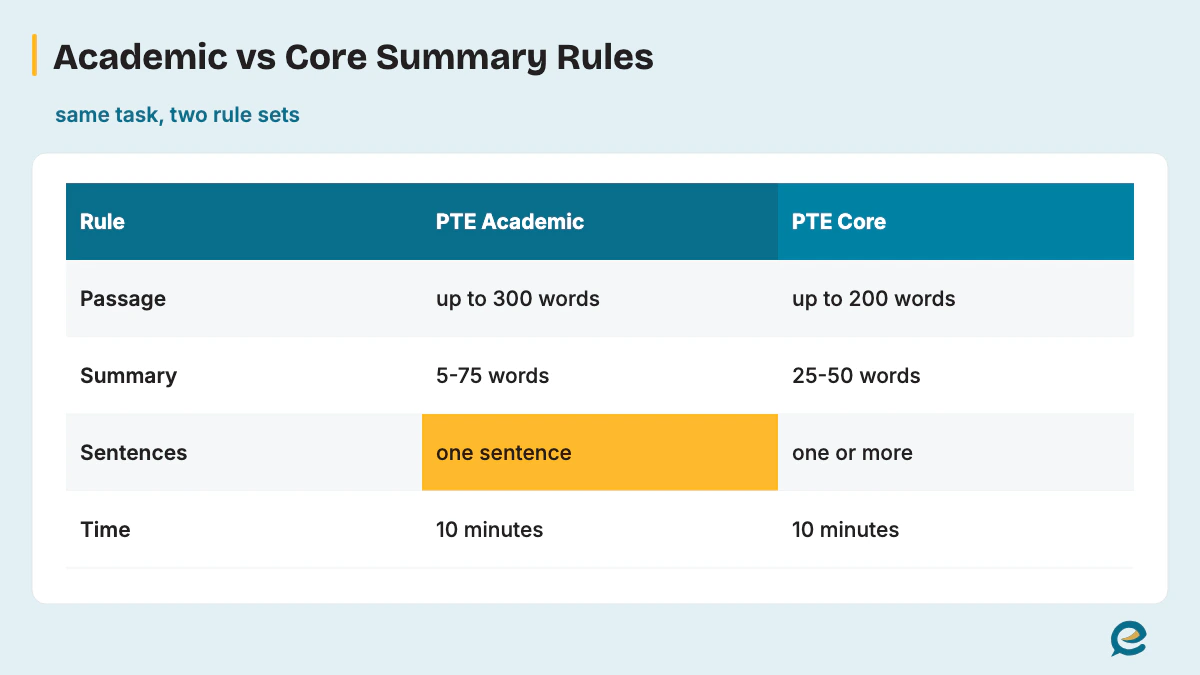
PTE Academic wants one complete sentence of 5-75 words from a passage of up to 300 words; PTE Core wants 25-50 words in one or more sentences from a passage of up to 200 words. Both give 10 minutes. Passage length, summary length and sentence rules differ between the two tests, as the table shows.
| Rule | PTE Academic | PTE Core |
|---|---|---|
| Passage length | Up to 300 words. | Up to 200 words. |
| Summary length | 5-75 words. | 25-50 words. |
| Number of sentences | One complete sentence. | One or more complete sentences. |
| Time | 10 minutes. | 10 minutes. |
| Skills scored | Reading and writing. | Reading and writing. |
| Items per test | 2. | 1-2. |
| Outside the word range | Zero on all four factors. | Task page: zero outside 25-50; Score Guide: zero below 5 or above 60. |
| All capital letters | Form scores 0. | Form scores 0. |
Pearson's Academic test tip is to check that the response is one sentence "with a capital letter at the beginning and only one full stop at the end". Pearson's 2021 writing article adds that a summary written all in capital letters or all in lower case scores zero. Some prep sites and an older Pearson India blog still say the Academic sentence can run to "more than 75 words". Pearson's current page says "no more than 75 words".
How Many Words Count in Summarize Written Text?
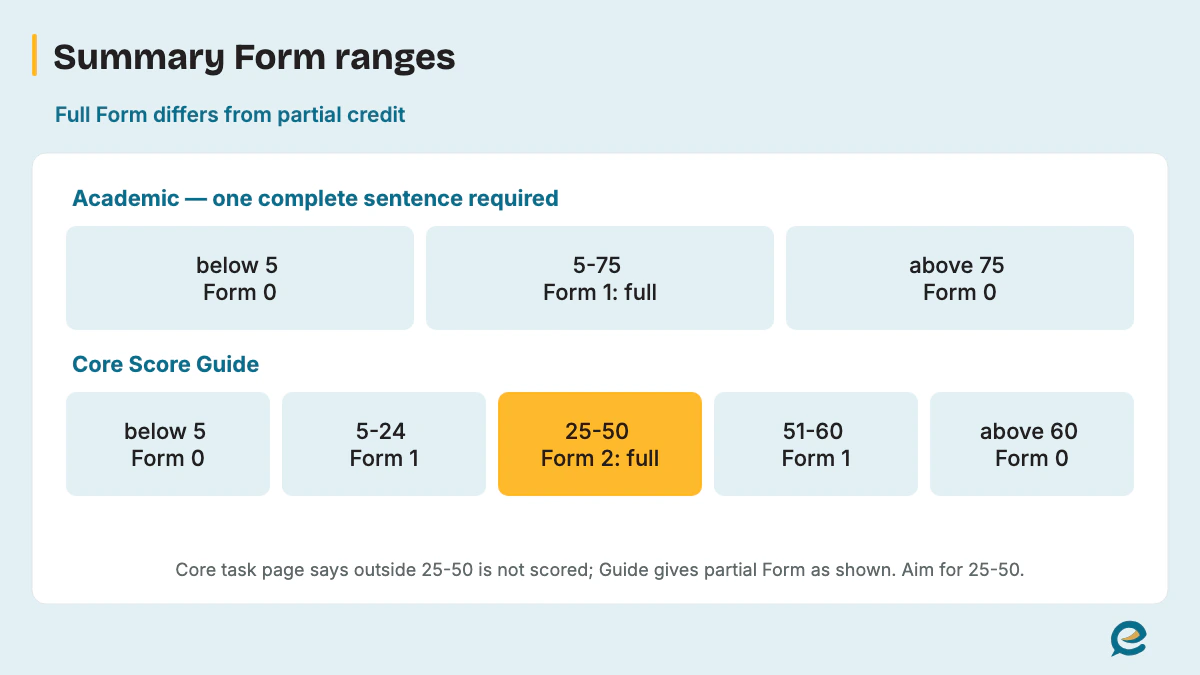
The word limit is 5-75 words in PTE Academic and 25-50 words in PTE Core; outside those ranges Pearson's task pages say the response gets no score points on any factor. Pearson's 2021 self-improvement article adds a tip for Academic: "A good sentence for this question type is 20-35 words long." That figure is advice, not a rule, and the scored range stays 5-75.
The PTE Core Score Guide is softer than the Core task page: it gives Form 1 point (not 2) for 5-24 or 51-60 words, and 0 below 5 or above 60. Write 25-50 words and both sources agree you are safe. A long single sentence is harder to keep grammatical, so a shorter sentence that still carries the main idea and one supporting point is safer than one near 75 words.
How Is Summarize Written Text Scored?
Pearson scores it on four factors: Content, Form, Grammar and Vocabulary, and its Score Guides publish the points for each.
| Factor | PTE Academic | PTE Core | What Pearson looks for |
|---|---|---|---|
| Content | 0-4 | 0-2 | The main points; misreading the topic or purpose scores zero on all four factors. |
| Form | 0-1 | 0-2 | Academic: one sentence of 5-75 words. Core: 2 for 25-50 words. |
| Grammar | 0-2 | 0-2 | Correct structure; "The best responses usually consist of a main clause and subordinate clause." |
| Vocabulary | 0-2 | 0-2 | Relevant, academically appropriate words that "use words from the passage appropriately". |
That gives a maximum of 9 trait points in PTE Academic and 8 in PTE Core. A full Content score in Academic needs all main ideas identified, extraneous detail removed and effective paraphrasing; a Core summary that "misses one or two aspects" drops to 1. Grammar and vocabulary errors that don't hinder communication cost 1 point, not 2. In PTE Academic, a summary that relies heavily on repeating excerpts from the passage without reformulating them in your own words is described at Content 2 of 4, so paraphrase rather than copy.
All PTE tasks are AI-scored, and the Academic Score Guide lists Summarize Written Text among the tasks that also get a human expert review of Content. Spelling isn't a separate trait in this task.
How Do You Summarize Written Text in PTE Step by Step?
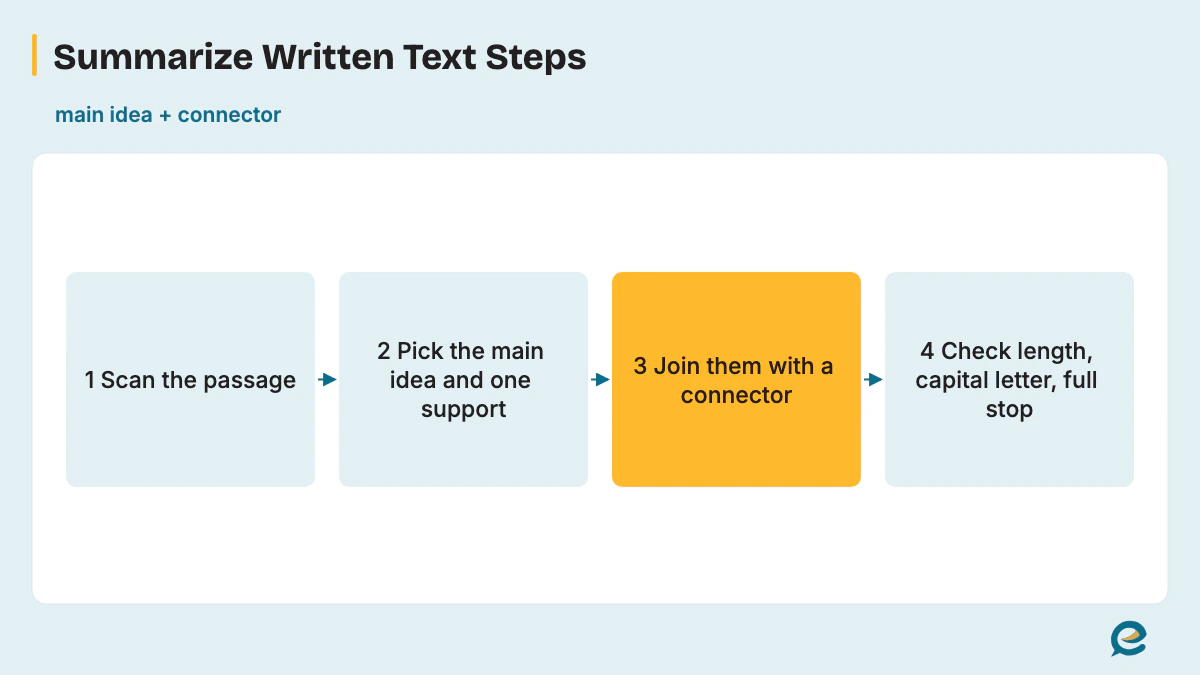
Find the main idea and the essential supporting points, then join them in one complex or compound sentence, and check length, capital letter and full stop. The whole routine fits inside the 10 minutes.
- Scan the passage for its topic, paying attention to the first and last sentences, where writers often state their point.
- Note the main idea of each paragraph in a few words.
- Choose the main point and condense the essential supporting points into a short phrase, leaving out examples.
- Join them with a connector into one complex sentence or compound sentence (Academic), or into 25-50 words (Core).
- Paraphrase: keep the passage's key terms, but rebuild the wording with your own phrasing and synonyms, and write in the third person.
- Proofread the word count, the capital letter and full stop, proper nouns, and the grammar.
Pearson's tip says "you will need to use a complex or compound sentence" for this task. That sentence has to cover "the main point of the passage" and "briefly mention the supporting detail". Pearson's 2021 article adds: "Do not include examples or supporting evidence." Leave out your own opinion and any facts that aren't in the passage, since Content is judged on what the passage says.
What Does a Summarize Written Text Example With Answer Look Like?
The example is one original academic passage, then an Academic one-sentence answer and a Core 25-50 word answer to the same passage. The example passage is original practice material, not a real exam topic.
Vertical farms grow crops indoors on stacked shelves under LED lights, with water and nutrients delivered directly to the roots. Because the climate inside is controlled, they can produce leafy greens all year, close to the city shops that sell them, and they use far less water per lettuce than open fields. Pests are rare indoors, so growers seldom need chemical sprays.
The main weakness is energy. Sunlight is free, but artificial light is not, and a vertical farm must also pay for heating, cooling and pumps. When electricity prices rose sharply in recent years, several large vertical-farming companies closed or cut back. For now, the method suits fast-growing, high-value crops such as herbs and salad leaves, while staple crops like wheat and rice remain far cheaper to grow outdoors.
PTE Academic sample answer (32 words, one sentence)
Vertical farms grow crops indoors all year using less water and few chemical sprays, but because artificial light and climate control make energy costly, the method currently suits only fast-growing, high-value crops.
The main idea is the trade-off between the farms' strengths and their energy cost; the connectors "but" and "because" attach the supporting point without listing the examples.
PTE Core sample answer (41 words, two sentences)
Vertical farms grow crops such as leafy greens indoors under LED lights all year, using far less water and few chemical sprays. However, their high energy costs mean they currently suit only fast-growing, high-value crops, not staples like wheat and rice.
Here the main idea opens the first sentence, and the connector "However" carries the limit on the method. Each word count sits inside its test's range.
Should You Use a Summarize Written Text Template?
A sentence frame of main point + connector + supporting point helps, but the ideas inside it must come from the passage, in your own words where you can. Content and Vocabulary are scored on this passage. A structural frame is a planning aid, not an exemption from Content scoring: the Academic Guide warns about significant memorized material that does not address the prompt. The real risk is a frame that misses the passage's main point, which costs Content.
The frame below uses a pattern of roles, not fixed words.
[main point of the passage] + [connector such as although, while or because] + [one supporting point]
In the example above, the frame becomes the farms' strengths plus "but" plus the point about energy, with the ideas taken from the passage and the wording paraphrased.
How Do You Practice Summarize Written Text?
Summarize one new passage a day under a 10-minute timer, check the word range and the four factors, and compare your main idea with the passage's topic sentence. Daily practice on varied subjects, such as science, history, economics and the arts, tests whether you can find the main point fast. Check that your sentence doesn't simply copy the passage's first line, which often gives background rather than the main point.
Which Connectors Work in Summarize Written Text?
Connectors such as although, while, because and which let you join the main idea and a supporting point in one grammatical sentence. Each one opens a subordinate clause, which matches Pearson's note that the best responses use a main clause and a subordinate clause. Clause practice is covered in PTE grammar rules.
Can You Copy and Paste in Summarize Written Text?
Yes: Pearson's item pages for both tests show cut, copy and paste buttons and a word count at the bottom of the screen while you write. Pearson allows words from the passage to be used appropriately, but pasting whole sentences rarely gives one grammatical summary, and the Academic Score Guide places a response built mostly from copied excerpts at Content 2 of 4. Use the buttons to move your own phrases around, not to assemble the passage's sentences. More task habits are in PTE writing tips.
How Many Summarize Written Text Items Are in the Exam?
The item count in Pearson's Score Guides is 2 Summarize Written Text items in PTE Academic and 1-2 in PTE Core. The test format overview at PTE format shows where they sit among the other tasks.
Does Summarize Written Text Count Toward Reading and Writing?
Yes, Pearson lists reading and writing as the skills this item scores, so one summary moves two skill scores. A misread main idea can zero the whole response, so it costs both skills at once. The PTE writing section guide shows every task that feeds the Writing score.
Practice PTE Writing on EasyEnglish
Try Writing tasks in a timed, computer-based format like the real test.
Try speaking practice without signing up. A free account is required for full mock tests. Practice scores are estimates, not official Pearson scores.
Written by
EasyEnglish Team
The team behind EasyEnglish's PTE practice and mock tests
EasyEnglish provides independent PTE practice and estimated scores. EasyEnglish is not affiliated with or endorsed by Pearson. Contact support@inverseai.com.
Format and scoring sources checked on 26 October 2026: Academic Speaking & Writing; Core Speaking & Writing; Academic Score Guide; Core Score Guide (January 2026). Academic and Academic UKVI details use the format introduced on 7 August 2025; Core details use its January 2026 Score Guide. Where a task page and Score Guide differ, the distinction is identified in the text; use the Guide for scoring criteria. Practice passages, names, figures, prompts and model answers are authored examples supplied with this guide, not authentic exam items or independently verified research findings. Suggested practice schedules and time splits are coaching advice, not Pearson requirements or score guarantees.
Editorial review completed .