
PTE Essay Writing: Task Requirements, Topics, Preparation and Tips
PTE Writing
You get one prompt of two or three sentences, 20 minutes, and a box to type an argumentative essay of 200-300 words. Write Essay appears only in PTE Academic and PTE Academic UKVI, and Pearson scores it on seven traits worth 26 points.
Two of those traits act as gates: an essay that misses the topic, runs under 120 or over 380 words, or leans on memorized material gets no points at all.
Table of Contents
What Is the PTE Write Essay Task?
Write Essay is a PTE Academic Speaking & Writing task in which you read a short prompt and write an argumentative essay of 200-300 words in 20 minutes. It comes once per test in Part 1 (about 76-84 minutes), after Summarize Written Text, and exists only in PTE Academic and PTE Academic UKVI, since PTE Core has Write Email instead. A Word Count at the bottom of the screen tracks your length, and cut, copy and paste buttons are available. Pearson's Score Guide credits the essay to your Writing score only. Pearson uses no "Task 2" label, so a course that calls it writing task 2 means this essay.
What Are the Key Requirements of PTE Write Essay?
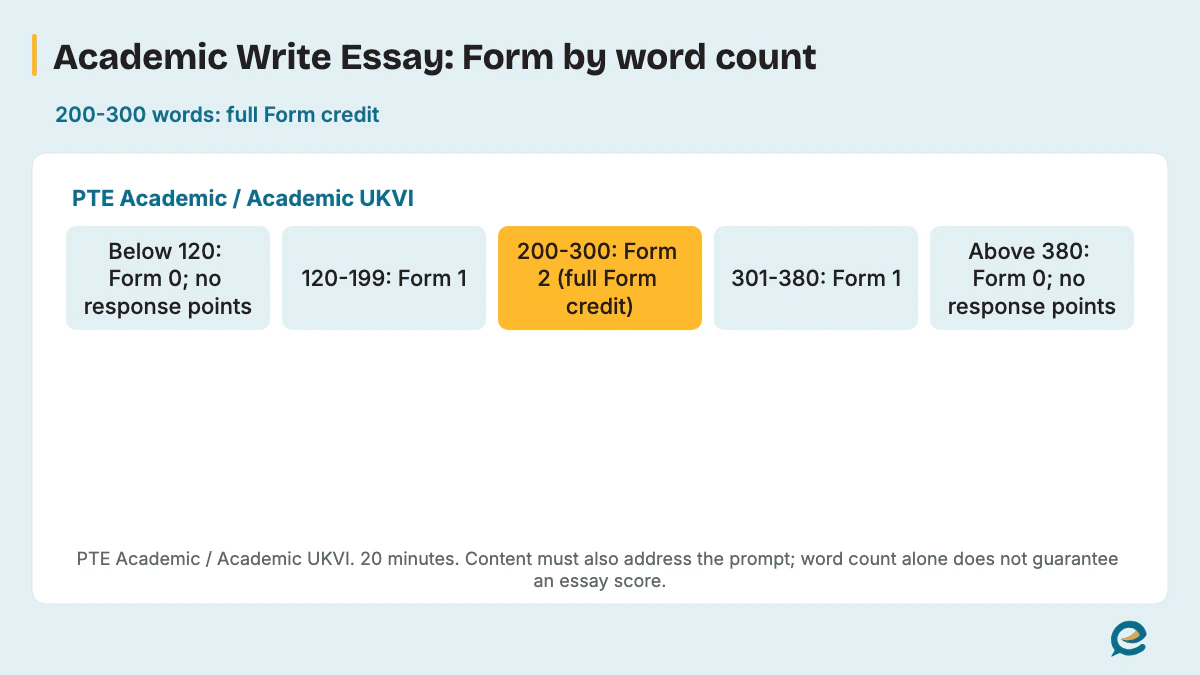
You need to write 200-300 words in 20 minutes on the given topic, in your own words and full paragraphs, with one spelling convention throughout. Eight rules from Pearson's task page and Score Guide decide whether the essay is scored at all and how much Form credit it earns.
| Requirement | Pearson's rule |
|---|---|
| Number of essays | One per test, according to the Score Guide. |
| Prompt | Two or three sentences. |
| Time | 20 minutes to plan, write and check. |
| Length | 200-300 words for full Form credit. |
| Essay type | Argumentative or persuasive. |
| Originality | No credit for an unoriginal response: "You must use your own words." |
| Layout | Full sentences; capitals only, no punctuation or bullet points score Form 0. |
| Spelling | US, UK, Australian or Canadian, used consistently. |
The word-count rule has three steps. An essay of 200-300 words earns Form 2, while 120-199 or 301-380 words earns Form 1 and "will decrease your score". Under 120 words or over 380 words, Form drops to 0 and you receive no score points on any of the seven factors. Some prep sites still quote a zero for anything under 200 words; Pearson's current page puts the zero line at 120.
How Is the PTE Essay Scored?
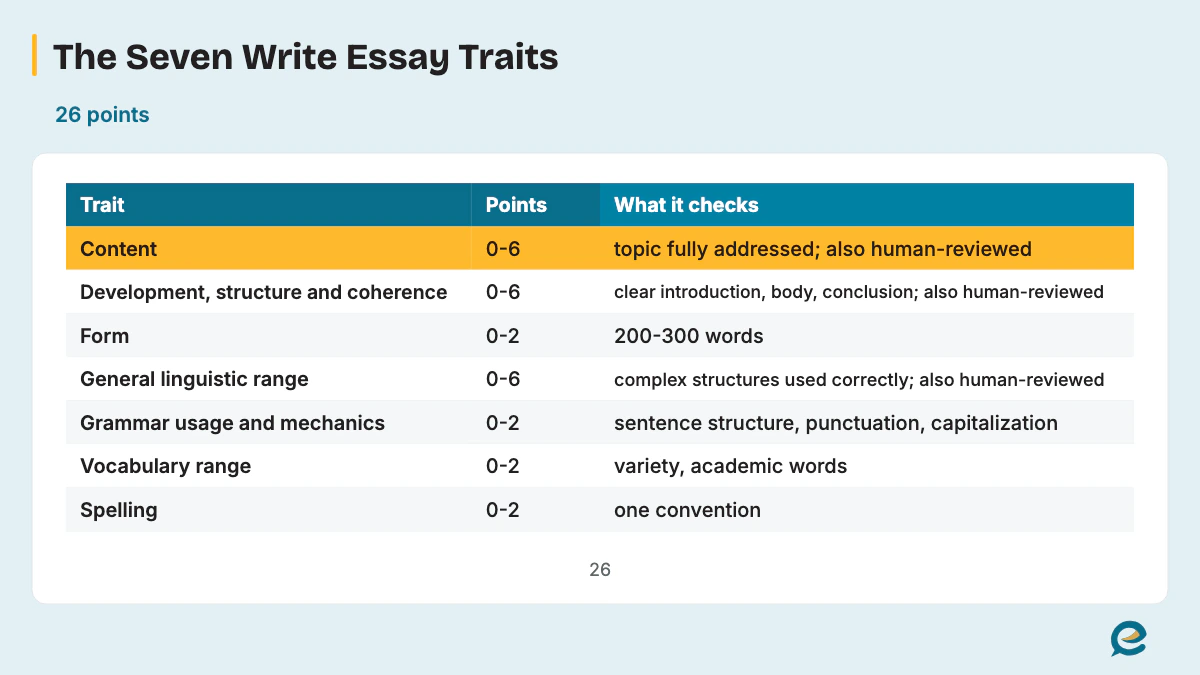
Pearson scores Write Essay on seven traits with partial credit, and the Score Guide sets Content, Development structure and coherence, and General linguistic range at 0-6 and the other four at 0-2, for 26 trait points. The table pairs each trait with what its top score describes.
| Trait | Points | What a top score needs |
|---|---|---|
| Content | 0-6 | The prompt addressed in depth, the issue reformulated in your own words, with relevant examples. |
| Development, structure and coherence | 0-6 | A clear introduction and conclusion, logical paragraphs and varied connective devices. |
| Form | 0-2 | Between 200 and 300 words. |
| General linguistic range | 0-6 | Varied expressions used precisely, with no sign of restriction. |
| Grammar usage and mechanics | 0-2 | Consistent control of complex language, with rare errors. |
| Vocabulary range | 0-2 | A broad lexical repertoire, including idiomatic expressions. |
| Spelling | 0-2 | No errors; one error scores 1 and more than one scores 0. |
Content and Form work as gates: the Score Guide says a 0 on either one means no score points for the response. Its examples are an essay on a different topic, an essay under 120 words, and a response built on memorized material, which Pearson classifies as irrelevant.
All seven traits are AI-scored. A human review by an expert also covers Content, Development structure and coherence, and General linguistic range before the task score is confirmed. The Guide describes second-human adjudication for Content disagreements in its Describe Image scoring example; it does not establish that exact workflow for this essay. Pearson's 2021 essay article printed smaller maximums (Content 3, the rest 2), and the Score Guide scales above replace them.
What Is the PTE Essay Format?
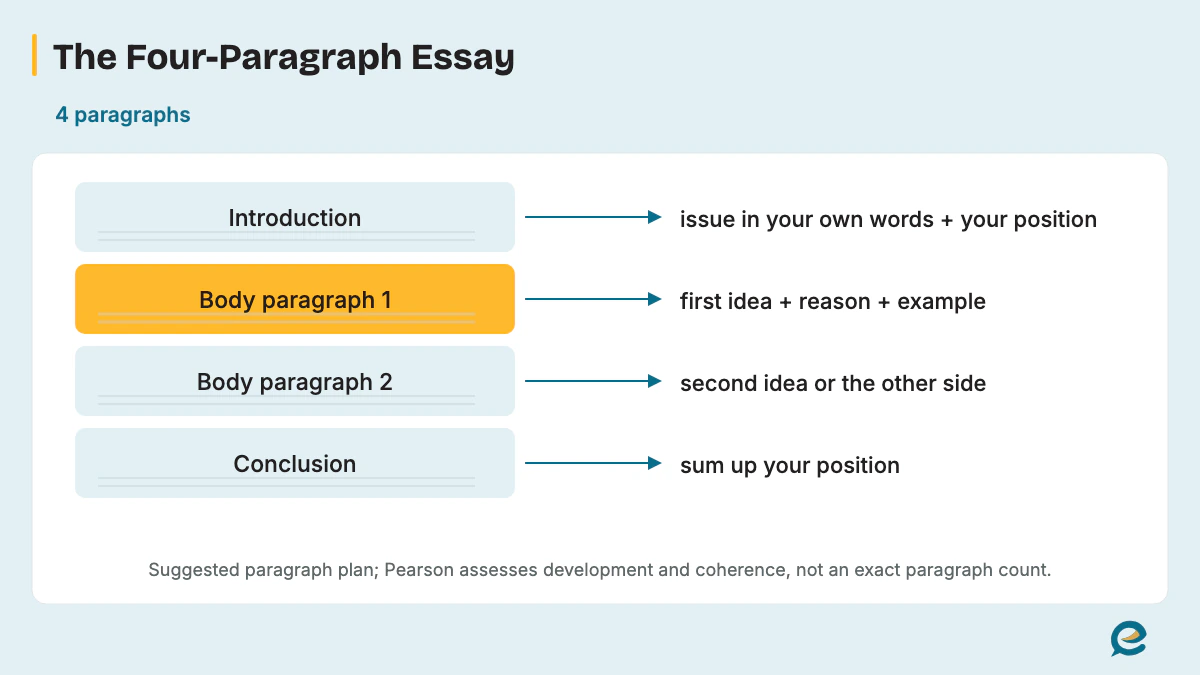
Pearson's essay article recommends four paragraphs: an introduction, two body paragraphs that each develop one idea, and a short conclusion. Each paragraph in this essay format carries one job.
- Introduction: restate the issue in your own words and give your position.
- Body paragraph 1: develop your first idea with a reason and an example.
- Body paragraph 2: develop a second idea, or answer the other side.
- Conclusion: sum up your position in two or three sentences.
The format earns points because the Score Guide's top Development, structure and coherence score describes a well-developed introduction and conclusion, logical paragraphs and a variety of connective devices. Pearson's 2021 article lists linkers such as "in view of", "in my opinion" and "to sum up" as examples, not a script. Pearson sets no sentence count per paragraph, so treat any count as a planning habit.
What Types of Essay Prompts Appear in PTE?
Pearson says essay prompts may ask whether you agree or disagree with a statement, or how different groups of people might feel about a situation, and you're judged on writing a persuasive or argumentative essay. Its 2021 essay article adds prompts that ask you to discuss problems or solutions, or to argue for or against an opinion. Pearson's test tip is to note the key words first, then find the topic, the key points and any points of view to discuss. Labels such as advantages and disadvantages or discuss both views come from coaching courses, not Pearson, and the job stays the same: answer every part and hold one position.
How Do You Write an Essay for PTE Step by Step?
Pearson's essay article sets three steps inside the 20 minutes: analyze the prompt and plan, write the essay, then proofread and make any necessary changes. Each step below lists the actions that protect a specific trait.
- Analyze the prompt and plan. Note the key words, choose a position you can defend, and write down two ideas with one example each.
- Write the essay. Build the four paragraphs in order and glance at the Word Count after each one so you finish between 200 and 300 words.
- Proofread. Ask "Have you addressed the prompt?", then check one spelling convention, grammar and the word range.
Here is step 1 worked on a practice prompt: "Restaurants and cafes should be required by law to show the calorie content of every dish on their menus. To what extent do you agree or disagree?" Planning notes this short take a couple of minutes.
| Plan item | Notes |
|---|---|
| Key words | required by law; calorie content; every dish; to what extent |
| Position | Largely agree, starting with large chains plus basic nutrition education |
| Body 1 | Information at the moment of ordering; example: a salad with a heavy dressing |
| Body 2 | Objection: cost for small businesses, numbers alone change little; answer: chains calculate once, small cafes get more time |
| Conclusion | Restate the position and the condition |
Pearson tells you to keep planning short and to give yourself a couple of minutes to proofread, but it publishes no fixed minute split. Time management is personal, so a split such as 3 minutes to plan, 14 to write and 3 to check works as your own plan, not a rule. Time one practice essay and adjust from the result.
What Does a PTE Essay Sample Look Like?
A strong sample essay answers every part of the prompt in four paragraphs and 200-300 words, restating the issue in its own words and backing each idea with a concrete example. This model essay follows the plan above and runs to 263 words, counted paragraph by paragraph.
Eating out has become a weekly habit for many families, yet most diners have little idea how much energy a plate of pasta or a large milkshake contains. I largely agree that restaurants should be required to print calorie counts on their menus, although the rule should apply first to large chains and should come with simple nutrition education.
The main benefit is that a legal requirement gives customers information at the exact moment they choose what to eat. A person ordering lunch may assume that a chicken salad is the lighter option, only to discover from the menu that its creamy dressing makes it heavier than a burger. When the number sits beside the price, diners can compare dishes in seconds, and parents can choose better meals for their children without searching online.
Opponents argue that measuring every dish would be expensive for small businesses and that numbers alone rarely change behavior. Both concerns are reasonable, but they call for careful design rather than rejection. Chains that sell identical meals in hundreds of branches can calculate the figures once and print them everywhere, so the cost per outlet is low. Independent cafes with daily specials could be given more time or a simpler labeling system, while short public campaigns could explain what the figures mean.
In summary, calorie labels turn a vague guess into a clear fact at the point of ordering. If the law starts with large chains and is supported by basic education, I believe it would help people eat more sensibly without placing an unfair burden on small restaurants.
| Paragraph | Words | What it does for the score |
|---|---|---|
| Introduction | 59 | Restates the prompt in new words ("print calorie counts") and gives a position with a condition, which the Content 6 wording rewards. |
| Body 1 | 75 | One reason plus a specific example (the salad), so the idea is developed, not just stated. |
| Body 2 | 82 | Raises the counter-argument and answers it, a move Pearson's 2021 article names as an option for the second paragraph. |
| Conclusion | 47 | Restates the position without new ideas and closes the argument. |
The connective devices change from paragraph to paragraph ("yet", "although", "When", "but", "so", "while", "If"), which matches the Score Guide's call for a variety of connective devices. Only Pearson can score a response, so read the model for its moves, not for a promised number. The 7 type-by-type samples on the templates page and the 5 topic answers on the topics page show the same moves on other prompts.
What Are Common Mistakes in PTE Write Essay?
These nine mistakes can lose points, and some can zero a response. Each one maps to a trait or rule in the Score Guide.
- An off-topic essay scores Content 0, which means no score points for the response.
- Breaking the word limits, under 120 or over 380 words, scores Form 0 with the same result.
- Memorized material, such as a pre-written essay, counts as irrelevant and can drop Content to 0.
- An essay typed in capitals only, with no punctuation, or as bullet points scores Form 0.
- Reusing the prompt wording in your introduction matches the low Content descriptors, which name "repeating language from the prompt".
- Going over 300 words drops Form from 2 to 1 and gives you more text to proofread.
- One long block of text with no clear structure weakens Development, structure and coherence.
- Repeating the same connectives in every paragraph misses the variety that the top structure score describes.
- Mixing spelling conventions or leaving more than one spelling error drops Spelling to 0.
How Do You Prepare for the PTE Essay?
Essay practice works best as timed essays on varied prompts, each followed by a self-check against the seven traits and the word-count rule. Set a weekly routine of three timed essays, each on a fresh prompt. After each one, score yourself trait by trait and make your lowest trait the next focus. For timed practice on screen, create a free account and write against the clock.
What Are the Best PTE Essay Writing Tips?
The following essay tips focus on the two zero gates and the three 0-6 traits that a human expert also reviews: Content, Development structure and coherence, and General linguistic range. Get the topic and the Form rule right first, then work on structure and range. The timing plan, grammar-error fixes and vocabulary themes are in PTE essay writing tips.
Should You Use a PTE Essay Template?
A memorized essay used for every topic is risky, because the Score Guide classifies pre-prepared or memorized material as irrelevant and Pearson gives no credit for an unoriginal response. A flexible structure that you fill with your own sentences gives the same planning help without that risk. The PTE essay templates and structure guide shows a safe essay template for seven prompt types and the phrases to avoid.
What Are Common PTE Essay Topics?
Essay prompts are short statements on general academic themes that ask you to take and argue a position, and Pearson publishes no official topic list or repeat-frequency data. The PTE essay topics collection groups 126 practice prompts into 10 themes, with idea outlines and five sample answers.
How Do You Improve Grammar for the PTE Essay?
Grammar usage and mechanics rewards a high proportion of correct complex sentences with accurate punctuation and capitalization, and its top score describes errors that are rare and difficult to spot. Practice joining two ideas with "although", "because" or "which" in sentences you can control, then check each one for agreement and commas. Rules and drills are in PTE grammar.
How Do You Build Vocabulary for the PTE Essay?
Vocabulary range rewards variety and academic appropriateness, such as precise synonyms and academic terms, used correctly rather than forced in. Pearson's essay article warns that idioms can help, but too many take away from the academic style. Choose a word for the meaning you need: "a nutritious diet" and "a supportive manager" are more precise than a vague positive adjective, so learn words in phrases from PTE vocabulary.
How Is Write Essay Different From Write Email in PTE Core?
PTE Core replaces Write Essay with Write Email: 9 minutes to answer a prompt of up to 100 words in an email that covers three bullet points, scored on seven factors including Email conventions. Pearson's Core page asks for "between 80 and 120 words" under How to answer, while its Form trait gives full credit for 50-120 words, so aim for 80-120. The task is explained in PTE Core Write Email.
How Do You Get 85 in PTE Writing?
The essay is one of four tasks that feed the Writing score in PTE Academic's Score Guide, alongside Summarize Written Text, Summarize Spoken Text and Write from Dictation, so 85 in Writing needs all four. No fixed essay score guarantees 79, 85 or 90, because the other three tasks count too. The PTE writing section guide shows how each task is scored.
Frequently Asked Questions
How Many Essays Are in the PTE Exam?
One. Pearson's PTE Academic Score Guide lists one Write Essay question per test, and PTE Core has no essay (it uses Write Email).
Practice PTE Writing on EasyEnglish
Try Writing tasks in a timed, computer-based format like the real test.
Try speaking practice without signing up. A free account is required for full mock tests. Practice scores are estimates, not official Pearson scores.
Written by
EasyEnglish Team
The team behind EasyEnglish's PTE practice and mock tests
EasyEnglish provides independent PTE practice and estimated scores. EasyEnglish is not affiliated with or endorsed by Pearson. Contact support@inverseai.com.
Format and scoring sources checked on 26 October 2026: Academic Speaking & Writing; Core Speaking & Writing; Academic Score Guide; Core Score Guide (January 2026). Academic and Academic UKVI details use the format introduced on 7 August 2025; Core details use its January 2026 Score Guide. Where a task page and Score Guide differ, the distinction is identified in the text; use the Guide for scoring criteria. Practice passages, names, figures, prompts and model answers are authored examples supplied with this guide, not authentic exam items or independently verified research findings. Suggested practice schedules and time splits are coaching advice, not Pearson requirements or score guarantees.
Editorial review completed .