
PTE Core Write Email: Rules, Scoring, Template and Samples
PTE Writing
A short situation of up to 100 words appears with a named reader and three bullet points, and a 9-minute timer starts. Write Email asks you to answer that prompt with an email response of 80-120 words that covers all three bullet points. It's a PTE Core task only; PTE Academic has Write Essay instead.
Pearson's item page and its PTE Core Score Guide (January 2026) set the rules, and they don't use the same length figure: the task says 80-120 words, while full Form credit starts at 50. The Score Guide also scores Content 0-3 and every other trait 0-2.
Table of Contents
What Does PTE Core Write Email Ask You to Do?
Write Email is a PTE Core writing item in which you read a short situation and write an email in response. The prompt runs up to 100 words with three bullet points, and you get 9 minutes to write an email that covers all three.
Pearson's PTE Core Score Guide lists 2-3 Write Email items per test, and each one is scored for writing only; reading is used just for the instructions and the prompt. It's item 7 of PTE Core Part 1 Speaking & Writing, right after Summarize Written Text, and PTE Academic has Write Essay in its place.
What Are the Key Write Email Task Rules?
Read a prompt of up to 100 words, note who the email is to and why, cover all three bullet points and finish inside 9 minutes. Pearson's item page and Score Guide fix nine rules between them.
| Rule | What Pearson says |
|---|---|
| Items per test | 2-3 Write Email items (PTE Core Score Guide). |
| Prompt length | Up to 100 words. |
| Time | 9 minutes for each email. |
| What to cover | Details relevant to all three bullet points. |
| Who and why | Note who the email is addressed to and its purpose. |
| On-screen tools | A word counter at the bottom of the screen, plus cut, copy and paste buttons. |
| Skill scored | Writing. |
| Credit | Partial credit; "No credit is given for no response or an irrelevant response." |
| Length | See the word limit below. |
The item page's credit note doesn't mention memorized text, but the Score Guide does. It says responses with significant amounts of pre-prepared or memorized material are not relevant responses, so they get 0 for Content and the email earns nothing.
How Many Words Should a PTE Core Email Have?
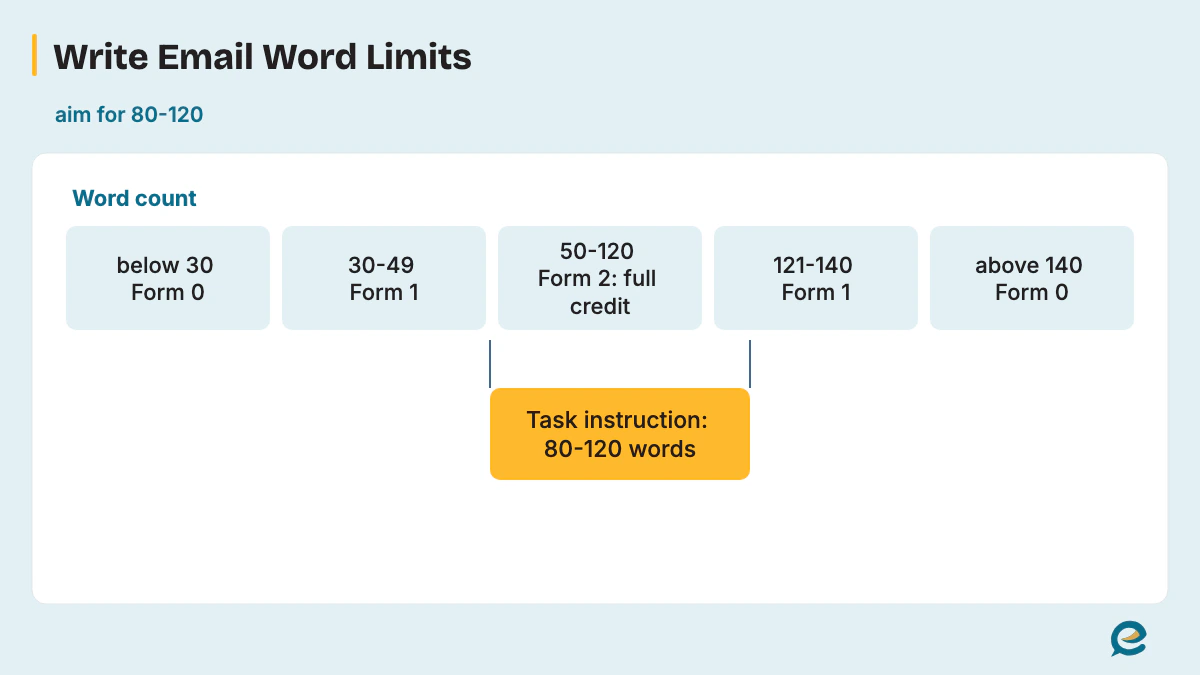
Pearson gives two figures, so aim for 80-120 words. The item page's task instruction says to "write an email containing between 80 and 120 words". Its Form trait says "You will receive full credit if your email is between 50 and 120 words", and the Score Guide uses the same 50-120 figure. Some prep sites still quote "at least 100 words" or "50-150 words in 10 minutes"; Pearson's current page says 80-120 words and 9 minutes.
The Score Guide's Form scale shows what happens outside the range.
| Word count | Form score (Score Guide) |
|---|---|
| 50-120 words | 2 (full credit) |
| 30-49 or 121-140 words | 1 |
| Fewer than 30 or more than 140 words | 0 |
| Written all in capital letters, or with no punctuation | 0 |
Outside 50-120 words, Pearson's item page says a penalty applies to Form. A Form score of 0 stops the scoring, so an email under 30 words earns no score points at all.
The word counter counts everything you type. The counts Pearson prints beside its Score Guide sample emails include the salutation and sign-off lines, so count your greeting and your name too.
How Is PTE Core Write Email Scored?
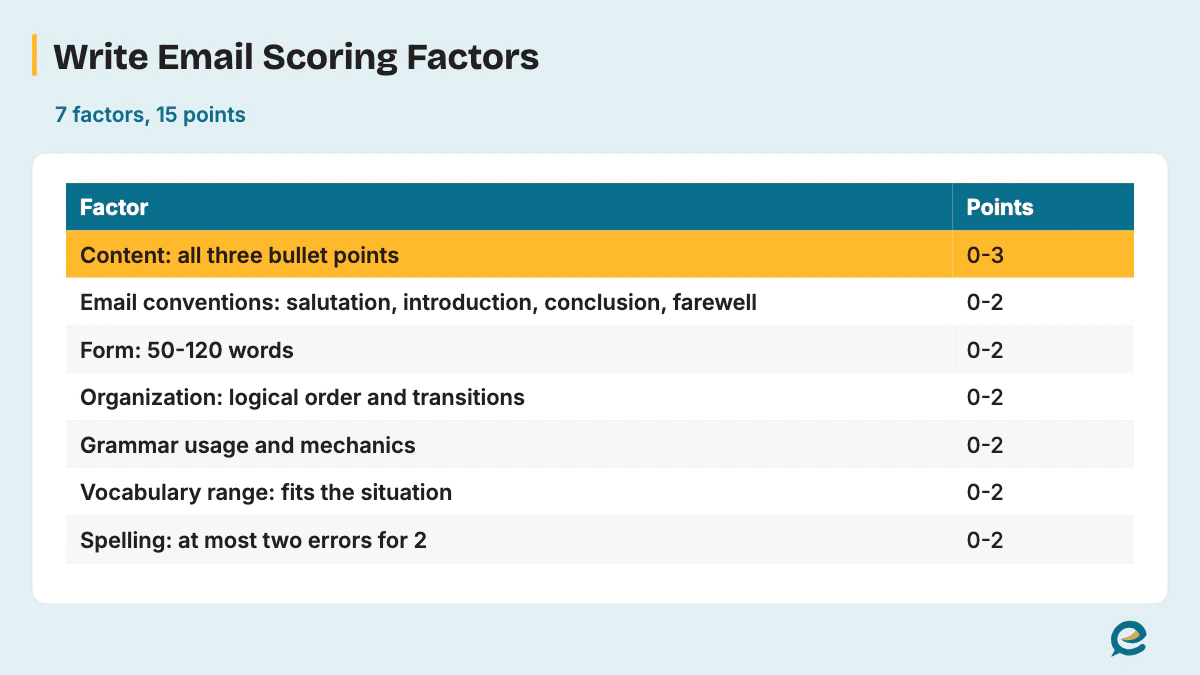
Pearson scores Write Email on seven factors: Content, Email conventions, Form, Organization, Grammar usage and mechanics, Vocabulary range and Spelling. The Score Guide marks Content from 0 to 3 and each of the other six from 0 to 2.
| Factor | What Pearson looks for | Score Guide scale |
|---|---|---|
| Content | All three bullet points addressed, with supporting details that fit the purpose. | 0-3; 0 if the email doesn't deal with the prompt. |
| Email conventions | "A salutation, an introduction, a conclusion and a farewell." | 0-2; 1 if parts are missing, too brief or in the wrong register. |
| Form | A length of 50-120 words for full credit. | 0-2; 1 for 30-49 or 121-140 words. |
| Organization | Ideas in logical order, related ideas grouped, transitions that guide the reader. | 0-2; 1 if transitions are mostly basic. |
| Grammar usage and mechanics | Sentence structure, punctuation and capitalization; the best emails have a high share of correct complex sentences. | 0-2; 0 for mainly simple structures or frequent mistakes. |
| Vocabulary range | Varied words that suit the situation. | 0-2; 1 if weak word choice causes some imprecision. |
| Spelling | One convention (US, UK, Canadian or Australian) used consistently. | 2 for at most two spelling or typing errors; 1 for three or four. |
Scoring runs in order. Content is checked first and Form second; if either scores 0, the other five traits aren't scored. The task total feeds your writing score and your overall score on the 10-90 scale.
Pearson's Score Guide also rates three real test-taker emails on one prompt, a reply to a manager named Julia about working from home two days a week. Each comment points to a fixable loss.
- CLB 4 (104 words): the right length, but no salutation, no names, no paragraphs and four spelling or typing errors.
- CLB 5 (103 words): a salutation and a sign-off, all parts addressed, but "Right?" made the tone too casual for the reader.
- CLB 7 (118 words): every part covered, paragraphs linked with "Another reason" and "Finally", yet three spelling or typing errors remained.
What Structure and Tone Work for PTE Core Write Email?
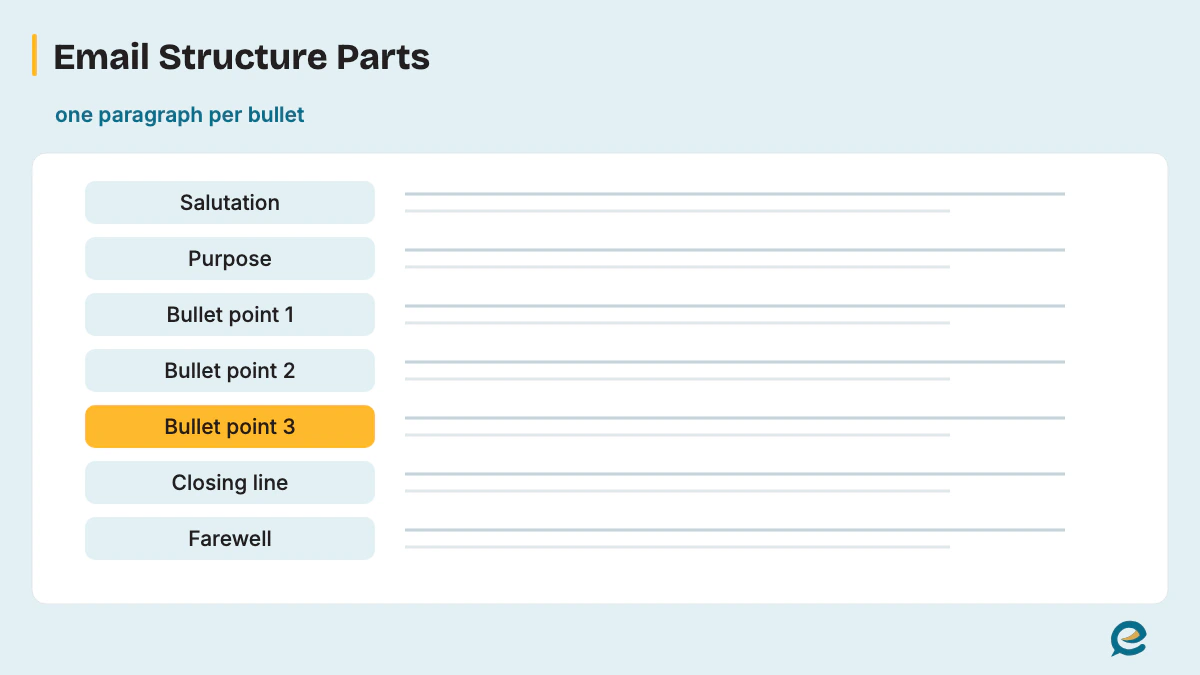
Use a salutation, an opening line that states your purpose, one short paragraph per bullet point, a closing line and a farewell, in a tone that fits the reader. A manager, an official or a stranger needs a formal tone, while a friend or relative can take an informal tone.
| Part | Formal email (manager, official) | Informal email (friend, colleague) |
|---|---|---|
| Salutation | "Dear Ms. Patel," with the reader's title and surname. | "Hi Sam," with the first name. |
| Opening line | State the purpose plainly in the first sentence. | Open with a friendly line, then the purpose. |
| Body | One short paragraph per bullet point, with full forms. | One short paragraph per bullet point; contractions are fine. |
| Closing line | Ask politely for the next step. | Suggest the next step in a relaxed way. |
| Farewell | "Yours sincerely," or "Kind regards," and your full name. | "See you soon," or "Take care," and your first name. |
The phrases below are building blocks for each job an email sentence does. Pick the ones that fit the prompt, then add your own details.
| Function | Formal | Informal |
|---|---|---|
| Greeting | Dear Mr. Novak, | Hey Leo, |
| Stating the purpose | I am writing to ask about the change to the class timetable. | Just a quick note about Saturday. |
| Giving details | The main issue is that the room is unavailable after 6 p.m. | The thing is, I can't get there before six. |
| Making a request | I would appreciate it if you could confirm the new date. | Could you send me the address? |
| Suggesting | One option would be to move the session to Thursday. | How about we meet at the café instead? |
| Closing line | I look forward to your reply. | Text me when you're free. |
| Sign-off | Yours sincerely, / Kind regards, | Cheers, / Talk soon, |
Pearson tells you to note who the email is addressed to and its purpose, and the tone follows from those two facts. Keep slang, emojis and text-message spellings such as "u" or "pls" out of a formal email. The Score Guide marks Email conventions down for a "too brief or inappropriate register", and full forms are a useful default for formal practice; contractions are not a separate automatic scoring penalty.
What Does a Flexible PTE Core Write Email Template Look Like?
A flexible template is a list of parts (salutation, purpose line, one paragraph per bullet point, closing line, farewell) that you fill with details from the prompt. The frame below sets each part's role rather than fixing its words.
- [salutation to the named reader]
- [why you are writing]
- [bullet point 1 answered]
- [bullet point 2 answered]
- [bullet point 3 answered]
- [closing line with the next step]
- [farewell]
Pearson's Score Guide treats significant amounts of pre-prepared or memorized material as not relevant, which scores 0 for Content. So keep the email template as a frame of roles and write fresh sentences for every prompt.
Organize the three bullet points in Pearson's task instructions into clear paragraphs. A subject line is not one of the four conventions named on its task page. Use an appropriate greeting and sign-off; the supplied model names are fictional.
What Do PTE Core Write Email Sample Answers Look Like?
The samples are three original prompts with three bullet points each, and an email of 80-120 words that answers every point in order. All three prompts are original practice material, not real exam questions.
Sample 1: formal email to a library manager. Each sample prompt follows Pearson's shape: a situation, a named reader and three bullet points.
Your local library plans to close at 1 p.m. on Saturdays from next month. Write an email to the library manager, Mr. Okafor.
- Explain how you use the library on Saturdays.
- Describe the effect the change would have on you.
- Suggest another way to save opening hours.
The first sample email labels each part.
[Salutation] Dear Mr. Okafor,
[Purpose line] I am writing about the plan to close the library at 1 p.m. on Saturdays from next month.
[Bullet point 1] I visit every Saturday afternoon with my two children, who borrow books for the week and join the reading club at 2 p.m.
[Bullet point 2] The new hours would end those visits, because I work late on weekdays and Saturday is my only free afternoon.
[Bullet point 3] Instead of cutting Saturday hours, could the library open one hour later on Monday mornings, when the reading room is usually quiet?
[Closing line] Thank you for considering this request. I would be glad to discuss it further.
[Farewell] Yours sincerely, Nadia Rahman
The word count is 104 without the labels, counted with the salutation and sign-off. It's formal because the reader is an official the writer doesn't know.
Sample 2: informal email to a friend.
Your friend Tomas is coming to stay with you for a weekend next month. Write an email to Tomas.
- Suggest a weekend that suits you.
- Describe a plan for the Saturday.
- Tell him what to bring.
Hi Tomas,
Great news that you can come and stay next month! The weekend of the 14th works best for me, since I'm off work that Friday too.
On Saturday, I thought we could hike up to the lookout in the morning and then try the night market by the river. The dumplings there are amazing.
You don't need much, but bring good walking shoes and a warm jacket, because it gets cold up on the hill. I've got a spare sleeping bag, so leave yours at home.
Let me know which train you're taking and I'll meet you at the station.
See you soon, Ella
This informal email has 106 words, again counted with the greeting and name. Contractions, an exclamation and a first-name sign-off suit a friend, while the sentences stay complete and correctly spelled.
Sample 3: semi-formal email to a neighbor.
Your apartment building is starting a shared rooftop garden, organized by your neighbor Mrs. Lindqvist. Write an email to Mrs. Lindqvist.
- Say why you want to join.
- Offer one way you can help.
- Ask a question about how the group works.
Dear Mrs. Lindqvist,
Thank you for the note about the rooftop garden. I would really like to join this year.
I have wanted to grow my own herbs since I moved in, and a shared garden sounds like a good way to meet more of our neighbors.
I can help with the watering on weekday evenings, and I also have two large planters on my balcony that the group is welcome to use.
Could you let me know how often the group meets and whether there is a schedule for the watering?
Best regards, Omar Haddad, Apartment 4B
This semi-formal email has 98 words. A neighbor you know only slightly gets "Dear" and a surname, full forms and a polite question, but a warmer opening than an official would.
How Should You Use the 9 Minutes in Write Email?
Read the prompt, mark the three bullet points, plan one line per point, write, then check the word count, the conventions and the spelling; Pearson publishes no fixed split of the 9 minutes. Four phases cover the whole task.
- Reading: mark the reader, the purpose and the three bullet points, and decide formal or informal.
- Planning: note one short detail you'll use for each bullet point.
- Writing: build the email part by part, from salutation to farewell, watching the word counter.
- Proofreading: check the word count, the four conventions, your spelling and your capital letters.
A minute-by-minute split is a practice habit, not a Pearson rule. Time your own practice emails, then keep at least the last 90 seconds for proofreading, since Spelling drops from 2 to 1 at the third error.
How Can You Practice Write Email and Fix Common Mistakes?
Write one timed 9-minute email a day from a new prompt, check it against the seven factors, and fix one mistake at a time. Timed practice shows whether reading, typing or checking slows you down. Nine common mistakes and their fixes follow.
- Missing a bullet point. A missed bullet point costs Content. Number the three points in your notes and tick each one off after its paragraph.
- Pasting a memorized email. Keep only the frame; the Score Guide gives 0 for Content when large parts are pre-prepared.
- Using the wrong register. Decide formal or informal from the reader before you type the salutation.
- Writing past 120 words. Stop adding ideas once each point has one clear detail; 121-140 words drops Form to 1.
- Writing under 80 words. Add a reason or an example to the thinnest paragraph, not a second greeting.
- Leaving out the salutation or sign-off. Type "Dear…" and your farewell first, then fill the middle.
- Mixing spelling conventions. Pick American or British spelling and keep it, so "organize" never sits beside "organise".
- Writing one block of text. Give each bullet point its own short paragraph so Organization can score 2.
- Skipping the final check. Reread for missing words, verb endings and capital letters before the timer ends.
Eight original practice prompts give you a different reader and register each day.
- Formal: Write to your manager, Mr. Daniel Cho. Ask to swap a shift next week, explain why, and say how your tasks will be covered.
- Informal: Write to your friend Priya, whose birthday dinner you missed. Apologize, explain what happened, and suggest another day to meet.
- Formal: Write to the manager of your sports center about broken lockers. Describe the problem, say how it affects members, and request a repair date.
- Semi-formal: Write to Marco, a new colleague who starts on Monday. Welcome him, describe a normal first day, and offer your help.
- Formal: Write to the director of your language school. Name your current class, explain why you want a morning class, and give your available days.
- Informal: Write to your cousin Ana, who is visiting your city. Recommend a place to eat, explain how to get from the airport, and tell her what clothes to pack.
- Formal: Write to the city council's parks office about a damaged playground near your home. Describe the damage, explain why it matters, and suggest a repair.
- Semi-formal: Write to your former teacher, Ms. Kowalski. Ask for a reference letter, say what it's for, and give the deadline.
How Many Write Email Questions Are in PTE Core?
Pearson's PTE Core Score Guide (January 2026) lists 2-3 Write Email items per test, each with its own 9 minutes; the item page itself doesn't give that item count. Every email adds to your writing score, so a weak first email still leaves one or two more chances. The full task order sits in the PTE Core test guide.
Does PTE Academic Have Write Email?
No, PTE Academic has Write Essay instead; Write Email appears only in PTE Core, and the 7 August 2025 update didn't add it to PTE Academic's Part 1 list. PTE Academic's writing tasks there are Summarize Written Text and Write Essay, a 200-300 word essay in 20 minutes. The other differences are set out in PTE Academic vs PTE Core.
How Do You Score 90 in PTE Core Writing?
No single task guarantees a 90 in writing, because PTE Core writing also includes Summarize Written Text, a 25-50 word summary; the reported score also receives credit from other integrated tasks. Prepare those alongside the summary and email. For Write Email that means Content 3 and 2 on every other trait in the Score Guide. More task-by-task advice is in PTE writing tips.
Is There a PTE Core Write Email PDF?
Pearson's free PTE Core Score Guide (January 2026) is the official Write Email PDF. It holds the trait scales and three rated sample emails at CLB 4, 5 and 7, with Pearson's comments on each. The PTE writing section guide covers Summarize Written Text, the other Core writing task.
Practice PTE Writing on EasyEnglish
Try Writing tasks in a timed, computer-based format like the real test.
Try speaking practice without signing up. A free account is required for full mock tests. Practice scores are estimates, not official Pearson scores.
Written by
EasyEnglish Team
The team behind EasyEnglish's PTE practice and mock tests
EasyEnglish provides independent PTE practice and estimated scores. EasyEnglish is not affiliated with or endorsed by Pearson. Contact support@inverseai.com.
Format and scoring sources checked on 26 October 2026: Academic Speaking & Writing; Core Speaking & Writing; Academic Score Guide; Core Score Guide (January 2026). Academic and Academic UKVI details use the format introduced on 7 August 2025; Core details use its January 2026 Score Guide. Where a task page and Score Guide differ, the distinction is identified in the text; use the Guide for scoring criteria. Practice passages, names, figures, prompts and model answers are authored examples supplied with this guide, not authentic exam items or independently verified research findings. Suggested practice schedules and time splits are coaching advice, not Pearson requirements or score guarantees.
Editorial review completed .