
PTE Listening Multiple Choice Single Answer: Rules & Tips
PTE Listening
Halfway through PTE Listening you hear a short talk, read one question and pick one answer. Multiple Choice Single Answer gives you five seconds to skim the question and options, plays a recording of 30-60 seconds once, and asks you to choose the one correct option. You'll meet 2-3 of these items in PTE Academic and 1-2 in PTE Core, and Pearson scores every one 1 or 0.
Table of Contents
What Is Multiple Choice Single Answer in PTE Listening?
Multiple Choice Single Answer in PTE Listening is a task that plays a recording of 30-60 seconds once and asks you to pick the one option that answers the question. You select a single response from several options. In PTE Academic it's task 5 of the 8 types in Part 3 Listening, and in PTE Core Listening it's task 4 of 7. It feeds your Listening score only, while a separate Single Answer task in the Reading section works from a written passage instead.
What Are the Listening Multiple Choice Single Answer Format and Timing Rules?
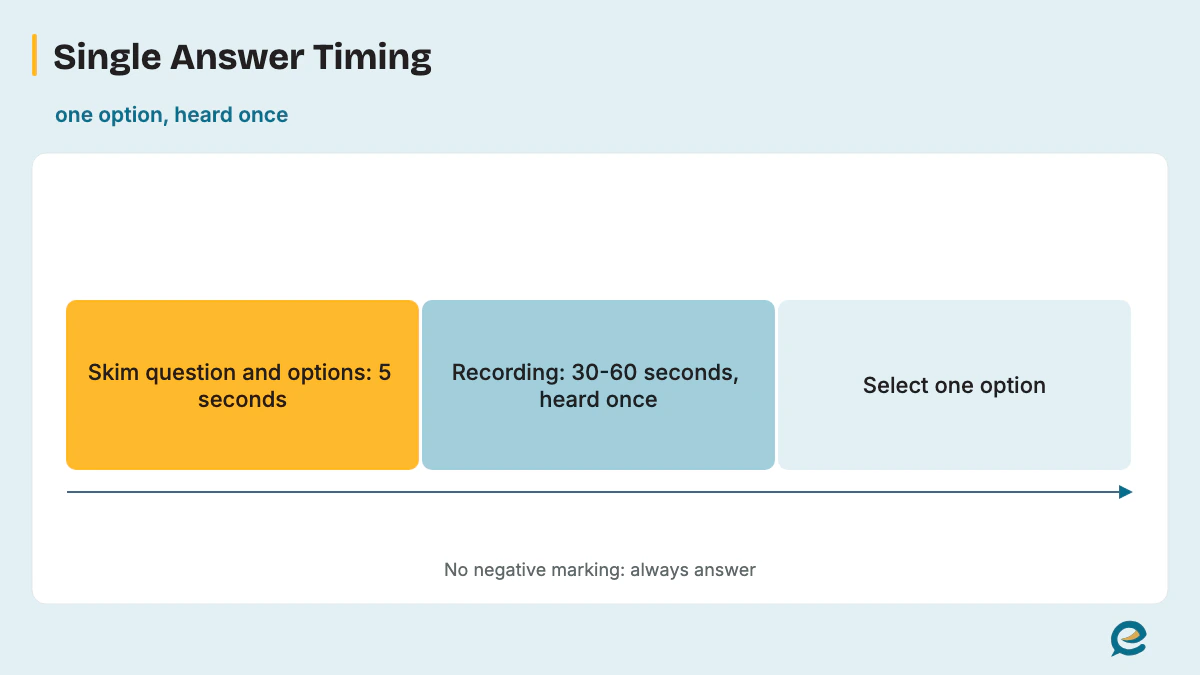
You get five seconds to skim the question and options, then a recording of 30-60 seconds plays once, and you select one option. One item breaks down into these four stages.
| Stage | What happens | Time or rule |
|---|---|---|
| Before the audio | You skim the question and the options. | Five seconds. |
| Recording | A short talk plays automatically. | 30-60 seconds, heard once. |
| Answering | You choose from several options. | One option only; it turns yellow when selected. |
| Notes | You can write while you listen. | An erasable noteboard is provided. |
Pearson's PTE Core Listening page gives the same 30-60 second recording and the same five seconds to read the question and options. If you change your mind, click your option again to deselect it, or click a different option. The item count comes from Pearson's Score Guides: 2-3 Multiple Choice Single Answer items in PTE Academic and 1-2 in PTE Core.
What Skills Does Listening Multiple Choice Single Answer Test?
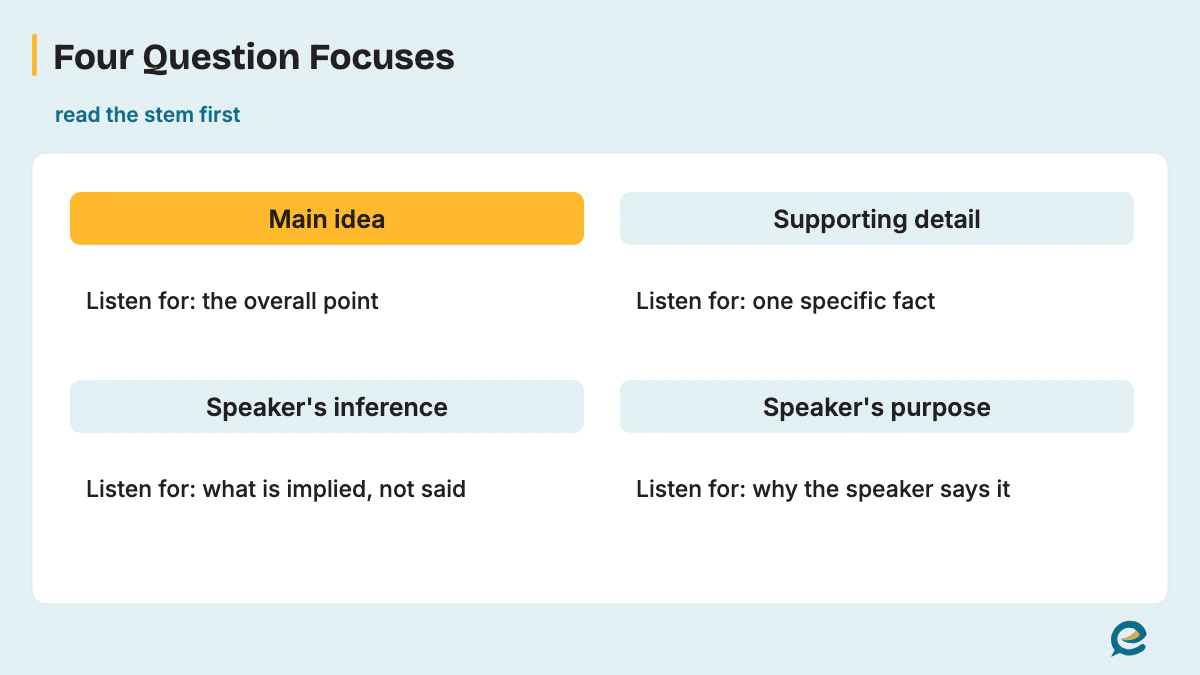
Pearson says the question stem tells you what to listen for: the main idea, a supporting detail, the speaker's inference or the speaker's purpose. Each focus calls for a different kind of listening, and the example stems in this table are our own.
| Question focus | What the stem asks | What to listen for | Example stem |
|---|---|---|---|
| Main idea | The overall point of the talk. | The claim the whole talk supports. | What is the speaker's main point about city parks? |
| Supporting detail | One specific fact. | A name, a cause, a number or an example. | Which material does the lecturer say lasts longest? |
| Speaker's inference | What the speaker implies. | Hints that point to an unstated view. | What can be inferred about the new rule? |
| Speaker's purpose | Why the speaker says something. | The reason behind an example or a comparison. | Why does the speaker mention the 1990s? |
Pearson describes the recording as a brief audio or video recording on an academic subject in PTE Academic, and on an everyday subject in PTE Core. Its FAQ adds that the test uses genuine academic lectures rather than actors reading scripts, and that PTE Academic includes non-native English accents. Spotting the focus in the five-second skim tells you whether to listen for the big picture or for one fact.
How Is Listening Multiple Choice Single Answer Scored?
Each item is scored correct or incorrect, with no partial credit and no negative marking. Pearson gives no credit for an incorrect answer or for no answer at all, so a wrong choice costs you nothing beyond the point you didn't win. Spelling plays no part, since you only select an option.
The item feeds only your Listening score in both Score Guides, even though a note on Pearson's PTE Core page says reading. Pearson uses question weighting in score calculations; an individual raw item point is not a fixed reported-score increment.
What Does a Listening Multiple Choice Single Answer Sample Question Look Like?
A changing display corner
What is the main point of the talk?
Recording voice: UK English.
Original practice recording.
Transcript
Our learning centre once used the corner beside reception to store spare chairs. When the chairs were moved, a tutor suggested using the space to show student work. The first display stayed up for an entire term, and regular visitors soon stopped noticing it. We now change a small part each week and invite students to add a short explanation of what they made. The corner has become a place for brief conversations about projects. It is still small and cannot show every piece of work, so different groups take turns choosing what appears there.
Answer and explanation
Correct option: A
- A: This covers the original use, change and current purpose.
- B: Chair storage is only background.
- C: The talk concerns one corner and makes no general recommendation.
- D: The limited space requires groups to take turns.
- E: No payment is mentioned.
Select the supported option; the other choices are contradicted or unsupported.
Original learning exercise; practice only, not an official Pearson test item or score.
What Are Some Listening Multiple Choice Single Answer Practice Questions With Answers?
These three practice questions cover the other three focuses: a detail question, an inference question and a purpose question. Have someone read each transcript aloud once, answer, then check the answer explanation for every option.
Preparing name badges
Why did the organisers choose large lettering?
Recording voice: US English.
Original practice recording.
Transcript
For tomorrow’s workshop, we are making name badges in advance. Each badge will show the participant’s first name and the colour of their activity group. We chose large lettering because people will read the badges while standing around a table. The group colour will help the coordinator direct participants to the right starting point. We have left family names off the badges because first names are enough for this small event. Blank badges will be available at reception for people whose names are missing from the booking list.
Answer and explanation
Correct option: A
- A: This is the stated reason for large lettering.
- B: Family names are left off.
- C: There are different activity groups.
- D: The badges are being prepared beforehand.
Select the supported option; the other choices are contradicted or unsupported.
Original learning exercise; practice only, not an official Pearson test item or score.
A suggestion box
What can be inferred about the original arrangement?
Recording voice: UK English.
Original practice recording.
Transcript
We placed a suggestion box beside the workshop door and expected it to produce ideas for next term. At first, almost every note concerned something that needed fixing immediately, such as missing paper or a broken chair. We have now put a contact card above the box explaining how to report urgent problems directly. The box remains there for ideas about future activities. We will check it each Friday and post a short response on the noticeboard. That should help people understand which channel to use and see what happened to their suggestions.
Answer and explanation
Correct option: A
- A: Most notes were urgent problems, prompting clarification.
- B: Direct reporting is now encouraged.
- C: There were many notes about immediate problems.
- D: Responses are planned; universal approval is not stated.
Select the supported option; the other choices are contradicted or unsupported.
Original learning exercise; practice only, not an official Pearson test item or score.
Packing by activity
Why does the speaker describe the previous packing arrangement?
Recording voice: US English.
Original practice recording.
Transcript
When we prepared materials for our last workshop, we packed all the pens together, all the cards together and all the clips together. At each table, volunteers then had to visit three boxes to collect what they needed. I mention that experience because it shows how a tidy arrangement can still be awkward to use. For the next workshop, we will pack one small set for each activity table. The boxes may look less uniform, but volunteers should be able to collect their materials in a single trip.
Answer and explanation
Correct option: A
- A: The tidy arrangement required awkward repeated trips.
- B: No comparison of their usefulness is made.
- C: The next workshop is being planned.
- D: Materials will be packed into sets, not bought by volunteers.
Select the supported option; the other choices are contradicted or unsupported.
Original learning exercise; practice only, not an official Pearson test item or score.
How Do You Answer Listening Multiple Choice Single Answer Step by Step?
Read the stem and options in the five seconds, note the main points while the recording plays, then use elimination until one option is left. Every step builds on the question focus named in the stem. Six steps take you from the five-second skim to a final choice.
- Read the question stem first and name its question focus.
- Glance at the options so you know the ground they cover.
- While listening, keep up your note-taking on the noteboard in shorthand and symbols: main points, names, dates and numbers.
- Mark signal words such as "however" or "but", which turn the point, and "most importantly", which flags it.
- After the audio, use elimination to cross out options that contradict the talk, overstate it or only repeat its words, then choose the option that gives a meaning match with your notes.
- Never leave the item blank.
What Are Common Listening Multiple Choice Single Answer Pitfalls?
The pitfalls are choosing an option because it repeats the speaker's words, answering from your own knowledge of the topic, and losing focus on the last part of the recording. Each has a simple fix, and these seven cover the usual traps.
- Word matching: an option that copies the speaker's words is often a trap, so check whether it means what the speaker meant.
- Background knowledge: an option that's true in general but wasn't said is wrong, so answer only from the talk.
- Partial options: when the stem asks for the main idea, reject an option that covers only one part of the talk.
- A late turn: a "however" near the end can reverse the point, so keep listening to the last sentence.
- Skim time misused: spending the five seconds on the options instead of the stem leaves you unsure what to listen for.
- Second-guessing: once one option clearly matches your notes, select it and move on.
- A blank answer: leaving it empty throws away a free chance, since a wrong answer costs nothing.
How Do You Practice Listening Multiple Choice Single Answer?
Useful Multiple Choice Single Answer practice means recordings heard once, each question labeled by its focus before you listen, and a log of the focus you miss most. Run a simple practice loop with a single play for each talk. Take notes, answer, then check against the key. Keep a focus tally so you can see whether main idea, detail, inference or purpose costs you the most points.
Because the test includes genuine lectures and non-native English accents, practice with university lectures and podcasts from speakers with different accents. Create a free account to practice with scored Listening items.
How Is Listening Multiple Choice Single Answer Different from Reading?
Both tasks have one correct option, but the Listening version works from a recording heard once and the Reading version from a passage on screen. The five-second preview and the 30-60 second recording belong to Listening only. For the written version, see Reading Multiple Choice Single Answer, where the Reading Single Answer rules are set out.
How Is Single Answer Different from Multiple Answer in PTE Listening?
Only one option is right in Single Answer and a wrong pick costs nothing, while Multiple Answer has several correct options and takes a point for each wrong one. That difference makes guessing safe here and risky there. The Listening Multiple Choice Multiple Answer page explains how Multiple Choice Multiple Answer scores each option.
Should You Ever Leave Listening Multiple Choice Single Answer Blank?
No, because a blank earns nothing and a wrong answer costs nothing, so an eliminated guess can only help and a blank answer never can. Narrow the options to two, then make an educated guess between them, since Pearson scores a wrong pick and a blank the same, at zero. See which PTE tasks have negative marking to know where there's no penalty and where there is one.
How Does Multiple Choice Single Answer Fit Into PTE Listening?
It's the fifth of eight question types in PTE Academic Listening and the fourth of seven in PTE Core, and one of the Listening tasks scored simply correct or incorrect. Highlight Correct Summary and Select Missing Word use the same 1-or-0 scoring in PTE Academic, inside a Listening section of 31-39 minutes. Our PTE Listening section guide walks through all eight tasks.
How Can You Improve Your Listening in PTE for Single Answer Questions?
Listening for the main idea and the speaker's purpose improves when you summarize short academic talks in one sentence after a single play. Write that one-sentence summary before you check any notes, because it tests what you kept from one play. Our PTE listening tips suggest talks to practice with.
Practice PTE Listening on EasyEnglish
Try Listening tasks in a timed, computer-based format like the real test.
Try speaking practice without signing up. A free account is required for full mock tests. Practice scores are estimates, not official Pearson scores.
Written by
EasyEnglish Team
The team behind EasyEnglish's PTE practice and mock tests
We build EasyEnglish PTE practice tasks and mock tests. Official test rules are checked against Pearson guidance; exercises are authored examples, not official or predicted exam questions. Practice scores are estimates. EasyEnglish is not affiliated with or endorsed by Pearson. Contact support@inverseai.com.
Editorial review completed .