PTE Reading Multiple Choice Multiple Answer: Tips and Tricks
PTE Reading
In PTE Reading, Multiple Choice Multiple Answer hands you a written passage on an academic subject, asks about its content or tone, and lets more than one of the options be right. The rules here come from Pearson's PTE Academic and PTE Core Reading pages and Score Guides, and the two tests use different passage lengths. One wrong click can wipe out a correct one, so the scoring arithmetic shapes every choice you make.
Table of Contents
What Is PTE Reading Multiple Choice Multiple Answer?
PTE Reading Multiple Choice Multiple Answer is a reading item with a passage of up to 350 words (275 in PTE Core) and a question about its content or tone. More than one option is correct, and you select all the ones you think are right.
It's task 2 of Part 2 Reading in both PTE Academic and PTE Core, right after the dropdown Fill in the Blanks. The task scores reading only. Pearson asks you to choose more than one response, and the screen never tells you how many. A separate Listening task with the same name works from a recording instead of a passage.
What Is the Test Format of Reading Multiple Choice Multiple Answer?
The screen layout puts the passage on one side and the question with its options on the other. You click each option you think is correct, it turns yellow, and a second click will deselect it. Here is what you see and do on that screen.
- The passage is a short academic text.
- The question stem asks about the passage's content or its tone.
- The answer options sit under the question stem.
- A left-click selects an option and shows it with a yellow highlight.
- A second click on the same option will deselect it if you change your mind.
- The screen does not show how many options are correct.
Pearson says only that more than one response is correct; it gives no fixed number of options or of correct answers. Never assume the answer is always two.
How Long Is the Reading Multiple Choice Multiple Answer Passage?
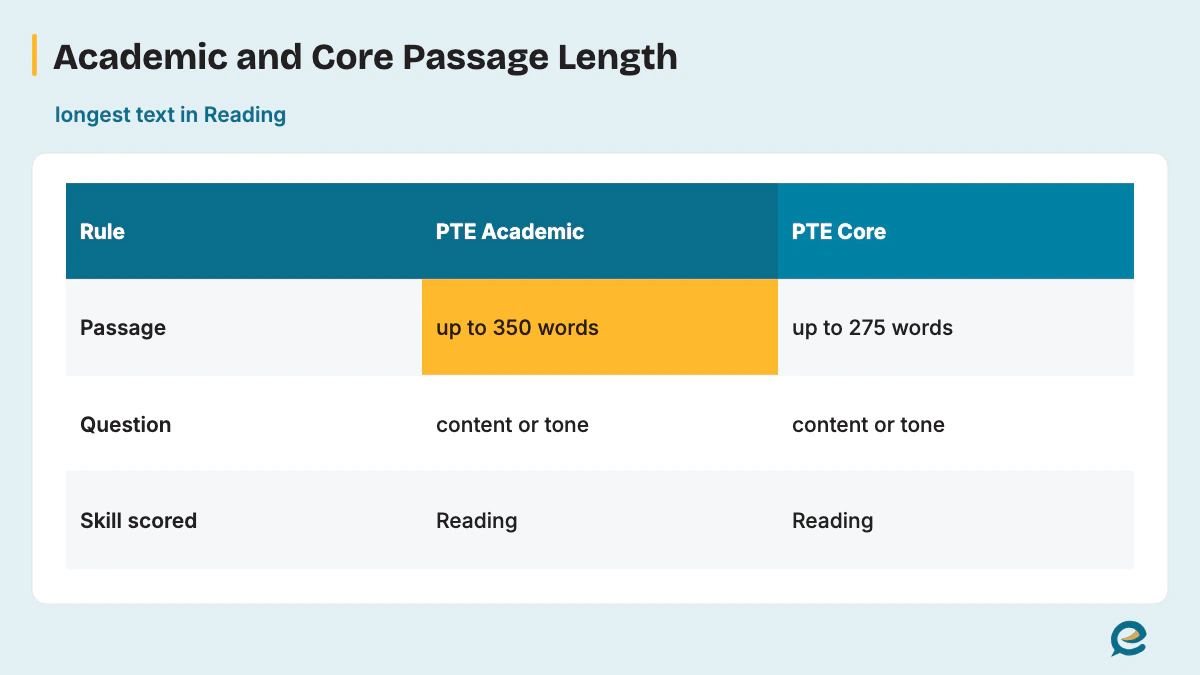
Pearson sets the passage at up to 350 words in PTE Academic and up to 275 words in PTE Core. Apart from that passage length and the item count, the two versions match.
| Feature | PTE Academic | PTE Core |
|---|---|---|
| Passage length | Up to 350 words | Up to 275 words |
| Subject | Academic subject | Academic subject |
| Question focus | Content or tone | Content or tone |
| Skill scored | Reading | Reading |
Some prep sites and an older Pearson article still say "up to 300 words". Pearson's current pages say 350 words for Academic and 275 words for Core. It has the highest permitted text length in Reading, so allow enough time to check its options without exhausting the shared timer.
How Many Multiple Choice Multiple Answer Questions Are in PTE Reading?
Pearson's Score Guides list 2-3 of these items in PTE Academic and 1-2 in PTE Core. The exact item count varies by test within that range, but the task is always the second task in the Reading part. In PTE Academic it sits among 15-20 Reading items in total, and in PTE Core among 13-18.
How Should You Manage Time on Reading Multiple Choice Multiple Answer?
This item has no timer of its own; the whole Reading part runs 23-30 minutes in PTE Academic and 27-37 minutes in PTE Core, so you set your own limit and move on when it is spent. Good time management on this task rests on four habits.
- Read the question and options before the passage so you know what to look for.
- Read closely only the parts of the passage that the options point to.
- Set a personal limit for the item during practice and keep it on test day.
- Move on once you have selected the options you can prove.
With 15-20 items in 23-30 minutes, PTE Academic averages about 1-2 minutes per Reading item. Pearson sets no per-item limit, so the "about two minutes per question" figure you may see is a practice target only. Because this is the longest text, a personal limit of 2-3 minutes here is reasonable. Win the time back on the 80-word drag-and-drop item, since one section timer covers all five Reading tasks.
Which Skills Does Reading Multiple Choice Multiple Answer Affect?
Only reading: Reading is the one entry under skills assessed on Pearson's task pages, and the task does not change your speaking, writing or listening scores.
Pearson's PTE Core block says it judges your ability to analyze, interpret and evaluate a short reading text on an academic subject. To analyze and evaluate an academic text means finding the main idea, locating the detail behind each option, drawing an inference the text supports and judging the writer's view or tone. A lost point here lowers only your Reading score.
How Is Reading Multiple Choice Multiple Answer Scored?
You earn one point for each correct option you select, partial credit is possible, and one point is deducted for each wrong option, per Pearson's Score Guides and PTE Core scoring block. Each kind of selection moves the item score in a fixed way.
| What you select | Effect on the item |
|---|---|
| A correct option | +1 |
| A wrong option | -1 |
| An unselected option | 0 |
| All options | Loses points (Pearson's tip) |
The Score Guides set a 0 minimum score for the item. Like every PTE question type, it is scored by AI, and it is not on Pearson's list of tasks that get an extra human review.
Is There Negative Marking in Reading Multiple Choice Multiple Answer?
Yes, Pearson says you lose points for incorrect options, so every wrong selection cancels a correct one. Because of this negative marking, selecting every option to collect the right ones by default loses points, one point deduction per wrong pick. Leave an option unselected unless the passage proves it, once you already hold at least one proven option. Pearson names this task and Highlight Incorrect Words as the tasks with deductions, and it counts Multiple Choice Multiple Answer in both Reading and Listening.
Multiple Choice, Single Answer has no deduction, so the guessing rule there is the opposite.
What Is the Minimum Score in Reading Multiple Choice Multiple Answer?
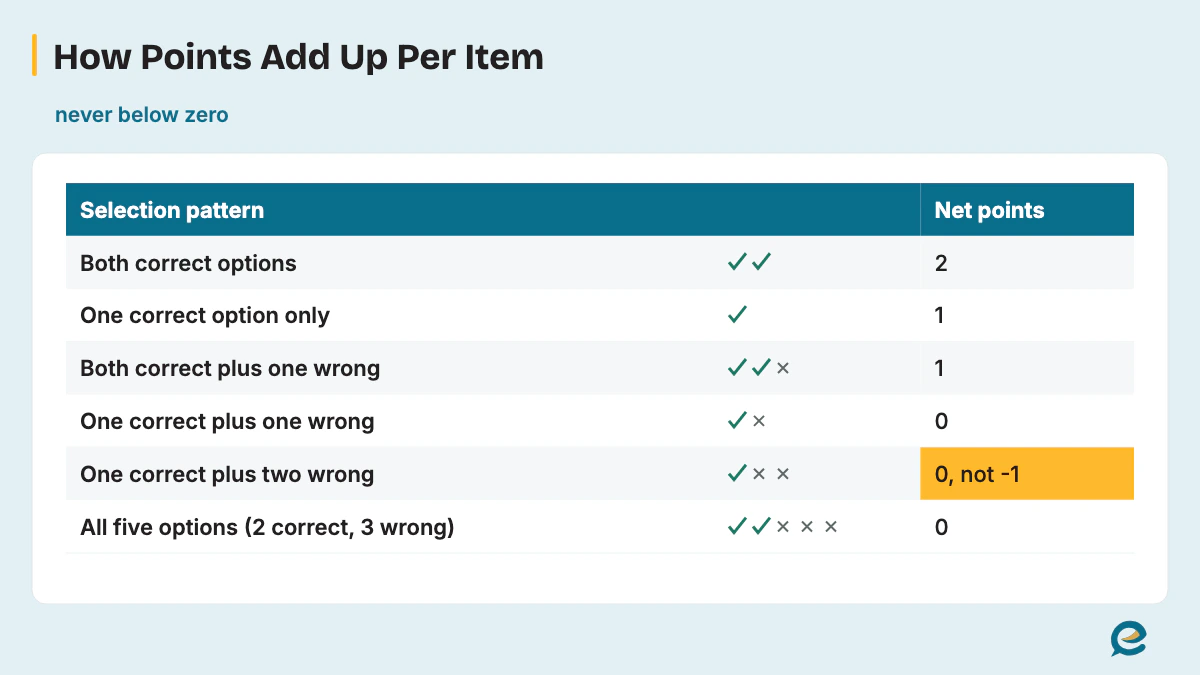
The minimum score is zero: deductions can cancel your correct options, but an item never goes below zero. The worked arithmetic below uses an item with two correct options and shows the net points for each pattern.
| What you select | Points |
|---|---|
| Both correct options | 2 |
| One correct option only | 1 |
| Both correct plus one wrong | 1 |
| One correct plus one wrong | 0 |
| One correct plus two wrong | 0, not -1 |
| Every option in this five-option example (two correct, three wrong) | 0 |
The zero floor is in Pearson's Score Guides and in Pearson's reading article, which says you cannot score below zero. Two correct options is only an example here, since Pearson does not fix the number.
What Does a Reading Multiple Choice Multiple Answer Sample Question Look Like?
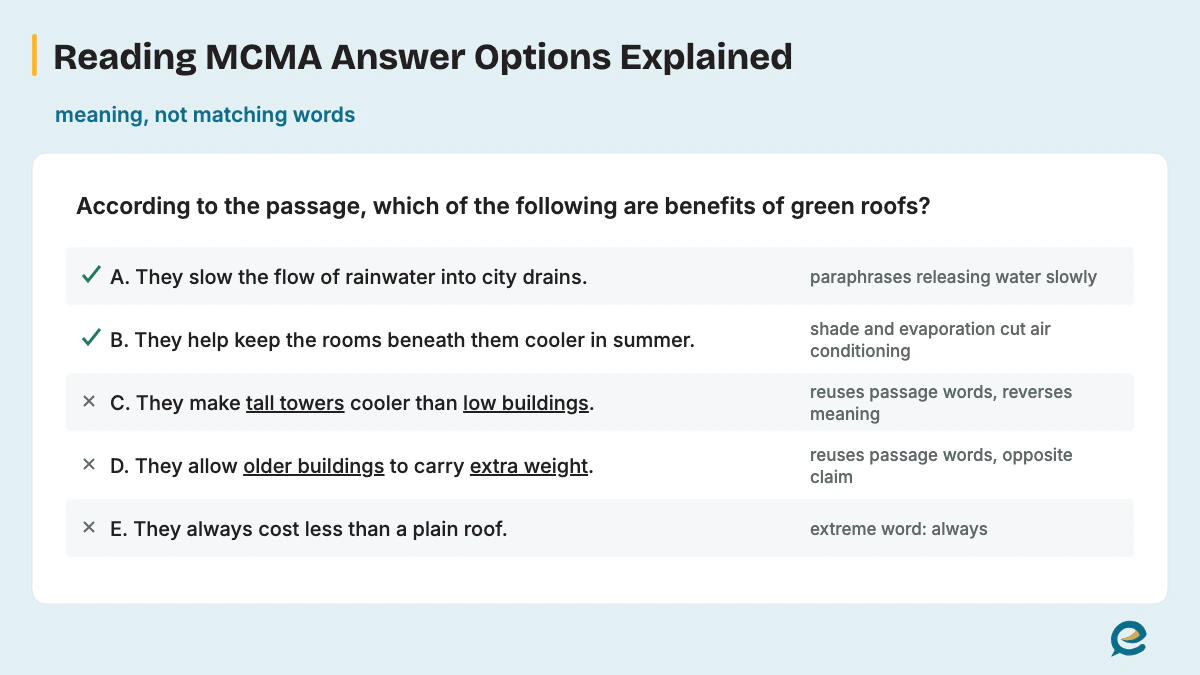
Each sample below gives you a short academic passage, a question about it, five or six options and two or three correct answers. The four sample passages below are original practice material, not real exam questions, and they are shorter than a full 350-word passage. Samples 1, 2 and 4 have five options and Sample 3 has six.
Sample 1: Green Roofs
Green roofs cover the top of a building with a waterproof layer, a thin growing medium and hardy plants. Planners first valued them for their appearance, but researchers now study what they do for the city around them. The clearest benefit is water control. During heavy rain, the growing medium holds part of the water and releases the rest slowly, which eases pressure on drains built for smaller storms.
A second benefit appears in summer. Plants shade the roof and cool the air as water evaporates from their leaves, so the rooms below need less air conditioning. The effect is strongest on low buildings, where the roof makes up a large share of the outer surface; on tall towers, the walls matter far more.
Cost remains the main barrier. A green roof needs a stronger structure than a plain one, and older buildings often cannot carry the extra weight without repairs. For this reason, most green roofs appear on new buildings rather than existing ones.
Question stem: According to the passage, which of the following are benefits of green roofs?
- A. They slow the flow of rainwater into city drains.
- B. They help keep the rooms beneath them cooler in summer.
- C. They make tall towers cooler than low buildings.
- D. They allow older buildings to carry extra weight.
- E. They always cost less than a plain roof.
Answer: A and B. The answer explanation for each option follows.
- A is correct: the growing medium "releases the rest slowly", which is a paraphrase of slowing the flow.
- B is correct: shade and evaporation mean "the rooms below need less air conditioning".
- C is wrong: it reuses "tall towers" and "low buildings" but reverses the passage, which says "The effect is strongest on low buildings".
- D is wrong: it reuses "older buildings" and "extra weight", yet the passage says those buildings "often cannot carry the extra weight".
- E is wrong: "always" overstates the passage, which calls cost "the main barrier".
Options C and D are distractors built from the passage's own words. A test taker who picks A, B and D gets 2 - 1 = 1 point instead of 2.
Sample 2: Roman Marine Concrete
Many Roman harbor walls have stood in seawater for about two thousand years, while some modern concrete structures in the sea begin to crack within decades. Roman builders mixed lime with volcanic ash, and in marine structures they often packed this mixture around chunks of rock. Seawater seeping into the material did not simply wear it down. Instead, it reacted with the ash and lime to form new minerals that grew into the cracks and pores, binding the material more tightly over time.
Researchers have also found small white lumps of lime scattered through some Roman concrete. When water enters a fresh crack, these lumps can dissolve and form new mineral deposits that help close it. Engineers are studying both processes, but Roman concrete gains strength more slowly than modern cement, so it is unlikely to replace it in buildings that must be finished quickly.
Question stem: Which of the following does the passage give as reasons Roman marine concrete has lasted so long?
- A. Seawater reacted with the ash and lime to form minerals that filled cracks and pores.
- B. Lumps of lime in the material could help seal new cracks.
- C. Roman builders kept seawater from seeping into the structures.
- D. Roman concrete gained strength faster than modern cement.
- E. The harbor walls were rebuilt every few decades.
Answer: A and B.
- A is correct: seawater "reacted with the ash and lime to form new minerals that grew into the cracks and pores".
- B is correct: the lumps "can dissolve and form new mineral deposits that help close it".
- C is wrong: the passage says seawater was "seeping into the material", so it was not kept out.
- D is wrong: it reverses the passage, which says Roman concrete "gains strength more slowly than modern cement".
- E is wrong: the walls "have stood in seawater for about two thousand years", and the passage never mentions rebuilding.
Selecting A, B and D gives 2 - 1 = 1 point. Selecting only A gives 1 point, which is the safe result when B still looks doubtful.
Sample 3: Volunteer Bird Surveys (Writer's View)
Each year, thousands of volunteers count the birds they see in gardens, parks and fields and send their records to research groups. No team of paid scientists could cover so many places at once, and the long run of records lets researchers track how common a species is over decades. The data are not perfect. Volunteers notice large, colorful birds more easily than small brown ones, and more people take part near cities than in remote areas.
Researchers therefore adjust the counts with statistical methods before drawing conclusions. Used with this care, the surveys have become a valuable source of information on how bird populations are changing. In my view, their worth lies less in any single count than in the pattern built up over many years.
Question stem: Which of the following reflect the writer's view of volunteer bird surveys?
- A. They cover more places than paid scientists alone could.
- B. Their records need adjusting before they support conclusions.
- C. Their main value comes from patterns across many years.
- D. They are less reliable than any study by paid scientists.
- E. Volunteers count small brown birds more carefully than colorful ones.
- F. Most volunteers live in remote areas.
Answer: A, B and C. This item has three correct options, which is why you never stop at two.
- A is correct: "No team of paid scientists could cover so many places at once."
- B is correct: researchers "adjust the counts with statistical methods before drawing conclusions".
- C is correct: "their worth lies less in any single count than in the pattern built up over many years".
- D is wrong: the writer says "The data are not perfect" but never compares them with every paid study, so the option is too general.
- E is wrong: it reverses the passage, which says volunteers notice "large, colorful birds more easily than small brown ones".
- F is wrong: "more people take part near cities than in remote areas".
A test taker who stops at A and B scores 2 out of 3, and one who picks A, B, C and D scores 3 - 1 = 2.
Sample 4: Railway Time
Before the railways, most towns kept their own local time, set by the position of the sun at midday. A town a few dozen miles to the west ran a few minutes behind its neighbor, which mattered little when travel by coach was slow. Fast trains changed that. A timetable that listed the local time at every station confused passengers and raised the risk of trains on the same line meeting unexpectedly.
In Britain, railway companies began in the 1840s to run their timetables on London time, and most towns gradually followed. In North America, the railroads introduced a small number of standard time zones in 1883. Some communities objected that clocks should follow the sun, not a company, and national laws making a standard time official came only years later.
Question stem: According to the passage, which of the following are true of railway time?
- A. It replaced local times that were based on the sun's position.
- B. It began in North America and was later copied in Britain.
- C. It was partly a response to safety risks on shared lines.
- D. Every community welcomed it as soon as it was introduced.
- E. National laws made it official at the same time the railways adopted it.
Answer: A and C.
- A is correct: towns kept local time "set by the position of the sun at midday", and most towns "gradually followed" railway time.
- B is wrong: it reverses the order; Britain began "in the 1840s", North America "in 1883".
- C is correct: local timetables "raised the risk of trains on the same line meeting unexpectedly".
- D is wrong: "Some communities objected", so "every" overstates the passage.
- E is wrong: national laws "came only years later".
Option B is the half-right trap: both places adopted railway time, but the option gets the order wrong.
How Do You Answer Reading Multiple Choice Multiple Answer Step by Step?
The method is simple: read the question first, note the words repeated across the options, scan the passage for them, then select only the options the passage proves. Each step below takes a few seconds once it becomes routine.
- Read the question stem and decide whether it asks about content or tone.
- Read the options and note repeated words, especially adjectives and nouns, as Pearson's tip suggests.
- Skim and scan in that order: skim the passage once for its main idea, and jot two or three key words if that helps you compare.
- Scan for the repeated words, then read the sentences around them closely.
- Strike out options with words such as must, always, never or only that the passage doesn't support.
- Test each remaining option against what the passage says, looking for a meaning match rather than a word match.
- Select only the proven options and leave the rest unselected.
What Are the Best Tips for Reading Multiple Choice Multiple Answer?
The best tips are to check every option directly against the passage, distrust options with extreme words, and leave an option unselected when unsure. These habits protect your points.
- Make a direct check of the text for each option, not of your memory of it.
- Beware extreme words such as always, only and never, which often overstate the passage.
- Keep to safe guessing: once you hold one proven option, an unproven one stays unselected.
- If no option is fully proven, still select the single most likely one, because the item cannot fall below zero.
- Expect the correct option to paraphrase the passage rather than copy it.
- Don't assume a fixed number of correct options.
Pearson's general multiple-choice tip says that if you cannot answer, choose the option most likely to be correct. On this task the zero floor makes that tip safe for your first pick only: one pick on an empty item scores 1 or 0, never -1. Every extra guess after a proven option risks cancelling a point you have already earned.
What Are Common Reading Multiple Choice Multiple Answer Mistakes?
The costly mistakes are picking an option because it repeats the passage's words, selecting too many options, and spending far too long on this one item. Each one costs either a point or minutes you need for later tasks.
- Word matching: choosing an option because it shares words with the passage often loses a point.
- Over-selecting: clicking every option loses points, as Pearson's tip warns.
- Assuming exactly two correct options leads to a forced wrong pick or a missed right one.
- Using outside knowledge instead of the passage adds options the text never proves.
- Reading the whole passage word by word before the question becomes a time drain.
- Carrying Listening habits into this Reading task wastes the chance to reread the text.
- Moving on without a final check of each selected option against its sentence.
The wrong options themselves follow a few patterns, and naming the pattern speeds up the check.
- Reversed: the option swaps the relationship, as in Sample 1, option C.
- Partly correct: one half matches the passage and the other half doesn't, as in Sample 4, option B.
- Too general or too strong: "every", "all" or "always" where the passage says "some", "most" or "often".
- Too specific: a precise figure or detail the passage never gives.
- Not stated: a claim that sounds sensible but has no sentence behind it, as in Sample 2, option E.
How Do You Practice Reading Multiple Choice Multiple Answer?
Effective practice means full-length passages under a personal time limit: select, check, and log why each wrong option looked right. A good practice loop starts with one timed attempt, then the selection, then an answer check against the passage.
Finish with a short error log that names the trap behind each lost point, using the patterns above. Pearson's reading article adds daily reading of short academic articles of about 300 words, a target of at least 220 words per minute, and reading in chunks rather than single words. It also advises learning synonyms and paraphrasing, because the correct answer generally doesn't reuse the text's words, so add the paraphrase pairs you meet in each passage to a word list.
How Is Reading Multiple Choice Different From Listening Multiple Choice?
Both tasks ask you to select more than one correct option and both deduct points for wrong ones. The Reading version works from a passage on screen and the Listening version from a recording heard once. That difference matters, because you can reread the passage but not a recording, so the lengths and timing in this guide belong to Reading only. See PTE listening multiple choice multiple answer for the audio task.
How Is Multiple Answer Different From Single Answer in PTE Reading?
Multiple Choice, Single Answer has one correct option, a text of up to 110 words and no deduction, so you always answer it; here a wrong pick costs a point. The guessing rule flips between the two tasks. Our guide to PTE reading multiple choice single answer covers the single answer method.
Which PTE Tasks Have Negative Marking?
Pearson names Multiple Choice Multiple Answer in Reading and Listening plus Highlight Incorrect Words as the tasks where wrong answers lose points. Our page on PTE negative marking explains how each point deduction works across the whole test.
How Do You Get 90 in Reading PTE?
A 90 in Reading needs accuracy on every task; on this one that means losing no points to doubtful selections. The PTE reading section overview covers preparation for your Reading score across all five tasks.
Practice PTE Reading on EasyEnglish
Try Reading tasks in a timed, computer-based format like the real test.
Try speaking practice without signing up. A free account is required for full mock tests. Practice scores are estimates, not official Pearson scores.
Written by
EasyEnglish Team
The team behind EasyEnglish's PTE practice and mock tests
EasyEnglish provides independent PTE practice and estimated scores. EasyEnglish is not affiliated with or endorsed by Pearson. Contact support@inverseai.com.
Format and scoring sources checked on 26 October 2026: Academic Reading; Core Reading; Academic Score Guide; Core Score Guide (January 2026). Academic and Academic UKVI details use the format introduced on 7 August 2025; Core details use its January 2026 Score Guide. Where a task page and Score Guide differ, the distinction is identified in the text; use the Guide for scoring criteria. Practice passages, names, figures, prompts and model answers are authored examples supplied with this guide, not authentic exam items or independently verified research findings. Suggested practice schedules and time splits are coaching advice, not Pearson requirements or score guarantees.
Reading pace suggestions come from Pearson's 8 July 2021 reading advice, checked 26 October 2026. They are practice targets, not requirements for a particular score.
Editorial review completed .