PTE Reading Multiple Choice Single Answer: Tips and Tricks
PTE Reading
In PTE Reading, Multiple Choice Single Answer closes the part with a short text of up to 110 words and a question or an unfinished sentence, and exactly one correct option earns the point. Pearson's PTE Academic and PTE Core Reading pages set the same 110-word limit for both tests, and Pearson's Score Guide puts 2-3 of these items in PTE Academic and 1-2 in PTE Core.
A wrong pick costs nothing, so you always answer. Two worked samples and ten practice questions further down let you test the method, with a reason for every wrong option.
Table of Contents
What Is PTE Reading Multiple Choice Single Answer?
PTE Reading Multiple Choice Single Answer is a reading item that gives you a text of up to 110 words and a question or sentence to complete, with only one correct option for you to select.
It's the fifth and last task of Part 2 Reading in both PTE Academic and PTE Core. Pearson's PTE Core page adds that the question is on the content or tone of the text, and you can select only one response. The task scores reading only. A separate Listening task with the same name works from a recording instead of a text.
What Are the Key Task Details of Reading Multiple Choice Single Answer?
The key details are up to 110 words of academic text in both PTE Academic and PTE Core, one question, several options, one correct answer and reading only. Pearson's task pages and Score Guides set each one, as the table shows.
| Detail | What Pearson says |
|---|---|
| Text length | Up to 110 words, Academic and Core |
| Prompt | A question or an unfinished sentence; Core says on content or tone |
| Response options | Words, phrases or sentences; "several," no fixed number |
| Answers allowed | One; it shows a yellow highlight; click it again or click another option to change it |
| Items per test | Academic 2-3, Core 1-2 |
| Position | Task 5 of 5 in Reading |
| Skill scored | Reading |
| Time to answer | Not applicable; shares the Reading part's time |
Some prep sites still print 300 words, or 100-150 words, for this text. Pearson's current pages give up to 110 words for both tests.
How Many Multiple Choice Single Answer Questions Are in PTE Reading?
PTE Academic has 2-3 Reading Multiple Choice Single Answer items and PTE Core has 1-2, according to Pearson's Test Taker Score Guides. The PTE Academic Test Taker Score Guide (2025) lists 15-20 Reading items in a part of about 23-30 minutes, so this task supplies only a small slice of the item count.
The PTE Core Score Guide (January 2026) lists 13-18 Reading items across its rows in 27-37 minutes. As the last task in Reading, it meets you with whatever section time left you have.
How Is Reading Multiple Choice Single Answer Scored?
Pearson marks it correct or incorrect: the right option earns 1 point, and a wrong option or no answer earns 0. Pearson says the item judges your ability to analyze, interpret and evaluate a short academic reading text. The Score Guide lists 1 point for a correct response and 0 as the minimum, so there is no partial credit.
The item feeds your Reading score only, and Pearson's scoring is automated, with some responses reviewed by a human expert before the score is final. Do not convert this item's raw point directly into a fixed share of the reported Reading score; the reported scale is 10-90.
Is There Negative Marking in Reading Multiple Choice Single Answer?
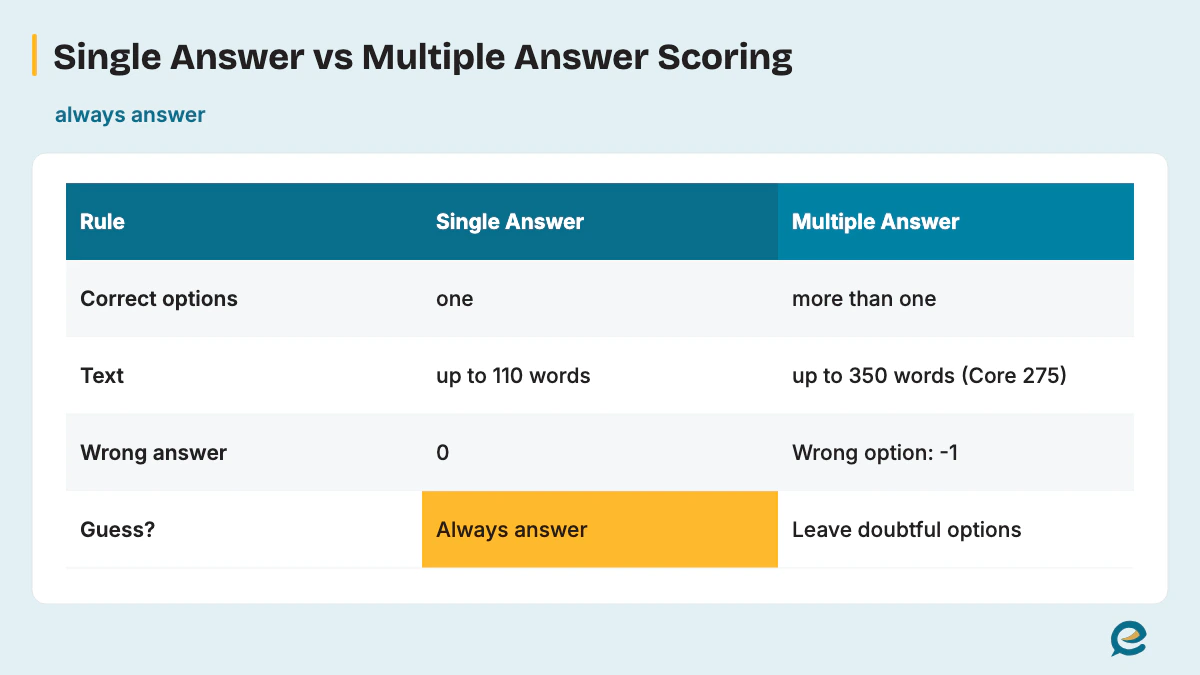
No, a wrong answer scores the same as a blank, so you should always answer. In the Score Guide, the only tasks that deduct points are Multiple Choice, Multiple Answers, in Reading and Listening, and Highlight Incorrect Words. Pearson's own tip says that if you can't answer after reading, pick the most likely option, the one you think has the best chance of being correct.
That guessing rule is the opposite of the Multiple Answer task, where each wrong pick costs a point.
How Should You Manage Time on Reading Multiple Choice Single Answer?
The item has no timer of its own; it shares the 23-30 minutes of the Reading part in PTE Academic (27-37 minutes in PTE Core). Good time management starts from one fact: Pearson sets this as the last task, so you need to keep time in hand for it.
Spread 23-30 minutes over 15-20 Academic Reading items and you get roughly 70 seconds to 2 minutes per item; that is our arithmetic, not a Pearson rule. A practice target of about 90 seconds for this short text protects the longer tasks, and four habits help you hold it.
- Read the prompt before the text so you know what to find.
- Read the 110-word text once for its main point.
- Go back only to the lines an option points to.
- If two options survive, pick the better-supported one and move on.
What Does a Reading Multiple Choice Single Answer Sample Question Look Like?
A sample item gives you a text of up to 110 words, one question, several options and one correct answer. The two samples here use five options each, and both are original practice material, not real exam questions. Sample 1 asks about a detail; Sample 2 is a main idea question. Read each sample text first, then the answer explanation under it.
Sample 1: a detail question
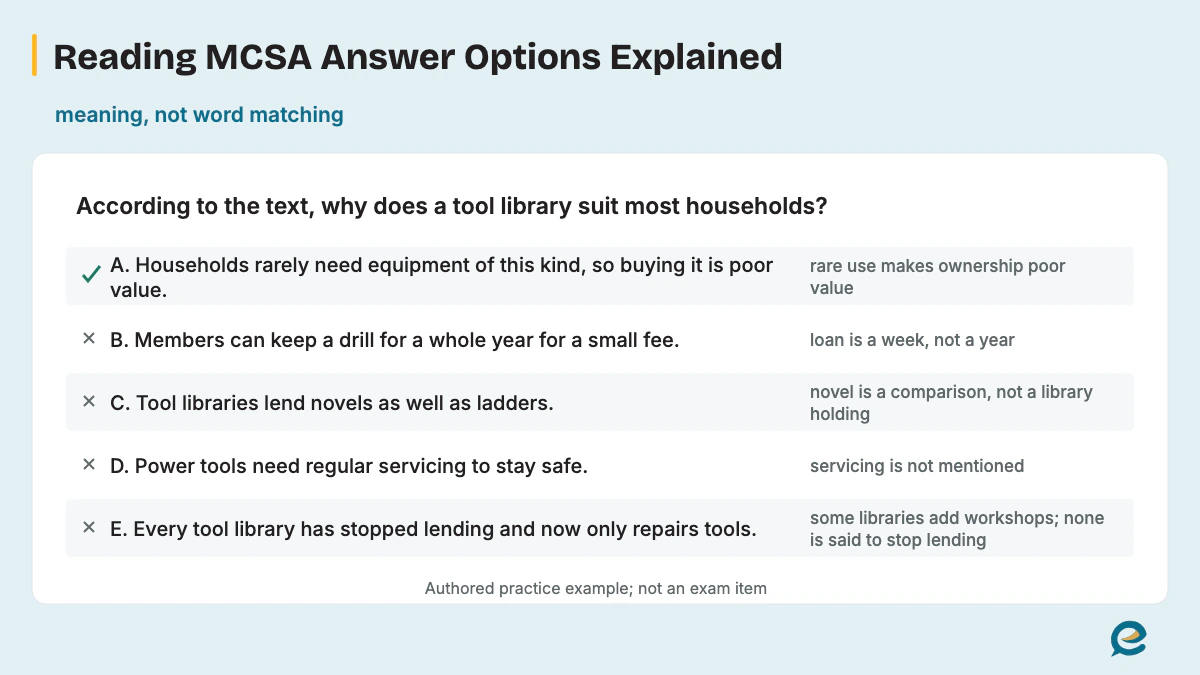
In several towns, residents can now borrow a drill, a ladder or a pressure washer from a tool library in the same way they borrow a novel. Members pay a small yearly fee and take items out for a week at a time. Organizers argue that most households use such tools only a few times a year, so owning one makes little sense. Sharing one machine among dozens of members also means fewer tools are manufactured and thrown away. Some libraries now run repair workshops as well.
Question stem: According to the text, why does a tool library suit most households?
- A. Households rarely need equipment of this kind, so buying it is poor value.
- B. Members can keep a drill for a whole year for a small fee.
- C. Tool libraries lend novels as well as ladders.
- D. Power tools need regular servicing to stay safe.
- E. Every tool library has stopped lending and now only repairs tools.
Answer: A. Here is why each option wins or fails.
- A is correct: it is the paraphrased answer, restating "use such tools only a few times a year, so owning one makes little sense" without sharing a key phrase with the text.
- B is wrong: it reuses "small yearly fee," but the loan lasts a week at a time.
- C is wrong: it reuses "borrow a novel," which only compares tool loans with book loans.
- D is wrong: servicing may matter in real life, but the text never mentions it.
- E is wrong: "every" and "only" overstate a text in which some libraries add workshops as well.
Sample 2: a main-idea question
Long before official weather stations existed, farmers, ship captains and clergy kept daily notes on rain, frost and wind. For years these diaries sat unread in archives, valued mainly by family historians. Climate scientists now treat them as data. Volunteers transcribe the entries, and researchers compare them with modern records to see how storms and growing seasons have shifted over centuries. The notes are uneven, since each writer used their own words and instruments, but cross-checking between diaries removes many errors.
Question stem: What is the writer's main point?
- A. Private weather notes, once ignored, have become useful evidence for climate research.
- B. Family historians are the main readers of archive diaries today.
- C. Volunteers transcribe the entries because scientists can't read old handwriting.
- D. Modern weather stations are more accurate than human observers.
- E. Old diaries contain no errors once they have been cross-checked.
Answer: A. It sums up the whole text, from the unread archives to the new scientific use.
- B is wrong: it reuses "family historians," who valued the diaries in the past, not now.
- C is wrong: it reuses "volunteers transcribe the entries" and adds a reason the text never gives.
- D is wrong: it may be true, but the text doesn't compare accuracy.
- E is wrong: cross-checking removes many errors, not all of them.
In both samples, the distractors built from the text's own words fail on meaning, while the correct option says the same thing in new words.
What Are Some Reading Multiple Choice Single Answer Practice Questions With Answers?
Ten more original practice questions follow, spread across eight question types, each with one answer key and a reason why every wrong option fails. They are not real exam questions. Answer each one under a 90-second limit before you read its key, and note which trap caught you.
Practice 1: detail
When one rural school district moved to a four-day week, it hoped mainly to cut transport and heating costs. The savings proved small, about two percent of the budget, because teachers' salaries, the largest expense, did not change. The change had another effect, however. The district found it easier to recruit teachers, many of whom said the free weekday was the main attraction. Parents were less united: some welcomed longer family weekends, while others had to pay for childcare on the fifth day.
Question: What unexpected advantage did the district find?
- A. The budget fell by a large share.
- B. Filling teaching posts became less difficult.
- C. Teachers' salaries were reduced.
- D. All parents supported the longer weekend.
- E. Students' test results improved.
Answer: B. A is contradicted (about two percent). C reuses "teachers' salaries," which did not change. D overstates; parents were split. E is never mentioned.
Practice 2: main idea
Before refrigerators, cooks in many cultures preserved vegetables, milk and fish by fermenting them. In this process, bacteria or yeasts feed on the sugars in food and produce acids or alcohol. These products make the food hostile to the microbes that cause rot, so cabbage can become sauerkraut that lasts for months. Fermentation also changes flavor and texture, which is why foods first made to survive a winter are now eaten by choice all year round.
Question: What is the main idea of the passage?
- A. Fermentation began as a way to stop food spoiling and is now enjoyed for its taste as well.
- B. Refrigerators replaced fermentation in every culture.
- C. Bacteria in food always make it rot.
- D. Sauerkraut is the only fermented food that keeps for months.
- E. Yeasts work better than bacteria in fermentation.
Answer: A. B overstates and is never stated. C contradicts the text, where some microbes protect food. D turns one example into an "only" claim. E compares two things the text never compares.
Practice 3: tone
Smartphone apps now let anyone record the birds they see and send the sightings to researchers. The volume of data is remarkable: a single weekend survey can produce more records than a small team of specialists could gather in years. Yet enthusiasm should not hide the limits. Volunteers tend to report from parks and gardens near cities, so remote habitats stay thinly covered, and rare species are sometimes misidentified. Used with these weaknesses in mind, the apps are a valuable addition to professional fieldwork, though not a replacement for it.
Question: Which best describes the writer's attitude toward bird-recording apps?
- A. Positive, but aware of their weak points.
- B. Strongly opposed, because the data can't be trusted.
- C. Convinced they can take the place of professional fieldwork.
- D. Uninterested in how the data are collected.
Answer: A. B ignores "a valuable addition." C reverses "not a replacement." D clashes with the writer's close attention to where volunteers report from.
Practice 4: word in context
One city council gave tentative approval to a protected bike lane on its main shopping street last spring. Before any concrete barriers are built, the lane will be marked with temporary posts for six months. Traffic engineers will count cyclists, measure delays for buses and collect complaints from shop owners. If the numbers support it, the council will vote again on a permanent design; if not, the posts can be removed in a day.
Question: The word "tentative" in the text is closest in meaning to
- A. final
- B. provisional
- C. unanimous
- D. secret
Answer: B. The approval depends on a trial and a second vote. A is contradicted by that second vote. C and D describe how a vote might go or be held, which the text never says.
Practice 5: writer's purpose
For centuries, a lighthouse needed a keeper who climbed the tower each evening, trimmed the wick and kept the lamp burning until dawn. During the twentieth century, electric lamps, automatic switches and later remote monitoring took over these tasks one by one. By the end of that century, lighthouses in Britain ran with no one living on site, and the last resident keepers left in 1998. Many keepers' cottages have since become museums or holiday homes.
Question: What is the main purpose of the text?
- A. To explain how technology ended the need for resident lighthouse staff.
- B. To argue that lighthouses should return to human keepers.
- C. To describe how keepers' cottages became museums.
- D. To list the British lighthouses that lost their keepers in 1998.
- E. To show that ships no longer need lighthouses.
Answer: A. B gives the writer an opinion the text never states. C is a minor detail from the last sentence. D reuses "1998," which only dates the end of the change. E may sound plausible, but ships are never mentioned.
Practice 6: inference
Linguists judge the health of a language less by how many people speak it than by who those speakers are. A language with thousands of speakers can still be in danger if almost all of them are grandparents. Once parents stop using it with their children at home, schools and radio programs rarely make up the loss on their own. Programs that pair elders with young families, so the language is heard in daily life, have shown better results.
Question: What can be inferred from the passage?
- A. A language spoken mostly by older people may die out even if it has many speakers.
- B. A language is safe as long as schools teach it.
- C. Radio programs are the best way to save a language.
- D. Linguists decide a language's health mainly by counting its speakers.
- E. Grandparents no longer speak to their grandchildren.
Answer: A. B contradicts "rarely make up the loss on their own." C contradicts the same line. D reverses "less by how many people speak it." E is a sweeping claim the text never makes.
Practice 7: unfinished sentence
Staff at one hospital measured noise on its wards at night and found that alarms, rolling carts and talk at the nurses' station often went well above the levels advised for patient rooms. Patients who slept badly asked for more pain relief the next day. The hospital then dimmed corridor lights after 10 p.m., replaced squeaky cart wheels and moved routine checks so that patients were woken less often. Complaints about noise fell within a month.
Question: The hospital's changes were mainly intended to
- A. reduce the number of nurses on night shifts.
- B. help patients sleep with fewer interruptions.
- C. stop every alarm from sounding at night.
- D. replace the hospital's old carts with new ones.
- E. brighten the corridors for night staff.
Answer: B. A is never mentioned. C overstates; the text targets noise, not every alarm. D twists "replaced squeaky cart wheels." E is contradicted, since the lights were dimmed.
Practice 8: function of a detail
In the early nineteenth century, each town in Britain kept its own local time, set by the position of the sun. Bristol's clocks, for example, ran more than ten minutes behind London's. This mattered little when travel was slow, but railway timetables became confusing when every station used a different hour. In the 1840s, railway companies began running their trains on London time, and most towns had adopted it within about fifteen years.
Question: Why does the writer mention Bristol?
- A. To give an example of how local times differed between towns.
- B. To show that Bristol was the first town to adopt London time.
- C. To suggest that trains to Bristol usually ran late.
- D. To explain why travel was slow in that period.
Answer: A. B is never stated. C twists "ran more than ten minutes behind," which describes clocks, not trains. D answers a different question; slow travel is background, not the reason for the example.
Practice 9: main idea
Many cities once lined whole avenues with a single species of tree, chosen for its shape and its tolerance of city air. When Dutch elm disease spread in the twentieth century, some of those cities lost most of their street trees within a few years. Planners now follow a different rule: no single species, and ideally no single genus, should make up a large share of the urban forest. A pest that attacks one kind of tree can then thin the canopy but not remove it.
Question: What is the main point of the passage?
- A. Cities now plant a mix of trees so that one pest can't wipe most of them out.
- B. Dutch elm disease has now been wiped out.
- C. City trees are chosen mainly for their shape.
- D. Single-species avenues suit city air best.
- E. Planners have banned elms from every city.
Answer: A. B is never stated. C reuses "chosen for its shape," which describes the old practice. D reuses "city air" but backs the approach the text rejects. E overstates the planners' rule.
Practice 10: supported statement
Most large museums display only a small fraction of what they own; the rest sits in storage. Photographing objects and publishing them online lets students and researchers study items they could never see in person. The work is slow, however. Each object must be cleaned, measured, photographed from several angles and described in a catalog record, and one fragile textile can take a conservator a full day. For this reason, many museums put the items researchers ask for most online first.
Question: Which statement is supported by the text?
- A. Museums often decide what to put online first by how much demand there is.
- B. Most museum objects are on public display.
- C. Online images have replaced visits to museums.
- D. Every object takes a full day to digitize.
- E. Conservators refuse to handle fragile textiles.
Answer: A. B contradicts "only a small fraction." C is never stated. D turns one textile into "every object." E contradicts the conservator spending a full day on a textile.
How Do You Answer Reading Multiple Choice Single Answer Step by Step?
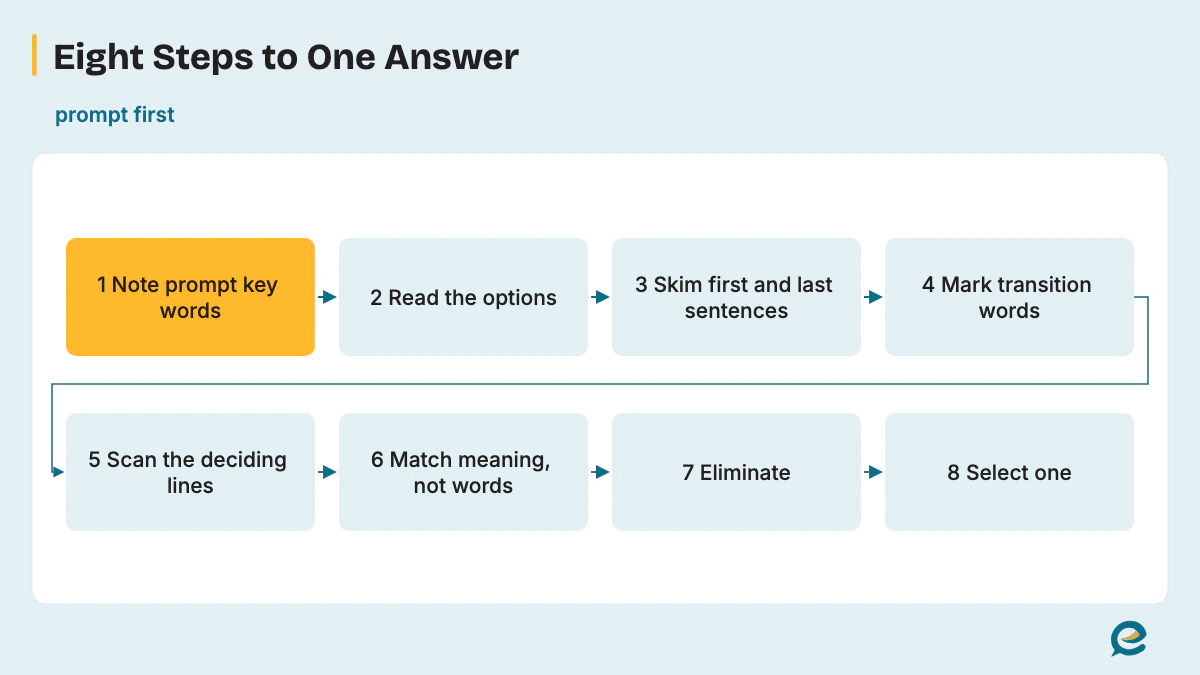
The method runs in a fixed order: note the prompt key words, judge the options, skim and scan the text, then eliminate until one option is left. The first step is Pearson's own tip; the rest are reading technique that turns it into a routine.
- Note the prompt key words, as Pearson advises, and decide whether the prompt asks for the main idea, a detail, the writer's purpose or tone.
- Read the options so you know what each one claims.
- Skim the text, reading its first and last sentences closely, since they often carry the core idea.
- Mark transition words such as however, in contrast, therefore and as a result, because they show where the writer turns or concludes.
- Scan for the lines that the key words point to.
- Check each option's meaning against those lines, not its words.
- Use a process of elimination to drop options the text contradicts, never mentions or overstates.
- Select the one option left; if two remain, pick the one the text supports more directly, which is your main point check.
Should You Use Outside Knowledge in Reading Multiple Choice Single Answer?
Use outside knowledge only to judge which options look likely before you read; the final choice must come from the text. Pearson's tip says you can use what you know to decide whether options are likely or unlikely, even before reading. Some prep advice bans outside knowledge, because an option can be true in the world but absent from the text.
Both points hold: knowledge narrows the likely options, and text evidence decides. Option D in Sample 1 and option E in Practice 5 show the risk of letting knowledge make the final pick.
How Do You Spot Trap Options in Reading Multiple Choice Single Answer?
Trap options repeat the text's words but change the meaning, and Pearson notes that the words of the text are generally not used in the correct answer. The samples and practice set above contain every trap type listed here.
- A word match option reuses the text's words with a changed meaning.
- A true-in-general option states a real fact the text never mentions.
- Overstated options push the text too far with words such as always, all, only or never.
- An off-target option answers a different question than the prompt asks.
- A partial option covers only one part of the main idea.
- A minor-detail option picks one example when the prompt asks for the main point.
- A reversed option flips cause and effect, or past and present.
Learning synonyms and paraphrase is Pearson's own advice for this task, from its 2021 reading article.
How Do You Practice Reading Multiple Choice Single Answer?
Effective practice means short academic texts under a personal time limit, a reason for every wrong option, and daily reading for paraphrase awareness. Run a practice loop: a timed attempt, a check, and a one-line reason per option, starting with the twelve items above.
Keep an error log of the trap types you fall for, and review it each week. To build your own items, take a 100-word paragraph from an editorial or opinion piece. Write one main-idea and one tone question about it, since editorials train the tone and argument reading that PTE Core asks about. Pearson's reading article adds daily reading of short articles of around 300 words, aiming for at least 220 words per minute.
How Does Multiple Choice Single Answer Fit Into PTE Reading?
It closes the five Reading tasks, after Fill in the Blanks (Drag and Drop), and its 2-3 items share one timed Reading part with 13-17 other items in PTE Academic. Pearson's Score Guide scores all five as Reading items. The other four tasks are covered in our guide to PTE Reading, with their formats and scoring.
How Is Multiple Choice Single Answer Different in PTE Core?
PTE Core keeps the 110-word limit and the correct-or-incorrect scoring. It sets 1-2 items instead of 2-3, describes the question as being on the content or tone of the text, and gives Reading 27-37 minutes. The full list of differences is in PTE Academic vs Core.
Which PTE Reading Tasks Have Negative Marking?
In Reading, only Multiple Choice, Multiple Answers deducts a point for each wrong option, down to a minimum of 0. Across the whole test, Highlight Incorrect Words and the Listening Multiple Answers task deduct too. Our guide to PTE negative marking sets out the full rule.
How Is Single Answer Different From Multiple Answer in PTE Reading?
Multiple Choice Multiple Answer has more than one correct option, a longer text of up to 350 words (275 in PTE Core) and a point lost for each wrong pick. Single Answer allows only one right choice and takes nothing away for a wrong one. That is why you always answer here but leave doubtful options unselected there. Our guide to PTE reading multiple choice multiple answer covers that task.
How Is Reading Single Answer Different From Listening Single Answer?
The Listening task asks the same kind of one-answer question about a recording heard once; the Reading task gives you a text you can reread. The timings and text lengths here belong to the Reading version only, not the Listening version. See PTE listening multiple choice single answer for the audio task.
Which Is the Toughest Section in PTE?
Difficulty depends on the test taker; Pearson does not rank its parts, so compare the question types and judge your own weak tasks. Our page on PTE question types lays out every task side by side.
How Do You Get 100% on Multiple-Choice Questions?
No method guarantees full marks, but three habits protect the points you can earn: read the prompt first, match meaning rather than words, and always answer. Our PTE reading tips page trains those reading habits across all five tasks, and the Score Guide awards the full point only for the single correct option.
Practice PTE Reading on EasyEnglish
Try Reading tasks in a timed, computer-based format like the real test.
Try speaking practice without signing up. A free account is required for full mock tests. Practice scores are estimates, not official Pearson scores.
Written by
EasyEnglish Team
The team behind EasyEnglish's PTE practice and mock tests
EasyEnglish provides independent PTE practice and estimated scores. EasyEnglish is not affiliated with or endorsed by Pearson. Contact support@inverseai.com.
Format and scoring sources checked on 26 October 2026: Academic Reading; Core Reading; Academic Score Guide; Core Score Guide (January 2026). Academic and Academic UKVI details use the format introduced on 7 August 2025; Core details use its January 2026 Score Guide. Where a task page and Score Guide differ, the distinction is identified in the text; use the Guide for scoring criteria. Practice passages, names, figures, prompts and model answers are authored examples supplied with this guide, not authentic exam items or independently verified research findings. Suggested practice schedules and time splits are coaching advice, not Pearson requirements or score guarantees.
Reading pace suggestions come from Pearson's 8 July 2021 reading advice, checked 26 October 2026. They are practice targets, not requirements for a particular score.
Editorial review completed .