PTE Reading Fill in the Blanks: Rules, Examples and Tips
PTE Reading
You'll meet Fill in the Blanks (Drag and Drop) as the fourth task in PTE Reading, and PTE Core calls it simply "Fill in the Blanks". The drop-down task, Reading & Writing: Fill in the Blanks, is a different task with its own page. In this drag-and-drop task, a text of up to 80 words shows gaps, a word box below holds more words than gaps, and you drag one word into each gap.
Pearson's Reading pages for PTE Academic and PTE Core set those rules, and its PTE Academic Test Taker Score Guide adds the count: 4-5 drag-and-drop items per test, each gap worth one point. A wrong word costs nothing, so those points go to whoever reads the clues around each gap: grammar, collocation and meaning.
Table of Contents
What Is PTE Reading Fill in the Blanks?
PTE Reading Fill in the Blanks is the Reading task in which you complete a short text by dragging words from a box into its gaps. Each item is an 80-word text at most, and the box below it always holds more words than gaps, so some words stay unused. It's the fourth Reading task of five in Pearson's order, and you can drag and drop a word from one gap to another or back to the box.
Pearson judges your answer on how well you use context and grammatical cues, so the task draws on vocabulary, grammar and reading comprehension together. It appears in PTE Academic, PTE Academic UKVI and PTE Core, where Pearson's page names it "Fill in the Blanks".
How Does Drag and Drop Differ From the Dropdown Fill in the Blanks?
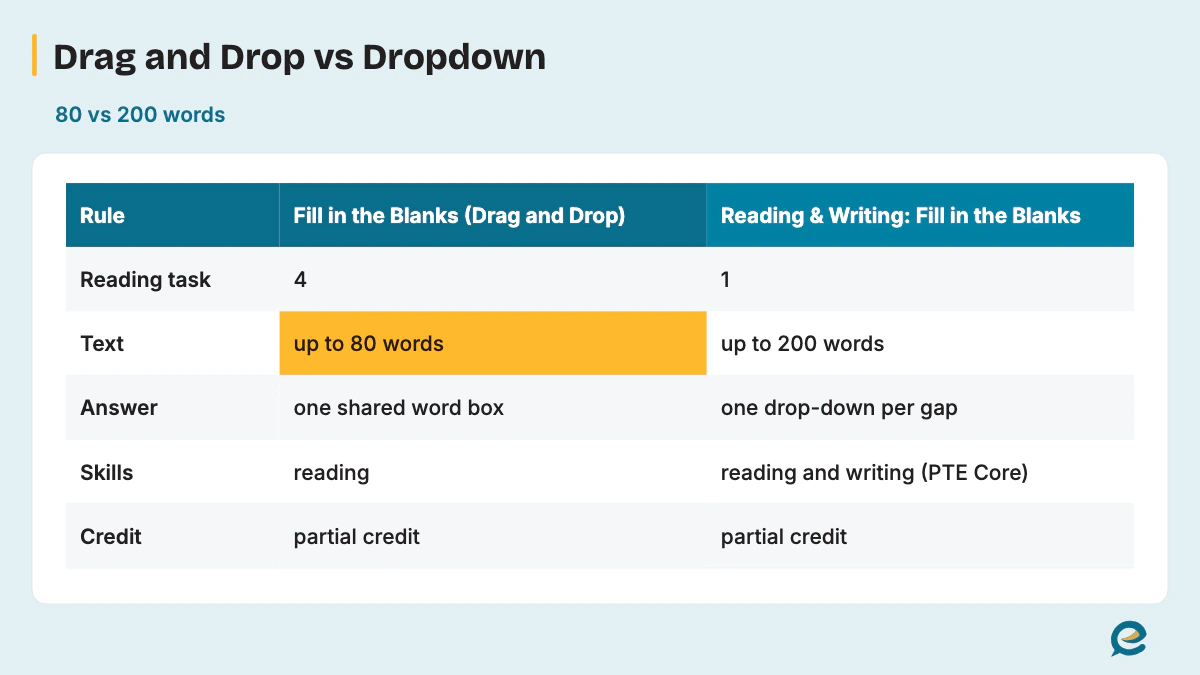
The drag-and-drop task gives one shared word box for a text of up to 80 words and scores reading only. The drop-down task gives a separate menu for each gap in a 200-word text at most, and in PTE Core it scores reading and writing. Task position, text length and answer method separate the two at a glance.
| Feature | Fill in the Blanks (Drag and Drop) | Reading & Writing: Fill in the Blanks |
|---|---|---|
| Task position in Reading | Task 4 | Task 1 |
| Text length | Up to 80 words | Up to 200 words |
| How you answer | One shared word box | One drop-down per gap |
| Skills scored | Reading | Reading and writing in PTE Core |
| Items per test (Score Guide) | 4-5 | 5-6 |
| Credit | Partial credit | Partial credit |
Some prep sites still quote "up to 300 words" for the drop-down passages; Pearson's current pages say up to 200.
How Do You Answer Reading & Writing Fill in the Blanks?
Reading & Writing: Fill in the Blanks asks you to pick one word from a separate drop-down list for each gap, so the method there is about matching meaning and grammar inside each list. Its text runs up to 200 words, and in PTE Core it counts toward reading and writing. Our page on PTE reading and writing fill in the blanks covers that task step by step.
What Are the Format and Rules of PTE Reading Fill in the Blanks?
The text appears with gaps and a word box below it, and the task has no timer of its own. You drag a word into each gap and can drag between gaps or back to the box before you move on. Each stage of an item follows one rule.
| Stage | What happens | Rule |
|---|---|---|
| Text appears | A text of up to 80 words shows several gaps. | Read it for meaning first. |
| Word box | More words than gaps sit below the text. | Some unused words stay in the box. |
| Dragging | You drag a word into a gap. | One word per gap. |
| Changing an answer | You drag between gaps or back to the box. | Change freely before you click Next. |
| Time | No per-item timer applies. | 23-30 minutes for all Reading in PTE Academic, 27-37 in PTE Core. |
| Moving on | You click Next. | Fill every gap first. |
The section time covers all five Reading task types, so every minute spent here comes out of the other tasks.
How Does PTE Reading Fill in the Blanks Scoring Work?
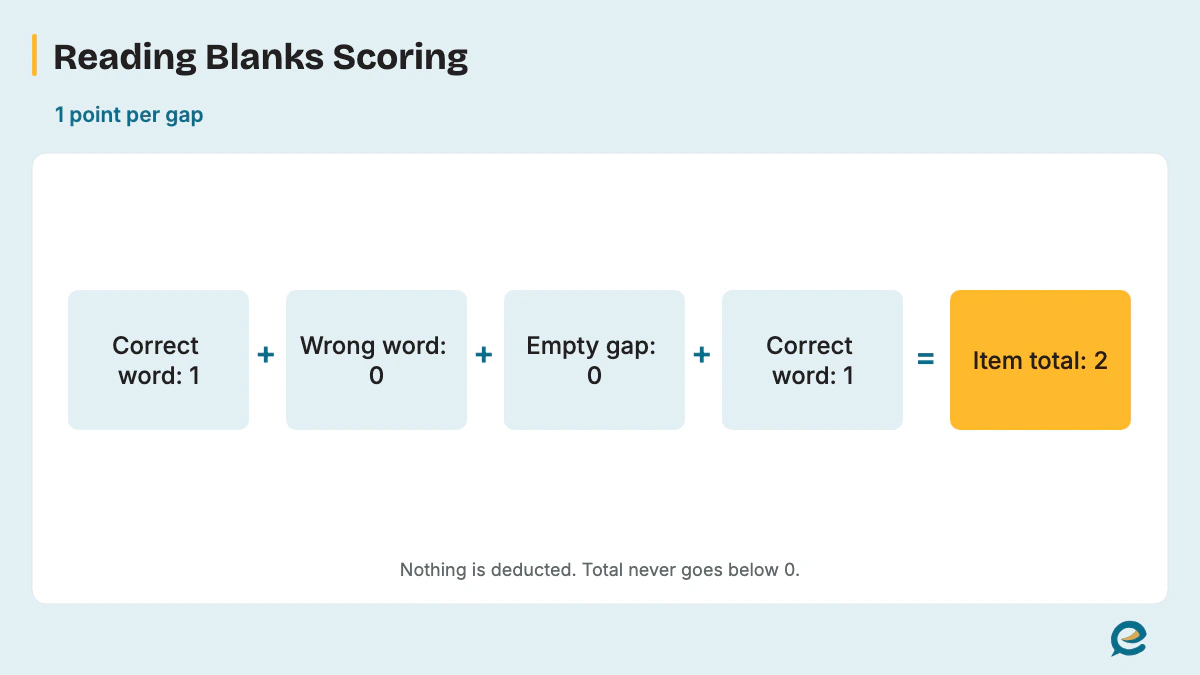
Pearson awards one point per gap filled correctly, with partial credit and no deduction, and the task counts toward reading only. Each outcome maps to a simple result.
| What you do | Result |
|---|---|
| Correct word in a gap | 1 point |
| Wrong word in a gap | 0 for that gap |
| Gap left empty | 0 |
| All gaps correct | Maximum points for the item |
| Total for the item | Never below zero |
Pearson judges the task on your ability to use context and grammatical cues to complete a reading text. The Score Guide sets the minimum item score at 0, so a wrong word never cancels a right one. Multiple Choice, Multiple Answers is the only Reading task that deducts points, and the same scoring rule applies in PTE Core.
How Many Reading Fill in the Blanks Are in PTE?
Pearson's PTE Academic Test Taker Score Guide lists 4-5 Fill in the Blanks (Drag and Drop) items per test. The same Score Guide table lists 5-6 drop-down items, so the two Fill in the Blanks tasks make up 9-11 of your Reading items.
All of them run on a shared timer with the other three Reading task types inside the 23-30 minute Reading part. Pearson publishes no per-item time, so keep a steady pace on these short texts and save minutes for the longer Multiple Choice passages.
Is Fill in the Blanks Important in PTE Reading?
Yes, every gap scores on its own and nothing is deducted, so each correct word adds to your Reading score and guessing can only help. With 4-5 items of several gaps each, the task hands you many separate scoring points in one section.
Per-gap scoring also means one hard gap doesn't sink the whole item. The task counts toward reading only, unlike the drop-down task in PTE Core, which also feeds writing. The linked task tables describe raw scoring rather than a fixed conversion to a reported-score percentage.
What Does a PTE Reading Fill in the Blanks Example Look Like?
A typical item is a short academic text of up to 80 words with four or five gaps and a word box holding a few extra words. This original sample text has 65 words and five gaps; it isn't a real exam question.
Urban gardens are spreading in many large cities. They give residents a place to grow food and (1) ________ the local environment. Studies suggest that green spaces can (2) ________ stress and improve mood. Yet the (3) ________ public often knows little about how these gardens are run. Most rely on volunteers who meet several (4) ________ a week, and their future depends (5) ________ steady support from local councils.
Word box: protect, reduce, general, times, on, common, time, in
Each line of the answer key names the clue and the tempting distractor that fails.
- protect: "and" joins a second verb to "grow", so a verb fits; "reduce" is a verb too, but nobody wants to reduce the environment (meaning clue).
- reduce: "can" needs a base verb (a part-of-speech clue), and stress is something you lower; "protect stress" makes no sense (meaning clue).
- general: "the general public" is a fixed collocation clue; "common" is an adjective but "the common public" isn't a set phrase.
- times: "several" needs a plural noun, and "times a week" is the set phrase; "time" fails the plural clue because it's singular.
- on: "depends on" fixes the preposition; "in" doesn't follow "depend".
Every word in this box tempts at least one gap, so elimination alone can't solve it. The 11 practice texts in the next section use the same layout.
Where Can You Practice PTE Reading Fill in the Blanks With Answers?
The 11 original practice texts below follow the test format: a text of up to 80 words, four gaps, and a word box with more words than gaps. Try each one before you read its answers, and name the clue for every gap.
Practice text 1: Desert plants
Desert plants survive with very little rain. A cactus (1) ________ water in its thick stem and uses it slowly during dry months. Botanists have (2) ________ that many desert species open their pores only at night, when the air is cooler. This habit makes them far less (3) ________ to lose water through their leaves. Plant breeders now study these species to (4) ________ crops that need less irrigation.
Word box: stores, store, shown, showed, likely, probable, develop, development
Answers: (1) stores: singular subject "A cactus" needs -s. (2) shown: "have" needs the past participle; "showed" is past simple. (3) likely: "less likely to" is the collocation; "probable" doesn't take "to". (4) develop: "to" needs a base verb, not the noun.
Practice text 2: The telegraph
The electric telegraph (1) ________ long-distance communication in the 1840s. Before it, a message could travel only as fast as a horse or a ship. With telegraph lines, news crossed a country in minutes, so a far (2) ________ share of people could follow events as they happened. This jump in (3) ________ also changed trade, because merchants began to (4) ________ prices in distant markets almost at once.
Word box: transformed, transforms, greater, great, speed, speedy, compare, comparison
Answers: (1) transformed: the time marker "in the 1840s" needs past simple. (2) greater: "far" before a gap signals a comparative. (3) speed: "jump in" needs a noun, not the adjective. (4) compare: "began to" needs a base verb.
Practice text 3: Inflation
Inflation measures how quickly prices (1) ________ over time. When it is high, each unit of money buys less, so households feel (2) ________ even if their income stays the same. Central banks often respond (3) ________ raising interest rates, which makes borrowing more expensive. Although this can slow price growth, it can also (4) ________ business investment.
Word box: rise, rises, poorer, poverty, by, to, reduce, boost
Answers: (1) rise: plural "prices" takes the verb without -s. (2) poorer: "feel" takes an adjective, not a noun. (3) by: "respond by raising" describes the method of responding; "respond to raising" would make the raising itself the trigger, which is not the meaning here. (4) reduce: "Although" flags a contrast, so the second clause names a downside.
Practice text 4: Wetlands
Wetlands act as natural filters. Plants and soil (1) ________ pollutants from water before it reaches rivers and lakes. Wetlands also store large amounts of carbon, which makes them (2) ________ in efforts to limit climate change. Yet many have been drained for farming and building. As a (3) ________, several governments now fund projects that restore damaged sites and (4) ________ the ones that remain.
Word box: remove, removal, valuable, value, result, effect, protect, protection
Answers: (1) remove: "remove X from Y" is the verb pattern. (2) valuable: "makes them" plus an adjective. (3) result: "as a result" is the fixed phrase. (4) protect: "and" joins it to the verb "restore".
Practice text 5: Electric car batteries
Electric cars depend (1) ________ batteries that store a large amount of energy in a small space. Early models could travel only short distances before they needed (2) ________ charge. Since then, engineers (3) ________ improved battery chemistry, so today's cars can go much further. The next challenge is to make batteries from materials that are easier to (4) ________ at the end of their life.
Word box: on, of, a, an, have, has, recycle, recycling
Answers: (1) on: "depend on" is fixed. (2) a: "charge" starts with a consonant sound, so "an" fails. (3) have: "Since then" needs present perfect, and plural "engineers" takes "have". (4) recycle: "easier to" needs a base verb.
Practice text 6: Hand washing
Washing hands with soap is one of the most (1) ________ ways to stop infections from spreading. Soap breaks down the oily layer that (2) ________ many germs, so they rinse away with water. Health experts advise people to wash well, especially before eating and after (3) ________ public transport. The habit costs almost nothing, yet it (4) ________ the risk of common illnesses.
Word box: effective, effectively, protects, protect, using, used, lowers, raises
Answers: (1) effective: "the most" before a noun needs an adjective, not an adverb. (2) protects: "that" refers to "the oily layer", so the relative clause needs the singular verb "protects". (3) using: "after" as a preposition takes an -ing form. (4) lowers: "yet" contrasts low cost with a real benefit.
Practice text 7: Online learning
Online courses give students the freedom to study at their own (1) ________. A learner in a remote town can now take classes from a university hundreds of miles away. Studying alone, though, requires strong self-discipline, and some students (2) ________ to keep up without a fixed timetable. Some universities therefore combine online lessons (3) ________ regular live sessions. This model aims to offer flexibility while keeping students (4) ________.
Word box: pace, time, struggle, struggles, with, to, engaged, engagement
Answers: (1) pace: "at their own pace" is the collocation; "time" goes with "in their own time". (2) struggle: plural "some students" takes no -s. (3) with: "combine X with Y". (4) engaged: "keeping students" plus an adjective.
Practice text 8: City transport
Cities with good public transport tend to have cleaner air and less traffic. A single bus can carry as many people as dozens of cars, which (1) ________ congestion at peak hours. Yet in the 1950s, many cities (2) ________ their tram lines to make room for cars. Today, some of those same cities are spending large sums to (3) ________ them. Planners argue that a reliable network is an (4) ________ part of a modern economy.
Word box: eases, ease, removed, remove, rebuild, rebuilt, essential, vital
Answers: (1) eases: "which" refers to the whole singular clause. (2) removed: "in the 1950s" needs past simple. (3) rebuild: "to" needs a base verb. (4) essential: "an" needs a vowel sound, so "vital" fails.
Practice text 9: First language learning
Children learn their first language without formal lessons. By the age of five, most children (1) ________ thousands of words and use complex sentences. They do this by listening to the speech around them and testing their own (2) ________ of how words fit together. Adults learning a second language, by (3) ________, usually need structured practice. Researchers still debate why the ability to (4) ________ a language without effort fades with age.
Word box: know, knows, understanding, understand, contrast, difference, acquire, acquisition
Answers: (1) know: plural "most children" takes no -s. (2) understanding: "their own" needs a noun. (3) contrast: "by contrast" is the fixed linking phrase. (4) acquire: "ability to" needs a base verb, and "acquire a language" is the collocation.
Practice text 10: Museums
Museums once focused mainly on collecting and displaying objects. Over the past few decades, their role has (1) ________ to include education and community events. Many now offer free entry on certain days to (2) ________ a wider audience, and some run virtual tours online. Critics warn, though, that a screen cannot fully (3) ________ the experience of standing in front of an original (4) ________ of art.
Word box: expanded, expand, attract, attraction, replace, replaced, work, job
Answers: (1) expanded: "Over the past few decades" plus "has" needs a past participle. (2) attract: "to" needs a base verb, and "attract an audience" is the collocation. (3) replace: "cannot" needs a base verb. (4) work: "a work of art" is the fixed phrase.
Practice text 11: Bees and crops
Bees (1) ________ many of the crops that people eat, including fruits and nuts. As they move from flower to flower, they carry the pollen that plants need to (2) ________ seeds. In recent decades, bee numbers have fallen in several regions, a decline linked to habitat loss, pesticides and disease. In (3) ________ to this decline, some farmers now plant wild flowers beside their fields. Simple steps like this can make a real (4) ________.
Word box: pollinate, pollinates, produce, product, response, result, difference, effect
Answers: (1) pollinate: plural "Bees" takes no -s. (2) produce: "need to" needs a base verb. (3) response: "in response to" is the fixed phrase. (4) difference: "make a difference" is the collocation; you "have" an effect.
Want more texts in the same format? Create a free account on our practice app to work through further Reading sets with every gap checked.
How Do You Find the Right Word in PTE Reading Fill in the Blanks?
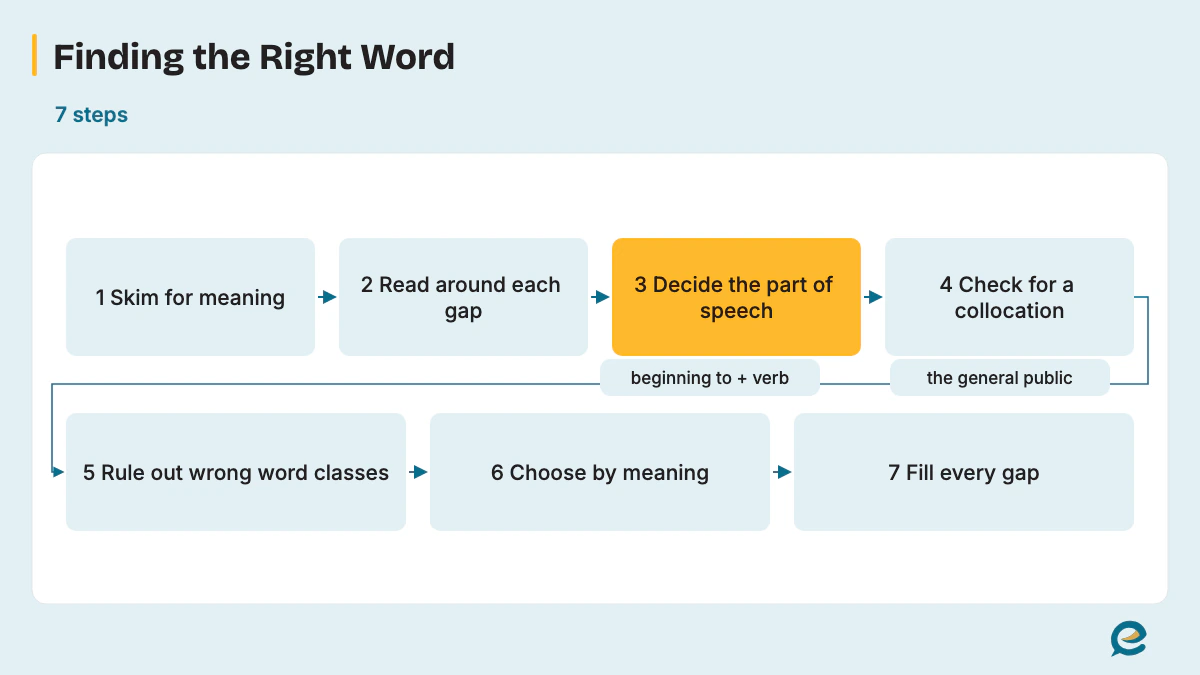
Skim for meaning, read around each gap, decide the part of speech, check for a collocation, use elimination, then choose by meaning. Seven steps put Pearson's own tips in working order.
- Skim for meaning across the whole text before you touch a word.
- Read the context clues before and after each gap.
- Decide the part of speech: Pearson's example "beginning to" needs an infinitive verb.
- Look for a word that collocates, as in Pearson's example "the general public".
- Rule out every word of the wrong word class through elimination.
- Choose between the remaining words by meaning: we "cite" references, not "view" them.
- Fill every gap before you click Next.
Linking words tell you which way the meaning turns. "Although" and "however" signal a contrast, so the gap word pushes against the clause before it: "Although the drug works, it can ________ side effects" needs "cause", not "prevent". "Consequently" and "therefore" signal a result, so the gap word follows from what came before. The topic narrows the box too: in a text about schools, words such as "curriculum" and "assessment" deserve a look before unrelated ones.
What Should You Do With an Unknown Word in the Box?
Leave an unknown word for last: place every word you know first, then test the unknown word only against the gaps still open. Its suffix often shows its word class: -tion, -ment and -ity mark nouns, -ous, -ive and -al mark adjectives, -ize and -ify mark verbs, and -ly marks most adverbs. That lets grammar rule it in or out without knowing its meaning.
If one word makes you freeze, our guide to PTE exam anxiety has calming steps that protect the rest of your section time.
Why Should You Never Leave Blanks Empty?
An empty gap always scores zero while a guess costs nothing, so Pearson's own advice is to fill every space. With no penalty for a wrong word, your best guess can only add a point. Pearson's reading article adds that you don't need every gap right to get points, so guess from context and move on. Our guide to common PTE mistakes covers other reading slips that cost easy points.
How Do Collocations Help in Reading Fill in the Blanks?
A collocation is a pair of words that regularly go together, so when one half sits next to the gap, the other half is often the answer. Pearson's own tip uses "the general public". Pearson built its Academic Collocation List of 2,469 collocations from written academic English, and it's the official study resource for these word pairs. A few original examples show how they sit around a gap:
- Adjective and noun: "a ________ increase" points to "significant".
- Verb and noun: "________ research" points to "conduct".
- Noun and preposition: "access ________ education" points to "to".
- Verb and noun: "________ a conclusion" points to "draw".
Dependent prepositions work the same way, because a verb + preposition pair is fixed, and many adjectives lock in their preposition too. This table groups six of those patterns, each with a gap you can test.
| Word type and preposition | Our examples | Gap example |
|---|---|---|
| Verb + with | cope with, comply with, interact with, deal with | "Hospitals must comply ________ safety rules" needs "with". |
| Verb + from | benefit from, differ from, recover from, suffer from | "She recovered ________ the flu in a week" needs "from". |
| Verb + in | result in, invest in, specialize in, participate in | "Heavy rain can result ________ floods" needs "in". |
| Verb + on | insist on, comment on, act on, draw on | "The report draws ________ ten years of data" needs "on". |
| Adjective + to | similar to, vulnerable to, equivalent to, prone to | "Coastal towns are vulnerable ________ storms" needs "to". |
| Adjective + about | concerned about, curious about, optimistic about, anxious about | "Investors are optimistic ________ growth" needs "about". |
Which Collocations Help in PTE Reading?
The collocations that help most are the academic word pairs Pearson collected in its Academic Collocation List, because Reading texts use written academic English. Learn academic collocations as pairs, never as single words. Our PTE collocation list groups the most useful ones by type.
How Do Grammar Rules Help in Reading Fill in the Blanks?
Grammar tells you what kind of word a gap needs before you think about meaning, which removes most of the box in seconds. Pearson's own reading article names grammar, pronouns, cohesive devices and plural nouns as knowledge the Fill in the Blanks tasks test. These grammar clues fix the word type fast:
- Infinitive to takes a base verb: "plans to ________ the bridge" needs "rebuild". Prepositional to is different, as in "look forward to reading".
- A noun follows an article or adjective: "a rapid ________" needs "change".
- An adjective sits before a noun: "a ________ effect" needs "lasting".
- Plural nouns follow "many" or "several": "several ________" needs "studies".
- Prepositions are fixed by the word before: "rely ________" needs "on".
Time markers, articles and agreement give sharper clues still. Each row below pairs a clue with what it signals.
| Clue around the gap | What it signals | Original example |
|---|---|---|
| "Over the last decade", "since 2010" | Present perfect | "Since 2010, sales have ________" needs "doubled". |
| "In 1850", "two centuries ago" | Past simple | "In 1850, the railway ________ the town" needs "reached". |
| "will", "is expected to", "experts predict" | Base verb after "will" or "to" | "Demand is expected to ________ by 2040" needs "rise". |
| "a" before the gap | A word starting with a consonant sound | "a ________ rise" takes "sharp", not "unexpected". |
| "an" before the gap | A word starting with a vowel sound | "an ________ rise" takes "unexpected", not "sharp". |
| "the" before the gap | A specific noun, or an adjective plus noun | "the ________ of the study" needs "aim". |
| "a/an/the ________ of" | A noun | "a ________ of methods" needs "variety". |
| "is/was" + "very/highly" | An adjective | "The plan was highly ________" needs "effective". |
| Singular subject | Verb with -s in present simple | "The data set ________ every year" needs "grows". |
Subject-verb agreement settles a gap whenever the box holds the -s and no-s forms of one verb, as practice texts 1, 3 and 6 show.
Word families give the last check. When the box holds two forms of one root, pick the form the gap's grammar needs, and watch for pairs that differ in meaning too: "economic" means about the economy, while "economical" means saving money.
| Noun | Verb | Adjective | Adverb |
|---|---|---|---|
| economy | economize | economic, economical | economically |
| dependence | depend | dependent | dependently |
| production | produce | productive | productively |
| happiness | (none) | happy | happily |
Which Grammar Rules Matter in PTE Reading?
The grammar rules that matter in Reading are the ones that fix a word's class and form around a gap, such as articles, plurals and verb patterns. Articles signal a noun, and verb patterns such as "decide to" or "avoid" + -ing fix the word forms that follow. Our guide to grammar for PTE reading covers each rule with examples.
How Do You Improve PTE Reading Fill in the Blanks?
Practice short texts daily, keep a notebook of every collocation and word form you missed, and review the same item again a day later. That practice loop runs in four steps.
- Do one timed set of three or four texts.
- Check each wrong gap against its clue: collocation, part of speech or meaning.
- Add the missed collocations and word forms to your notebook.
- Repeat the set the next day and test yourself on the notebook before a new set.
Pearson's own reading advice fits this daily practice: read often for short periods, practice speed reading every day, and work with short articles of around 300 words. Add wide reading of newspapers, popular-science magazines and academic articles, and copy each new word pair you meet into the same notebook.
What Are the Best Tips and Tricks for Reading Fill in the Blanks?
The tips that work are the ones Pearson itself gives: collocation first, part of speech second, meaning last, and no empty gaps. Two tips and tricks from the tables above add speed: check the time marker before you pick a verb form, and check "a" or "an" before you pick a noun or adjective. Our PTE reading tips cover the other four Reading tasks.
Are Most Repeated Fill in the Blanks Worth Memorizing?
Pearson publishes no list of repeated questions, so "most repeated" sets are a prep site's own collection: useful as practice texts, not as answers to memorize. The vocabulary and collocations behind those sets transfer to any new text, while memorizing answers doesn't. Build your PTE vocabulary instead.
Is There Negative Marking in Reading Fill in the Blanks?
No, a wrong word scores zero for that gap but takes nothing away, so always fill every gap. Multiple Choice, Multiple Answers is the Reading task that does make a deduction. The rules for every task are on our PTE negative marking page.
Is Reading Fill in the Blanks the Same in PTE Core?
Yes, PTE Core uses the same drag-and-drop task with a text of up to 80 words, scored for reading with partial credit, but its page calls it "Fill in the Blanks". The task itself is identical; around it, the task name changes and the Core Reading part runs 27-37 minutes instead of 23-30. Read more about the PTE Core test.
How Do You Get 90 in PTE Reading?
Fill in the Blanks is one of five Reading tasks, so 90 in Reading also needs careful picks in Multiple Choice, Multiple Answers and a clean Reorder Paragraph. Our PTE reading section guide covers all five Reading tasks.
Practice PTE Reading on EasyEnglish
Try Reading tasks in a timed, computer-based format like the real test.
Try speaking practice without signing up. A free account is required for full mock tests. Practice scores are estimates, not official Pearson scores.
Written by
EasyEnglish Team
The team behind EasyEnglish's PTE practice and mock tests
EasyEnglish provides independent PTE practice and estimated scores. EasyEnglish is not affiliated with or endorsed by Pearson. Contact support@inverseai.com.
Format and scoring sources checked on 26 October 2026: Academic Reading; Core Reading; Academic Score Guide; Core Score Guide (January 2026). Academic and Academic UKVI details use the format introduced on 7 August 2025; Core details use its January 2026 Score Guide. Where a task page and Score Guide differ, the distinction is identified in the text; use the Guide for scoring criteria. Practice passages, names, figures, prompts and model answers are authored examples supplied with this guide, not authentic exam items or independently verified research findings. Suggested practice schedules and time splits are coaching advice, not Pearson requirements or score guarantees.
Editorial review completed .