PTE Reading: Test Format, Scoring, Question Types, Answers and Tips
PTE Reading
PTE Reading gives you one timer for 15-20 items, so a slow start costs you the last few answers. Part 2 of the test shows on-screen texts and asks you to select, drag or reorder answers across 5 question types: 23-30 minutes in PTE Academic and 27-37 minutes in PTE Core. Pearson owns and scores PTE, and every timing, text length and item count below comes from Pearson's Reading pages and its Score Guides.
PTE Academic and PTE Academic UKVI share one format. PTE Core keeps the five types, renames two of them, and caps one text at 275 words instead of 350.
Table of Contents
What Is the PTE Reading Section?
PTE Reading is Part 2 of the test: 5 question types in 23-30 minutes in PTE Academic and 27-37 minutes in PTE Core, timed as one block with no timer per question. In Part 2 Reading you read short academic or everyday on-screen texts and answer by choosing, dragging or reordering.
It comes after Speaking & Writing and before Listening in PTE Academic, a test of about 2 hours. Your Reading score sits on the same 10-90 scale as the other skills, and integrated tasks in Part 1 and Part 3 add to it. The section timer covers the whole part, so you pace yourself across every item.
How Is the PTE Reading Section Structured?
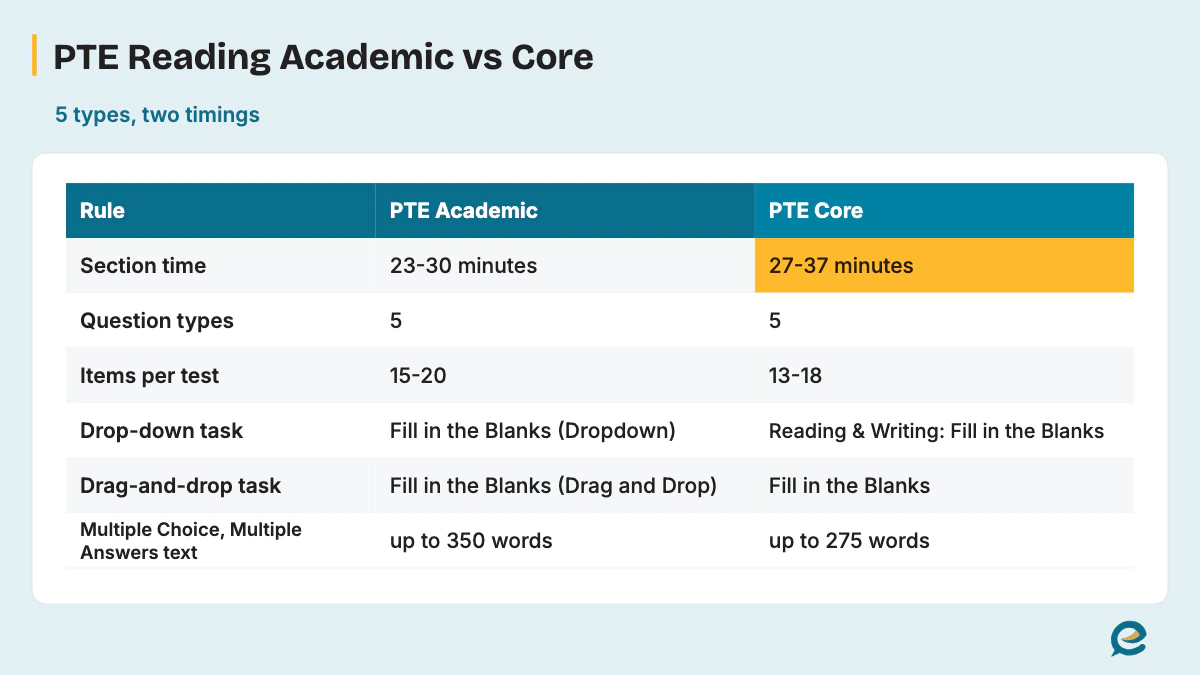
PTE Academic Reading has 5 question types and 15-20 items in 23-30 minutes, while PTE Core Reading has the same 5 types with 13-18 items in 27-37 minutes, and two task names change. Pearson's Score Guide for each version gives the item counts per task, and the Reading pages give each text limit.
| Task (Pearson order) | PTE Academic items | PTE Core items | Max text length |
|---|---|---|---|
| Fill in the Blanks (Dropdown); Core: Reading & Writing: Fill in the Blanks | 5-6 | 5-6 | 200 words |
| Multiple Choice, Multiple Answers | 2-3 | 1-2 | 350 words (Core 275) |
| Reorder Paragraph | 2-3 | 2-3 | 110 words |
| Fill in the Blanks (Drag and Drop); Core: Fill in the Blanks | 4-5 | 4-5 | 80 words |
| Multiple Choice, Single Answer | 2-3 | 1-2 | 110 words |
| Total | 15-20 items | 13-18 items | |
| Section time | 23-30 minutes | 27-37 minutes |
Pearson's Reading web page gives no item count, which is why the counts come from the PTE Academic Test Taker Score Guide and the PTE Core Score Guide (January 2026). No task has its own clock: Pearson lists the time to answer each one as "Not applicable", so section time is all you get. Some prep sites still quote 29-30 minutes for Reading; Pearson's current page says 23-30 for Academic and 27-37 for PTE Core Reading.
What Does the PTE Reading Module Include?
The Reading module runs the five task types in a fixed task order under one timer, so the time you spend on one item comes out of the time left for the rest. Pearson sets each task's text limit separately.
The module opens with its largest block, 5-6 drop-down items, and its texts range from up to 80 words to up to 350 words in PTE Academic. The task-by-task table with each on-screen instruction sits on our PTE reading format page.
What Are the PTE Reading Rules?
The Reading rules that decide your points are few. One timer covers the whole part, and only Multiple Choice, Multiple Answers takes points away for wrong picks. Every other task gives partial credit or marks you correct or incorrect. Empty blanks in either Fill in the Blanks task can't score, so put an answer in every gap.
Pearson sets no time per item, so set your own time budget before the section clock starts. Spread 23-30 minutes over 15-20 items and you get roughly 1.2 to 2 minutes per item, about 1.5 on average. Give the 80-word drag-and-drop texts less than that and the long Multiple Choice, Multiple Answers texts more.
Pearson's reading advice says that task needs more time than the single-answer one, because you read the question and options closely before scanning the text for the matching part.
What Are the PTE Reading Question Types?
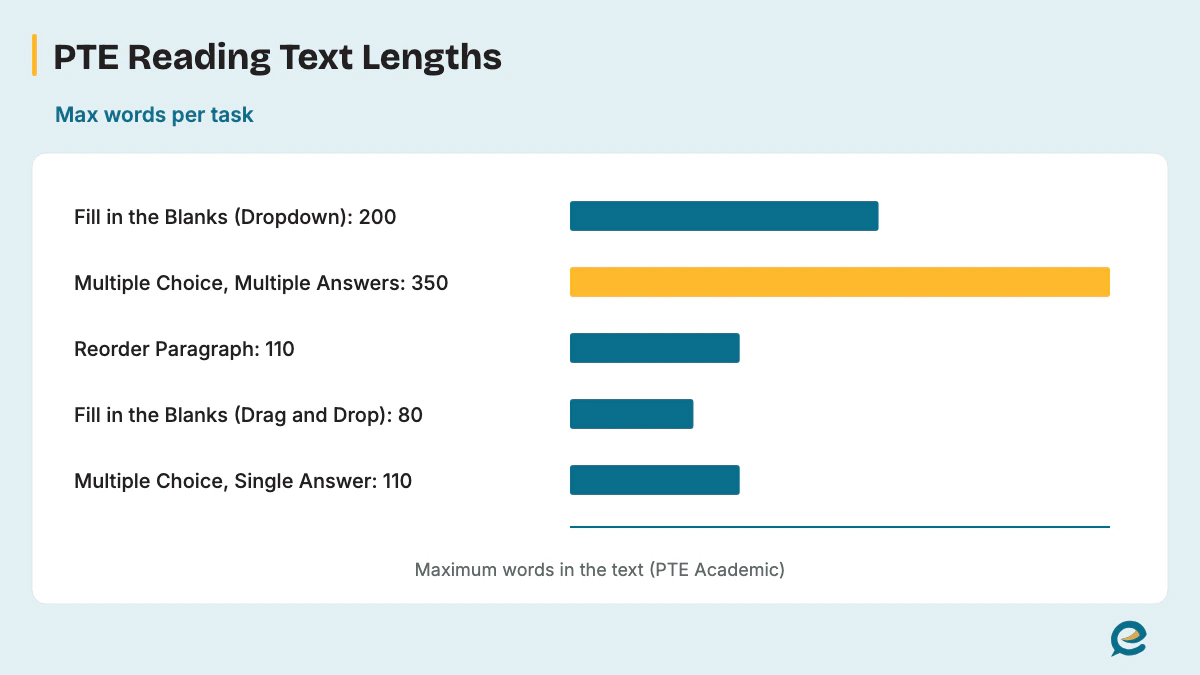
In Pearson order, the five question types are Fill in the Blanks (Dropdown), Multiple Choice, Multiple Answers, Reorder Paragraph, Fill in the Blanks (Drag and Drop) and Multiple Choice, Single Answer. PTE Core keeps all five in the same order, but its PTE Core names differ for two: "Reading & Writing: Fill in the Blanks" and "Fill in the Blanks".
Pearson scores each task its own way. Each block below lists the text length, the item count and the scoring, then gives one sample item with its answer to try. Each task page has the full method and more samples.
What Is Reading & Writing: Fill in the Blanks?
Reading & Writing: Fill in the Blanks shows a text of up to 200 words with gaps, and you choose the right word for each gap from a drop-down menu. You'll get 5-6 items in both versions, and the task earns partial credit, one point per correct blank.
For skills, Pearson's PTE Academic page calls it Fill in the Blanks (Dropdown): the part intro says it also assesses writing, but the task block and the PTE Academic Score Guide credit reading only. PTE Core's Score Guide scores it for reading and writing.
Sample. Many city libraries now (1) ____ laptops to members free of charge for up to two weeks. The service suits students who cannot (2) ____ a computer of their own, and it brings in visitors (3) ____ might otherwise stay away.
| Blank | Options |
|---|---|
| (1) | lend / borrow / rent / owe |
| (2) | afford / provide / spend / pay |
| (3) | who / which / whose / whom |
Answers: (1) lend, because the library gives the laptops out free of charge, so "rent" fails, and members are the ones who borrow. (2) afford, since "cannot afford a computer" is the fixed pattern. (3) who, the subject pronoun for people. Practice more on PTE reading and writing fill in the blanks.
What Is Multiple Choice, Multiple Answers?
Multiple Choice, Multiple Answers gives you a text of up to 350 words in PTE Academic (275 in PTE Core) and asks you to select every option that answers the question. PTE Academic has 2-3 of these items and PTE Core has 1-2, with 275 words as the Core text limit. More than one correct option exists, and you earn one point per correct pick. Scoring takes minus one per wrong option, never below zero, which makes it the only Reading task with a deduction.
Sample. When a regional bus company cut its weekday evening timetable, it expected passenger numbers to fall only slightly. Instead, evening ridership dropped by almost half within three months, and daytime ridership also declined. A survey of former passengers found that many had bought cars or arranged lifts, because they could no longer rely on getting home after late shifts. Once they had changed their routine, they rarely returned to the bus, even for daytime trips.
Which of the following are supported by the text? Select all correct responses.
- A. The company predicted a small drop in evening passengers.
- B. Daytime passenger numbers stayed the same.
- C. Some former passengers found other ways to travel.
- D. The company restored its evening timetable after the survey.
- E. Passengers who changed their routine seldom came back.
Answers: A, C and E, for 3 points. B contradicts "daytime ridership also declined", and D is never mentioned, so picking either would cost a point. The method is on PTE reading multiple choice multiple answer.
What Is Reorder Paragraph?
Reorder Paragraph shows text boxes of up to 110 words in total in a random order, and you drag them, or use the arrow buttons, into the original order. Both versions have 2-3 items, and Pearson scores adjacent pairs: each correctly ordered pair earns one point. The task scores reading only.
Sample. Put these four boxes in order.
- A. As a result, the town now pays less for electricity than it did a decade ago.
- B. Ten years ago, a small coastal town decided to put solar panels on every public building.
- C. The project was expensive at first, and some residents opposed the cost.
- D. However, the panels paid for themselves within six years.
Answer: B, C, D, A, worth 3 points for the pairs B-C, C-D and D-A. B is the topic sentence because it introduces "a small coastal town" without a linking word. "The project" in C points back to B, "However" in D turns against the cost, and "As a result" in A closes the chain. See how to find the opening box on PTE reorder paragraphs.
What Is Fill in the Blanks (Drag and Drop)?
Fill in the Blanks (Drag and Drop) shows a text of up to 80 words with gaps and one word box below it. The word box holds more words than gaps, and you drag one word into each gap. You'll meet 4-5 items in both versions, each correct blank earns one point with no deduction, and PTE Core calls the task Fill in the Blanks.
Sample. Regular exercise does more than build muscle. It also (1) ____ the risk of several long-term illnesses and can (2) ____ mood within a short time. Doctors therefore (3) ____ some activity on most days of the week.
Word box: reduces / reducing / improve / improvement / recommend / recommendation
Answers: (1) reduces, a singular verb after "It also". (2) improve, the base verb after "can". (3) recommend, the verb the subject "Doctors" needs. The three spare words are the wrong part of speech, which is how grammar narrows the box. More sets are on our PTE reading fill in the blanks page.
What Is Multiple Choice, Single Answer?
Multiple Choice, Single Answer gives you a text of up to 110 words and one question with only one correct option. PTE Academic has 2-3 items and PTE Core has 1-2. Pearson scores each response correct or incorrect and gives no credit for no response, so an answer always beats a blank.
Sample. The museum introduced free entry on Sunday mornings two years ago. Sunday visitor numbers have since doubled, but staff noticed that most newcomers left within an hour. To encourage longer visits, the museum now runs short guided tours every thirty minutes during the free period, and early figures show the average Sunday visit has grown longer.
Why did the museum start the guided tours?
- A. Sunday visitor numbers had fallen.
- B. Free entry had become too expensive.
- C. New visitors were not staying long.
- D. Visitors asked for free entry on Sunday mornings.
Answer: C. It paraphrases "left within an hour" rather than repeating it, while D copies the text's own words and answers nothing. The method is on PTE reading multiple choice single answer.
How Is the PTE Reading Section Scored?
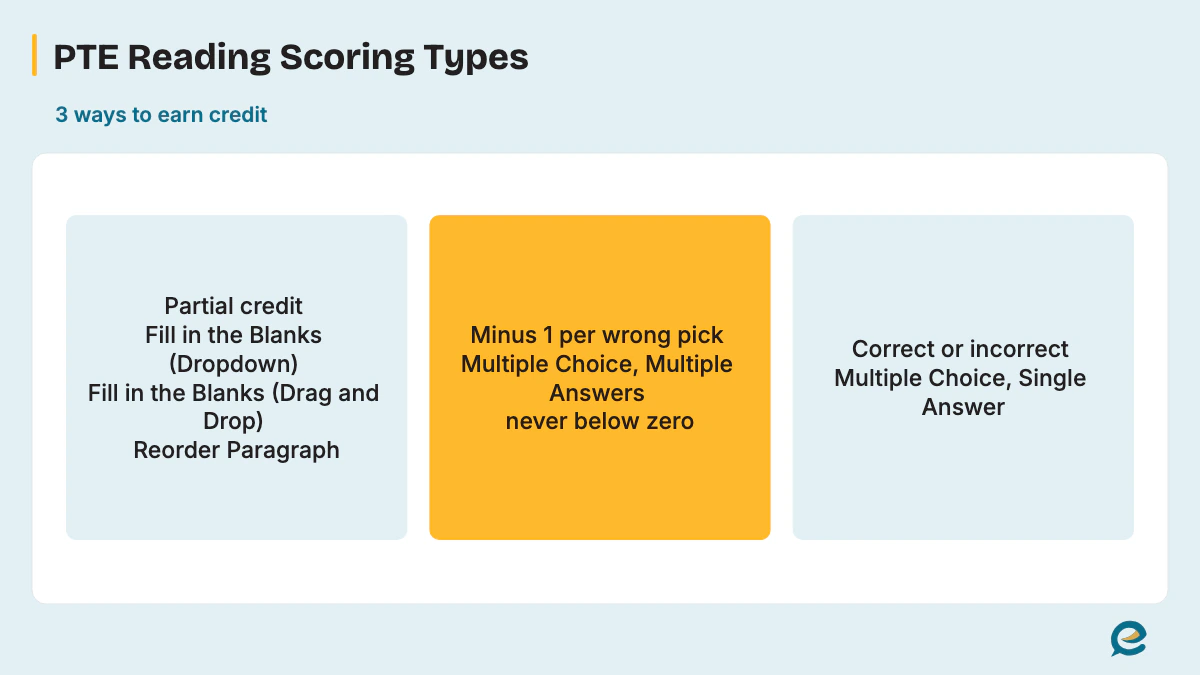
Pearson scores PTE with AI scoring, with some responses getting human review by an expert. Reading tasks earn credit in three ways, and the table pairs each way with its tasks. Reorder Paragraph counts adjacent pairs, not whole answers.
| Scoring type | Tasks | Points per item |
|---|---|---|
| Partial credit | Both Fill in the Blanks tasks; Reorder Paragraph | One per correct blank, or one per correct pair of adjacent boxes, with no deduction. |
| Partial credit with deduction | Multiple Choice, Multiple Answers | Plus one per correct option, minus one per wrong one, never below zero. |
| Correct or incorrect | Multiple Choice, Single Answer | One point for the right option and zero for a wrong or empty answer. |
Your Reading score sits on the 10-90 scale, and Pearson's Score Guide lists every Part 2 task as feeding it. The scoring tables do not provide a fixed raw-point formula for predicting your reported Reading score. Prepare across all contributing tasks.
Is There Negative Marking in PTE Reading?
PTE Reading has negative marking in one task only: Multiple Choice, Multiple Answers, where each wrong option costs a point and the item score cannot drop below zero. Both Fill in the Blanks tasks, Reorder Paragraph and Multiple Choice, Single Answer never deduct, so a reasoned guess there costs nothing. The rules for every part are on our PTE negative marking page.
Which Other PTE Tasks Count Toward Reading?
Summarize Written Text feeds the Reading score in both tests, Highlight Incorrect Words feeds it in both, Highlight Correct Summary feeds it in PTE Academic, and Read Aloud feeds it in PTE Core. These integrated skills tasks sit in Part 1 and Part 3, and Pearson's documents split on Read Aloud in PTE Academic.
- Read Aloud counts toward reading and speaking in PTE Core; the PTE Academic Score Guide lists it under Speaking only, though Pearson's Academic task page still says it affects reading.
- Summarize Written Text scores reading and writing in both tests. Academic allows 10 minutes for one sentence of 5-75 words from up to 300 words; Core allows 10 minutes for 25-50 words from up to 200 words.
- Highlight Correct Summary (PTE Academic only, 2-3 items) and Highlight Incorrect Words (2-3 items in Academic, 1-2 in Core) are Listening tasks that the Score Guides credit to listening and reading.
Reading practice that skips Part 1 and Part 3 misses part of the Reading score, since Summarize Written Text and Highlight Incorrect Words count toward it in both PTE Academic and PTE Core. Treat Read Aloud as reading practice too: you can't read a text aloud fluently if you haven't followed it.
How Do You Get 90 in PTE Reading?
To get 90 in Reading, protect every point the scoring rules allow: fill every gap, pick only the options you're sure of, and keep time for the last items. Eight habits follow from Pearson's scoring and its own task tips.
- Leave no empty gaps in either Fill in the Blanks task, since each correct gap scores and none costs a point.
- Make only confident picks in Multiple Choice, Multiple Answers, because each wrong option costs one point.
- Skim the whole text for its meaning first, then read before and after each blank.
- Find the topic sentence first in Reorder Paragraph, then follow cohesive devices, pronouns, articles and the logical or time order of ideas to chain the rest.
- Use collocation, part of speech and singular or plural form to rule out words in both Fill in the Blanks tasks.
- Expect the right option in Multiple Choice, Single Answer to paraphrase the text, so build synonyms instead of matching words.
- Note the key words in the question before you read a multiple-choice text.
- Include Summarize Written Text, and Read Aloud if you sit PTE Core, in your reading practice.
Pearson doesn't publish a number of correct answers that equals 90, so treat any such count as a guess.
How Do You Use Skimming and Scanning in PTE Reading?
Skim first for the topic and the writer's point, then scan for the exact words, names or numbers a gap or question needs. Pearson's tips apply this skim-then-scan method task by task. Skim a drop-down text for overall meaning, and scan for repeated words before you read around them. In a multiple-choice text, scan for the key words from its prompt.
Our guide to skimming and scanning in PTE reading has drills for both.
What Are Common Mistakes in PTE Reading?
The common mistakes that cost the most are spending too long on one item, selecting every option, leaving gaps empty, and matching repeated words instead of meaning. Each mistake below breaks a scoring rule or skips a fix Pearson recommends.
- Spending too long on one difficult question takes time from later tasks under the single section timer.
- Ignoring signal words such as "however", "therefore" or "in contrast" breaks the logic Reorder Paragraph tests.
- Choosing options because they repeat words from the text goes against Pearson's advice to match meaning.
- Using select all in Multiple Choice, Multiple Answers costs a point for every wrong option.
- Leaving blanks empty gives up partial credit that a reasoned guess could earn.
- Answering from memory instead of checking the passage again lets a misread detail slip through.
- Letting outside knowledge pick the answer chooses an option the passage never supports; Pearson's tip lets you use what you know only to rule out unlikely options before reading.
- Picking a distractor that is true but irrelevant scores nothing when it doesn't answer the question.
- Skipping elimination leaves clearly wrong options in play when you could strike them first.
How Do You Practice PTE Reading?
Practice each task type under the real section timer, review every wrong gap and option, and build reading speed with short daily texts. A seven-day practice plan keeps every task in rotation and ends each week with a full timed section.
| Day | What to do | Why |
|---|---|---|
| 1 | Timed set of Fill in the Blanks (Dropdown) | The largest block, 5-6 items |
| 2 | Timed set of Fill in the Blanks (Drag and Drop) | Drills part of speech and collocation |
| 3 | Both Multiple Choice tasks | Trains meaning over matching words |
| 4 | Reorder Paragraph sets | Trains topic sentences and linking words |
| 5 | Review list day | Fixes the same error before it repeats |
| 6 | One full Reading section in 23-30 minutes | Tests your time budget |
| 7 | Light reading of short articles | Builds speed without a timer |
Your review list holds every missed collocation, word form and linking word, such as "conduct research", "pay attention to", "access to" and "in contrast to". Pearson's own reading advice is to read short texts of about 300 words often and aim for at least 220 words per minute. It also suggests reading in chunks rather than single words once your speed is steady.
What Are the Best PTE Reading Tips?
The best Reading tips follow how each task is scored, which is why they differ from task to task. Pearson's task tips give one habit per task.
Read around each drop-down blank, and never click every multiple-answer option. Find the topic sentence before reordering, think of words seen together for drag-and-drop gaps, and note the prompt's key words before a single-answer text. Our full set of PTE reading tips goes task by task.
How Do You Improve Reading in PTE?
Reading improves fastest when you read short texts every day at a steady pace and practice spotting paraphrase instead of repeated words. A multiple-choice option that paraphrases the text tests meaning, which is the skill Pearson rewards. Daily reading builds reading speed faster than one long weekly session, because short texts train you to keep a steady pace. See how to improve PTE reading speed.
Which Is the Hardest Section in PTE?
Pearson does not rank its sections by difficulty, so the hardest section is the one that tests your weakest skill. Reading puts five task types under one timer, so you have to pace yourself across all five. Our list of PTE question types shows every part.
How Do PTE Academic and PTE Core Reading Differ?
PTE Core Reading keeps the same five task types in the same order but runs 27-37 minutes instead of 23-30 and caps the Multiple Choice, Multiple Answers text at 275 words instead of 350. It also has fewer multiple-choice items (1-2 of each instead of 2-3) and renames two tasks: Reading & Writing: Fill in the Blanks and Fill in the Blanks. Read more about the PTE Core test.
Where Can You Take a PTE Reading Practice Test?
A useful PTE Reading practice test copies the five task types, runs one timer for the whole section, and shows which gaps and options you got wrong. Pearson's official route is Smart Prep, which gathers its free and paid practice materials, including guided practice tests, videos and test tips, and opens through a myPTE account whether or not you've booked. Pearson's Scored Practice Test is its official scored option, and practice scores from any prep site, ours included, are estimates.
Our page on the benefits of online PTE practice explains what to check, and you can create a free account for timed Reading sets.
Practice PTE Reading on EasyEnglish
Try Reading tasks in a timed, computer-based format like the real test.
Try speaking practice without signing up. A free account is required for full mock tests. Practice scores are estimates, not official Pearson scores.
Written by
EasyEnglish Team
The team behind EasyEnglish's PTE practice and mock tests
EasyEnglish provides independent PTE practice and estimated scores. EasyEnglish is not affiliated with or endorsed by Pearson. Contact support@inverseai.com.
Format and scoring sources checked on 26 October 2026: Academic Reading; Core Reading; Academic Score Guide; Core Score Guide (January 2026). Academic and Academic UKVI details use the format introduced on 7 August 2025; Core details use its January 2026 Score Guide. Where a task page and Score Guide differ, the distinction is identified in the text; use the Guide for scoring criteria. Practice passages, names, figures, prompts and model answers are authored examples supplied with this guide, not authentic exam items or independently verified research findings. Suggested practice schedules and time splits are coaching advice, not Pearson requirements or score guarantees.
Reading pace suggestions come from Pearson's 8 July 2021 reading advice, checked 26 October 2026. They are practice targets, not requirements for a particular score.
Editorial review completed .