PTE Reading and Writing Fill in the Blanks: Rules and Tips
PTE Reading
PTE Reading opens with a gap-fill task: a passage of up to 200 words, a drop-down list beside each gap, and one word to choose per gap. Pearson's PTE Academic page heads this dropdown task "Fill in the Blanks (Dropdown)", while PTE Core calls it "Reading & Writing: Fill in the Blanks". It's the same task in both tests, and the drag-and-drop task is a separate one.
Pearson's Score Guide lists 5-6 of these items per test, each correct blank earns 1 point, and a wrong choice costs nothing. PTE Core credits reading and writing; the PTE Academic Score Guide credits reading. Each of the nine original passages here comes with an answer key that names the cue deciding every gap.
Table of Contents
What Is Reading and Writing Fill in the Blanks in PTE?
Reading and Writing Fill in the Blanks is the first Reading task in PTE: a passage of up to 200 words with gaps. Each gap has a drop-down list, and you pick the word that best completes the text. PTE Academic names it the dropdown task, "Fill in the Blanks (Dropdown)", and asks you to restore the text. PTE Core names it "Reading & Writing: Fill in the Blanks" and asks you to complete the text, which is the same action. Pearson's reading article says the task draws on vocabulary, collocations, grammar, pronouns and cohesive devices, plus skimming for meaning.
What Are the Key Task Details of Reading and Writing Fill in the Blanks?
The key details are up to 200 words, one drop-down list beside each gap, item 1 of the Reading part, 5-6 items per test and no timer of its own. Apart from the task name and the skill credit, PTE Academic and PTE Core run this item the same way.
| Detail | PTE Academic | PTE Core |
|---|---|---|
| Task name | Fill in the Blanks (Dropdown) | Reading & Writing: Fill in the Blanks |
| Text length | Up to 200 words | Up to 200 words |
| How you answer | Left-click the drop-down button, choose, click another option to change | Same |
| Position | Task 1 of 5 | Task 1 of 5 |
| Items per test | 5-6 | 5-6 |
| Skills credited | Reading | Reading and writing |
| Time | Shares the 23-30 minute Reading part | Shares the 27-37 minute Reading part |
The item counts and skill credit come from Pearson's Score Guides (PTE Academic 2025, PTE Core 2026). Neither the Score Guides nor Pearson's current task pages fix a gap count per passage or the number of options in each list. Pearson's 2021 Part 2 article described "up to five blank spaces" and "five options in each drop-down list", but the same article gave an 80-word limit that the current 200-word pages have replaced. Treat those counts as Pearson's 2021 description, not a current rule.
Which Skills Does Reading and Writing Fill in the Blanks Test?
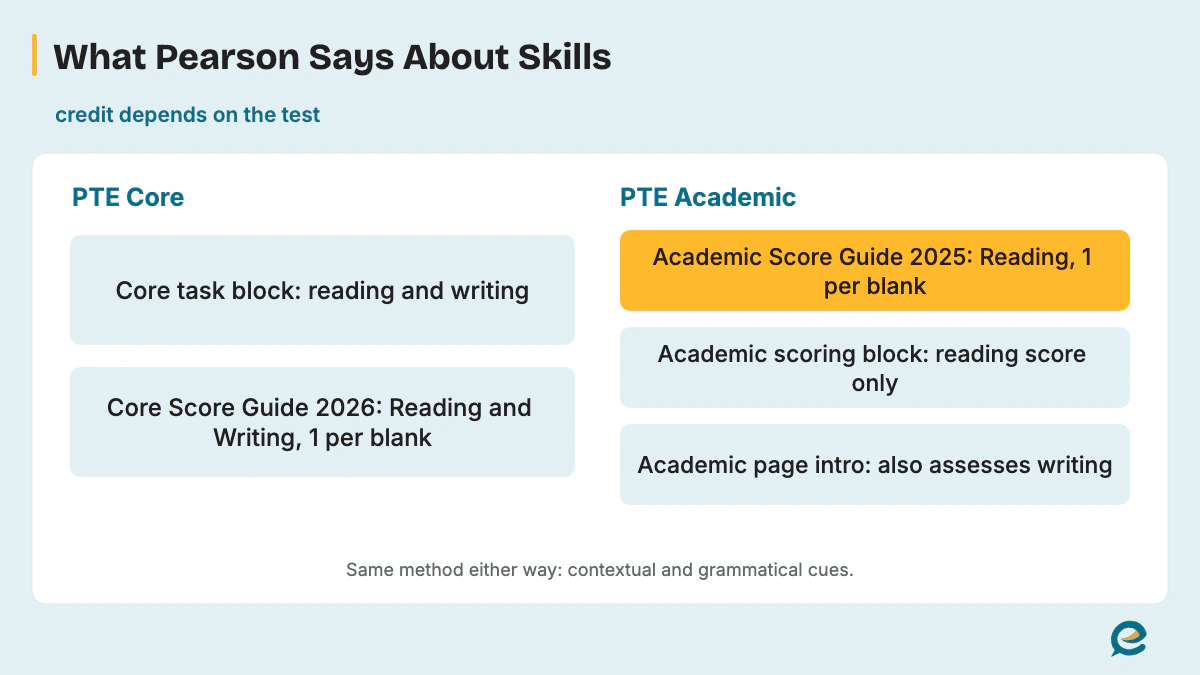
PTE Core counts the task toward reading and writing, while PTE Academic's Score Guide and scoring block credit reading only. The Academic page intro still says the item also assesses writing skills, so the writing credit depends on your test. Pearson's five statements line up like this.
| Pearson document | What it says about skills |
|---|---|
| PTE Core task block | Skills assessed: reading and writing; listening and speaking aren't tested. |
| PTE Core Score Guide (2026) | Reading and Writing: 1 point for each correctly completed blank. |
| PTE Academic Score Guide (2025) | Reading: 1 point for each correctly completed blank. |
| PTE Academic scoring block | Affects your reading score; speaking and writing skills aren't tested. |
| PTE Academic page intro | This item type also assesses writing skills. |
For PTE Academic, plan on reading credit only, following the current Score Guide and task-specific scoring block, and don't count on this task to lift your Writing score. For PTE Core the same points feed both skills. Pearson scores the task on contextual and grammatical cues either way, so the method stays the same, and a correct-blank count alone does not establish a fixed reported-score percentage.
How Long Is the Reading and Writing Fill in the Blanks Passage?
Pearson sets the passage length at up to 200 words in both PTE Academic and PTE Core. That's the second-longest text in the Reading part after Multiple Choice, Multiple Answers (up to 350 words in PTE Academic), which is why skimming for overall meaning comes before any list. Some prep sites still quote "up to 300 words", and an older Pearson article from 2021 described "up to 80 words with up to five blanks"; Pearson's current Reading pages say up to 200 words.
How Many Reading and Writing Fill in the Blanks Are in PTE?
Pearson's Score Guides list 5-6 Reading and Writing Fill in the Blanks items per test in both PTE Academic and PTE Core. The task opens Reading, and with the 4-5 drag-and-drop items that come later, the two Fill in the Blanks tasks make up 9-11 of your Reading items. That makes the dropdown task the most frequent item in the part.
Pearson's task web pages give no item count, so the Score Guide row is the figure to trust. A "4 to 5" figure you may see belongs to the drag-and-drop task.
How Is Reading and Writing Fill in the Blanks Scored?
Pearson uses partial credit: 1 point for each correctly completed blank, with a minimum score of 0 and nothing deducted for a wrong choice. Pearson judges your ability to use contextual cues and grammatical cues to identify the words that complete a reading text, and filling every blank correctly earns the item's maximum. A wrong option scores 0 for that gap and costs nothing else, so an empty gap is the only sure loss.
Pearson's reading article puts it plainly: don't leave any spaces blank, and you don't need every space right to get points. The points count toward reading in PTE Academic and toward reading and writing in PTE Core.
How Should You Manage Time on Reading and Writing Fill in the Blanks?
The item has no timer of its own; the whole Reading part runs 23-30 minutes in PTE Academic and 27-37 minutes in PTE Core, shared by 15-20 Academic items or 13-18 Core items (the Score Guide counts). The average per item works out at about 1.5 minutes in PTE Academic and about 2 in PTE Core.
That's simple arithmetic from Pearson's figures, not a Pearson limit. A 200-word passage with several gaps can fairly take longer than the average, while a short item takes less. Any per-item figure such as "2-3 minutes" is a pacing suggestion, not a rule. These habits protect your time management.
- Skim the passage once for meaning before you open any list.
- Fill the gaps you're sure of first.
- Return to the hard gaps once, not again and again.
- Pick the most likely option rather than leaving any gap empty.
- Move on as soon as every gap holds an answer.
How Does the Dropdown Differ From Reading Fill in the Blanks?
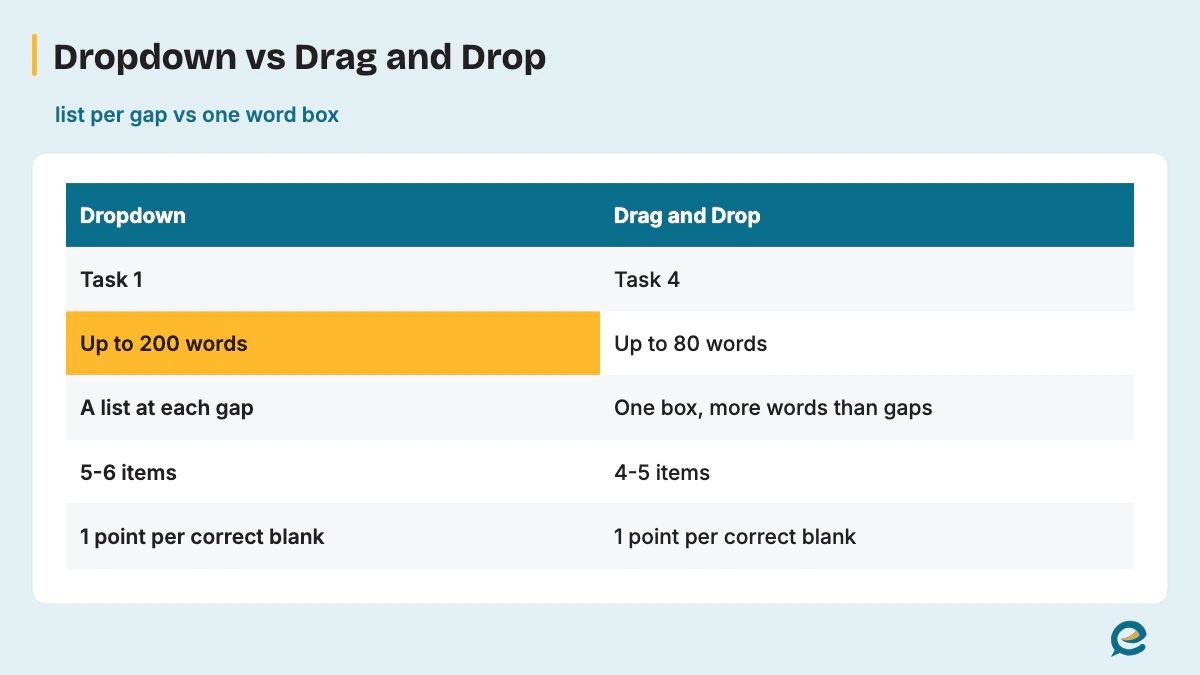
The dropdown task gives a separate list at each gap in a text of up to 200 words; the drag-and-drop task gives one shared word box for a text of up to 80 words. Position, length, the way options appear and the skill credit separate them.
| Feature | Reading and Writing Fill in the Blanks (dropdown) | Fill in the Blanks (drag and drop) |
|---|---|---|
| Position | Task 1 | Task 4 |
| Text length | Up to 200 words | Up to 80 words |
| Options | A list per gap | One box with more words than gaps |
| Items per test | 5-6 | 4-5 |
| Skills | Reading (Academic); reading and writing (Core) | Reading only |
| Scoring | 1 point per correct blank | 1 point per correct blank |
In the dropdown, each list serves only its own gap, so elimination tests options inside one list. In drag and drop, a word you place in one gap is gone from the others.
How Do You Answer Reading Fill in the Blanks Drag and Drop?
Read the short text for meaning, then drag a word from the shared word box into each gap. The box always holds more words than there are gaps, and the extra words are there to tempt you. Our guide to PTE reading fill in the blanks covers its rules, a worked example and its own practice texts.
What Does a Reading and Writing Fill in the Blanks Example Look Like?
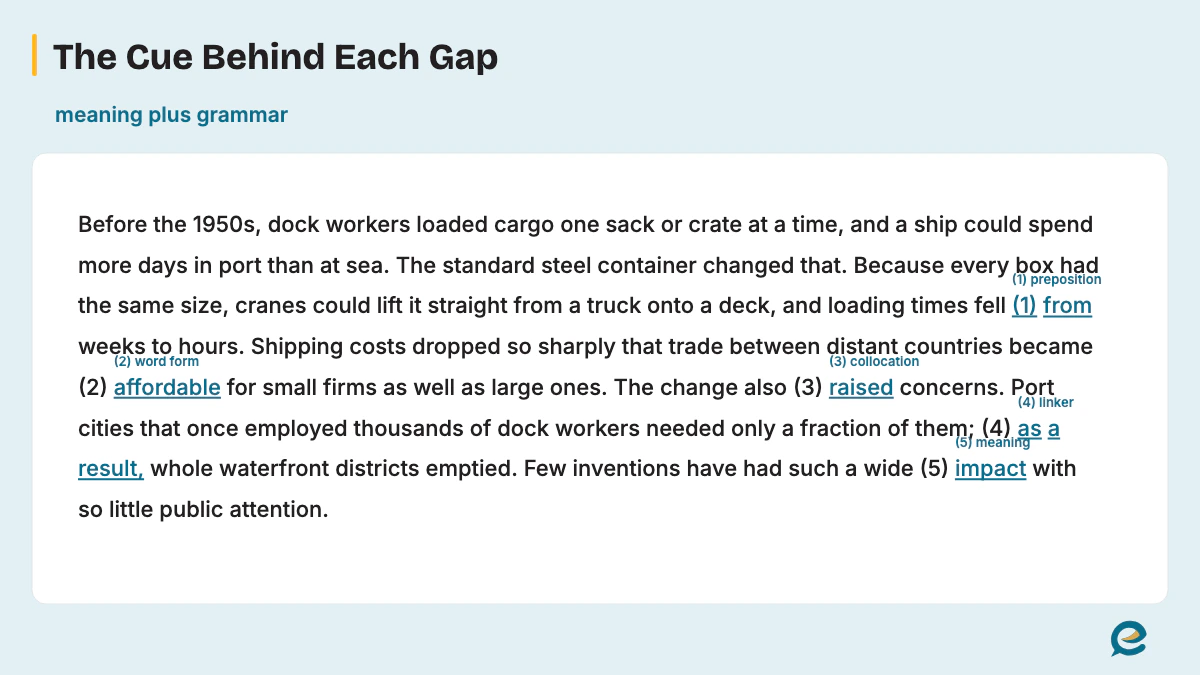
An example gives you a short academic passage with several gaps and a list at each gap where only one word fits both meaning and grammar. This sample passage is original practice material, not a real exam question, and its five gaps and four options per gap are this example's choice, not Pearson's.
Before the 1950s, dock workers loaded cargo one sack or crate at a time, and a ship could spend more days in port than at sea. The standard steel container changed that. Because every box had the same size, cranes could lift it straight from a truck onto a deck, and loading times fell (1) ____ weeks to hours. Shipping costs dropped so sharply that trade between distant countries became (2) ____ for small firms as well as large ones.
The change also (3) ____ concerns. Port cities that once employed thousands of dock workers needed only a fraction of them; (4) ____, whole waterfront districts emptied. Few inventions have had such a wide (5) ____ with so little public attention.
| Gap | Options | Answer | Deciding cue and the tempting option that fails |
|---|---|---|---|
| 1 | from / since / by / at | from | Preposition: "fell from X to Y"; "by" gives an amount, not a starting point. |
| 2 | afford / affordable / affordably / affordability | affordable | Word form: "became" needs an adjective; "affordability" is a noun. |
| 3 | raised / rose / arose / lifted | raised | Collocation: you raise concerns; "rose" and "arose" can't take an object, and "lifted" concerns would mean removing them, the opposite of what follows. |
| 4 | as a result / in contrast / for example / even so | as a result | Linker: empty districts follow from fewer jobs; "even so" signals a contrast. |
| 5 | impact / touch / hit / strike | impact | Meaning: "a wide impact" is an effect; the others are physical contacts. |
Each gap tests one cue, and gap 3 in the answer key shows why grammar comes first: "rose" looks right in meaning, but it can't take "concerns" as an object.
Where Can You Practice Reading and Writing Fill in the Blanks With Answers?
The eight original practice passages below follow the dropdown format, each with four or five gaps and four options per gap. Try each one before you read its answer key, and name the cue for every gap.
Practice passage 1: Tidal power
Tidal power uses the rise and fall of the sea to (1) ____ electricity. Unlike wind, tides follow a pattern that can be (2) ____ years in advance, which helps grid operators plan supply. Few coasts are suitable, though, because a station needs a large difference (3) ____ high and low tide. A barrage across an estuary is expensive, and it can (4) ____ the habitats of fish and wading birds. (5) ____ these drawbacks, several countries are testing turbines fixed to the seabed.
Options: (1) generate / generation / generated / generating. (2) calculated / calculating / calculation / calculates. (3) between / among / from / within. (4) disturb / disturbance / disturbing / disturbed. (5) Despite / Although / Because / However.
Answers: (1) generate: "to" needs a base verb. (2) calculated: "can be" needs a past participle (passive). (3) between: "a difference between X and Y". (4) disturb: "can" needs a base verb. (5) Despite: it takes a noun phrase; "Although" needs a full clause, and "Because" would need "of".
Practice passage 2: Ending smallpox
Smallpox is the only human disease that has been (1) ____ wiped out. During the final campaign, rather than vaccinating whole populations, health teams (2) ____ on finding each new case quickly and vaccinating everyone (3) ____ contact with the patient. This method, known as ring vaccination, (4) ____ far fewer doses than mass campaigns. The World Health Organization declared the disease eradicated in 1980, a result that shows what (5) ____ international cooperation can achieve.
Options: (1) completely / complete / completion / completes. (2) focused / focus / focusing / focuses. (3) in / on / at / with. (4) required / requested / inquired / acquired. (5) sustained / sustain / sustains / sustainably.
Answers: (1) completely: an adverb modifies "wiped out". (2) focused: "During the final campaign", "required" and "declared" in 1980 set the story in the past, so past simple fits, while "focus" is present tense and "focuses" needs a singular subject. (3) in: "in contact with" is fixed. (4) required: a method needs doses; it can't "request" them. (5) sustained: an adjective before the noun "cooperation".
Practice passage 3: Shade-grown coffee
Coffee was traditionally grown under a canopy of taller trees. In recent decades, many farms have (1) ____ these trees to plant coffee in full sun, which raises yields in the short term. Shade trees, (2) ____, offer benefits that a sun farm lacks. They shelter birds, protect the soil from (3) ____ and keep coffee plants cooler in hot spells. Some buyers now pay more for beans grown this way, (4) ____ farmers a reason to keep their trees.
Options: (1) cleared / clear / clearing / clears. (2) however / therefore / for example / as a result. (3) erosion / erode / eroded / erosive. (4) giving / given / give / gives.
Answers: (1) cleared: "have" needs a past participle. (2) however: shade benefits contrast with sun yields. (3) erosion: "from" needs a noun. (4) giving: an -ing clause adds the result to the main clause; "gives" would need "which".
Practice passage 4: Lichens and clean air
Lichens are partnerships between a fungus and an alga, and they (1) ____ most of their water and nutrients straight from the air. Because they have no roots to filter what they take in, many species are highly sensitive (2) ____ pollution. Scientists can therefore (3) ____ air quality by recording which lichens grow on trees and walls. On busy roads only a few (4) ____ species survive. When the air gets cleaner, species that had vanished can gradually (5) ____.
Options: (1) absorb / absorbs / absorbing / absorption. (2) to / of / with / at. (3) assess / access / excess / assist. (4) tolerant / tolerance / tolerate / tolerantly. (5) reappear / disappear / reappearance / reappeared.
Answers: (1) absorb: plural "they" takes no -s. (2) to: "sensitive to" is the fixed pair. (3) assess: you judge air quality; "access" and "assist" only look alike. (4) tolerant: an adjective before "species". (5) reappear: "can" needs a base verb, and "had vanished" points to coming back.
Practice passage 5: The four-day week
Several companies have (1) ____ trials of a four-day working week, in which staff work fewer hours for the same pay. Supporters say a shorter week reduces stress and (2) ____ staff to plan their time more carefully. Critics reply that the model suits office work better than jobs that are (3) ____ around fixed shifts, such as nursing. Early results look encouraging, (4) ____ researchers warn that a few years of data can't show long-term effects.
Options: (1) carried out / carried away / carried off / carried over. (2) encourages / encourage / encouragement / encouraging. (3) organized / organize / organization / organizing. (4) but / so / because / or.
Answers: (1) carried out: the phrasal verb for doing a trial. (2) encourages: it pairs with "reduces" after the singular "a shorter week". (3) organized: "are" plus a past participle forms the passive. (4) but: the warning contrasts with the encouraging results.
Practice passage 6: Drinking water from the sea
Most of the Earth's water is too salty to drink, so dry coastal countries increasingly rely on desalination, the process of (1) ____ salt from seawater. One widely used method, reverse osmosis, pushes water through a membrane at high (2) ____. The process needs a great (3) ____ of energy, which makes the water expensive. It also leaves behind brine, a very salty liquid that can (4) ____ marine life if it's pumped back into the sea carelessly. Engineers are now working to (5) ____ the energy each plant uses.
Options: (1) removing / remove / removal / removed. (2) pressure / press / pressing / pressed. (3) deal / number / lot / many. (4) harm / harmful / harmless / harmed. (5) reduce / raise / reform / refuse.
Answers: (1) removing: "of" takes an -ing form. (2) pressure: "high" needs a noun after it. (3) deal: "a great deal of" goes with uncountable "energy"; "number" needs a plural noun. (4) harm: "can" needs a base verb. (5) reduce: the problem is high energy use, so the goal is to cut it.
Practice passage 7: How birds find their way
Every autumn, millions of birds fly thousands of kilometers to warmer regions, and many (1) ____ to the same nesting site the following spring. Some species steer by the position of the sun; (2) ____ use the stars at night. Experiments also suggest that birds can sense the Earth's magnetic field, although how they do this (3) ____ unclear. Bright city lights can (4) ____ birds that fly at night, drawing them toward lit buildings.
Options: (1) return / returns / returning / returned. (2) others / another / other / the other. (3) remains / remain / remaining / remained. (4) confuse / confusion / confused / confusing.
Answers: (1) return: plural "many" in the present simple. (2) others: a plural pronoun contrasting with "Some species". (3) remains: "how they do this" is singular, and the passage is in the present. (4) confuse: "can" needs a base verb.
Practice passage 8: Small loans
Microfinance institutions lend small sums to people who can't borrow from ordinary banks, often because they have no (1) ____ to offer as security. Bangladesh's Grameen Bank, which shared the 2006 Nobel Peace Prize with its founder, Muhammad Yunus, made the idea widely known.
Borrowers often (2) ____ in small groups and encourage one another to repay on time. Early supporters (3) ____ that small loans would lift large numbers of families out of poverty. Later studies were more cautious: the loans make it easier for households to (4) ____ with irregular incomes, but their effect on poverty looks modest. For this (5) ____, many economists now see microfinance as a useful tool, not a cure.
Options: (1) collateral / colleague / collision / collection. (2) meet / meets / meeting / met. (3) argued / argument / arguing / arguable. (4) cope / coping / coped / copes. (5) reason / cause / purpose / result.
Answers: (1) collateral: the word for security on a loan; the others only share its opening letters. (2) meet: plural "Borrowers" in the present simple. (3) argued: the sentence needs a past verb after its subject. (4) cope: "to" needs a base verb, and "cope with" is the pair. (5) reason: "For this reason" links the cautious findings to the experts' view; "For this purpose" would mean "to reach this goal", which doesn't fit a conclusion drawn from evidence.
For more dropdown passages, create a free account on our practice app, where each Reading set comes with its answers checked.
How Do You Answer Reading and Writing Fill in the Blanks Step by Step?
The method is skim for overall meaning, read before and after each gap, decide what the gap needs, test each option for meaning and grammar, eliminate, and fill every gap. Pearson's published tips sit at the start of the routine.
- Skim the whole passage for its topic and direction, as Pearson's first tip advises.
- Scan for repeated words and read around them, which is Pearson's third tip.
- Read the words before and after the gap.
- Decide what the gap needs: a part of speech, a tense, a preposition, a linker or a pronoun's referent.
- Open the list and test each option against meaning and grammar.
- Use elimination to drop every option that breaks either one.
- Read ahead when the next sentence decides the gap.
- Fill every gap before you leave the item.
- Do a final reread of the whole passage once.
Pronouns and cohesive devices such as "this", "these", "such" and "however" point back to an earlier noun or idea, so the clue often sits in the sentence before the gap. Pearson's reading article lists pronouns and cohesive devices among the knowledge both Fill in the Blanks tasks test.
How Do Grammar and Collocations Help in Reading and Writing Fill in the Blanks?
Options often look alike in meaning, so grammar and fixed word partners decide the gap. Pearson's own example is "gained access to", where only "access" fits both the verb before it (gain access) and the preposition after it (access to). These cues settle most close calls between options.
- Verb-noun collocations such as "pose a risk" tie a verb to one noun.
- Noun-preposition and adjective-preposition pairs such as "access to" and "capable of" fix the word after the gap.
- Word form after articles and before nouns shows whether you need a noun or an adjective.
- Tense and subject-verb agreement rule out options that clash with the sentence.
- Linking words signal contrast or result, so the sentence's logic picks one option.
- Singular and plural nouns must match the verb and determiner around them.
- Phrasal verbs and fixed idioms such as "carry out" and "in the long run" accept only one particle or word.
A quick part-of-speech test tells you which slot the gap fills before you think about meaning.
| If the gap... | It needs | Original example |
|---|---|---|
| Names a thing or idea | A noun | "The ____ of the new road took six years" takes a noun such as "construction". |
| Shows an action or state | A verb | "The council plans to ____ the road next year" takes a verb such as "widen". |
| Describes a noun | An adjective | "a ____ decline in sales" takes an adjective such as "steady". |
| Describes a verb, adjective or clause | An adverb | "Sales fell ____ over the decade" takes an adverb such as "steadily". |
The sentence's direction gives a second check. A contrast linker flips it: "Although the bridge is old, it is still ____" needs "sturdy", not "fragile". A result linker continues it: "Rents rose sharply; consequently, many families ____ to the suburbs" needs "moved". A problem leads to a response: "Floods damaged the town twice, so the council ____ a sea wall" needs "built".
Other academic pairs worth knowing include "meet a deadline", "draw attention to", "reach a consensus", "widely accepted", "responsible for" and "consist of". Pearson's Academic Collocation List holds 2,469 collocations from written academic English and is free on pearsonpte.com.
Which Grammar Rules Matter in Reading and Writing Fill in the Blanks?
Word form, tense, agreement and prepositions decide most gaps, because the options usually share a topic but not a grammatical slot. Practice passages 2, 6 and 7 above test exactly these rules. Our page of PTE grammar rules explains each one with examples.
How Do You Identify Collocations in Fill in the Blanks?
Academic verb-noun and noun-preposition pairs help most, and Pearson's Academic Collocation List is the official place to study these academic collocations as word pairs. When one half of a pair sits beside the gap, test which option completes it, as in "a great ____ of energy". Our page on PTE collocations groups the most useful pairs by type.
What Are Common Reading and Writing Fill in the Blanks Mistakes?
The common mistakes are choosing by meaning alone and ignoring grammar, judging a gap without reading the next sentence, and leaving a gap empty. Each costs a point the passage itself was offering. Check your own practice sets against each mistake and its cost.
- Ignored context around the gap leads to a word that fits the sentence but not the passage.
- Overlooking grammar rules lets a tense or agreement clash slip through.
- Ignoring word forms puts a verb where the slot needs a noun or adjective.
- Picking familiar words that don't collocate costs the gap whenever the pair is fixed.
- Panicking over an unknown option wastes time; eliminate the options you know on grammar and context, and the unknown word may be the answer.
- Spending too long on one gap steals minutes from the later Reading tasks.
- Skipping the final reread misses a choice that breaks the next sentence.
- Leaving empty gaps gives a sure zero for each one.
What Are the Best Reading and Writing Fill in the Blanks PTE Tips?
The best tips are to build a collocation habit, check grammar before meaning on close options, read academic texts daily, and log the cue you missed on each wrong gap. A short practice loop turns those habits into a weekly routine.
- Do one timed passage from a set such as the eight above.
- Check every answer against its key.
- Give each miss a one-word label in a cue log: collocation, form, tense, preposition, linker or meaning.
- Each week, review your most common label and practice gaps of that type.
Add daily reading of academic articles, and copy each new word pair into the same log.
Is There Negative Marking in Reading and Writing Fill in the Blanks?
No, a wrong choice earns nothing for that gap but takes nothing away, which is why every gap should be filled. With no deduction on this task, filled gaps can only raise your score. Pearson deducts points only in Reading and Listening Multiple Choice, Multiple Answers and in Highlight Incorrect Words. Our page on PTE negative marking explains how those deductions work.
Which PTE Vocabulary Helps With Fill in the Blanks?
Academic word families and their usual partners help more than long lists of rare words. Learning "sustain, sustainable, sustainability, sustainably" together covers the word-form gaps like those in the practice passages. Our PTE vocabulary page builds academic vocabulary lists around PTE tasks.
Is Reading and Writing Fill in the Blanks the Same in PTE Core?
Yes, PTE Core runs the same task, with its 200-word limit, drop-down lists and 5-6 items. What changes is the name, the skill credit (reading and writing) and the Reading part, which runs 27-37 minutes instead of 23-30. Our PTE Core test guide covers the rest of the Core exam.
How Does Reading and Writing Fill in the Blanks Fit Into PTE Reading?
It opens the Reading part and, at 5-6 items, is its most frequent task, ahead of the 4-5 drag-and-drop items and 2-3 items each of the other three tasks in PTE Academic's Score Guide. Because it comes first, a steady pace here leaves time for the longer Multiple Choice, Multiple Answers passage later. Our guide to the PTE reading section covers all five Reading tasks.
Practice PTE Reading on EasyEnglish
Try Reading tasks in a timed, computer-based format like the real test.
Try speaking practice without signing up. A free account is required for full mock tests. Practice scores are estimates, not official Pearson scores.
Written by
EasyEnglish Team
The team behind EasyEnglish's PTE practice and mock tests
EasyEnglish provides independent PTE practice and estimated scores. EasyEnglish is not affiliated with or endorsed by Pearson. Contact support@inverseai.com.
Format and scoring sources checked on 26 October 2026: Academic Reading; Core Reading; Academic Score Guide; Core Score Guide (January 2026). Academic and Academic UKVI details use the format introduced on 7 August 2025; Core details use its January 2026 Score Guide. Where a task page and Score Guide differ, the distinction is identified in the text; use the Guide for scoring criteria. Practice passages, names, figures, prompts and model answers are authored examples supplied with this guide, not authentic exam items or independently verified research findings. Suggested practice schedules and time splits are coaching advice, not Pearson requirements or score guarantees.
Editorial review completed .