How to Achieve a Score of 90 in Each PTE Skill?
Scores and Results
A score of 90 is the top of Pearson's 10-90 scale, and you earn it one skill at a time. PTE Academic reports four communicative skills (speaking, writing, reading and listening), and its integrated tasks feed two skill scores at once, so a weak Repeat Sentence or Write from Dictation drags down two numbers. That makes the plan simple: master the two-skill tasks, obey Pearson's word limits and scoring rules in every skill, and practice under real test conditions.
Every trait, word limit and timing quoted here belongs to PTE Academic.
Table of Contents
Is 90 a Good Score for PTE?
90 is the highest PTE score. In Pearson’s July 2025 concordance, an overall 90 aligns approximately with IELTS Academic 9.0. For individual skills, Listening and Reading 81-90 align with IELTS 9.0; Speaking and Writing 90 align with IELTS 8.5, and the table gives no Speaking/Writing value for IELTS 9.0. These alignments are estimates, not admission or visa requirements. A target of 79 is a personal goal unless an accepting body states it; its IELTS alignment also depends on whether it is overall or a skill score.
How Is PTE Scored?
Pearson scores every response with AI scoring, sends some for human expert review before the score is final, and reports an overall score plus four skill scores on the 10-90 scale. Our page on PTE score explained covers the full system.
Which High-Priority Modules Should You Master for 90?
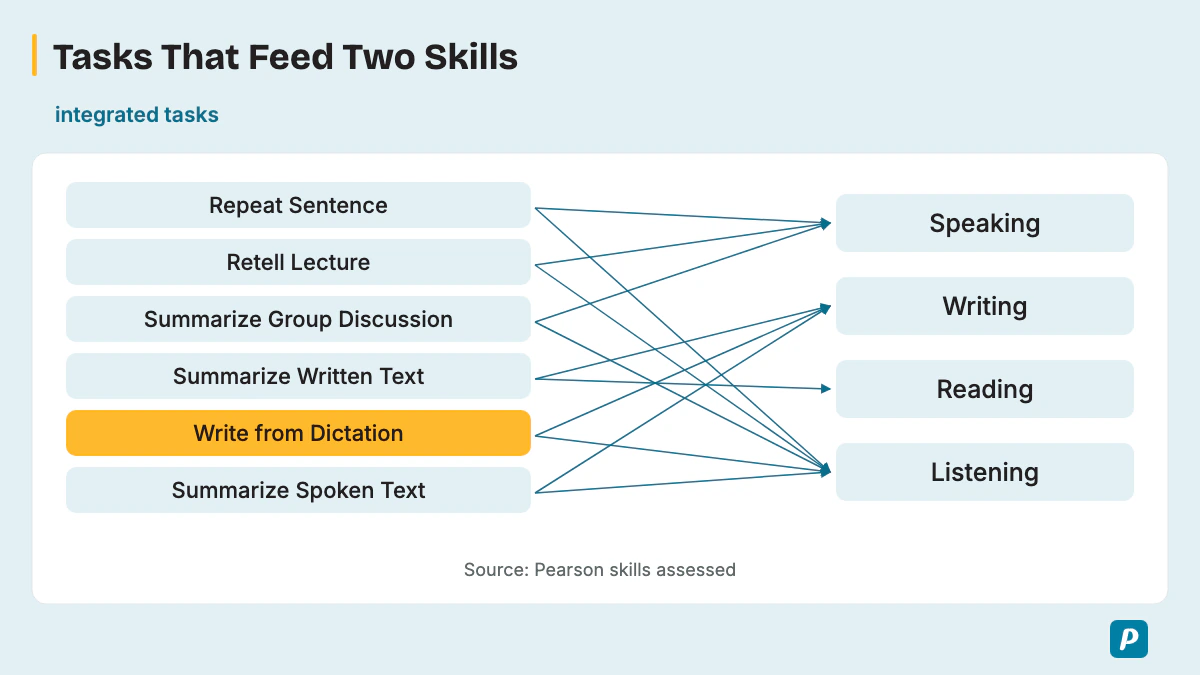
Master the integrated tasks first, because Pearson credits them to two skills. Repeat Sentence, Retell Lecture and Summarize Group Discussion feed listening and speaking, Summarize Written Text feeds reading and writing, and Write from Dictation feeds listening and writing. Pearson's task notes list the skills assessed for each one.
| Task | Skills Pearson credits | Why it matters for 90 |
|---|---|---|
| Repeat Sentence | Listening and speaking. | One response lifts two skill scores. |
| Retell Lecture | Listening and speaking. | It needs both understanding and clear delivery. |
| Summarize Group Discussion | Listening and speaking. | It rewards accurate content in your own words. |
| Answer Short Question | Listening. | Short spoken answers add listening credit from Part 1. |
| Summarize Written Text | Reading and writing. | One sentence counts for two skills. |
| Write from Dictation | Listening and writing. | Every correctly spelled word earns a point. |
| Summarize Spoken Text | Listening and writing. | Spelling and form count alongside content. |
| Fill in the Blanks (listening) | Listening (current Score Guide). | Each correctly spelled word scores. |
| Highlight Correct Summary | Listening and reading. | One right choice credits two skills. |
| Highlight Incorrect Words | Listening and reading. | Correct clicks score, wrong clicks deduct. |
For current PTE Academic scoring, follow the current Score Guide: Read Aloud contributes to Speaking, and Listening Fill in the Blanks contributes to Listening. Some general web descriptions retain broader language; do not add Reading or Writing credit based on those descriptions.
Pearson explains that question weighting and difficulty affect its scoring model. A fixed-mark recipe from a video cannot predict your official score. Use current official scoring guidance alongside your own error pattern, and practise every task type rather than treating one task as a guaranteed route to 90.
How Do You Score 90 in PTE Speaking?
Pearson scores speaking on content, pronunciation and oral fluency, so a 90 needs relevant content in your own words, delivered clearly and smoothly without long pauses or restarts.
- Cover the content the prompt asks for, point by point, so nothing on screen or in the audio is left out.
- Keep a steady rhythm and keep talking through a missed word; Pearson warns that repeating ideas, correcting yourself or hesitating wastes time and loses points.
- Pronounce words clearly and copy the speaker's stress and intonation in Repeat Sentence, without changing your own accent.
- Describe the image on screen in Describe Image, never a memorized script; Pearson warns that memorized or templated responses can lead to a score of 0 for content, and then fluency and pronunciation aren't scored either.
- Avoid any unoriginal response, because Pearson gives no credit for one.
Grammar isn't a listed speaking trait on Pearson's page. Content still counts the words you say, though: in Read Aloud every replaced, added or missing word lowers Content, and Repeat Sentence counts correct word sequences.
Each speaking task needs its own method, matched to Pearson's timings.
| Task | Pearson's timing | Practice approach |
|---|---|---|
| Read Aloud | Text up to 60 words; 30-40 seconds to prepare. | Mark chunks at the punctuation, stress the information words, and read every word as printed. |
| Repeat Sentence | Prompt 3-9 seconds; 15 seconds to answer. | Hold the sentence as 2-3 word chunks in order, then start as soon as the microphone opens. |
| Describe Image | 25 seconds to study; 40 seconds to answer. | Give the main idea, then 2-3 key details, then a conclusion or implication. |
| Retell Lecture | Lecture up to 90 seconds; 10 seconds to prepare; 40 seconds to answer. | Note about five keywords, then speak an introduction, 2-3 key points and a conclusion. |
Pearson's own Describe Image tip is blunt: if you organize what you say, you get a better score. For Retell Lecture, Pearson warns that a few disjointed ideas will lower your score. So link your keywords into a short account of the lecture rather than listing them.
What Is the 3 Second Rule in PTE?
Pearson's Answer Short Question block says that if you wait more than three seconds, or stop for three seconds while speaking, the recording stops. The item status then changes to completed. Pearson adds that this also applies to Read Aloud, Repeat Sentence, Describe Image and Re-tell Lecture. So start speaking when the microphone opens and treat any pause as a risk; our PTE 3 second rule explainer covers each task.
How Do You Score 90 in PTE Writing?
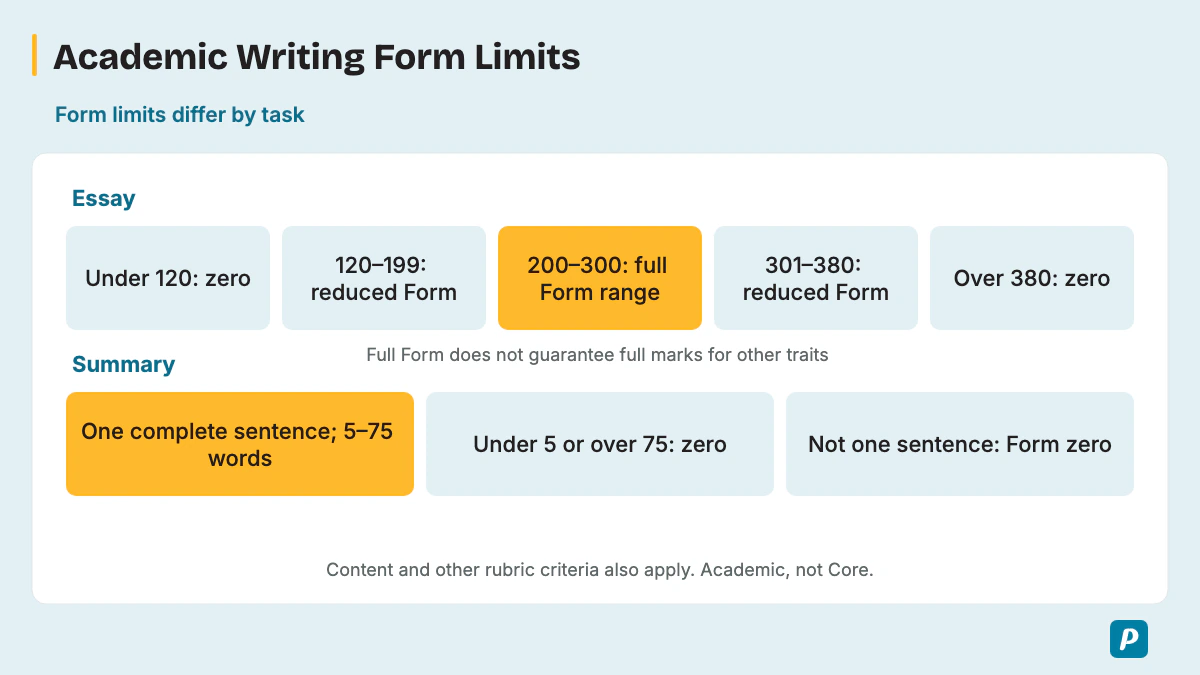
Stay inside Pearson's word limits, write in your own words, and make every sentence grammatically correct and correctly spelled. Write Essay is scored on seven traits, and Summarize Written Text must be one sentence. Form penalties depend on the task and how far the response is outside its limit; some breaches score zero, while others reduce Form. Check the specific rule below.
| Task | Pearson's rule | Practice approach |
|---|---|---|
| Write Essay | 200-300 words in 20 minutes; under 120 or over 380 words scores zero on all seven traits. | Uses four paragraphs (introduction, two body paragraphs, conclusion) and keeps a couple of minutes to proofread. |
| Summarize Written Text | One full sentence of no more than 75 words; under 5 or over 75 scores nothing. | Joins the main point and its support in one main clause plus a subordinate clause. |
| Write from Dictation | One point per correct word spelled correctly. | Types every word in order with correct spelling and a final full stop. |
The seven traits are Content; Development, structure and coherence; Form; General linguistic range; Grammar usage and mechanics; Vocabulary range; and Spelling. Pearson notes that the best essays use a high proportion of correct complex sentences, and that the best responses have a clear introduction, body and conclusion.
Pearson's essay article sets out three steps: analyze the prompt and plan, write the essay, then proofread. Build each body paragraph from a topic sentence, an explanation and an example. Pearson calls the task an argumentative essay, and its tips say a prompt may ask whether you agree or disagree with a statement, or how different groups of people might feel about a situation. Labels such as opinion, discussion, problem-solution and advantages-disadvantages are practice categories, not Pearson's.
Here is a sample plan for an original prompt: "Some people think cities should make public transport free for everyone. To what extent do you agree or disagree?"
- Introduction (about 45 words): restate the issue in your own words and state a clear position, such as partial agreement.
- Body 1 (about 85 words): topic sentence on lower traffic and cleaner air; explain how free fares move car users onto buses; give a city-wide example.
- Body 2 (about 85 words): topic sentence on cost; explain that taxes must replace fare income; give the example of service cuts if funding falls short.
- Conclusion (about 35 words): restate the position and the condition that makes it work, such as secure public funding.
That plan lands near 250 words, which leaves room inside the 200-300 range and time to check. Linking phrases make the structure visible, and this bank of 13 groups them by job:
- Adding a point: "In addition", "Also", "Beyond this".
- Contrasting: "However", "On the other hand", "Even so".
- Cause and result: "As a result", "Therefore", "Because of this", "This means that".
- Concluding: "To sum up", "Overall", "In short".
For Summarize Written Text, find the main idea and two or three supporting points, then merge them with a cause, result or contrast connector into one compound or complex sentence. Pearson's tip for the task is "Practice using compound and complex sentences." Paraphrase rather than lifting whole chunks of the passage, and end with a single full stop.
Spelling follows one rule: Pearson recognizes US, UK, Australian and Canadian spelling, as long as you use one convention consistently in a response. Some prep sites say American spelling is preferred; Pearson's page doesn't say that.
Templates need care. Pearson gives no credit for unoriginal responses. A "50% unique content" rule circulates online, but no percentage appears on Pearson's pages.
Is It Possible to Get 85 in PTE Writing?
Yes, writing credit comes from Write Essay, Summarize Written Text and Write from Dictation among others, and Summarize Spoken Text adds writing credit too. Those tasks use different scoring criteria. Spelling matters, but not every written task awards one point per correctly spelled word; use each task’s rubric and treat 85 as a goal, not a guaranteed result.
Can a PTE Writing Essay Template Get a 90 Score?
A structure helps, but Pearson sets a no-credit rule for an unoriginal response, and a memorized essay template with reused sentences risks exactly that. Build the frame and write the content fresh in your own words every time. Our PTE essay templates page shows frames that leave room for that.
How Do You Score 90 in PTE Reading?
Protect the partial-credit tasks, avoid wrong picks in Multiple Choice, Multiple Answers, and write a strong Summarize Written Text, which Pearson credits to reading too. Partial credit means every correct blank and every correct Reorder pair scores.
- Fill every blank, since a wrong blank costs nothing.
- Lock in each Reorder pair you're sure of, because each correct adjacent pair earns a point.
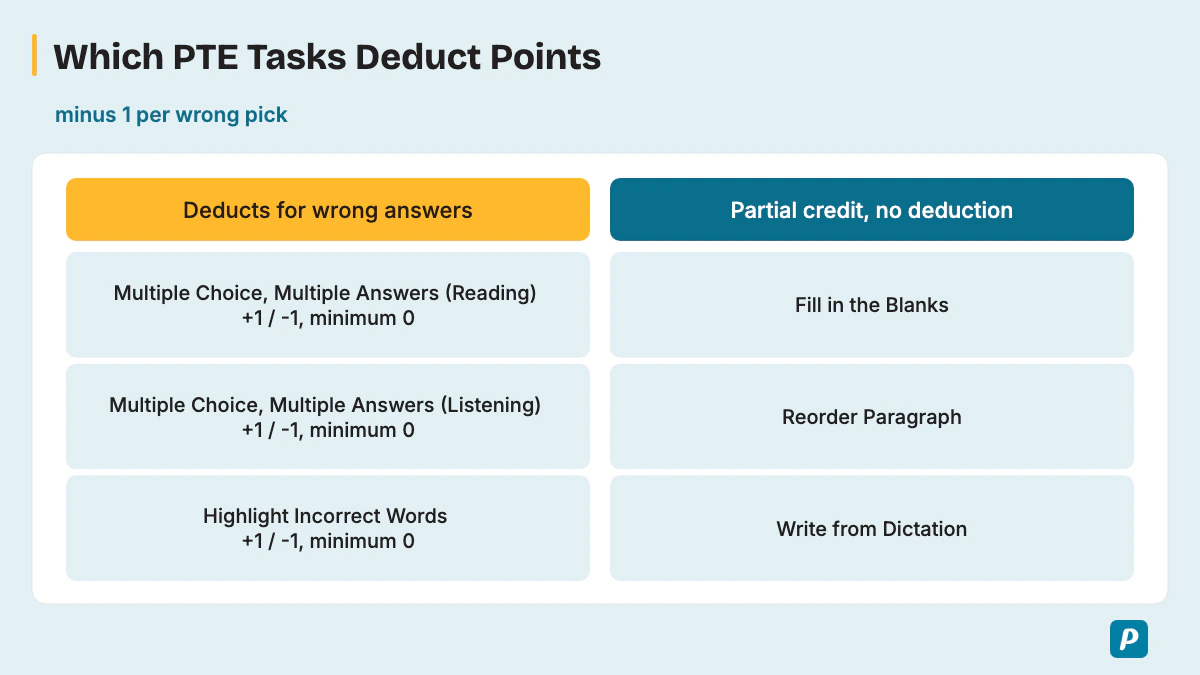
- Choose only options you can prove in Multiple Choice, Multiple Answers, where negative marking takes 1 per wrong option, never below zero.
- Read at a steady pace; Pearson's reading article suggests at least 220 words per minute.
- In Fill in the Blanks, read around each blank, decide the part of speech, rule out the wrong word classes, then choose by meaning and collocation.
- In Reorder Paragraph, find the topic sentence first, then build pairs from linking words and pronouns.
Fill the blanks you're sure of first, then return to the harder ones in the same item. Grammar clues then narrow the options. Check the preposition that follows ("gain access to"), the tense of nearby verbs, the article before the gap and the words that naturally go together. Pearson's own example: in "the general ___", collocation points to "public."
Pearson describes the topic sentence as one that can stand alone. It doesn't begin with a linker or with a pronoun that refers back to someone or something. Once it's placed, a sentence that opens with "However" or "This" must follow the idea it reacts to, and a sentence using "they" needs the noun it points back to.
PTE Academic Reading is one 23-30 minute block with no per-item timer, so spend your minutes where partial credit lives: Fill in the Blanks and Reorder Paragraph. Multiple Choice, Single Answer scores only right or wrong, and Pearson's tip is to choose the option most likely to be correct if you can't prove one. Some videos say to skip Multiple Choice after 30 seconds or spend 1.5-2 minutes per blank; those timings aren't Pearson's.
Which PTE Reading Tips Help You Score 90?
Read around each blank, test the connections between paragraphs and select only justified options in negative-marking questions. These habits support accuracy; they cannot guarantee a Reading score of 90. Use your errors to choose the next practice task.
How Do You Score 90 in PTE Listening?
Listening receives credit from Part 3 and integrated tasks in Part 1. Practice accurate dictation, relevant summaries and justified selections in negative-marking tasks. Each error can lose raw points, but these rules do not establish a fixed error allowance or guarantee a reported score of 90.
- Type every Write from Dictation word correctly while the audio plays, adding or skipping nothing; each correct word earns a point, and spelling counts.
- Write Summarize Spoken Text in your own words; it's scored on content, form, grammar, vocabulary and spelling.
- Click only words you're sure of in Highlight Incorrect Words and options you can prove in Multiple Choice, Multiple Answers, since negative marking applies to both.
- Treat Repeat Sentence and Retell Lecture as listening tasks too, not only speaking ones.
- In Fill in the Blanks, skim the text and guess what kind of word fits each gap, note what you hear, then fix spelling and plurals after the audio.
- In Highlight Correct Summary, listen and note keywords first, then choose the option closest in detail to your notes.
Fill in the Blanks gives you seven seconds to skim before the recording starts. Use them to judge what each gap needs: a name, a figure, an action word or a describing word. Pearson's tip is to write what you hear on the noteboard and decide the spelling after the recording ends.
Pearson says not to read the Highlight Correct Summary options before or while you listen, even though some prep sites tell you to pre-read them. After the audio, cross out options that fail one of four checks. Watch for a scope that is too broad or too narrow, a cause and result swapped, one example passed off as the main point, or a tone more extreme than the speaker's.
Summarize Spoken Text needs 50-70 words, and Pearson suggests leaving one or two minutes to check grammar, spelling and punctuation. In both multiple-choice listening tasks, read the question stem before the audio starts. In Multiple Choice, Multiple Answers, take notes rather than clicking while the audio plays, and pick options that match the meaning, not the ones that repeat words from the recording.
What Common Mistakes Stop Students From Crossing 79?
Off-topic responses, serious Form breaches, spelling errors, unsupported selections and long speaking pauses can lose points. Their effect depends on the task and the complete scoring model; no individual mistake here establishes a universal ceiling of 79.
- Memorized responses in Describe Image can score 0 for content, and an unoriginal essay earns no credit.
- An essay under 120 or over 380 words scores zero on every trait.
- A Summarize Written Text of more than one sentence, or over the 75-word limit, earns no points.
- A misspelled Write from Dictation word earns no point for that word.
- Guessing in Multiple Choice, Multiple Answers or Highlight Incorrect Words costs 1 per wrong choice.
- Hesitation and restarts lower oral fluency across the speaking tasks.
- Grammar slips such as subject-verb agreement, wrong tense, run-on sentences and missing articles cost marks under Grammar usage and mechanics.
- Repeating tasks without finding out why an answer lost marks keeps the same error in every attempt.
Which Practical Checklist Helps You Aim for 85-90 in PTE?
Get your starting range from a scored practice test, fix the integrated tasks first, drill the word-limit and spelling rules, and retest under full test conditions. Work through this seven-step checklist in order, then repeat the loop.
- Take a Scored Practice Test to get a baseline score.
- List the tasks where you lose marks, skill by skill.
- Drill the integrated tasks until each feels automatic.
- Check every written answer against its word limit.
- Proofread spelling in every typed task before you move on.
- Record and replay your speaking answers to catch pauses and restarts.
- Retest and compare each skill score with your baseline.
How Do You Simulate Perfect Exam Conditions?
Take full-length timed practice tests in one sitting, with a headset, a quiet room and no pauses, so the timing, the microphone and the fatigue match test day under real test conditions. Pearson's Scored Practice Test uses the official task types and scoring and shows where you lose marks. A third-party mock test gives you a practice estimate, not an official score.
Record your practice answers and play them back, marking every hesitation and restart. Run at least one full test this way before test day.
How Should You Set Up Your Headset and Microphone?
Pearson's test tip is to position the microphone around two fingers' distance from your mouth and keep your headset on throughout the test, because other test takers in the room may be speaking. Pearson also warns of background noise, so practice at that same distance until breath and popping sounds stay off your recordings. Our PTE headphones and microphone guide covers the equipment in detail.
How Do You Get 90 Overall in PTE?
The overall score is calculated independently from the four reported skill scores. A 90 overall does not mean every skill must also be 90, and four reported skills do not let a calculator predict it. Aim for accurate performance across the test; no task strategy or practice result guarantees the maximum score.
Where Is 90 on the PTE Score Chart?
90 is the highest PTE score. In Pearson’s July 2025 concordance, an overall 90 aligns approximately with IELTS Academic 9.0. For individual skills, Listening and Reading 81-90 align with IELTS 9.0; Speaking and Writing 90 align with IELTS 8.5, and the table gives no Speaking/Writing value for IELTS 9.0. These alignments are estimates, not admission or visa requirements.
What Score Is 7 Each in PTE?
On Pearson's July 2025 concordance, IELTS 7.0 lines up with PTE 63 overall, but the per-skill minimums differ: Listening 58, Reading 59, Speaking 76 and Writing 69. So "7 each" maps to those four skill scores rather than 63 in every skill, unless the body setting the requirement publishes its own PTE figure. Some prep sites still quote the old 65 or 65-72 for 7.0; Pearson's current table says 63 overall. See our PTE vs IELTS score conversion for every level.
Which Is the Toughest Section in PTE?
Pearson publishes no difficulty ranking. Your toughest section is the skill your Scored Practice Test puts lowest, so treat that baseline as your starting point.
Practice PTE Online on PTE Practice
Try Speaking, Writing, Reading and Listening tasks in a timed, computer-based format.
Try speaking practice without signing up. A free account is required for full mock tests. Practice scores are estimates, not official Pearson scores.
Written by
PTE Practice Team
The team behind PTE Practice's PTE practice and mock tests
We build the PTE practice tasks, mock tests and scoring on PTE Practice, and we oversee every guide on this site. Our guides draw on official test and government sources where applicable. Requirements can change; use the linked source and check the rules for your exact test, course or route. Practice examples are independent learning material. PTE Practice is not affiliated with Pearson.
Editorial review completed .