
PTE Reading Reorder Paragraph: Rules, Examples and Tips
PTE Reading
In PTE Reading, Reorder Paragraph gives you one short academic passage cut into text boxes, shuffles them, and asks you to restore the original order. You earn one point for every pair of neighboring boxes you get right.
Moving one box can break several adjacent pairs. In a short item it can leave no correct pairs, so count the pairs rather than assuming some credit remains. Pearson sets the rules on its PTE Academic and PTE Core Reading pages, and the task is the same in both tests; older Pearson material calls it Re-order Paragraphs. The fastest route to those pairs is a stand-alone opener followed by grammar clues.
Table of Contents
What Is PTE Reading Reorder Paragraph?
PTE Reading Reorder Paragraph is a reading item that shows a passage of up to 110 words split into text boxes in random order, which you put back in the order the writer intended. It's task 3 of 5 in Part 2 Reading, in both PTE Academic and PTE Core. Pearson says the item judges your understanding of the organization and cohesion of an academic text, so it tests how sentences connect rather than how many words you know.
Pearson's PTE Academic Score Guide lists 2-3 Reorder Paragraph items per test, and each one scores reading only.
What Is the Reorder Paragraph Task Format?
The task format is up to 110 words of academic text in random boxes, moved by drag and drop or arrow buttons, with no timer of its own. Each rule in this table comes from Pearson's PTE Academic and PTE Core Reading pages, except the item count, which comes from the Score Guide.
| Rule | What Pearson says |
|---|---|
| Text length | Up to 110 words, Academic and Core |
| Layout | Boxes in random order on the left, your answer on the right |
| Moving a box | Click and drag, or select it and use the left and right arrow buttons |
| Reordering on the right | Up and down arrow buttons |
| Deselecting | Click elsewhere on the screen |
| Time | No item timer; Reading runs 23-30 minutes (Academic) or 27-37 (Core) |
| Skill scored | Reading |
| Items per test | 2-3 (PTE Academic Score Guide) |
You can keep moving boxes with either method until the order reads correctly. Some prep sites still quote 50 or 150 words; Pearson's current page says up to 110 words for both tests. Pearson publishes no box count, so be ready for any number of boxes. The PTE Core Reading page gives no item count.
How Is Reorder Paragraph Scored?
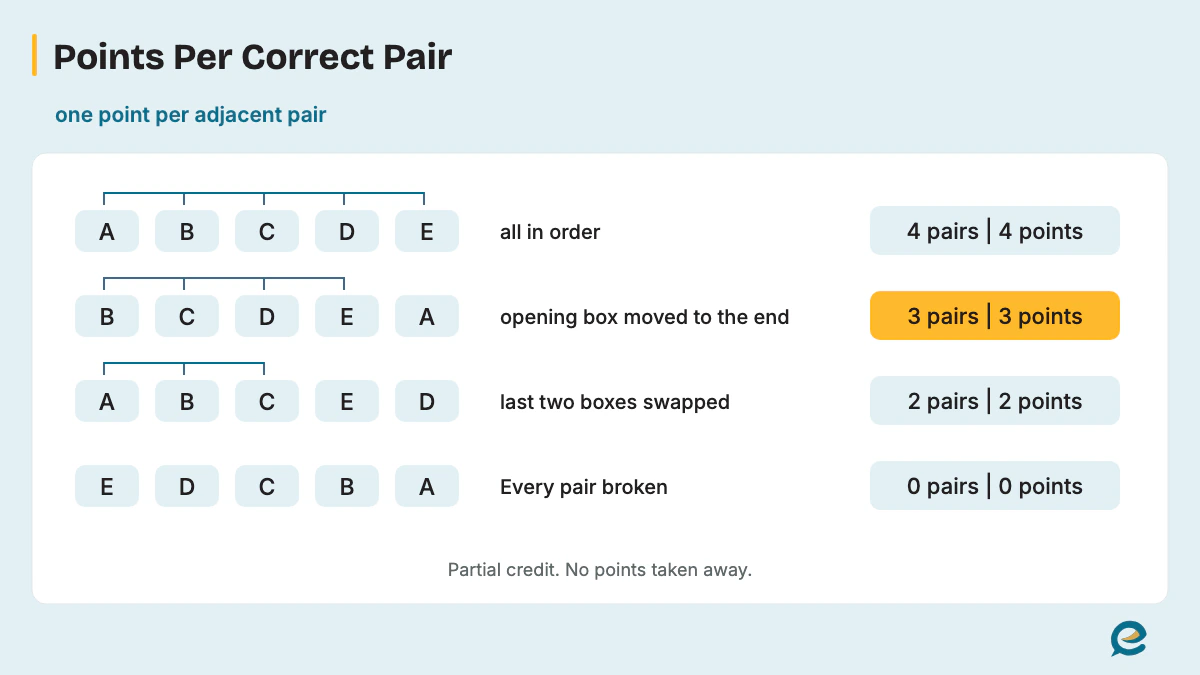
You earn one point for each pair of boxes placed next to each other in the right order, with partial credit, no deduction, and a minimum of zero. A passage of five boxes in the correct order A-B-C-D-E has four adjacent pairs (A-B, B-C, C-D, D-E), and this worked scoring shows what common slips cost.
| Your order | Correct adjacent pairs | Points |
|---|---|---|
| A-B-C-D-E (all in order) | 4 | 4 |
| B-C-D-E-A (opening box moved to the end) | 3 | 3 |
| A-B-C-E-D (last two boxes swapped) | 2 | 2 |
| Every pair broken | 0 | 0 |
The maximum is always the number of boxes minus one, so a four-box item is worth 3 points and a six-box item 5.
Pearson's web pages say all boxes in order earns the maximum and one or more wrong earns partial credit; the one-point-per-adjacent-pair rule and the zero minimum come from Pearson's Score Guide. A wrong pair earns 0, not half a point, and the item total depends on the box count, so there's no fixed "6 points".
What Types of Passages Appear in Reorder Paragraph?
Reorder Paragraph uses short academic texts whose order shows through logic, time sequence or argument, which is the organization Pearson says the task tests. Six passage patterns cover most texts, and each comes with the clue that usually settles it.
- Chronological order passages move through dates and time words such as then, later and eventually.
- Process order passages run through first, next and finally, one step per box.
- Cause and effect passages link a cause to its result with because, as a result or therefore.
- Claim and support passages state a point, back it with an example, then often turn with however.
- Problem and solution passages describe a difficulty before the fix, often with "one solution is".
- Explanatory passages move from a definition to an explanation, an example and a conclusion.
These passage patterns are study aids, not official Pearson categories. Pearson's 2021 reading article names logical and chronological order as the orders to look for.
How Do You Solve Reorder Paragraph Step by Step?
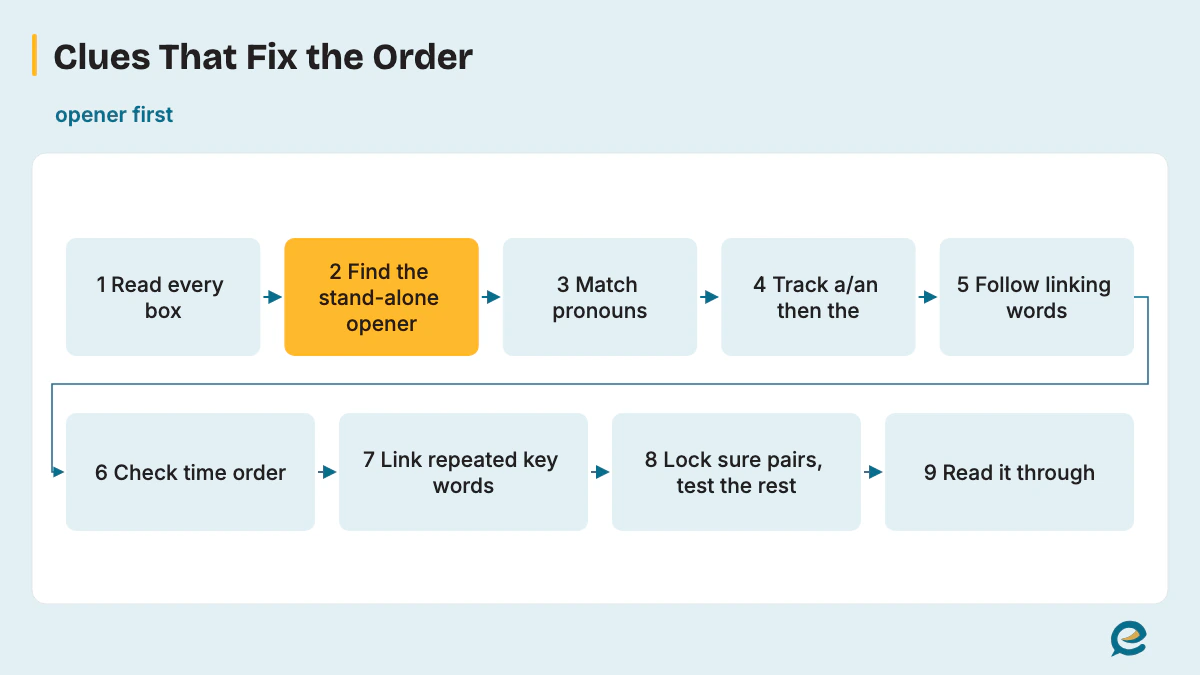
The method is read every box quickly, find the topic sentence, then chain the rest through pronouns, articles, linking words, time order and repeated key words.
- Read every box and note the key words, as Pearson advises.
- Find the stand-alone topic sentence.
- Match pronouns to nouns.
- Track a/an, then the.
- Follow linking words.
- Check the time or process order.
- Link repeated key words and synonyms.
- Fix the locked pairs you're sure of, then test the few orders left.
- Read the final order once from top to bottom.
Most academic passages run from general to specific: an introduction, an explanation, an example, then a conclusion. So the most general box tends to open, and a result or summary box tends to close.
How Do You Find the Independent Opening Sentence?
The opening sentence can stand alone: it does not start with a linking word or a pronoun such as he or this, and it does not point back to something already said. Pearson's own example is a passive line like "No link was found", which points back to a search already described.
Test every box against these checks and cross out each one with a back reference: this, they, it, another, such, these, thus, however, eventually, or "the" before a noun no other box has introduced. Usually one box survives, and that topic sentence stands alone as your first box. One exception: a dummy "it", as in "It is often believed that…", points forward, not back, so it can open a passage.
How Do You Match Nouns to Pronouns?
A pronoun needs a noun before it, so a box that starts with it, they or this follows the box that names the thing. Pearson's grammar guidance says pronouns help you find the correct position of sentences in this task. Reference words such as these, such and another work the same way: "another connection" only makes sense after a first one.
Noun before pronoun is the rule, but the noun box isn't always directly ahead; check which earlier box the pronoun reference actually points to.
How Do You Track Articles (A/An vs The)?
A noun usually appears first with a or an and later with the, so the box with "a study" comes before the box with "the study". Pearson gives this indefinite article before definite article rule for exactly this task, and adds that articles help you find the topic sentence. Our guide to PTE grammar rules covers articles with more examples.
How Do Transition and Contrast Clues Link the Boxes?
Words like however, therefore, as a result and for example tie a box to the one before it, so they almost never open the passage. Contrast clues such as however and but signal a turn away from the idea in the previous box. Addition words (also, in addition) and late-sequence words (eventually, finally) need an earlier box too. Pearson's 2021 article on common mistakes names ignoring linking words and opening and concluding statements as one of them.
How Do You Follow Chronological or Process Order?
Dates, sequence words and the steps of a process set an order you can check box by box. A time order check works best as the last pass over a nearly finished order. If the process steps run backward anywhere, or a later date sits above an earlier one, one box is still out of place.
How Do Repeated Keywords and Synonyms Link the Boxes?
Key words that appear in one box and come back in another, either as a repeated noun or as one of its synonyms, tie the two boxes together. If one box ends on "global warming" and another opens with "This climate change", the second follows the first. Use this clue when no pronoun or linker decides a pair. The same logic links a box that asks a question to the box that answers it.
When Should You Use Trial and Error in Reorder Paragraph?
Use trial and error only after you've fixed the opener and the locked pairs you're sure of, because by then only two or three orders are left to test. Read each remaining order through and keep the one with no broken reference. The closing box is usually a result or summary (as a result, therefore, overall), which narrows the options from the end.
What Does a Reorder Paragraph Example Look Like?
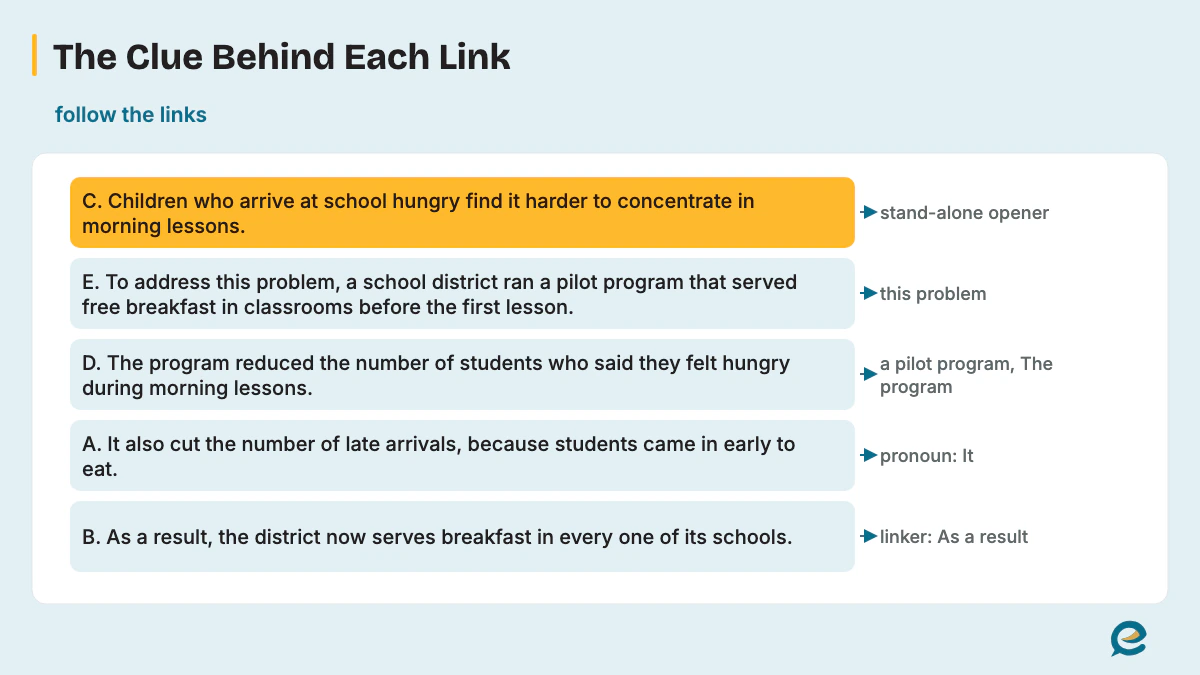
An example gives you five short boxes from one academic passage in jumbled order, an elimination check that leaves one opener, the correct order, and the clue that fixes each link. These sample boxes are original practice material, not a real exam question. Try it before reading the answer.
- A. It also cut the number of late arrivals, because students came in early to eat.
- B. As a result, the district now serves breakfast in every one of its schools.
- C. Children who arrive at school hungry find it harder to concentrate in morning lessons.
- D. The program reduced the number of students who said they felt hungry during morning lessons.
- E. To address this problem, a school district ran a pilot program that served free breakfast in classrooms before the first lesson.
Start with elimination. A opens with "It also", B with the linker "As a result", D with "The program" (a program nobody has mentioned yet), and E with "this problem". Only C stands alone, so C opens.
Correct order: C-E-D-A-B. Four link clues hold it together.
- C to E: "this problem" points back to the hungry children in C.
- E to D: "a pilot program" becomes "The program", the article clue.
- D to A: "It" needs the program, and "also" adds a second result to the one in D.
- A to B: "As a result" draws the conclusion from both results, so B closes the passage.
The swap cost is easy to count. If you swap the last two boxes, C-E-D-B-A, you keep C-E and E-D but break D-A and A-B, scoring 2 of 4. If you move the opener to the end, E-D-A-B-C, you keep three pairs and score 3 of 4.
What Are Some Reorder Paragraph Practice Questions With Answers?
These ten practice sets are original material, not real exam questions, and each one has an intended order supported by the reference and linking clues. Every set has one stand-alone opener, and every other box carries back-pointing words that tie it to one earlier box. The sets mix the six passage patterns above, so solve each one before reading its answer key, then check which clue you missed.
Set 1: Longitude at sea (chronological, 4 boxes)
- A. The answer to that problem eventually came from timekeeping: a clock that kept accurate time at sea let navigators compare local noon with the time at their home port.
- B. For centuries, sailors worked out how far north or south they were by measuring the angle of the sun or the North Star above the horizon.
- C. Once such clocks became affordable, ships could fix their longitude, and long voyages became safer.
- D. This method worked well, but it could not show how far east or west a ship had traveled.
Answer: B-D-A-C. B stands alone; "This method" in D points to B; "that problem" in A points to D; "such clocks" in C points to A.
Set 2: How black tea is made (process, 5 boxes)
- A. Next, the rolled leaves are left in warm, humid air to oxidize, which turns them from green to a copper color.
- B. This finished tea is then sorted and graded by leaf size before it is packed.
- C. Black tea production begins with withering, when freshly picked leaves are spread out so they lose some of their water.
- D. Finally, the leaves are dried with hot air, which stops the oxidation and removes most of the remaining moisture.
- E. The softened leaves are then rolled, which breaks their cells and presses out their juices.
Answer: C-E-A-D-B. C stands alone, and "The softened leaves" in E follows the withering in C. "Next, the rolled leaves" in A follows E, "Finally" in D ends the processing, and "This finished tea" in B follows the dried leaves.
Set 3: Cane toads in Australia (cause and effect, 4 boxes)
- A. As a result, native predators that eat the toads may die from the toxins they carry.
- B. However, the toads proved ineffective at controlling the beetles.
- C. In 1935, cane toads were released in northern Queensland to control beetles that were damaging sugar cane crops.
- D. Worse, they spread rapidly across Queensland and into other parts of Australia.
Answer: C-B-D-A. C stands alone with a date, and "However, the toads" in B turns against the plan in C. "Worse, they" in D adds a second problem to the failure in B, and "As a result" in A follows their spread.
Set 4: Plain-language documents (claim and support, 4 boxes)
- A. Supporters say the change saves money, because readers who understand a form the first time rarely need to call a help line.
- B. The challenge, therefore, is to make documents clearer without making them less precise.
- C. However, critics warn that these savings come at a cost, because simplifying legal wording can change what it means.
- D. Many government agencies now write public documents in plain language.
Answer: D-A-C-B. D stands alone; "the change" in A is the switch to plain language; "these savings" in C points to A; "therefore" in B draws the conclusion from the trade-off.
Set 5: Losing coastal wetlands (problem and solution, 4 boxes)
- A. Their loss matters because wetlands absorb the force of storm surges and filter polluted water before it reaches the sea.
- B. Over time, the flooded land turns into new salt marsh that protects the coast as the lost wetlands once did.
- C. Coastal wetlands are disappearing as towns expand and concrete sea walls replace natural shorelines.
- D. One solution is managed realignment, in which an old sea wall is deliberately opened so that the tide can flood the land behind it.
Answer: C-A-D-B. C stands alone; "Their loss" in A needs the wetlands in C; "One solution" in D answers the problem; "the flooded land" in B follows the flooding in D.
Set 6: Marie Curie (biography, 5 boxes)
- A. Their work earned them a share of the 1903 Nobel Prize in Physics.
- B. In 1891, she moved to Paris to study physics and mathematics at the Sorbonne.
- C. Eight years later, she won a second Nobel Prize, this time in chemistry.
- D. Marie Curie was born in Warsaw in 1867 and received some of her early scientific training from her father.
- E. In Paris she met the physicist Pierre Curie, and the couple later studied radiation together.
Answer: D-B-E-A-C. D names her and stands alone, and "she" in B needs D. "In Paris" in E needs B, "Their work" in A needs the couple in E, and "Eight years later" in C counts from 1903.
Set 7: Food deserts (explanatory, 4 boxes)
- A. Such areas usually form where large supermarkets are far away and nearby shops sell mostly packaged snacks.
- B. Where that happens, a household without a car may need a long bus ride simply to buy vegetables.
- C. This extra effort is one reason researchers link food deserts to poorer diets, although the strength of that link is still debated.
- D. A food desert is an area where residents have little access to affordable fresh food.
Answer: D-A-B-C. D defines the term with "A food desert", and "Such areas" in A points to D. "Where that happens" in B points to A, and "This extra effort" in C points to the bus ride in B.
Set 8: Open-plan offices (contrast, 5 boxes)
- A. These findings suggest that removing walls does not by itself make people work together more.
- B. However, a study of two large companies found the opposite, with face-to-face interaction falling sharply after the walls came down.
- C. Open-plan offices spread partly because removing walls was expected to make colleagues talk more.
- D. Instead, employees sent more emails and instant messages.
- E. The idea was simple: with nothing between their desks, people would share ideas faster.
Answer: C-E-B-D-A. C stands alone, and "The idea" in E restates the expectation in C. "However" in B turns against it, "Instead" in D says what happened in place of talk, and "These findings" in A sums up B and D.
Set 9: How a rainbow forms (process, 4 boxes)
- A. Because each color leaves at a slightly different angle, an observer with the sun behind them sees the colors as separate bands.
- B. The colors then reflect off the back of the drop and bend again as they leave it.
- C. As the light enters each drop, it bends and splits into its separate colors.
- D. A rainbow appears when sunlight passes through raindrops in the air.
Answer: D-C-B-A. D stands alone, and "the light" and "each drop" in C point to D. "The colors then" in B follows the splitting in C, and "leaves at a slightly different angle" in A needs the exit described in B.
Set 10: The Great Stink of 1858 (chronological, 5 boxes)
- A. The stench reached the Houses of Parliament, which stand on the river's bank.
- B. Over the following decades, the system also helped end the cholera outbreaks that had repeatedly struck the city.
- C. Faced with the problem every working day, lawmakers approved funding for a new sewer network designed by the engineer Joseph Bazalgette.
- D. In the hot summer of 1858, the smell of untreated sewage in the River Thames became so strong that Londoners called it the Great Stink.
- E. His network carried waste away from central London to outfalls further down the river.
Answer: D-A-C-E-B. D stands alone with a date, and "The stench" in A points to D. "The problem" in C points to A, "His network" in E needs Bazalgette in C, and "the system also" in B adds a later effect.
What Are Common Reorder Paragraph Mistakes?
The common mistakes are opening with a box that points back, ordering boxes by topic instead of the links between them, and moving every box when only one is out of place. The cost of a mistake depends on how many correct adjacent pairs it breaks, the unit this task scores. Pearson's own 2021 article lists ignoring linking words and opening and concluding statements.
- Opening with a back-referring box can make the passage harder to follow; check which adjacent pairs the chosen order actually preserves.
- Topic grouping puts similar boxes together but ignores the grammatical links, so two or more pairs break.
- Ignoring articles lets a "the" box sit before its "a" box, which breaks at least one pair.
- Reading the boxes in random order, instead of all of them first, makes it easy to miss the opener and lose the first pair.
- Trusting memorized templates over the text forces a pattern the passage doesn't follow and breaks every pair it misplaces.
- Reshuffling a nearly correct order creates broken pairs that were right before.
- Skipping the final read-through leaves a swapped pair in place, which can cost two or three points in a five-box item.
- Spending too long on one item doesn't lose pairs there, but it steals time from the two Reading tasks after it.
How Do You Practice Reorder Paragraph?
Effective practice means short academic passages cut into boxes, solved against a time budget, with the clue behind every missed link named afterward. Start with the ten sets above, and for each wrong attempt write down which pair broke and why.
Then build your own practice loop. Copy a paragraph from a news report or textbook, cut it into shuffled sentences, solve it the next day, and check it against the original. Keep an error log of the missed clue type (opener, pronoun, article, linker, time order or key word), and drill the type that appears most in your own log.
Should You Use a Reorder Paragraph Template?
A template is a memory aid, not a Pearson method; the clues in the text decide the order, so use a checklist of clues rather than a fixed pattern. Pearson does not publish any template for this task. A short clue checklist does the job: opener, pronouns and reference words, articles, linkers and time words, then a read-through.
Does Reorder Paragraph Have Negative Marking?
No, Reorder Paragraph has no negative marking: a wrong pair scores 0, the zero minimum means nothing is taken away, and you should always submit a complete order. In PTE Academic, points are deducted only in Multiple Choice, Multiple Answers (Reading and Listening) and Highlight Incorrect Words. Our guide to PTE negative marking lists the scoring rule for every task.
How Much Time Should You Spend on Each Reorder Paragraph?
Pearson sets no timer for the item, so set your own time budget: about two minutes per Reorder Paragraph is a practical target, not a Pearson rule. PTE Academic Reading gives you 23-30 minutes for 15-20 items on a shared Reading clock, which averages roughly 1.2 to 2 minutes per item, and this task needs more reading than a single blank. The PTE reading format page shows the timing of all five tasks.
Is Reorder Paragraph the Same in PTE Academic and PTE Core?
Yes, the item works the same way in PTE Academic and PTE Core: up to 110 words, partial credit and Reading only. The difference sits around it, since Reading runs 23-30 minutes in PTE Academic and 27-37 minutes in PTE Core.
Pearson's current pages set the same 110-word limit for both, and PTE Academic UKVI uses the same test content, format and scoring as PTE Academic. Our PTE Academic vs Core comparison covers the other differences between the tests.
What Are the Best Reorder Paragraph Tips and Tricks?
The tips that hold up are Pearson's: read every box first, find the stand-alone opener, and build the order through grammar links. Pearson's 2021 reading article recommends checking cohesive devices, articles and chronological order. Our PTE reading tips page applies the same Reading tips across all five tasks.
Which Is the Toughest Section in PTE?
Pearson does not rank its parts or tasks by difficulty, so judge from your own practice results which weak tasks lose you the most points. Reorder Paragraph is the only Reading task scored by adjacent pairs, and in Reading only Multiple Choice, Multiple Answers takes points away for wrong answers. Our page on PTE question types sets every task side by side, so you can compare them.
How Does Reorder Paragraph Fit the PTE Reading Format?
It is the third of five Reading tasks, between Multiple Choice, Multiple Answers and Fill in the Blanks (Drag and Drop), inside one timed part. That task order means it shares the Reading format's single clock with the other four. Our PTE Reading guide covers each of those tasks.
Practice PTE Reading on EasyEnglish
Try Reading tasks in a timed, computer-based format like the real test.
Try speaking practice without signing up. A free account is required for full mock tests. Practice scores are estimates, not official Pearson scores.
Written by
EasyEnglish Team
The team behind EasyEnglish's PTE practice and mock tests
EasyEnglish provides independent PTE practice and estimated scores. EasyEnglish is not affiliated with or endorsed by Pearson. Contact support@inverseai.com.
Format and scoring sources checked on 26 October 2026: Academic Reading; Core Reading; Academic Score Guide; Core Score Guide (January 2026). Academic and Academic UKVI details use the format introduced on 7 August 2025; Core details use its January 2026 Score Guide. Where a task page and Score Guide differ, the distinction is identified in the text; use the Guide for scoring criteria. Practice passages, names, figures, prompts and model answers are authored examples supplied with this guide, not authentic exam items or independently verified research findings. Suggested practice schedules and time splits are coaching advice, not Pearson requirements or score guarantees.
Editorial review completed .