PTE Personal Introduction: Topics, Samples and Tips
PTE Speaking
The Personal Introduction opens the Speaking & Writing part of PTE Academic and PTE Core, gives you 25 seconds to read an on-screen prompt and prepare, then records your answer once in 30 seconds. Pearson's current format pages call it a question for familiarization only, with no effect on your score, so use it to test the microphone and settle into speaking.
Table of Contents
What Is the Personal Introduction in PTE?
The Personal Introduction is the opening speaking item of PTE Academic and PTE Core, where you read an on-screen prompt and record a short answer about yourself. It's the first item in Part 1 Speaking & Writing. You get 25 seconds to read the prompt and prepare, then 30 seconds to record, and you can record only once.
Pearson describes it as a chance to get familiar with the test technology and to prepare for the speaking and listening questions that follow. Read Aloud comes straight after it, so your first scored item is only seconds away.
Is the PTE Personal Introduction Scored?
No, the Personal Introduction is an unscored task. Pearson's PTE Academic and PTE Core pages both say it does not contribute to your score and is "for familiarization purposes only". In plain terms, you get no Content, Pronunciation or Oral Fluency score for it, and nothing you say moves your overall result on the 10-90 score scale.
Prepare it as a calm warm-up before the scored items. Complete the separate equipment check as instructed and raise any recording problem with the test administrator before continuing.
How Long Is the PTE Personal Introduction?
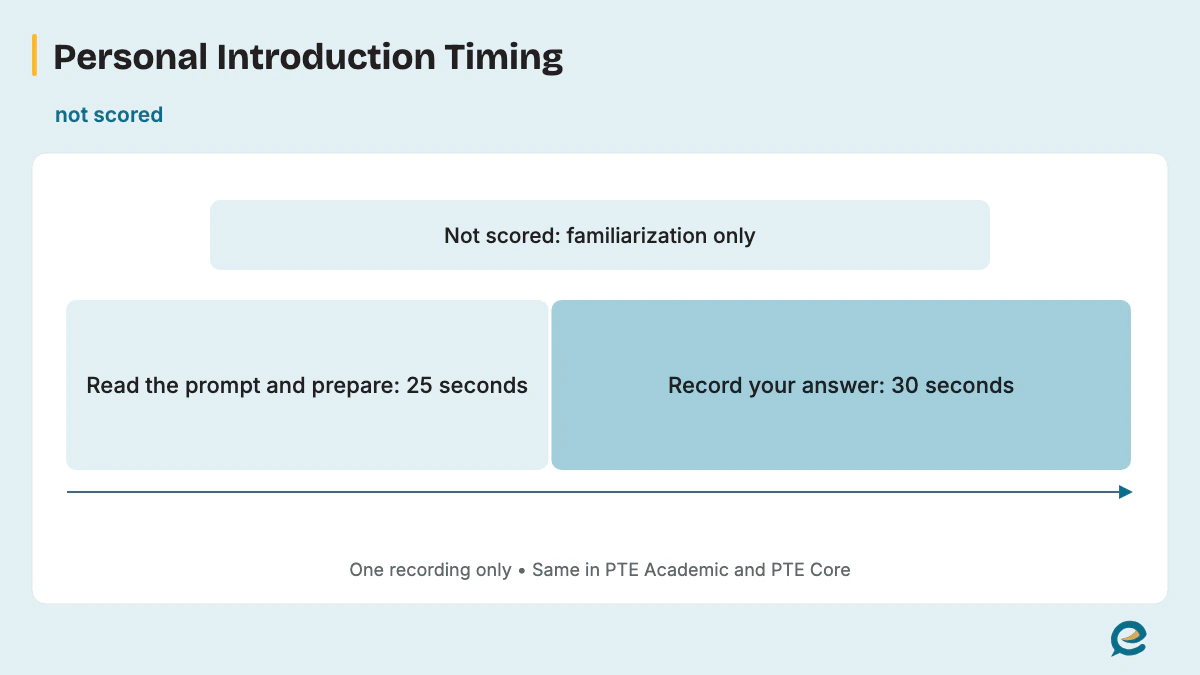
You get 25 seconds to read the prompt and prepare, then 30 seconds to record, and there's one recording only. Pearson gives those two timings; the table breaks the item into four stages.
| Stage | What happens | Time |
|---|---|---|
| Prompt on screen | A short prompt asks you to introduce yourself. | Shown at the start. |
| Preparation | You read the prompt and plan what to say. | 25 seconds of preparation time. |
| Recording | You speak your answer into the microphone. | 30 seconds of recording time. |
| Finishing | The recording ends and the item closes. | One recording, no second try. |
Pearson sets the same timing on its PTE Academic and PTE Core pages. Start speaking only once the microphone opens, because Pearson's speaking blocks warn that anything said before then is not recorded. Because you can't re-record, plan an answer that finishes comfortably inside 30 seconds rather than one that gets cut off mid-sentence.
Do Universities Actually Listen to the PTE Personal Introduction?
Pearson's format pages call the Personal Introduction familiarization only, but Pearson's March 2025 handbook lists it among the security data taken on test day. That list also includes your photograph, signature and palm vein scan. The handbook adds that this data may be shared with government authorities or institutions processing an application that includes your PTE results, or that you have named as score recipients.
A July 2021 Pearson article went further and said the item "will be sent together with your score report to the institutions selected by you". Neither source tells you how admissions teams use the recording. Speak as if a person might hear it, because a polite, clear introduction costs you nothing.
What Should You Say in a PTE Personal Introduction?
Answer the on-screen prompt; Pearson sets no required content, so a short, natural introduction covering who you are, your home city, your studies or job, and why you're taking PTE fits the 30 seconds. These topic slots are common prep advice, not a Pearson checklist. Pick four or five that suit you.
- Your name.
- Your hometown, city or country.
- Your studies or work.
- A hobby or interest.
- Your reason for taking PTE, such as a study, work or migration plan.
Some guides tell you to give your full name exactly as it appears on your passport. Pearson doesn't state that rule, so it's optional. Leave out any personal detail you aren't comfortable sharing.
What Is a Good PTE Introduction Template?
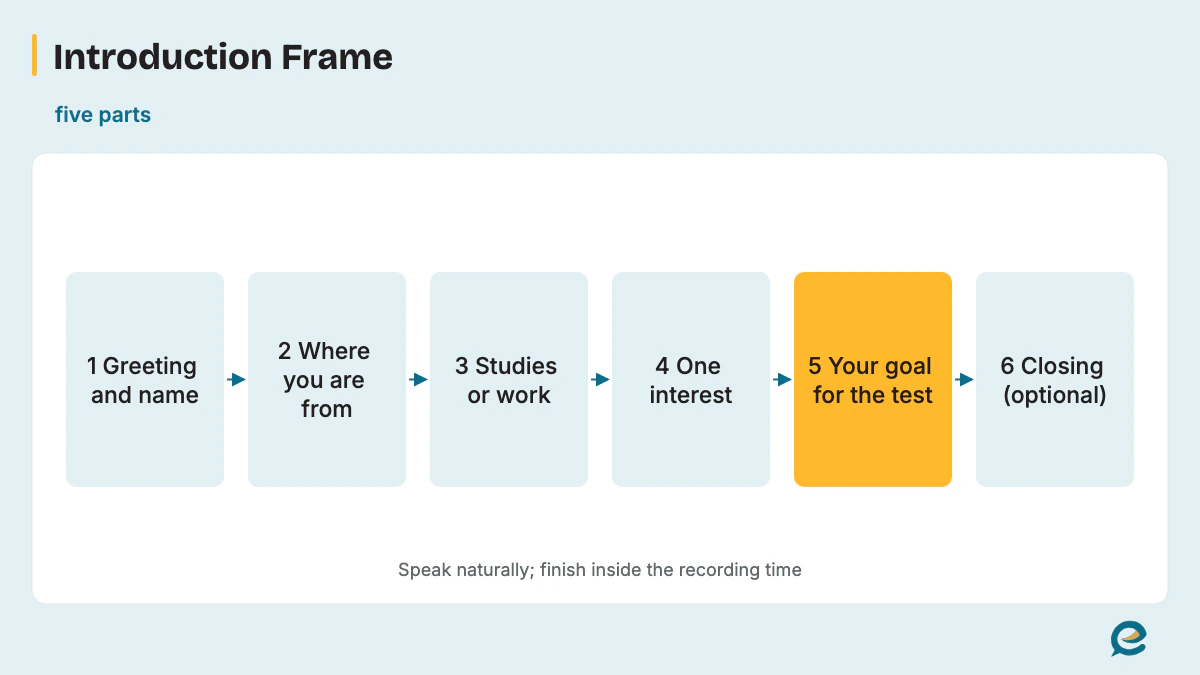
A good template is a five-part introduction frame (greeting and name, where you're from, studies or work, one interest, your goal for the test) plus a short closing line. Each part below comes with sentence starters you can adapt.
- Greeting and name: "Hello, my name is ..."
- Where you're from: "I'm from ..., a city in ..."
- Studies or work: "I recently finished a degree in ..." or "I work as a ..."
- One interest: "In my free time, I enjoy ..."
- Your goal for the test: "I'm taking PTE because I plan to ..."
- Closing: "Thank you." or "I'm looking forward to the next step."
Another way to order it is present, past, future: who you are now, what you've studied or done, and what you plan next. Age is an optional slot; add it only if you want to.
A frame is fine here because the item is unscored. Still, natural delivery matters more than the exact words, since that habit carries into the scored items. In the scored tasks, Pearson's Score Guide treats memorized responses or pre-prepared material as irrelevant. Its Describe Image, Retell Lecture and Summarize Group Discussion notes also say "You must use your own words", so don't carry a fixed script past this item.
What Does a PTE Introduction Sample Answer Look Like?
Each sample answer below runs about 60 spoken words, for a student, a working professional, a doctoral applicant and a job-offer applicant, built on the frame above. All four are invented examples; the names aren't real people.
Hello, my name is Ananya Rao. I'm from Pune, a busy city in western India. I recently completed a bachelor's degree in computer science. In my free time, I like playing badminton and reading short stories. I'm taking PTE because I plan to study for a master's degree in data science abroad next year, and I'm looking forward to that next step.
Frame map for this student introduction: sentence 1 = greeting and name, 2 = where you're from, 3 = studies, 4 = interest, 5 = goal.
Good morning, my name is Rahul Mehta. I come from Ahmedabad in Gujarat. I've worked as a civil engineer for six years, mostly on road and bridge projects. Outside work, I enjoy cooking with my family on weekends. I'm taking PTE as part of my plan to migrate and continue my engineering career overseas, where I hope to work on larger infrastructure projects.
Frame map for this professional introduction: sentence 1 = greeting and name, 2 = where you're from, 3 = work, 4 = interest, 5 = goal.
Hello, my name is Linh Tran. I'm from Da Nang, a coastal city in central Vietnam. I teach chemistry at a local college, and before that I finished a master's degree in materials science. In my spare time, I go running by the beach. I'm taking PTE because I've applied for a PhD program in renewable energy. Thank you.
Frame map for this doctoral applicant: sentence 1 = greeting and name, 2 = where you're from, 3 = work and studies, 4 = interest, 5 = goal, 6 = closing.
Good afternoon, my name is Tomás Herrera. I'm from Bogotá, the capital of Colombia. I've worked as a registered nurse in an intensive care unit for four years. I spend my weekends cycling in the mountains with friends. I'm taking PTE because a hospital in Australia has offered me a position, and I need the score for my registration, so thank you for listening.
Frame map for this job-offer applicant: sentence 1 = greeting and name, 2 = where you're from, 3 = work, 4 = interest, 5 = goal and closing.
The 60-word length is a practice guide for a calm speaking pace, not a Pearson rule. Read each sample aloud with a timer, and you'll see how much room 30 seconds leaves.
What Tips Help You Give a Strong Introduction in PTE?
Strong delivery comes down to a steady pace, a clear voice, finishing inside the time limit, and using the item to settle into the microphone. These delivery tips rest on habits you build before test day: rehearse aloud a few times, time yourself, and keep the tone friendly rather than scripted.
Rehearse aloud with a 30-second timer rather than only planning in your head, so you know where your answer ends. That rehearsal also takes the edge off test-day nerves. Avoid these common slips:
- Fillers such as "umm", "like" and "you know".
- A casual "hey" or slang in place of a polite greeting.
- Apologizing for your English; just speak.
- Restarting a sentence after a small mistake.
- Long pauses while you search for a detail.
- Long or rare words you can't yet say clearly.
What Should You Say If You Don't Have Job Experience?
Talk about your studies, a project or a skill you're building instead, because the prompt asks about you, not about a job. Without job experience, a student can say something like "I'm in my final year of a commerce degree." Then add a line on your career goals, such as working in finance. Plan these lines before test day, along with the check-in steps covered in what to expect on PTE exam day.
How Do You Use the Introduction to Check Your Microphone?
Use the Personal Introduction to settle your speaking pace and maintain the headset position established during the equipment check. Place the microphone near your mouth but not touching it, and slightly to the side so your breathing doesn't hit it. Watch the recording status box as you speak, then keep the same microphone position for the rest of the test. Read more about PTE headphones and headset setup.
How Does the Introduction Help You Prepare for Speaking Questions?
Pearson describes the item as a chance to get familiar with the test technology and to prepare for the speaking and listening questions. So treat it as your warm-up for Read Aloud and the tasks after it, and settle your pace and volume here before the scored speaking questions begin. The PTE speaking format page lists every item that follows.
Is the Personal Introduction the Same in PTE Academic and PTE Core?
Yes, Pearson's PTE Academic and PTE Core pages give the same 25 seconds to prepare, 30 seconds to record and the same unscored, familiarization-only status. The same timing means one practice routine works for both tests. See PTE Academic vs PTE Core for where the two tests do differ.
How Does the Personal Introduction Fit Into PTE Speaking?
The Personal Introduction opens the speaking section but adds nothing to the Speaking skill score; the scored tasks that follow decide that score, starting with Read Aloud. Use it to set your volume and pace. The PTE speaking section overview walks through those scored tasks.
Practice PTE Speaking on EasyEnglish
Try Speaking tasks in a timed, computer-based format like the real test.
Try speaking practice without signing up. A free account is required for full mock tests. Practice scores are estimates, not official Pearson scores.
Written by
EasyEnglish Team
The team behind EasyEnglish's PTE practice and mock tests
EasyEnglish provides PTE practice and independent preparation guides. Official test rules are checked against the sources identified in each guide; practice examples are illustrative, not real exam questions. Practice scores are estimates. Questions or corrections: support@inverseai.com. EasyEnglish is not affiliated with or endorsed by Pearson.
Editorial review completed .