PTE Answer Short Question: Strategies, Tips and Examples
PTE Speaking
You hear a spoken question once, and a short answer of one or a few words is all Pearson asks for. Answer Short Question plays a 3-9 second question, sometimes with an image, opens the microphone without a tone and gives you 10 seconds to reply. Pearson's Score Guides put 5-6 of these items in the Speaking section of both PTE Academic and PTE Core, and each one is worth 1 point if correct.
The task counts toward listening only in PTE Academic, while PTE Core also counts it toward speaking and vocabulary.
Table of Contents
What Is Answer Short Question in PTE?
Answer Short Question is a Part 1 Speaking & Writing item in which you hear a short question and answer it aloud in one or a few words. The question lasts 3-9 seconds and you get 10 seconds to give a few-word answer, which Pearson scores as correct or incorrect. The task appears in both PTE Academic and PTE Core.
In Pearson's Academic task order it's the fifth scored speaking item, with Summarize Group Discussion and Respond to a Situation still to come, so it isn't the final speaking task there. Some prep sites still call it the last speaking task; Pearson's current list says otherwise, though in PTE Core it does close the speaking items, after Respond to a Situation and before Summarize Written Text.
What Are the Answer Short Question Format and Timing Rules?
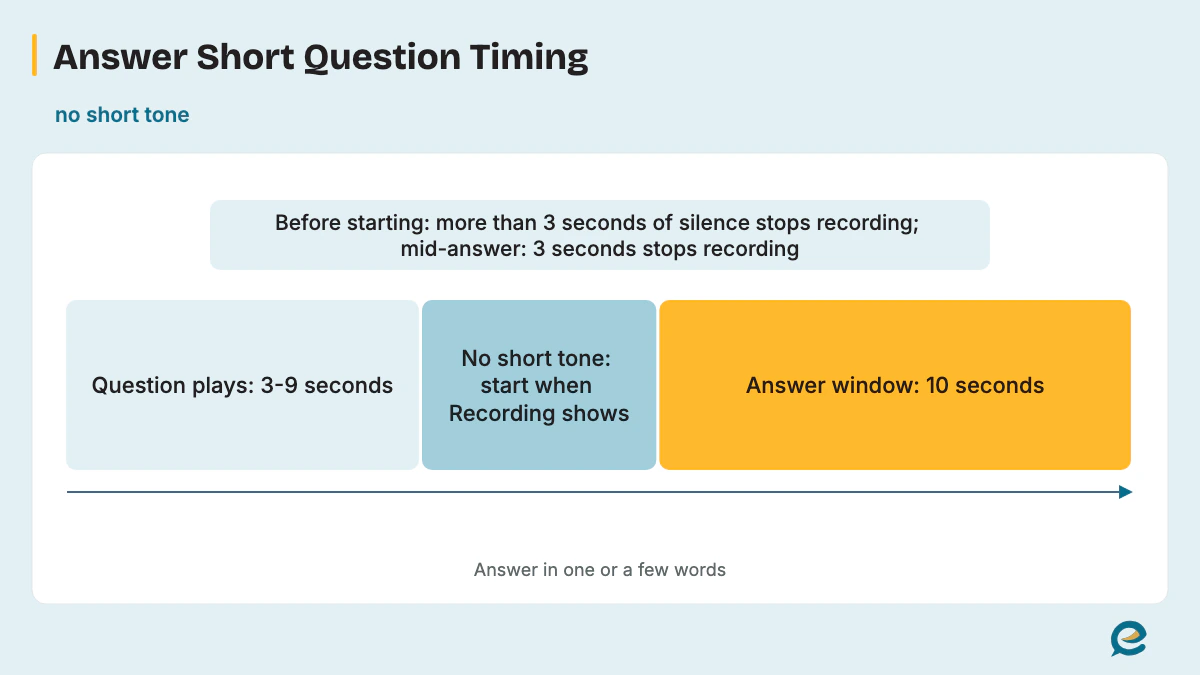
The question plays for 3-9 seconds, there's no short tone, and you have 10 seconds to answer; you may also see an image. If you wait more than three seconds, the recording stops.
| Stage | What happens | Time or rule |
|---|---|---|
| Audio plays | The question plays automatically, and an image may appear. | 3-9 seconds. |
| Start | There's no short tone, so watch the Recording status box. | Start when it shows Recording. |
| Answer window | You say one or a few words. | 10 seconds. |
| Silence | A long pause ends the recording. | More than three seconds before you start, or three seconds mid-answer. |
| After completion | The item status shows completed. | Click Next to move on. |
| Replays | The audio plays once and you record once. | No replay, no re-record. |
| Items per test | New questions keep coming in a row. | 5-6 in PTE Academic and PTE Core. |
Pearson's wording for this task is exact, in two parts.
"If you wait for more than three seconds, the recording will stop and the item status will change to completed."
"If you stop for three seconds whilst speaking, the recording status will change to completed even if you haven't finished, and you won't be able to continue answering."
Pearson also tells you not to stop "for more than a second or two" once you've started. Its phrase for answer length is "one or a few words", and its tips say there's "no need to rush". A counted window such as "start within 2 seconds" or a limit of "1-3 words" isn't part of the rule.
How Is Answer Short Question Scored?
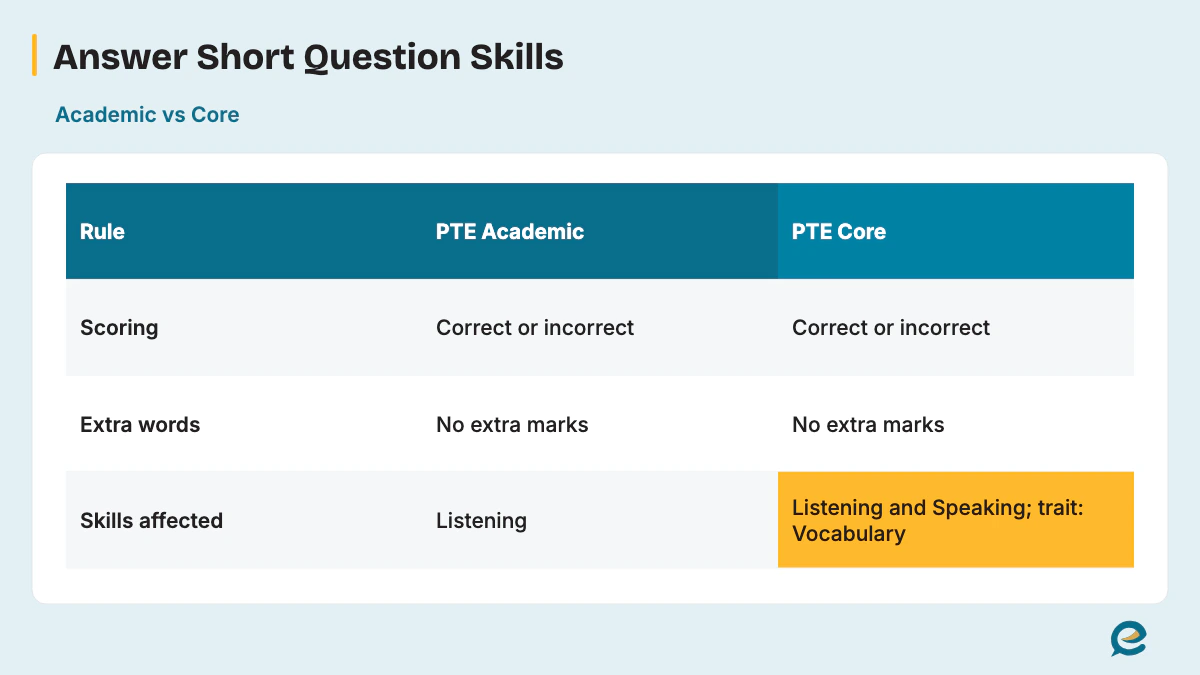
Each answer is scored correct or incorrect, earning 1 point when right and 0 when wrong or silent, and extra words earn no extra marks. In PTE Academic the item feeds your listening score only; in PTE Core it affects Listening and Speaking, using the Vocabulary trait. Pearson's Score Guide and task pages line the two tests up like this.
| Point | PTE Academic | PTE Core |
|---|---|---|
| Scoring type | Correct or incorrect | Correct or incorrect |
| Points per item | 1 correct, 0 incorrect or no response | 1 correct, 0 incorrect or no response |
| Trait scored | Vocabulary: 1 appropriate, 0 inappropriate word choice | Vocabulary: 1 appropriate, 0 inappropriate word choice |
| Extra words | No extra marks | No extra marks |
| Skills it affects | Listening only | Listening, speaking and vocabulary |
| Items per test | 5-6 | 5-6 |
In this original practice example, the short answer is “a reader”. A longer response such as “a person who reads” conveys the same idea. This text comparison makes no additional claim about official scoring.
Fluency and pronunciation aren't scored here: both Score Guides list Vocabulary as the only trait for this task, while Read Aloud and Retell Lecture carry Pronunciation and Oral Fluency scales. Pearson still asks you to speak clearly, so the word has to be easy to recognize.
A wrong answer scores 0, the same as silence, and Pearson lists no deduction for this item. Pearson doesn't publish how much one item adds to a 10-90 skill score, so the useful figure is the raw one: 5-6 items at 1 point each.
What Are Examples of Answer Short Questions?
Short question 105
Listen and answer with one word or a short phrase.
Recording voice: UK English.
Original practice recording.
Transcript
Which word means a person who reads a book?
Answer and explanation
Practice key: A reader
Accepted examples: A reader; a person who reads. Equivalent answers may also be supported; this is not official scoring.
Reader is the noun for a person who reads.
Original learning exercise; practice only, not an official Pearson test item or score.
Short question 106
Listen and answer with one word or a short phrase.
Recording voice: US English.
Original practice recording.
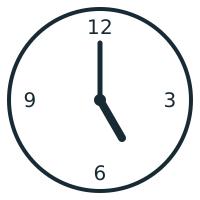
An analog clock with its minute hand at twelve and its hour hand at five. This alternative reveals the clock reading for accessibility. It is a practice alternative, with no claim of official test equivalence.
Transcript
Look at the clock. What time is shown?
Answer and explanation
Practice key: Five o'clock
Accepted examples: Five o'clock; five; five o’clock; 5 o'clock; 5:00; 5. Equivalent answers may also be supported; this is not official scoring.
The short hand points to five and the long hand to twelve.
Original learning exercise; practice only, not an official Pearson test item or score.
The 104 original practice questions are arranged in 13 groups of eight. They focus on everyday vocabulary, simple reasoning and information supplied in the question, with one-word or short-phrase answers.
Time and arrangements
| # | Practice question | Short answer |
|---|---|---|
| 1 | Short question 1Listen and answer with one word or a short phrase. Recording voice: UK English. Original practice recording. TranscriptA meeting starts at two and lasts one hour. When does it end? Answer and explanationPractice key: Three o'clock Accepted examples: Three o'clock; three; three o’clock. Equivalent answers may also be supported; this is not official scoring. The ending is one hour after two. Original learning exercise; practice only, not an official Pearson test item or score. | AnswerThree o'clock |
| 2 | Short question 2Listen and answer with one word or a short phrase. Recording voice: US English. Original practice recording. TranscriptWhich comes first in a day, breakfast or an evening meal? Answer and explanationPractice key: Breakfast Accepted examples: Breakfast. Equivalent answers may also be supported; this is not official scoring. Breakfast is the earlier meal. Original learning exercise; practice only, not an official Pearson test item or score. | AnswerBreakfast |
| 3 | Short question 3Listen and answer with one word or a short phrase. Recording voice: UK English. Original practice recording. TranscriptIf today is Thursday, what day is tomorrow? Answer and explanationPractice key: Friday Accepted examples: Friday. Equivalent answers may also be supported; this is not official scoring. Friday follows Thursday. Original learning exercise; practice only, not an official Pearson test item or score. | AnswerFriday |
| 4 | Short question 4Listen and answer with one word or a short phrase. Recording voice: US English. Original practice recording. TranscriptA class meets every seven days. Is it daily or weekly? Answer and explanationPractice key: Weekly Accepted examples: Weekly. Equivalent answers may also be supported; this is not official scoring. A seven-day interval is a week. Original learning exercise; practice only, not an official Pearson test item or score. | AnswerWeekly |
| 5 | Short question 5Listen and answer with one word or a short phrase. Recording voice: UK English. Original practice recording. TranscriptWhat do you call the day before today? Answer and explanationPractice key: Yesterday Accepted examples: Yesterday; yesterday. Equivalent answers may also be supported; this is not official scoring. Yesterday refers to the preceding day. Original learning exercise; practice only, not an official Pearson test item or score. | AnswerYesterday |
| 6 | Short question 6Listen and answer with one word or a short phrase. Recording voice: US English. Original practice recording. TranscriptA shop opens at nine and closes at ten. How many hours is it open? Answer and explanationPractice key: One Accepted examples: One; one hour; 1; 1 hour. Equivalent answers may also be supported; this is not official scoring. There is one hour between nine and ten. Original learning exercise; practice only, not an official Pearson test item or score. | AnswerOne |
| 7 | Short question 7Listen and answer with one word or a short phrase. Recording voice: UK English. Original practice recording. TranscriptWhich part of the day comes after morning and before evening? Answer and explanationPractice key: Afternoon Accepted examples: Afternoon. Equivalent answers may also be supported; this is not official scoring. Afternoon lies between those periods. Original learning exercise; practice only, not an official Pearson test item or score. | AnswerAfternoon |
| 8 | Short question 8Listen and answer with one word or a short phrase. Recording voice: US English. Original practice recording. TranscriptIf a lesson begins before lunch, is it earlier or later than lunch? Answer and explanationPractice key: Earlier Accepted examples: Earlier. Equivalent answers may also be supported; this is not official scoring. Before means earlier in time. Original learning exercise; practice only, not an official Pearson test item or score. | AnswerEarlier |
Counting and comparison
| # | Practice question | Short answer |
|---|---|---|
| 9 | Short question 9Listen and answer with one word or a short phrase. Recording voice: UK English. Original practice recording. TranscriptYou have three blue folders and two green folders. How many folders altogether? Answer and explanationPractice key: Five Accepted examples: Five; 5; five folders. Equivalent answers may also be supported; this is not official scoring. Three plus two is five. Original learning exercise; practice only, not an official Pearson test item or score. | AnswerFive |
| 10 | Short question 10Listen and answer with one word or a short phrase. Recording voice: US English. Original practice recording. TranscriptSix people arrive and one leaves. How many remain? Answer and explanationPractice key: Five Accepted examples: Five; 5; five people. Equivalent answers may also be supported; this is not official scoring. Six minus one is five. Original learning exercise; practice only, not an official Pearson test item or score. | AnswerFive |
| 11 | Short question 11Listen and answer with one word or a short phrase. Recording voice: UK English. Original practice recording. TranscriptWhich is the smaller number, twelve or twenty? Answer and explanationPractice key: Twelve Accepted examples: Twelve; 12. Equivalent answers may also be supported; this is not official scoring. Twelve is less than twenty. Original learning exercise; practice only, not an official Pearson test item or score. | AnswerTwelve |
| 12 | Short question 12Listen and answer with one word or a short phrase. Recording voice: US English. Original practice recording. TranscriptWhat number is halfway between two and six? Answer and explanationPractice key: Four Accepted examples: Four; 4. Equivalent answers may also be supported; this is not official scoring. Four is two away from both endpoints. Original learning exercise; practice only, not an official Pearson test item or score. | AnswerFour |
| 13 | Short question 13Listen and answer with one word or a short phrase. Recording voice: UK English. Original practice recording. TranscriptFour boxes each contain two pens. How many pens are there? Answer and explanationPractice key: Eight Accepted examples: Eight; 8; eight pens. Equivalent answers may also be supported; this is not official scoring. Four groups of two make eight. Original learning exercise; practice only, not an official Pearson test item or score. | AnswerEight |
| 14 | Short question 14Listen and answer with one word or a short phrase. Recording voice: US English. Original practice recording. TranscriptIf you divide ten cards equally between two people, how many does each get? Answer and explanationPractice key: Five Accepted examples: Five; 5; five cards. Equivalent answers may also be supported; this is not official scoring. Ten divided by two is five. Original learning exercise; practice only, not an official Pearson test item or score. | AnswerFive |
| 15 | Short question 15Listen and answer with one word or a short phrase. Recording voice: UK English. Original practice recording. TranscriptWhat number comes immediately before thirty? Answer and explanationPractice key: Twenty-nine Accepted examples: Twenty-nine; twenty nine; 29. Equivalent answers may also be supported; this is not official scoring. Subtracting one gives twenty-nine. Original learning exercise; practice only, not an official Pearson test item or score. | AnswerTwenty-nine |
| 16 | Short question 16Listen and answer with one word or a short phrase. Recording voice: US English. Original practice recording. TranscriptWhich has more pages, a booklet with eight or one with eighteen? Answer and explanationPractice key: The one with eighteen Accepted examples: The one with eighteen; eighteen; 18; the booklet with eighteen pages. Equivalent answers may also be supported; this is not official scoring. Eighteen is greater than eight. Original learning exercise; practice only, not an official Pearson test item or score. | AnswerThe one with eighteen |
Position and direction
| # | Practice question | Short answer |
|---|---|---|
| 17 | Short question 17Listen and answer with one word or a short phrase. Recording voice: UK English. Original practice recording. TranscriptA picture hangs above a desk. Is the picture higher or lower? Answer and explanationPractice key: Higher Accepted examples: Higher. Equivalent answers may also be supported; this is not official scoring. Above means at a higher position. Original learning exercise; practice only, not an official Pearson test item or score. | AnswerHigher |
| 18 | Short question 18Listen and answer with one word or a short phrase. Recording voice: US English. Original practice recording. TranscriptYou enter a room and then leave it. Are you now inside or outside? Answer and explanationPractice key: Outside Accepted examples: Outside. Equivalent answers may also be supported; this is not official scoring. Leaving takes you out of the room. Original learning exercise; practice only, not an official Pearson test item or score. | AnswerOutside |
| 19 | Short question 19Listen and answer with one word or a short phrase. Recording voice: UK English. Original practice recording. TranscriptWhich direction is opposite to left? Answer and explanationPractice key: Right Accepted examples: Right. Equivalent answers may also be supported; this is not official scoring. Left and right are opposing directions. Original learning exercise; practice only, not an official Pearson test item or score. | AnswerRight |
| 20 | Short question 20Listen and answer with one word or a short phrase. Recording voice: US English. Original practice recording. TranscriptIf a box is underneath a chair, is it above or below the chair? Answer and explanationPractice key: Below Accepted examples: Below. Equivalent answers may also be supported; this is not official scoring. Underneath means below. Original learning exercise; practice only, not an official Pearson test item or score. | AnswerBelow |
| 21 | Short question 21Listen and answer with one word or a short phrase. Recording voice: UK English. Original practice recording. TranscriptThree people stand in a line. Which position is between first and third? Answer and explanationPractice key: Second Accepted examples: Second. Equivalent answers may also be supported; this is not official scoring. Second is the middle position. Original learning exercise; practice only, not an official Pearson test item or score. | AnswerSecond |
| 22 | Short question 22Listen and answer with one word or a short phrase. Recording voice: US English. Original practice recording. TranscriptA book is behind a lamp. Which object is in front? Answer and explanationPractice key: The lamp Accepted examples: The lamp. Equivalent answers may also be supported; this is not official scoring. The stated relationship puts the lamp in front. Original learning exercise; practice only, not an official Pearson test item or score. | AnswerThe lamp |
| 23 | Short question 23Listen and answer with one word or a short phrase. Recording voice: UK English. Original practice recording. TranscriptWhich is nearer, a desk beside you or one across the room? Answer and explanationPractice key: The desk beside you Accepted examples: The desk beside you; beside you; the desk next to you. Equivalent answers may also be supported; this is not official scoring. Beside indicates the shorter distance here. Original learning exercise; practice only, not an official Pearson test item or score. | AnswerThe desk beside you |
| 24 | Short question 24Listen and answer with one word or a short phrase. Recording voice: US English. Original practice recording. TranscriptIf you turn a page over, do you see its front again or its back? Answer and explanationPractice key: Its back Accepted examples: Its back; the back; back. Equivalent answers may also be supported; this is not official scoring. Turning it over reveals the other side. Original learning exercise; practice only, not an official Pearson test item or score. | AnswerIts back |
Learning and classroom objects
| # | Practice question | Short answer |
|---|---|---|
| 25 | Short question 25Listen and answer with one word or a short phrase. Recording voice: UK English. Original practice recording. TranscriptWhat do you call the list of books used when preparing an essay? Answer and explanationPractice key: A bibliography Accepted examples: A bibliography; a reference list; references. Equivalent answers may also be supported; this is not official scoring. A bibliography lists sources used or consulted. Original learning exercise; practice only, not an official Pearson test item or score. | AnswerA bibliography |
| 26 | Short question 26Listen and answer with one word or a short phrase. Recording voice: US English. Original practice recording. TranscriptWhat do we call the first version of a piece of writing? Answer and explanationPractice key: A draft Accepted examples: A draft. Equivalent answers may also be supported; this is not official scoring. A draft is a version prepared before revision. Original learning exercise; practice only, not an official Pearson test item or score. | AnswerA draft |
| 27 | Short question 27Listen and answer with one word or a short phrase. Recording voice: UK English. Original practice recording. TranscriptWhat do you call comments intended to help improve your work? Answer and explanationPractice key: Feedback Accepted examples: Feedback. Equivalent answers may also be supported; this is not official scoring. Feedback provides a response to the work. Original learning exercise; practice only, not an official Pearson test item or score. | AnswerFeedback |
| 28 | Short question 28Listen and answer with one word or a short phrase. Recording voice: US English. Original practice recording. TranscriptWhat heading tells you what a book or essay is called? Answer and explanationPractice key: Its title Accepted examples: Its title; title; the title. Equivalent answers may also be supported; this is not official scoring. The title names the work. Original learning exercise; practice only, not an official Pearson test item or score. | AnswerIts title |
| 29 | Short question 29Listen and answer with one word or a short phrase. Recording voice: UK English. Original practice recording. TranscriptWhat do you call a brief account of a longer text's main points? Answer and explanationPractice key: A summary Accepted examples: A summary. Equivalent answers may also be supported; this is not official scoring. A summary condenses the main ideas. Original learning exercise; practice only, not an official Pearson test item or score. | AnswerA summary |
| 30 | Short question 30Listen and answer with one word or a short phrase. Recording voice: US English. Original practice recording. TranscriptWhat word describes work done by several people together? Answer and explanationPractice key: Teamwork Accepted examples: Teamwork; collaboration; collaborative work. Equivalent answers may also be supported; this is not official scoring. Teamwork means working together as a team. Original learning exercise; practice only, not an official Pearson test item or score. | AnswerTeamwork |
| 31 | Short question 31Listen and answer with one word or a short phrase. Recording voice: UK English. Original practice recording. TranscriptWhat do you call the final date by which work must be submitted? Answer and explanationPractice key: A deadline Accepted examples: A deadline. Equivalent answers may also be supported; this is not official scoring. A deadline is the latest allowed time for submission. Original learning exercise; practice only, not an official Pearson test item or score. | AnswerA deadline |
| 32 | Short question 32Listen and answer with one word or a short phrase. Recording voice: US English. Original practice recording. TranscriptWhat do we call the small written reminders you make during a lesson? Answer and explanationPractice key: Notes Accepted examples: Notes. Equivalent answers may also be supported; this is not official scoring. Notes record points for later use. Original learning exercise; practice only, not an official Pearson test item or score. | AnswerNotes |
Everyday objects
| # | Practice question | Short answer |
|---|---|---|
| 33 | Short question 33Listen and answer with one word or a short phrase. Recording voice: UK English. Original practice recording. TranscriptWhat handheld object do you use to comb your hair? Answer and explanationPractice key: A comb Accepted examples: A comb. Equivalent answers may also be supported; this is not official scoring. The question names the action of combing. Original learning exercise; practice only, not an official Pearson test item or score. | AnswerA comb |
| 34 | Short question 34Listen and answer with one word or a short phrase. Recording voice: US English. Original practice recording. TranscriptWhat object has pages for writing your daily plans and appointments? Answer and explanationPractice key: A diary Accepted examples: A diary; a planner; an appointment diary. Equivalent answers may also be supported; this is not official scoring. A diary can hold dated plans and appointments. Original learning exercise; practice only, not an official Pearson test item or score. | AnswerA diary |
| 35 | Short question 35Listen and answer with one word or a short phrase. Recording voice: UK English. Original practice recording. TranscriptWhat container do you put a letter inside before mailing it? Answer and explanationPractice key: An envelope Accepted examples: An envelope. Equivalent answers may also be supported; this is not official scoring. An envelope encloses the letter. Original learning exercise; practice only, not an official Pearson test item or score. | AnswerAn envelope |
| 36 | Short question 36Listen and answer with one word or a short phrase. Recording voice: US English. Original practice recording. TranscriptWhat do you sit on that has a seat and a back? Answer and explanationPractice key: A chair Accepted examples: A chair; an armchair; a bench; a sofa. Equivalent answers may also be supported; this is not official scoring. Those parts describe a chair. Original learning exercise; practice only, not an official Pearson test item or score. | AnswerA chair |
| 37 | Short question 37Listen and answer with one word or a short phrase. Recording voice: UK English. Original practice recording. TranscriptWhat do you use to sweep loose dust from a floor? Answer and explanationPractice key: A broom Accepted examples: A broom; a brush; a dust brush. Equivalent answers may also be supported; this is not official scoring. A broom is used for sweeping. Original learning exercise; practice only, not an official Pearson test item or score. | AnswerA broom |
| 38 | Short question 38Listen and answer with one word or a short phrase. Recording voice: US English. Original practice recording. TranscriptWhat object do you use to see your own reflection? Answer and explanationPractice key: A mirror Accepted examples: A mirror. Equivalent answers may also be supported; this is not official scoring. A mirror shows a reflection. Original learning exercise; practice only, not an official Pearson test item or score. | AnswerA mirror |
| 39 | Short question 39Listen and answer with one word or a short phrase. Recording voice: UK English. Original practice recording. TranscriptWhat do you call a bag carried on your back with two shoulder straps? Answer and explanationPractice key: A backpack Accepted examples: A backpack; a rucksack; a knapsack. Equivalent answers may also be supported; this is not official scoring. The straps and position describe a backpack. Original learning exercise; practice only, not an official Pearson test item or score. | AnswerA backpack |
| 40 | Short question 40Listen and answer with one word or a short phrase. Recording voice: US English. Original practice recording. TranscriptWhat do you call the container in which you keep loose coins? Answer and explanationPractice key: A purse Accepted examples: A purse; a coin purse; a wallet; a piggy bank; a coin jar; a money box; a coin box. Equivalent answers may also be supported; this is not official scoring. A purse is a small container for money. Original learning exercise; practice only, not an official Pearson test item or score. | AnswerA purse |
Practical language
| # | Practice question | Short answer |
|---|---|---|
| 41 | Short question 41Listen and answer with one word or a short phrase. Recording voice: UK English. Original practice recording. TranscriptWhat verb means to get something on loan and return it later? Answer and explanationPractice key: Borrow Accepted examples: Borrow. Equivalent answers may also be supported; this is not official scoring. Borrowing involves temporary use with return expected. Original learning exercise; practice only, not an official Pearson test item or score. | AnswerBorrow |
| 42 | Short question 42Listen and answer with one word or a short phrase. Recording voice: US English. Original practice recording. TranscriptWhat do you call a written list of things you intend to buy? Answer and explanationPractice key: A shopping list Accepted examples: A shopping list. Equivalent answers may also be supported; this is not official scoring. It records planned purchases. Original learning exercise; practice only, not an official Pearson test item or score. | AnswerA shopping list |
| 43 | Short question 43Listen and answer with one word or a short phrase. Recording voice: UK English. Original practice recording. TranscriptWhat do you call an arrangement to meet someone at a particular time? Answer and explanationPractice key: An appointment Accepted examples: An appointment. Equivalent answers may also be supported; this is not official scoring. An appointment is an arranged meeting. Original learning exercise; practice only, not an official Pearson test item or score. | AnswerAn appointment |
| 44 | Short question 44Listen and answer with one word or a short phrase. Recording voice: US English. Original practice recording. TranscriptWhat word means permission to enter a place? Answer and explanationPractice key: Admission Accepted examples: Admission; entry; admittance. Equivalent answers may also be supported; this is not official scoring. Admission means being allowed to enter. Original learning exercise; practice only, not an official Pearson test item or score. | AnswerAdmission |
| 45 | Short question 45Listen and answer with one word or a short phrase. Recording voice: UK English. Original practice recording. TranscriptWhat do you call a request to keep a seat for you in advance? Answer and explanationPractice key: A reservation Accepted examples: A reservation; a booking. Equivalent answers may also be supported; this is not official scoring. A reservation holds a place in advance. Original learning exercise; practice only, not an official Pearson test item or score. | AnswerA reservation |
| 46 | Short question 46Listen and answer with one word or a short phrase. Recording voice: US English. Original practice recording. TranscriptWhat verb means to stop an event that was planned? Answer and explanationPractice key: Cancel Accepted examples: Cancel; call off. Equivalent answers may also be supported; this is not official scoring. To cancel is to call off the planned event. Original learning exercise; practice only, not an official Pearson test item or score. | AnswerCancel |
| 47 | Short question 47Listen and answer with one word or a short phrase. Recording voice: UK English. Original practice recording. TranscriptWhat do you call a short message that helps you remember something? Answer and explanationPractice key: A reminder Accepted examples: A reminder. Equivalent answers may also be supported; this is not official scoring. A reminder brings something back to mind. Original learning exercise; practice only, not an official Pearson test item or score. | AnswerA reminder |
| 48 | Short question 48Listen and answer with one word or a short phrase. Recording voice: US English. Original practice recording. TranscriptWhat verb means to move an appointment to a later time? Answer and explanationPractice key: Postpone Accepted examples: Postpone; delay; reschedule for later. Equivalent answers may also be supported; this is not official scoring. Postponing moves it later. Original learning exercise; practice only, not an official Pearson test item or score. | AnswerPostpone |
People and roles
| # | Practice question | Short answer |
|---|---|---|
| 49 | Short question 49Listen and answer with one word or a short phrase. Recording voice: UK English. Original practice recording. TranscriptWhat do we call a person who writes novels? Answer and explanationPractice key: A novelist Accepted examples: A novelist. Equivalent answers may also be supported; this is not official scoring. A novelist writes novels. Original learning exercise; practice only, not an official Pearson test item or score. | AnswerA novelist |
| 50 | Short question 50Listen and answer with one word or a short phrase. Recording voice: US English. Original practice recording. TranscriptWho serves customers at restaurant tables? Answer and explanationPractice key: A waiter Accepted examples: A waiter; a server; a waitress. Equivalent answers may also be supported; this is not official scoring. A waiter serves people at tables. Original learning exercise; practice only, not an official Pearson test item or score. | AnswerA waiter |
| 51 | Short question 51Listen and answer with one word or a short phrase. Recording voice: UK English. Original practice recording. TranscriptWhat do we call someone who translates written material between languages? Answer and explanationPractice key: A translator Accepted examples: A translator. Equivalent answers may also be supported; this is not official scoring. A translator works between languages in writing. Original learning exercise; practice only, not an official Pearson test item or score. | AnswerA translator |
| 52 | Short question 52Listen and answer with one word or a short phrase. Recording voice: US English. Original practice recording. TranscriptWho checks and improves writing before it is published? Answer and explanationPractice key: An editor Accepted examples: An editor; a copy editor. Equivalent answers may also be supported; this is not official scoring. An editor reviews and improves writing. Original learning exercise; practice only, not an official Pearson test item or score. | AnswerAn editor |
| 53 | Short question 53Listen and answer with one word or a short phrase. Recording voice: UK English. Original practice recording. TranscriptWhat do we call a person who takes photographs as their work? Answer and explanationPractice key: A photographer Accepted examples: A photographer. Equivalent answers may also be supported; this is not official scoring. Photography is the work described. Original learning exercise; practice only, not an official Pearson test item or score. | AnswerA photographer |
| 54 | Short question 54Listen and answer with one word or a short phrase. Recording voice: US English. Original practice recording. TranscriptWho cuts and styles people's hair? Answer and explanationPractice key: A hairdresser Accepted examples: A hairdresser; a barber; a hairstylist; a hair stylist. Equivalent answers may also be supported; this is not official scoring. A hairdresser cuts and styles hair. Original learning exercise; practice only, not an official Pearson test item or score. | AnswerA hairdresser |
| 55 | Short question 55Listen and answer with one word or a short phrase. Recording voice: UK English. Original practice recording. TranscriptWhat do we call someone who visits a place as a guest? Answer and explanationPractice key: A visitor Accepted examples: A visitor. Equivalent answers may also be supported; this is not official scoring. A visitor comes to a place temporarily. Original learning exercise; practice only, not an official Pearson test item or score. | AnswerA visitor |
| 56 | Short question 56Listen and answer with one word or a short phrase. Recording voice: US English. Original practice recording. TranscriptWhat do we call the person leading an orchestra? Answer and explanationPractice key: A conductor Accepted examples: A conductor; an orchestra conductor. Equivalent answers may also be supported; this is not official scoring. A conductor directs the orchestra. Original learning exercise; practice only, not an official Pearson test item or score. | AnswerA conductor |
Places
| # | Practice question | Short answer |
|---|---|---|
| 57 | Short question 57Listen and answer with one word or a short phrase. Recording voice: UK English. Original practice recording. TranscriptIn a school, what do you call the room where a class has lessons? Answer and explanationPractice key: A classroom Accepted examples: A classroom. Equivalent answers may also be supported; this is not official scoring. A classroom is the room for lessons. Original learning exercise; practice only, not an official Pearson test item or score. | AnswerA classroom |
| 58 | Short question 58Listen and answer with one word or a short phrase. Recording voice: US English. Original practice recording. TranscriptWhat room has a bed and is mainly used for sleeping? Answer and explanationPractice key: A bedroom Accepted examples: A bedroom. Equivalent answers may also be supported; this is not official scoring. A bedroom is intended for sleeping. Original learning exercise; practice only, not an official Pearson test item or score. | AnswerA bedroom |
| 59 | Short question 59Listen and answer with one word or a short phrase. Recording voice: UK English. Original practice recording. TranscriptWhat do you call a room used for storing things? Answer and explanationPractice key: A storeroom Accepted examples: A storeroom; a storage room. Equivalent answers may also be supported; this is not official scoring. A storeroom holds stored items. Original learning exercise; practice only, not an official Pearson test item or score. | AnswerA storeroom |
| 60 | Short question 60Listen and answer with one word or a short phrase. Recording voice: US English. Original practice recording. TranscriptWhere would you watch a film on a large screen with an audience? Answer and explanationPractice key: A cinema Accepted examples: A cinema; a movie theater; a movie theatre. Equivalent answers may also be supported; this is not official scoring. A cinema shows films to an audience. Original learning exercise; practice only, not an official Pearson test item or score. | AnswerA cinema |
| 61 | Short question 61Listen and answer with one word or a short phrase. Recording voice: UK English. Original practice recording. TranscriptWhat do you call the space in a building where visitors first report their arrival? Answer and explanationPractice key: Reception Accepted examples: Reception; a reception area; a reception desk; a front desk. Equivalent answers may also be supported; this is not official scoring. Reception receives arriving visitors. Original learning exercise; practice only, not an official Pearson test item or score. | AnswerReception |
| 62 | Short question 62Listen and answer with one word or a short phrase. Recording voice: US English. Original practice recording. TranscriptWhat do you call a room where meetings are held? Answer and explanationPractice key: A meeting room Accepted examples: A meeting room; a conference room. Equivalent answers may also be supported; this is not official scoring. The room's purpose supplies its name. Original learning exercise; practice only, not an official Pearson test item or score. | AnswerA meeting room |
| 63 | Short question 63Listen and answer with one word or a short phrase. Recording voice: UK English. Original practice recording. TranscriptWhat do you call the area in a shop where customers pay? Answer and explanationPractice key: The checkout Accepted examples: The checkout; the till; a cash desk; a checkout counter. Equivalent answers may also be supported; this is not official scoring. Customers pay at the checkout. Original learning exercise; practice only, not an official Pearson test item or score. | AnswerThe checkout |
| 64 | Short question 64Listen and answer with one word or a short phrase. Recording voice: US English. Original practice recording. TranscriptWhat do you call a covered space used to keep a car at home? Answer and explanationPractice key: A garage Accepted examples: A garage; the garage; a carport. Equivalent answers may also be supported; this is not official scoring. A garage can house a car. Original learning exercise; practice only, not an official Pearson test item or score. | AnswerA garage |
Instructions and choices
| # | Practice question | Short answer |
|---|---|---|
| 65 | Short question 65Listen and answer with one word or a short phrase. Recording voice: UK English. Original practice recording. TranscriptA notice says to use the rear entrance. Which entrance should you use? Answer and explanationPractice key: The rear entrance Accepted examples: The rear entrance; the back entrance. Equivalent answers may also be supported; this is not official scoring. It is the entrance specified by the notice. Original learning exercise; practice only, not an official Pearson test item or score. | AnswerThe rear entrance |
| 66 | Short question 66Listen and answer with one word or a short phrase. Recording voice: US English. Original practice recording. TranscriptYou need a quiet place to read. Which suits you better, a silent room or a noisy hall? Answer and explanationPractice key: A silent room Accepted examples: A silent room. Equivalent answers may also be supported; this is not official scoring. Silent matches the stated need for quiet. Original learning exercise; practice only, not an official Pearson test item or score. | AnswerA silent room |
| 67 | Short question 67Listen and answer with one word or a short phrase. Recording voice: UK English. Original practice recording. TranscriptThe blue label means collect today. Which label should your parcel have for today's collection? Answer and explanationPractice key: Blue Accepted examples: Blue. Equivalent answers may also be supported; this is not official scoring. The question defines blue as today's collection. Original learning exercise; practice only, not an official Pearson test item or score. | AnswerBlue |
| 68 | Short question 68Listen and answer with one word or a short phrase. Recording voice: US English. Original practice recording. TranscriptYour form says write in capitals. Should you use uppercase or lowercase letters? Answer and explanationPractice key: Uppercase Accepted examples: Uppercase; uppercase letters; capital letters; capitals. Equivalent answers may also be supported; this is not official scoring. Capitals are uppercase letters. Original learning exercise; practice only, not an official Pearson test item or score. | AnswerUppercase |
| 69 | Short question 69Listen and answer with one word or a short phrase. Recording voice: UK English. Original practice recording. TranscriptA sign says tickets are required. What must you have to enter? Answer and explanationPractice key: A ticket Accepted examples: A ticket. Equivalent answers may also be supported; this is not official scoring. The sign states the entry requirement. Original learning exercise; practice only, not an official Pearson test item or score. | AnswerA ticket |
| 70 | Short question 70Listen and answer with one word or a short phrase. Recording voice: US English. Original practice recording. TranscriptA message asks for a reply by email. How should you reply? Answer and explanationPractice key: By email Accepted examples: By email; email; e-mail; by e-mail. Equivalent answers may also be supported; this is not official scoring. The requested communication method is email. Original learning exercise; practice only, not an official Pearson test item or score. | AnswerBy email |
| 71 | Short question 71Listen and answer with one word or a short phrase. Recording voice: UK English. Original practice recording. TranscriptThe organiser asks everyone to arrive early. Should you come before or after the start? Answer and explanationPractice key: Before Accepted examples: Before; before the start; before the scheduled start. Equivalent answers may also be supported; this is not official scoring. Early means before the scheduled start. Original learning exercise; practice only, not an official Pearson test item or score. | AnswerBefore |
| 72 | Short question 72Listen and answer with one word or a short phrase. Recording voice: US English. Original practice recording. TranscriptA desk is marked reserved. Is it kept for someone or free for anyone? Answer and explanationPractice key: Kept for someone Accepted examples: Kept for someone; reserved; set aside. Equivalent answers may also be supported; this is not official scoring. Reserved means set aside. Original learning exercise; practice only, not an official Pearson test item or score. | AnswerKept for someone |
Opposites
| # | Practice question | Short answer |
|---|---|---|
| 73 | Short question 73Listen and answer with one word or a short phrase. Recording voice: UK English. Original practice recording. TranscriptWhich word is the opposite of noisy: quiet or crowded? Answer and explanationPractice key: Quiet Accepted examples: Quiet. Equivalent answers may also be supported; this is not official scoring. Quiet contrasts with noisy. Original learning exercise; practice only, not an official Pearson test item or score. | AnswerQuiet |
| 74 | Short question 74Listen and answer with one word or a short phrase. Recording voice: US English. Original practice recording. TranscriptIf a door is not open, what is it? Answer and explanationPractice key: Closed Accepted examples: Closed; shut. Equivalent answers may also be supported; this is not official scoring. Closed is the opposite state. Original learning exercise; practice only, not an official Pearson test item or score. | AnswerClosed |
| 75 | Short question 75Listen and answer with one word or a short phrase. Recording voice: UK English. Original practice recording. TranscriptWhat is the opposite of the word empty? Answer and explanationPractice key: Full Accepted examples: Full. Equivalent answers may also be supported; this is not official scoring. Full contrasts with empty. Original learning exercise; practice only, not an official Pearson test item or score. | AnswerFull |
| 76 | Short question 76Listen and answer with one word or a short phrase. Recording voice: US English. Original practice recording. TranscriptWhich is the opposite of arriving: leaving or waiting? Answer and explanationPractice key: Leaving Accepted examples: Leaving. Equivalent answers may also be supported; this is not official scoring. Leaving reverses arriving. Original learning exercise; practice only, not an official Pearson test item or score. | AnswerLeaving |
| 77 | Short question 77Listen and answer with one word or a short phrase. Recording voice: UK English. Original practice recording. TranscriptWhat is the opposite of increasing a number? Answer and explanationPractice key: Decreasing it Accepted examples: Decreasing it; decreasing; reducing; reducing it. Equivalent answers may also be supported; this is not official scoring. Decreasing makes the number smaller. Original learning exercise; practice only, not an official Pearson test item or score. | AnswerDecreasing it |
| 78 | Short question 78Listen and answer with one word or a short phrase. Recording voice: US English. Original practice recording. TranscriptWhat is the opposite of polite? Answer and explanationPractice key: Rude Accepted examples: Rude; impolite; discourteous. Equivalent answers may also be supported; this is not official scoring. Rude contrasts with polite. Original learning exercise; practice only, not an official Pearson test item or score. | AnswerRude |
| 79 | Short question 79Listen and answer with one word or a short phrase. Recording voice: UK English. Original practice recording. TranscriptWhich word is the opposite of narrow: wide or deep? Answer and explanationPractice key: Wide Accepted examples: Wide. Equivalent answers may also be supported; this is not official scoring. Wide contrasts with narrow. Original learning exercise; practice only, not an official Pearson test item or score. | AnswerWide |
| 80 | Short question 80Listen and answer with one word or a short phrase. Recording voice: US English. Original practice recording. TranscriptWhat is the opposite of remembering something? Answer and explanationPractice key: Forgetting it Accepted examples: Forgetting it; forgetting. Equivalent answers may also be supported; this is not official scoring. Forgetting is failing to retain or recall it. Original learning exercise; practice only, not an official Pearson test item or score. | AnswerForgetting it |
Word forms
| # | Practice question | Short answer |
|---|---|---|
| 81 | Short question 81Listen and answer with one word or a short phrase. Recording voice: UK English. Original practice recording. TranscriptWhat is the plural of the word box? Answer and explanationPractice key: Boxes Accepted examples: Boxes. Equivalent answers may also be supported; this is not official scoring. Add es to box. Original learning exercise; practice only, not an official Pearson test item or score. | AnswerBoxes |
| 82 | Short question 82Listen and answer with one word or a short phrase. Recording voice: US English. Original practice recording. TranscriptWhat is the past tense of walk? Answer and explanationPractice key: Walked Accepted examples: Walked. Equivalent answers may also be supported; this is not official scoring. Walk takes the regular ed ending. Original learning exercise; practice only, not an official Pearson test item or score. | AnswerWalked |
| 83 | Short question 83Listen and answer with one word or a short phrase. Recording voice: UK English. Original practice recording. TranscriptWhat is the comparative form of small? Answer and explanationPractice key: Smaller Accepted examples: Smaller. Equivalent answers may also be supported; this is not official scoring. Smaller compares size. Original learning exercise; practice only, not an official Pearson test item or score. | AnswerSmaller |
| 84 | Short question 84Listen and answer with one word or a short phrase. Recording voice: US English. Original practice recording. TranscriptWhat is the plural of the word baby? Answer and explanationPractice key: Babies Accepted examples: Babies. Equivalent answers may also be supported; this is not official scoring. The consonant plus y changes to ies. Original learning exercise; practice only, not an official Pearson test item or score. | AnswerBabies |
| 85 | Short question 85Listen and answer with one word or a short phrase. Recording voice: UK English. Original practice recording. TranscriptWhich pronoun refers to the speaker: I or they? Answer and explanationPractice key: I Accepted examples: I. Equivalent answers may also be supported; this is not official scoring. I refers to the person speaking. Original learning exercise; practice only, not an official Pearson test item or score. | AnswerI |
| 86 | Short question 86Listen and answer with one word or a short phrase. Recording voice: US English. Original practice recording. TranscriptWhat is the past tense of write, as in write a letter? Answer and explanationPractice key: Wrote Accepted examples: Wrote. Equivalent answers may also be supported; this is not official scoring. In "write a letter", write is the verb whose past tense is wrote. Original learning exercise; practice only, not an official Pearson test item or score. | AnswerWrote |
| 87 | Short question 87Listen and answer with one word or a short phrase. Recording voice: UK English. Original practice recording. TranscriptWhich word completes this phrase: one chair, two what? Answer and explanationPractice key: Chairs Accepted examples: Chairs. Equivalent answers may also be supported; this is not official scoring. Two requires the plural chairs. Original learning exercise; practice only, not an official Pearson test item or score. | AnswerChairs |
| 88 | Short question 88Listen and answer with one word or a short phrase. Recording voice: US English. Original practice recording. TranscriptWhich word is an action: run or blue? Answer and explanationPractice key: Run Accepted examples: Run. Equivalent answers may also be supported; this is not official scoring. Run names an action; blue names a colour here. Original learning exercise; practice only, not an official Pearson test item or score. | AnswerRun |
Relationships and meaning
| # | Practice question | Short answer |
|---|---|---|
| 89 | Short question 89Listen and answer with one word or a short phrase. Recording voice: UK English. Original practice recording. TranscriptWhat do you call two people who work for the same organisation? Answer and explanationPractice key: Colleagues Accepted examples: Colleagues; co-workers; coworkers; workmates. Equivalent answers may also be supported; this is not official scoring. Colleagues work together in an organisation. Original learning exercise; practice only, not an official Pearson test item or score. | AnswerColleagues |
| 90 | Short question 90Listen and answer with one word or a short phrase. Recording voice: US English. Original practice recording. TranscriptWhat do you call a person who buys goods from a shop? Answer and explanationPractice key: A customer Accepted examples: A customer; a shopper; a buyer. Equivalent answers may also be supported; this is not official scoring. A customer purchases goods or services. Original learning exercise; practice only, not an official Pearson test item or score. | AnswerA customer |
| 91 | Short question 91Listen and answer with one word or a short phrase. Recording voice: UK English. Original practice recording. TranscriptWhat do you call someone who rents a home from its owner? Answer and explanationPractice key: A tenant Accepted examples: A tenant; a renter. Equivalent answers may also be supported; this is not official scoring. A tenant rents the property. Original learning exercise; practice only, not an official Pearson test item or score. | AnswerA tenant |
| 92 | Short question 92Listen and answer with one word or a short phrase. Recording voice: US English. Original practice recording. TranscriptWhat do you call a person who sends you a letter? Answer and explanationPractice key: The sender Accepted examples: The sender; sender. Equivalent answers may also be supported; this is not official scoring. The sender is the person sending it. Original learning exercise; practice only, not an official Pearson test item or score. | AnswerThe sender |
| 93 | Short question 93Listen and answer with one word or a short phrase. Recording voice: UK English. Original practice recording. TranscriptWhat do you call the person to whom a parcel is addressed? Answer and explanationPractice key: The recipient Accepted examples: The recipient; recipient; the addressee. Equivalent answers may also be supported; this is not official scoring. The recipient is meant to receive it. Original learning exercise; practice only, not an official Pearson test item or score. | AnswerThe recipient |
| 94 | Short question 94Listen and answer with one word or a short phrase. Recording voice: US English. Original practice recording. TranscriptWhat do you call a person who belongs to a club? Answer and explanationPractice key: A member Accepted examples: A member. Equivalent answers may also be supported; this is not official scoring. Membership means belonging to a group. Original learning exercise; practice only, not an official Pearson test item or score. | AnswerA member |
| 95 | Short question 95Listen and answer with one word or a short phrase. Recording voice: UK English. Original practice recording. TranscriptWhat do you call someone who offers to help without being forced? Answer and explanationPractice key: A volunteer Accepted examples: A volunteer. Equivalent answers may also be supported; this is not official scoring. A volunteer offers willingly. Original learning exercise; practice only, not an official Pearson test item or score. | AnswerA volunteer |
| 96 | Short question 96Listen and answer with one word or a short phrase. Recording voice: US English. Original practice recording. TranscriptWhat do you call someone who takes part in an activity? Answer and explanationPractice key: A participant Accepted examples: A participant. Equivalent answers may also be supported; this is not official scoring. A participant takes part. Original learning exercise; practice only, not an official Pearson test item or score. | AnswerA participant |
Amounts and order
| # | Practice question | Short answer |
|---|---|---|
| 97 | Short question 97Listen and answer with one word or a short phrase. Recording voice: UK English. Original practice recording. TranscriptA tray holds eight cups. Half are removed. How many remain? Answer and explanationPractice key: Four Accepted examples: Four; 4; four cups. Equivalent answers may also be supported; this is not official scoring. Half of eight is four. Original learning exercise; practice only, not an official Pearson test item or score. | AnswerFour |
| 98 | Short question 98Listen and answer with one word or a short phrase. Recording voice: US English. Original practice recording. TranscriptYou finish the first task and begin the next. Which task are you starting? Answer and explanationPractice key: The second Accepted examples: The second; the second task. Equivalent answers may also be supported; this is not official scoring. Second follows first. Original learning exercise; practice only, not an official Pearson test item or score. | AnswerThe second |
| 99 | Short question 99Listen and answer with one word or a short phrase. Recording voice: UK English. Original practice recording. TranscriptTwo groups of three people join together. How many people are there? Answer and explanationPractice key: Six Accepted examples: Six; 6; six people. Equivalent answers may also be supported; this is not official scoring. Two times three is six. Original learning exercise; practice only, not an official Pearson test item or score. | AnswerSix |
| 100 | Short question 100Listen and answer with one word or a short phrase. Recording voice: US English. Original practice recording. TranscriptIf all four seats are occupied, how many are empty? Answer and explanationPractice key: None Accepted examples: None; zero; no seats; 0. Equivalent answers may also be supported; this is not official scoring. All seats being occupied leaves zero empty seats. Original learning exercise; practice only, not an official Pearson test item or score. | AnswerNone |
| 101 | Short question 101Listen and answer with one word or a short phrase. Recording voice: UK English. Original practice recording. TranscriptYou need ten cards but have seven. How many more do you need? Answer and explanationPractice key: Three Accepted examples: Three; 3; three cards. Equivalent answers may also be supported; this is not official scoring. Ten minus seven is three. Original learning exercise; practice only, not an official Pearson test item or score. | AnswerThree |
| 102 | Short question 102Listen and answer with one word or a short phrase. Recording voice: US English. Original practice recording. TranscriptWhich is larger, a half or a quarter of the same cake? Answer and explanationPractice key: A half Accepted examples: A half; one half; 1/2. Equivalent answers may also be supported; this is not official scoring. One half exceeds one quarter of the same whole. Original learning exercise; practice only, not an official Pearson test item or score. | AnswerA half |
| 103 | Short question 103Listen and answer with one word or a short phrase. Recording voice: UK English. Original practice recording. TranscriptWhat number comes next in this pattern: five, ten, fifteen? Answer and explanationPractice key: Twenty Accepted examples: Twenty; 20. Equivalent answers may also be supported; this is not official scoring. The pattern adds five each time. Original learning exercise; practice only, not an official Pearson test item or score. | AnswerTwenty |
| 104 | Short question 104Listen and answer with one word or a short phrase. Recording voice: US English. Original practice recording. TranscriptA list has five names. You remove the last one. How many names remain? Answer and explanationPractice key: Four Accepted examples: Four; 4; four names. Equivalent answers may also be supported; this is not official scoring. Removing one from five leaves four. Original learning exercise; practice only, not an official Pearson test item or score. | AnswerFour |
Cover the answer column, have someone read each practice question aloud, and answer before three seconds pass. For more items under real timing with an instant score, create a free account in the practice app.
How Do You Answer a Short Answer Question in PTE?
The method is catch the question word and keywords, answer the moment the status box shows Recording, say one or a few words, and stop. Each step comes straight from the timing and scoring rules above.
- Listen for the question word, such as what, which, who or how many, because it tells you whether the answer is a thing, a person or a number.
- Catch the keywords after it; they point to the answer.
- Look at the image if one appears, since the answer may sit in it.
- Start speaking as soon as Recording shows in the status box, well inside three seconds.
- Give the shortest accurate answer, because Pearson says "Do not try to give a long answer."
- If unsure, say your best guess, since silence and a wrong answer both score 0.
- Click the Next button once the status shows completed.
Short question 107
Listen and answer with one word or a short phrase.
Recording voice: UK English.
Original practice recording.
Transcript
What do you call a person who writes poems?
Answer and explanation
Practice key: A poet
Accepted examples: A poet. Equivalent answers may also be supported; this is not official scoring.
The action and text type identify a poet.
Original learning exercise; practice only, not an official Pearson test item or score.
What Vocabulary Helps With Answer Short Question?
The answers are everyday nouns and common terms, so topic vocabulary helps more than any memorized answer list. Ten word groups of 8 words each cover the areas the practice questions draw on, from opposites and baby animals to units of measurement.
| Word group | Words to know |
|---|---|
| Time and arrangements | Three o'clock, Breakfast, Friday, Weekly |
| Counting and comparison | Five, Five, Twelve, Four |
| Position and direction | Higher, Outside, Right, Below |
| Learning and classroom objects | A bibliography, A draft, Feedback, Its title |
| Everyday objects | A comb, A diary, An envelope, A chair |
| Practical language | Borrow, A shopping list, An appointment, Admission |
| People and roles | A novelist, A waiter, A translator, An editor |
| Places | A classroom, A bedroom, A storeroom, A cinema |
| Instructions and choices | The rear entrance, A silent room, Blue, Uppercase |
| Opposites | Quiet, Closed, Full, Leaving |
Say each word aloud as you learn it, and pair it with one short question you write yourself. Both Score Guides mark this task on one Vocabulary trait, appropriate word choice. In PTE Core, Vocabulary is the scoring trait for this item, contributing to Listening and Speaking; it is not a separate communicative skill score.
What Tips Help You Score High in Answer Short Question?
Answer fast, keep it short, use general knowledge, and never leave the 10 seconds silent.
- Listen for synonyms and paraphrasing, because the question describes the answer rather than naming it.
- Keep general knowledge fresh with a short daily quiz on one topic group.
- Use clear speech at a normal volume, so a single word is unmistakable on the recording.
- Drop fillers such as "umm" or "I think"; they use seconds and add nothing.
- Match the form the question asks for: a question about "organs" takes a plural answer.
- Treat each item as fresh after a miss, since one wrong answer doesn't affect the next.
The wrong vs right answers below show how a reply can lose time or clarity even when you know the word.
For a question ending “one chair, two what?”, “chairs” is a concise answer. For the clock example, answer “five o’clock”. Say the answer clearly and stop; these are practice illustrations, not predicted official scores.
How Do You Practice Answer Short Questions?
Practice in short timed sets with the audio once only, answering out loud inside three seconds and logging every miss by topic. Run the practice loop like this: a 10-question timed set, a review of the misses in your miss log, the missed words added to your topic lists, then another set. Sort the log by topic group, and put your next reading time into whichever group appears most.
A study partner turns the 104 questions above into quick-fire drills: they read, you answer, and they stop you if you pass three seconds. Flashcards with the question on one side and the answer on the other train rapid recall between sessions. Listen to news and podcasts in several English accents too, so an unfamiliar voice in the audio doesn't cost you the item.
What Is the 3-Second Rule in Answer Short Question?
In Answer Short Question, Pearson says that if you wait more than three seconds, or stop for three seconds while speaking, the recording stops and the item status changes to completed. Once you see that completed status, you can't resume the answer.
Pearson then adds, "This also applies to speaking item types Read aloud, Repeat Sentence, Describe Image and Re-tell Lecture," and it doesn't name Summarize Group Discussion or Respond to a Situation. Read how the rule plays out across those tasks on the 3-second rule in PTE speaking.
How Many Answer Short Question Items Appear Per Test?
Pearson's Score Guides list 5-6 Answer Short Question items in PTE Academic and 5-6 in PTE Core. That item count means the whole task carries 5-6 raw points, and counts of 10-12 printed elsewhere don't match either Score Guide. The PTE exam format guide covers the full test layout.
Is Answer Short Question the Same in PTE Academic and PTE Core?
The timing and the 1-or-0 marking are the same in both tests, but the skills scored differ: PTE Academic scores listening only, while PTE Core scores Listening and Speaking, using the Vocabulary trait. Pearson's Core page repeats the Academic tip almost word for word, including the mention of Re-tell Lecture, a task PTE Core doesn't contain. See PTE Academic vs PTE Core for the wider differences.
How Does Answer Short Question Fit Into the PTE Speaking Section?
Answer Short Question is the shortest of the scored speaking items. In the task order of PTE Academic it comes after Retell Lecture and before Summarize Group Discussion and Respond to a Situation, and in PTE Core it follows Respond to a Situation. It uses the same microphone and status box as the longer speaking items, so it's a fast check that you start on time. The PTE Speaking section guide covers every task.
What Should You Do If You Freeze on an Answer Short Question?
Say your best guess or the key noun you heard before three seconds pass, because silence scores the same 0 as a wrong answer and ends the item. Each item is separate, so let a missed one go before the next audio starts and you won't freeze twice. For breathing and focus routines that help with test-day nerves, read managing PTE exam anxiety.
Where Can You Find Answer Short Question PDF Lists?
Answer Short Question PDF lists circulate widely, but a printed list can't train the part that costs marks: answering a spoken question inside three seconds. You can print the 104 questions above, but only audio under real timing trains the reflex the task measures. Read about the benefits of online PTE practice for that kind of drill.
Frequently Asked Questions
Is Fluency Scored in Answer Short Question?
No. Pearson's Score Guides list Vocabulary (appropriate word choice, 1 or 0) as the only trait for Answer Short Question; there is no Pronunciation or Oral Fluency score for this task.
Practice PTE Speaking on EasyEnglish
Try Speaking tasks in a timed, computer-based format like the real test.
Try speaking practice without signing up. A free account is required for full mock tests. Practice scores are estimates, not official Pearson scores.
Written by
EasyEnglish Team
The team behind EasyEnglish's PTE practice and mock tests
EasyEnglish provides PTE practice and independent preparation guides. Official test rules are checked against the sources identified in each guide; practice examples are illustrative, not real exam questions. Practice scores are estimates. Questions or corrections: support@inverseai.com. EasyEnglish is not affiliated with or endorsed by Pearson.
Editorial review completed .