PTE Speaking: Test Format, Scoring, Question Types, Answers and Tips
PTE Speaking
You speak to a computer, not an examiner, and every answer is recorded once. PTE Speaking sits inside Part 1 Speaking & Writing: the section records seven scored speaking question types plus an unscored Personal Introduction in PTE Academic, and five plus the Personal Introduction in PTE Core. Pearson owns and scores the test, and the AI scoring listens for Content, Oral Fluency and Pronunciation.
Table of Contents
What Is the PTE Speaking Section?
PTE Speaking is the spoken half of Part 1 Speaking & Writing, recording your answers to seven scored speaking question types in PTE Academic and five in PTE Core, plus an unscored Personal Introduction in both.
You answer into a headset microphone, and the computer keeps each recorded response once. The Speaking section shares one timed part with writing, so Pearson's pages give no separate speaking-only time. No face-to-face examiner sits in the room. The Personal Introduction doesn't count toward your score.
How Is the PTE Speaking Section Structured?
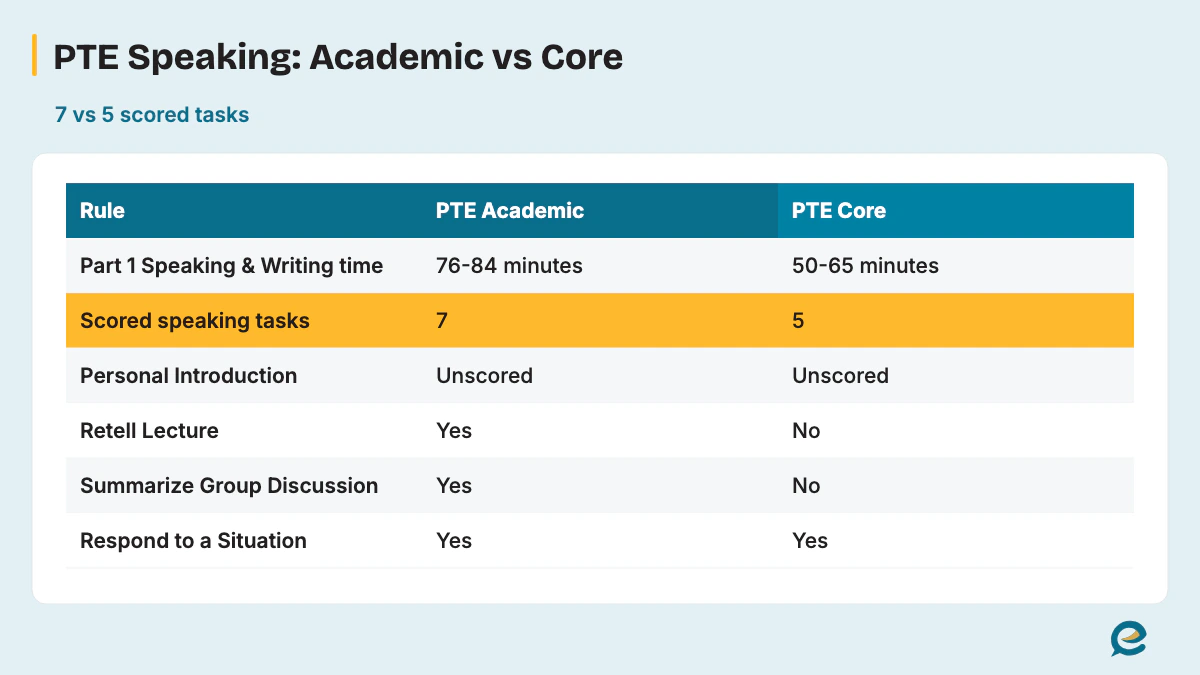
PTE Academic Part 1 runs 76-84 minutes with 9 scored question types: 7 spoken-response types and 2 writing types, plus an unscored Personal Introduction. PTE Core Part 1 runs 50-65 minutes with 7 scored question types: 5 spoken-response types and 2 writing types, plus the unscored Personal Introduction.
| Feature | PTE Academic and UKVI | PTE Core |
|---|---|---|
| Part of the test | Part 1, Speaking & Writing | Part 1, Speaking & Writing |
| Speaking & Writing time | 76-84 minutes | 50-65 minutes |
| Scored speaking types | 7 | 5 |
| Personal Introduction | Yes, unscored | Yes, unscored |
| Retell Lecture | Yes | No |
| Summarize Group Discussion | Yes | No |
| Respond to a Situation | Yes | Yes |
| Writing tasks in the same part | Summarize Written Text, Write Essay | Summarize Written Text, Write Email |
Pearson's Score Guides list how many items of each type you get. In PTE Academic: Read Aloud 6-7, Repeat Sentence 10-12, Describe Image 5-6, Retell Lecture 2-3, Answer Short Question 5-6, Summarize Group Discussion 2-3 and Respond to a Situation 2-3. In PTE Core: Read Aloud 6-7, Repeat Sentence 10-12, Describe Image 3-4, Respond to a Situation 2-4 and Answer Short Question 5-6. Some prep sites still quote 54-67 minutes for this part; Pearson's current pages say 76-84 minutes for PTE Academic and 50-65 minutes for PTE Core speaking and writing.
What Is the PTE Speaking Format Task by Task?
The Speaking Format guide lists every speaking task with its prompt length, preparation time and answer time, in Pearson order, with the PTE Core differences beside them. The table above stays at section level, so turn to the PTE speaking format guide for the full task timing table.
What Are the PTE Speaking Question Types?
In Pearson's PTE Academic order, the speaking question types are Personal Introduction (unscored), Read Aloud, Repeat Sentence, Describe Image, Retell Lecture, Answer Short Question, Summarize Group Discussion and Respond to a Situation. PTE Core omits Retell Lecture and Summarize Group Discussion and places Respond to a Situation before Answer Short Question, and each task page holds the full method. Pearson order puts the Personal Introduction first as an unscored item.
What Is Personal Introduction?
Personal Introduction gives you 25 seconds to read the prompt and prepare and 30 seconds to record a short introduction, and it does not count toward your score. It's an unscored item in both PTE Academic and PTE Core, and Pearson uses it to get you familiar with the test technology, so treat it as your microphone check. See our PTE speaking introduction guide for topic ideas.
What Is Read Aloud?
Read Aloud shows a text of up to 60 words, gives you 30-40 seconds of preparation time, and records you reading it aloud once, 6-7 times per test. Pearson scores it on Content, Pronunciation and Oral Fluency, and the preparation time is your only chance to mark pauses. Our PTE read aloud guide walks through marked sample passages.
What Is Repeat Sentence?
Repeat Sentence plays a sentence of 3-9 seconds once and asks you to repeat it exactly as you heard it, 10-12 times per test. Pearson gives partial credit for correct word sequences. The Academic page gives 15 seconds to answer after a short tone, while the Core page shows 40 seconds and no tone. Drills are on the PTE repeat sentence page.
What Is Describe Image?
Describe Image shows an image, such as a graph, chart, map or picture, and gives you 25 seconds to study it and 40 seconds to describe it. You get 5-6 images in PTE Academic and 3-4 in PTE Core, scored on Content, Pronunciation and Oral Fluency. Each chart type has its own guide under PTE describe image.
What Is Retell Lecture?
Retell Lecture plays a lecture of up to 90 seconds, then gives you 10 seconds to prepare and 40 seconds to retell it in your own words, 2-3 times per test. The task is PTE Academic only, so PTE Core test takers won't see it. The full note-taking method sits on the PTE retell lecture page.
What Is Answer Short Question?
Answer Short Question plays a 3-9 second question and gives you 10 seconds to answer in one or a few words, 5-6 times per test. A few-word answer is enough, because it is scored correct or incorrect: in PTE Academic it counts toward Listening, and in PTE Core toward Listening and Speaking. Sample questions are on the PTE answer short question page.
What Is Summarize Group Discussion?
Summarize Group Discussion plays a discussion between three speakers of up to 3 minutes, then gives you 10 seconds to prepare and 2 minutes to summarize it, 2-3 times per test. Pearson limits it to PTE Academic and wants you to paraphrase each speaker's points and how their views relate, not retell the conversation word for word. Read the PTE summarize group discussion guide for a worked example.
What Is Respond to a Situation?
Respond to a Situation shows and plays a situation of up to 60 words and gives you 40 seconds to respond to it as you would in real life. The situation prompt sets your register, formal or informal. Prep time differs: 10 seconds in PTE Academic and 20 seconds in PTE Core, with 2-3 items in Academic and 2-4 in Core. Practice prompts are on the PTE respond to a situation page.
How Is PTE Speaking Scored?
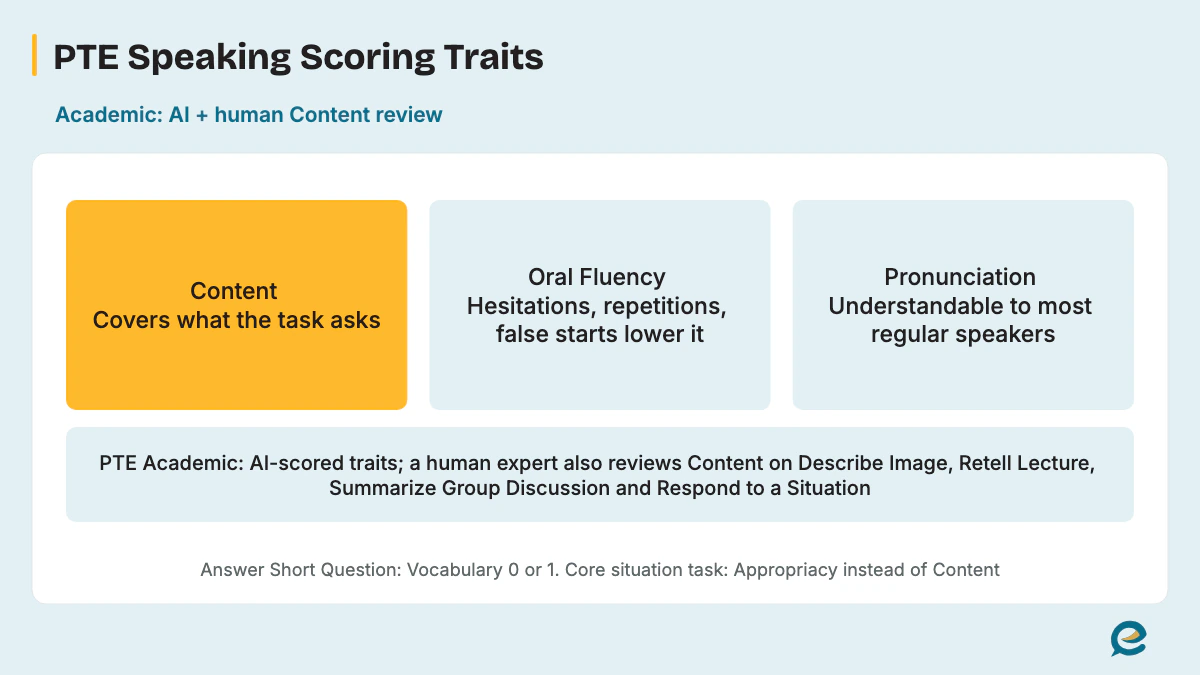
Pearson scores the open speaking tasks on Content, Oral Fluency and Pronunciation. These are AI-scored traits, and on Describe Image, Retell Lecture, Summarize Group Discussion and Respond to a Situation, Content also gets a human review by an expert before the task score is confirmed.
| Trait | What Pearson listens for | What lowers it |
|---|---|---|
| Content | The task's own rule, such as correct words in Read Aloud or all parts of the image in Describe Image. | Missing, wrong or unoriginal content. |
| Oral Fluency | Smooth rhythm, phrasing and stress at a constant, natural rate. | Hesitations, repetitions and false starts. |
| Pronunciation | Speech easily understandable to most regular speakers of English. | Unclear vowels or consonants, and stress on the wrong word or syllable. |
The Score Guides rate Pronunciation and Oral Fluency from 0 to 5. In PTE Academic, Content runs from 0 to 6 on Describe Image, Retell Lecture, Summarize Group Discussion and Respond to a Situation. Answer Short Question is the exception, scored correct or incorrect, and in PTE Core, Respond to a Situation uses Appropriacy instead of Content. Most other tasks give partial credit, and Pearson says you're scored on what you say, not on your accent.
Several tasks also feed another skill. Repeat Sentence, Retell Lecture and Summarize Group Discussion count toward Listening and Speaking, while Describe Image and Respond to a Situation count toward Speaking only. Read Aloud counts toward Speaking in the PTE Academic Score Guide, though Pearson's Academic task notes still mention reading, and toward Reading and Speaking in PTE Core. Scoring considers question scores, difficulty and weighting; a task percentage alone cannot predict your result. All skill scores sit on the 10-90 scale.
How Do You Get 90 in PTE Speaking?
A 90 in speaking needs Content, Oral Fluency and Pronunciation to hold up on every open task: a prompt start, no restarts, clear stress and answers that cover what the task asks.
- Start as soon as the microphone opens, because a prompt start keeps your opening words on the recording.
- Keep going after a slip, since a restart costs more Oral Fluency than one wrong word.
- Stress the key syllable of long words, which keeps Pronunciation easy to follow.
- Cover every part the task names, because Content on the open tasks rewards coverage, not length.
- Check trait balance after each practice set, so one weak trait doesn't drag the others down.
How do you get 76 in speaking? The same logic applies at a lower bar: steady fluency and full task coverage, with fewer gaps allowed. No method can promise a score or a number of days, and Pearson publishes no number of correct items that equals 90.
What Mistakes Should You Avoid in PTE Speaking?
The mistakes that cost the most are the ones Pearson names: speaking before the microphone opens, hesitating or restarting, running past the progress bar and using memorized sentences. Each one hits a specific trait, which makes it fixable.
- Starting before the microphone opens means your opening words aren't recorded.
- Self-correction mid-sentence adds false starts, which lowers Oral Fluency.
- Long silences can end the recording early under Pearson's 3-second wording.
- Ignoring the progress bar leaves your answer unfinished when recording ends.
- Rushing or dragging breaks the constant, natural rate Pearson rewards; its own instruction is "There is no need to rush."
- Fillers such as "um" break your rhythm and pull down Oral Fluency.
- Poor microphone technique, such as a boom too close to your mouth, gives an unclear recording, so set the headset during the microphone check and keep the same distance.
- A memorized template can score 0 for Content, and then Fluency and Pronunciation aren't scored.
Should You Use a PTE Speaking Template?
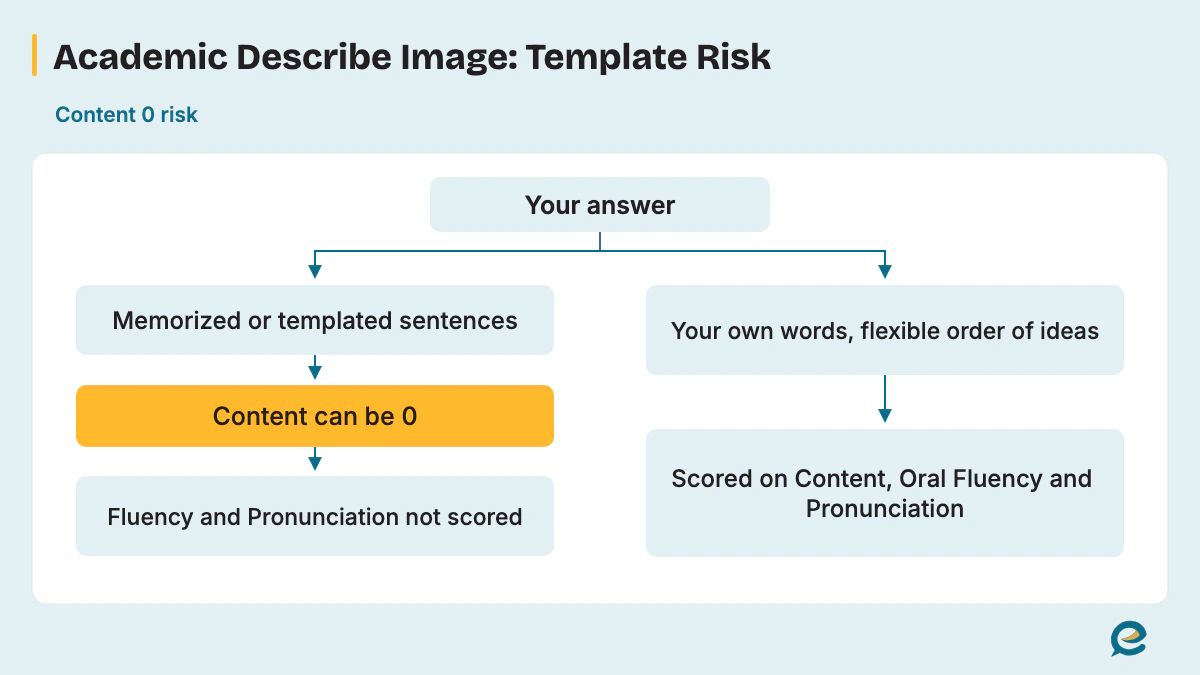
No, not a fixed template: Pearson says memorized responses or templated sentences can lead to a score of 0 for Content, and then Fluency and Pronunciation aren't scored either. Pearson's format page also gives no credit for an unoriginal response on Describe Image, Retell Lecture and Summarize Group Discussion. Its instruction is plain: "You must use your own words."
What does help is a flexible structure, a rough order of ideas filled with what you actually see or hear. For Describe Image, Pearson's own sample answer is labeled general content, main point, other details and conclusion. Some prep sites still sell one template for every task, but Pearson advises against it, and your Content score is what you'd risk.
How Do You Improve Speaking in PTE?
Improve by practicing every speaking task under its real timing, recording yourself and reviewing each recording one trait at a time. A simple weekly practice loop works: one timed practice set per task type, a self-recording review against Content, Oral Fluency and Pronunciation, and one full Part 1 run under test timing. Replay each recording and mark every hesitation and swallowed word ending, because speaking practice without playback hides the problems you can't hear while you talk.
What Is the 3-Second Rule in PTE Speaking?
Pearson states the 3-second rule in its Answer Short Question instructions: if you wait more than three seconds, or stop for three seconds while speaking, the recording stops and the item status changes to completed. Pearson then adds: "This also applies to speaking item types Read aloud, Repeat Sentence, Describe Image and Re-tell Lecture."
Pearson gives no 3-second statement for Summarize Group Discussion or Respond to a Situation, so never apply it to every task. Read more on the 3-second rule in PTE speaking.
How Do You Improve Oral Fluency in PTE Speaking?
Oral fluency improves when you keep a constant, natural pace and stop correcting yourself, because Pearson counts hesitations, repetitions and false starts against it. Practice in meaning chunks, pausing at phrase boundaries rather than mid-phrase. Our guide to oral fluency in PTE adds drills.
How Do You Improve Pronunciation in PTE Speaking?
Pronunciation improves when you aim to be easily understood by most regular speakers of English, which is Pearson's own test, rather than to copy a native accent. A regional accent is fine to that degree, and Pearson says its scoring is trained on over 120 accents; word stress on multi-syllable words matters more. The PTE pronunciation rules page explains the details.
Is PTE Speaking Difficult?
PTE Speaking feels difficult mostly because of strict timing and no replay, not because the questions are obscure. Practice under every real timer reduces that speaking difficulty, since the clock stops surprising you. Our page on common PTE speaking challenges breaks down each problem and its fix.
What Are the Best PTE Speaking Tips?
The tips that move speaking scores are the ones tied to a trait: start promptly, keep going after a slip, and cover what the task asks. A prompt start protects your opening words, and task coverage protects Content. The PTE speaking tips page lists the speaking tips task by task.
Where Can You Take a PTE Speaking Mock Test?
A speaking mock test is most useful when it runs every task under real timing and records each answer once, as the real test does.
Pearson offers official practice resources. When choosing a mock test, check its task coverage, timing and scoring basis. EasyEnglish practice scores are estimates, not official Pearson results.
Practice PTE Speaking on EasyEnglish
Try Speaking tasks in a timed, computer-based format like the real test.
Try speaking practice without signing up. A free account is required for full mock tests. Practice scores are estimates, not official Pearson scores.
Written by
EasyEnglish Team
The team behind EasyEnglish's PTE practice and mock tests
EasyEnglish provides PTE practice and independent preparation guides. Official test rules are checked against the sources identified in each guide; practice examples are illustrative, not real exam questions. Practice scores are estimates. Questions or corrections: support@inverseai.com. EasyEnglish is not affiliated with or endorsed by Pearson.
Editorial review completed .