PTE Speaking Read Aloud: Rules, Questions and Answers
PTE Speaking
Read Aloud opens the scored part of the PTE Speaking section, and you get one take at each text. It shows a text of up to 60 words, gives you 30-40 seconds of preparation time, opens the microphone after a short tone and records you reading it once. Pearson's PTE Academic Score Guide puts 6-7 Read Aloud items in each test and scores them on Content, Pronunciation and Oral Fluency, with the last two rated on a 0-5 scale.
Table of Contents
What Is Read Aloud in PTE?
Read Aloud is a PTE Speaking & Writing item in which a text appears on the screen and you read it aloud into the microphone. It shows a text of up to 60 words, gives you 30-40 seconds to prepare, and records you reading it once. In PTE Academic it's the first scored item in Part 1 Speaking & Writing, which runs 76-84 minutes across 9 question types; only the unscored Personal Introduction comes before it.
The Score Guide lists 6-7 Read Aloud items per test. Each recorded response is final, so there's no second take.
What Are the Read Aloud Format and Timing Rules?
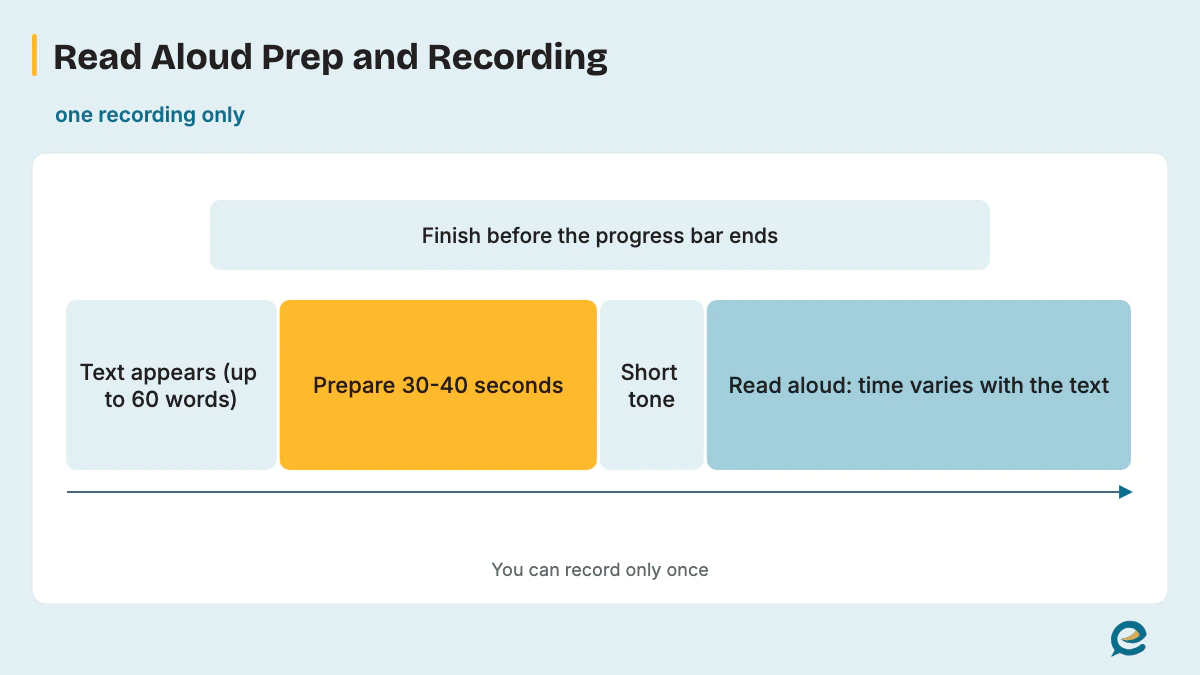
Each item runs through a text of up to 60 words, 30-40 seconds to read and prepare, a short tone, and one recording whose length depends on the text. Pearson's PTE Academic Score Guide sets 6-7 items per test. The microphone tone splits each item into a silent half and a spoken half.
| Stage | What happens | Time or rule |
|---|---|---|
| Text on screen | A countdown runs while the text is shown. | Up to 60 words. |
| Preparation | You read the text silently and plan pauses. | 30-40 seconds of preparation time. |
| Microphone opens | You hear a short tone. | Start speaking right after the tone. |
| Speaking | You read the whole text aloud once. | Answer time varies with the text length. |
| Finishing | "Recording" changes to "Completed". | Finish before the progress bar reaches the end. |
| Items per test | Read Aloud repeats with new texts. | 6-7 items in PTE Academic (Score Guide). |
Pearson warns that anything you say before the microphone opens is not recorded, and that you can record your answer only once. Some prep sites still quote "60-80 words" or a fixed "40 seconds" to speak; Pearson's current page says up to 60 words and an answer time that varies by item. The same page gives 30-40 seconds to prepare, not 35.
What Are the PTE Read Aloud Scoring Criteria?
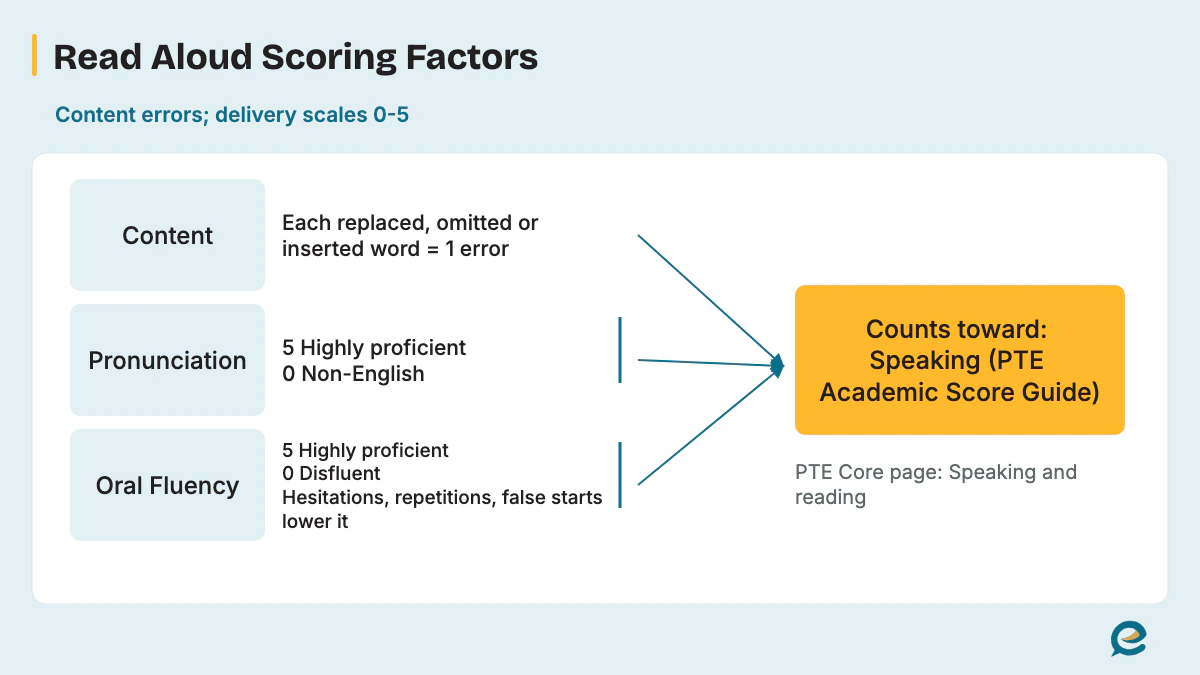
Pearson scores Read Aloud on Content, Pronunciation and Oral Fluency, with partial credit. Content counts errors, while Pronunciation and Oral Fluency are each rated from 0 to 5. Content is the only one of the three that counts words rather than rating how you sound.
| Criterion | What Pearson counts | What lowers it |
|---|---|---|
| Content | All the words in the text and only those words. | Each replacement, omission or insertion is one error. |
| Pronunciation | Speech that most regular speakers of English understand easily. | Unclear vowels and consonants, or stress on the wrong syllable. |
| Oral Fluency | Smooth rhythm, phrasing and stress. | Hesitations, repetitions and false starts. |
The Score Guide sets no fixed Content maximum: it depends on the length of the text. For the other two traits, the Score Guide uses the six levels in the second table, with the Oral Fluency descriptor shown because it maps most directly to how you read.
| Score | Pronunciation label | Oral Fluency label | What that Oral Fluency level sounds like |
|---|---|---|---|
| 5 | Highly proficient | Highly proficient | Smooth rhythm and phrasing, with no hesitations, repetitions or false starts. |
| 4 | Advanced | Advanced | Appropriate phrasing, with no more than one hesitation, one repetition or a false start. |
| 3 | Good | Good | More than one hesitation, but most words come in continuous phrases and there are no long pauses. |
| 2 | Intermediate | Intermediate | Uneven or staccato, at least one smooth three-word run, and at most one long pause. |
| 1 | Intrusive | Limited | Irregular phrasing, several hesitations, and one or two long pauses. |
| 0 | Non-English | Disfluent | Slow and labored, with most words isolated. |
Some prep sites still print "Native-like" for level 5; Pearson's current Score Guide says "Highly proficient". Pearson's 2025 update states that humans never check your pronunciation or fluency, so the AI rates both traits. Pearson also recognizes regional and national varieties of English if most regular speakers understand them, which means a regional accent, such as an Indian accent, isn't a penalty in itself. Aim for clear sounds, not an imitation accent.
Why Is Read Aloud Important for Your PTE Score?
Read Aloud is the first scored speaking task, it appears 6-7 times in PTE Academic, and every item feeds your Speaking score through Content, Pronunciation and Oral Fluency. For PTE Academic, the Score Guide names Speaking as the only communicative skill it scores, though the notes on Pearson's task page still list reading too. For PTE Core, Pearson lists "Speaking and reading", so count on both a Speaking score and a Reading score there. Listening and writing aren't tested by this item. Scoring considers question scores, difficulty and weighting; practising this task alone cannot predict your final result.
What Types of Passages Appear in Read Aloud?
Read Aloud texts are short factual passages, and sorting them into six passage types sharpens your practice: factual, cause and effect, process, definition, comparison and research-based. Pearson's Read Aloud description doesn't name passage types, so treat these as a way to organize practice, not as official categories. Each type uses its own signal words and tests a different reading skill when you read it aloud.
| Passage type | Signal words | What it tests when you read aloud |
|---|---|---|
| Factual | Names, numbers, technical terms | Clear pronunciation of proper nouns and key terms. |
| Cause and effect | because, as a result, therefore | Fluency across long clauses joined by linking words. |
| Process | first, then, finally | A steady pace through a sequence of steps. |
| Definition | refers to, is defined as | Correct stress on academic words. |
| Comparison | however, whereas, in contrast | Intonation that marks the contrast between two ideas. |
| Research-based | studies suggest, results indicate | Dense vocabulary read without hesitation. |
Pearson describes PTE Academic content as drawn from academic settings, while PTE Core focuses on everyday situations, so Core texts read less like a textbook.
What Does a Read Aloud Sample Paragraph Look Like?
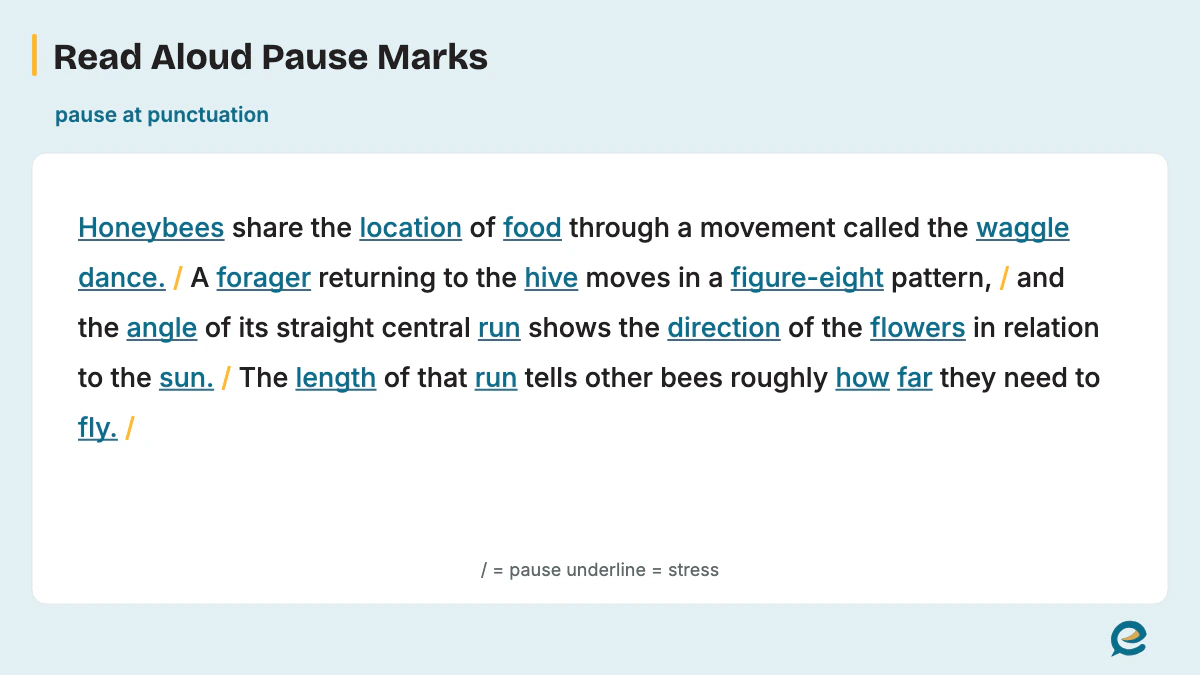
A Read Aloud text is a single academic-style paragraph of up to 60 words, and you work it by pausing at punctuation and putting word stress on the words that carry meaning.
The six practice passages, each on an academic topic and three of them with figures to say aloud, below cover one passage type each and were written for practice, not taken from a real exam. Under each one, the sample answer marks a slash (/) at every comma and full stop, bolds the words to stress, and shows the stressed syllable of two longer words in capitals.
Passage 1: Factual (58 words)
Honeybees share the location of food through a movement called the waggle dance. A forager returning to the hive moves in a figure-eight pattern, and the angle of its straight central run shows the direction of the flowers in relation to the sun. The length of that run tells other bees roughly how far they need to fly.
Sample answer:
Honeybees share the location of food through a movement called the waggle dance. / A forager returning to the hive moves in a figure-eight pattern, / and the angle of its straight central run shows the direction of the flowers in relation to the sun. / The length of that run tells other bees roughly how far they need to fly. /
Stress: lo-CA-tion, di-REC-tion. The second sentence runs 19 words after the comma, so take your breath at that comma and read the rest as one phrase.
Passage 2: Cause and Effect (55 words)
In April 1815, Mount Tambora in Indonesia erupted with enormous force. Because the eruption threw vast amounts of ash and gas into the upper atmosphere, less sunlight reached the ground the following year. As a result, 1816 became known as the Year Without a Summer, and crops failed across parts of Europe and North America.
Sample answer:
In April 1815, / Mount Tambora in Indonesia erupted with enormous force. / Because the eruption threw vast amounts of ash and gas into the upper atmosphere, / less sunlight reached the ground the following year. / As a result, / 1816 became known as the Year Without a Summer, / and crops failed across parts of Europe and North America. /
Stress: In-do-NE-sia, AT-mos-phere. Say the years as "eighteen fifteen" and "eighteen sixteen", and let your voice rise on "Because" and fall on "year" to show where the cause ends.
Passage 3: Process (60 words)
Maple syrup production starts in late winter, when farmers drill small holes in maple trees and collect the sap that flows out. The sap is then boiled in wide, shallow pans until most of its water evaporates. Because sap is mostly water, roughly 40 liters are needed to make a single liter of syrup, which is finally filtered and bottled.
Sample answer:
Maple syrup production starts in late winter, / when farmers drill small holes in maple trees and collect the sap that flows out. / The sap is then boiled in wide, / shallow pans until most of its water evaporates. / Because sap is mostly water, / roughly 40 liters are needed to make a single liter of syrup, / which is finally filtered and bottled. /
Stress: pro-DUC-tion, e-VAP-o-rates. The comma in "wide, shallow" is a short pause only, so keep "wide" and "shallow pans" close together and save the longer pause for the full stop.
Passage 4: Definition (57 words)
Biodiversity refers to the variety of living things in a particular area, from bacteria and fungi to plants and large animals. Scientists usually describe it at three levels: genetic variety within a species, the number of species in a habitat, and the range of ecosystems across a region. Greater variety often helps an ecosystem recover from disease.
Sample answer:
Biodiversity refers to the variety of living things in a particular area, / from bacteria and fungi to plants and large animals. / Scientists usually describe it at three levels: genetic variety within a species, / the number of species in a habitat, / and the range of ecosystems across a region. / Greater variety often helps an ecosystem recover from disease. /
Stress: bi-o-di-VER-si-ty, E-co-sys-tems. Make a short pause at the colon after "three levels", just as you would at a comma.
Passage 5: Comparison (53 words)
Printed books and e-readers both support careful reading, but they suit different situations. A printed book needs no battery and lets readers flip quickly between chapters, whereas an e-reader can store thousands of titles in a device lighter than one hardback. In contrast to paper, most e-readers also let readers enlarge the text.
Sample answer:
Printed books and e-readers both support careful reading, / but they suit different situations. / A printed book needs no battery and lets readers flip quickly between chapters, / whereas an e-reader can store thousands of titles in a device lighter than one hardback. / In contrast to paper, / most e-readers also let readers enlarge the text. /
Stress: sit-u-A-tions, THOU-sands. Lift your pitch slightly on "whereas" so the listener hears the switch from one side to the other.
Passage 6: Research-Based (57 words)
Researchers who drill deep into the Antarctic ice sheet can study the climate of the distant past. Tiny bubbles trapped in the ice hold samples of ancient air, and an earlier long ice-core record reaches back about 800,000 years. Results from these cores indicate that carbon dioxide levels and temperatures have risen and fallen together over that long period.
Sample answer:
Researchers who drill deep into the Antarctic ice sheet can study the climate of the distant past. / Tiny bubbles trapped in the ice hold samples of ancient air, / and an earlier long ice-core record reaches back about 800,000 years. / Results from these cores indicate that carbon dioxide levels and temperatures have risen and fallen together over that long period. /
Stress: Ant-ARC-tic, TEM-per-a-tures. Say the figure as "eight hundred thousand years", and decide that before the tone so the number doesn't cost you a hesitation.
Mark a fresh copy of each practice paragraph yourself before you look at the sample answer, then read it with a recording running. For more texts with a score on every attempt, create a free account in the practice app.
How Do You Answer Read Aloud Step by Step?
Use the preparation time to split the text into meaning chunks at its punctuation, then read at a steady pace from the tone to the end of the progress bar without going back. Every step below protects Content, Pronunciation or Oral Fluency. Steps 1-5 happen in the silent preparation time, and steps 6-9 start once the tone sounds.
- Read the whole text silently once during the preparation time.
- Mark punctuation pauses at every comma and full stop in your head.
- Pick the words that carry meaning, such as nouns, main verbs and numbers, and plan to stress them.
- Plan rising and falling intonation: a slight rise as a chunk begins and a fall as it ends, which is Pearson's own tip.
- Spot the two or three hardest words and say them in syllables under your breath.
- Start speaking immediately after the tone, as Pearson instructs.
- Read in chunks at a smooth, natural speed, neither too fast nor too slow.
- If you slip on a word, keep going, because Pearson counts a self-correction as added words.
- Stop cleanly before the progress bar ends and stay quiet until the status shows "Completed".
Before the first item, set the headset microphone around two fingers from your mouth and speak without shouting or whispering, as Pearson's test tip advises.
What Are Common Read Aloud Mistakes to Avoid?
The mistakes that cost marks are the ones Pearson names: replacing, adding or skipping words, and hesitating, repeating or restarting, plus starting before the microphone opens or waiting too long after it does. Pearson's Oral Fluency scale counts hesitations, repetitions and false starts, and its Content rule counts every word you change.
- Changing a word for a synonym is a replacement and costs Content.
- Adding a small word such as "the" counts among insertions and costs Content.
- Skipping a hard word counts among omissions and costs Content.
- Going back to fix a word adds words, and the restart is a false start that lowers Oral Fluency.
- Filler sounds such as "um" or "uh" are hesitations, so they lower Oral Fluency rather than Content.
- A long hesitation before a hard word breaks the phrase and counts against Oral Fluency.
- Starting before the tone loses your opening words, because Pearson doesn't record them.
- Waiting too long after the tone is risky, because Pearson's three-second sentence names Read Aloud.
- A flat monotone ignores Pearson's tip to stress key words and use rising and falling intonation.
- Dropping word endings, such as the final "d" in "changed", makes words harder to understand and costs Pronunciation.
- Racing to finish blurs sounds and costs Pronunciation and Oral Fluency together.
Pearson's own advice is a smooth, natural speed, so skip any drill that rewards reading as fast as you can.
How Do You Practice Read Aloud for a Higher Score?
Record yourself on full-length texts, compare each recording against the three scoring criteria, and fix one criterion at a time. The practice loop is short: read, record, listen back, mark every replaced, added or skipped word and every hesitation, then read the same text again. Self-recording catches slips you can't hear while you speak, and the replay shows which criterion costs you most.
For daily practice, a seven-day cycle rotates the passage types so each scoring criterion gets its own focus day, and day 7 replaces a mock test with a timed run of the Speaking section.
| Day | What to read | What to record | Criterion to check |
|---|---|---|---|
| 1 | A factual passage with names and numbers | One clean read | Content: every figure said in full |
| 2 | A cause-and-effect passage | Two reads back to back | Oral Fluency: breaths only at commas |
| 3 | A process passage | One read at your normal pace | Oral Fluency: even speed through the steps |
| 4 | A definition passage | The three longest words, then the passage | Pronunciation: stressed syllables |
| 5 | A comparison passage | One read | Pronunciation: pitch change on "however" or "whereas" |
| 6 | A research-based passage | One read, then the same text a day later | Content and Oral Fluency together |
| 7 | All Read Aloud items in a timed Speaking run | The full set under exam timing | All three criteria |
How Do You Improve Oral Fluency in Read Aloud?
Oral fluency improves when you stop correcting yourself mid-sentence, because Pearson counts hesitations, repetitions and false starts against it. Read in meaning chunks, breathe at punctuation rather than in the middle of a phrase, and keep an even pace across the hard words. Replace any "um" with a silent breath. For shadowing, play a short clip of clear spoken English, pause after each phrase, and copy the speaker's rhythm and pitch before moving on.
Our guide to oral fluency in PTE adds drills for longer texts.
How Do You Improve Pronunciation for Read Aloud?
Pronunciation improves when you aim to be understood by most regular speakers of English, which is Pearson's own test, rather than copy a native accent. Pearson also scores word stress, so check each long word's stressed syllable in a dictionary before you practice it. Work on these habits one at a time:
- Say every sound and keep word endings such as -s, -ed and -t.
- Break long words into syllables and put the word stress where the dictionary marks it.
- Stress content words such as nouns, main verbs and numbers more than small words like "of" and "the".
- Let your intonation rise as a chunk begins and fall as the sentence ends.
- Record the words you marked during preparation and replay them until each sounds clear.
The PTE pronunciation rules page explains how Pearson judges vowels, consonants and stress.
What Short Sentences Can You Drill for Read Aloud?
Short single sentences let you drill stress and chunking before you move to full passages, because each one tests a single breath group. In each of these 14 drill sentences, the stressed words are in bold and a slash marks the comma pause.
- The bridge was closed for repairs, / so drivers crossed the bay by ferry for three weeks.
- Coffee reached Europe through busy trading ports, / and coffeehouses soon became places for news and debate.
- The Eiffel Tower was completed in 1889, / and it stayed the tallest structure in the world for about four decades.
- The museum displays tools, / coins and pottery found during an excavation near the river.
- Glass is made by melting sand, / soda ash and limestone together at very high temperatures.
- Earthquakes happen when sections of the Earth's crust suddenly slip along a fault.
- The Moon takes about 27 days to orbit the Earth, / and it always shows us the same side.
- The committee postponed its decision until the final report on costs was ready.
- Remote work saves commuting time, / but it can make close working relationships harder to build.
- Volcanic soil is often rich in minerals, / which is why crops grow well on the slopes of some volcanoes.
- The professor summarized the findings in four clear points before opening the discussion.
- Antibiotics treat bacterial infections, / but they have no effect on viruses such as the common cold.
- Rising sea levels threaten low-lying cities, / so engineers are designing flood barriers and raised walkways.
- Photosynthesis lets plants turn carbon dioxide and water into sugar, / using energy from light.
The same chunking habit helps when you only hear the sentence, and our Repeat Sentence chunking tips show how to hold one in short-term memory.
How Do You Read Numbers and Dates in Read Aloud?
Say every figure in full spoken English, because a number in the text is a word you must not skip or replace. Pearson's Read Aloud page sets no special rule for numbers, so use the standard spoken forms below and fix each one in your head during preparation.
| Written | Say it as |
|---|---|
| 1815 | eighteen fifteen |
| 2008 | two thousand eight, or two thousand and eight |
| the 1860s | the eighteen sixties |
| the 14th century | the fourteenth century |
| 30% | thirty percent |
| 30 to 60% | thirty to sixty percent |
| 800,000 | eight hundred thousand |
| 2.5 | two point five |
| 2/3 | two thirds |
| 15°C | fifteen degrees Celsius |
| 40 km | forty kilometers |
Treat proper nouns the same way: if a name such as "Tambora" is new to you, choose a pronunciation during preparation, say it once with confidence and keep going. Skipping a name or a percentage is an omission, and stopping to think about it costs Oral Fluency as well.
What Is the 3-Second Rule in Read Aloud?
Pearson states the three-second rule in its Answer Short Question block. If you wait more than three seconds, the recording stops; if you stop for three seconds while speaking, the status changes to "Completed" even if you haven't finished. The block then names Read Aloud: "This also applies to speaking item types Read aloud, Repeat Sentence, Describe Image and Re-tell Lecture."
Pearson doesn't spell out whether that sentence extends the whole rule or only the step before it.
Treat it as covering Read Aloud. Good microphone timing here requires two things: your first word comes right after the tone, and no gap inside the text runs longer than a breath. Pearson's own tip is stricter still: once you start, don't stop for more than a second or two, and no silence should run long. Read more about the 3-second rule in PTE speaking.
How Should You Set Up the Microphone for Read Aloud?
Set the headset microphone around two fingers' distance from your mouth and speak clearly without shouting or whispering, which is Pearson's own test tip. You'll run an equipment check before the test starts, so use it to confirm the headset microphone picks up your voice at that distance.
Keep the headset on throughout, because other test takers in the room answer at the same time; Pearson assesses only what your own microphone records, so background noise from neighbors doesn't count against you. Keep the same distance for every item, and stop talking once you finish so no extra words are recorded. Our PTE headset and microphone guide covers the test-center equipment in detail.
Should You Use a Template for Read Aloud?
No, a template has nothing to add here, because Read Aloud scores the words of the given text and every inserted word is a Content error. The "one-line strategy" of reading only part of the text doesn't protect your Content score either, since every skipped word counts as an omission.
On the other speaking items, what helps is a structure, not fixed sentences, because Pearson's Score Guide treats pre-prepared or memorized material as an irrelevant response. Our PTE speaking tips show how to plan an answer without a script.
Is Read Aloud the Same in PTE Academic and PTE Core?
Read Aloud works the same way in both tests: up to 60 words, 30-40 seconds to prepare, an answer time that varies with the text, one recording, and scoring on Content, Oral Fluency and Pronunciation.
Pearson states two differences. PTE Core content focuses on everyday situations while PTE Academic uses academic settings, and the Core page lists "Speaking and reading" as the skills assessed, while the Academic Score Guide lists Speaking only. Pearson's Speaking & Writing page also covers PTE Academic and PTE Academic UKVI together, so Read Aloud is the same in UKVI. Our comparison of PTE Academic vs PTE Core covers how the two tests differ overall.
How Does Read Aloud Practice Help Other PTE Speaking Tasks?
Read Aloud trains the same two traits, Pronunciation and Oral Fluency, that Pearson scores in Repeat Sentence, Describe Image and Retell Lecture, so clean chunking and a steady pace carry straight over. It's the only one of those tasks where you see every word before you speak, which makes it the safest place to drill both traits. See our PTE Speaking section guide for how each task in the Speaking section is scored.
Practice PTE Speaking on EasyEnglish
Try Speaking tasks in a timed, computer-based format like the real test.
Try speaking practice without signing up. A free account is required for full mock tests. Practice scores are estimates, not official Pearson scores.
Written by
EasyEnglish Team
The team behind EasyEnglish's PTE practice and mock tests
EasyEnglish provides PTE practice and independent preparation guides. Official test rules are checked against the sources identified in each guide; practice examples are illustrative, not real exam questions. Practice scores are estimates. Questions or corrections: support@inverseai.com. EasyEnglish is not affiliated with or endorsed by Pearson.
Editorial review completed .