
PTE Retell Lecture: Format, Scoring and Answer Structure
PTE Speaking
You hear a short academic talk once, scribble what you can, and then have to explain it back clearly. Retell Lecture plays a lecture of up to 90 seconds, sometimes with an image, and allows note-taking while it plays. It then gives you 10 seconds to prepare and records your retelling, in your own words, for up to 40 seconds. It's a PTE Academic task only, since Pearson's PTE Core task list doesn't include it.
Table of Contents
What Is Retell Lecture in PTE?
Retell Lecture is a PTE Academic Part 1 Speaking & Writing item in which you listen to or watch a lecture and retell it in your own words. The lecture runs up to 90 seconds and can show an image on screen. You take notes while it plays, prepare for 10 seconds after it ends, then speak for up to 40 seconds after a short tone. You record once. Pearson says the task tests listening and speaking, and it appears in PTE Academic only.
What Are the Retell Lecture Format and Timings?
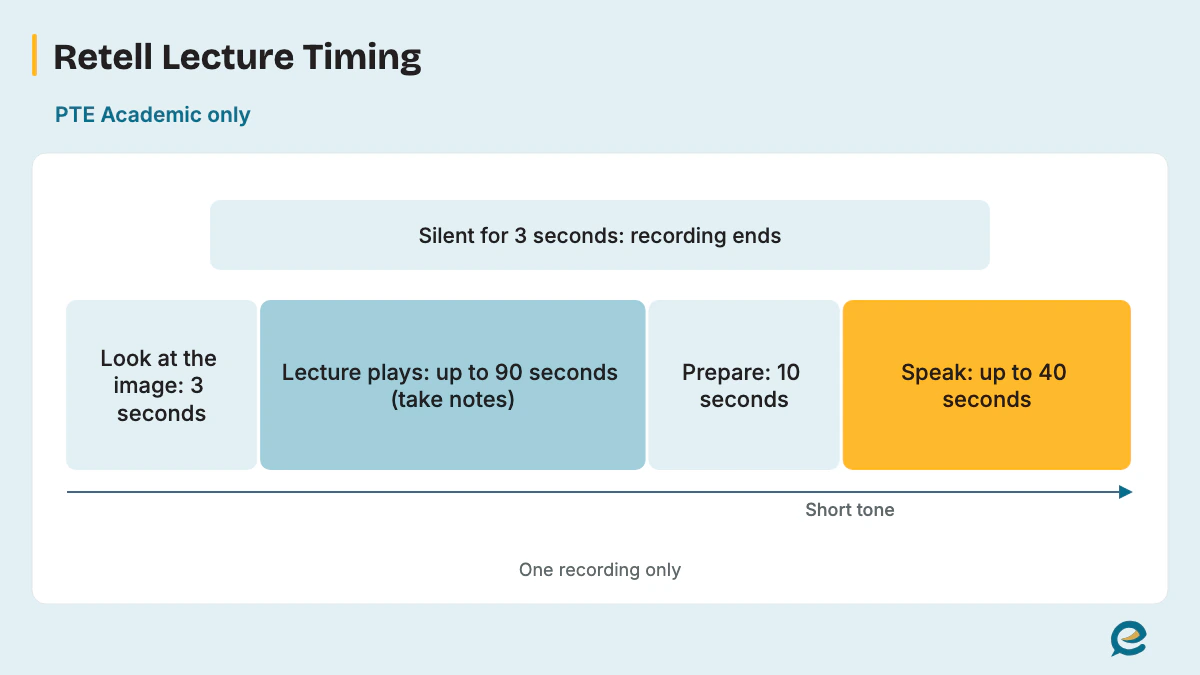
The sequence runs 3 seconds to look at any image, a lecture of up to 90 seconds, 10 seconds to prepare, a short tone, and up to 40 seconds to speak, with one recording. The timing breaks into six stages.
| Stage | What happens | Time |
|---|---|---|
| Image preview | You look at any image on screen before the audio starts. | 3 seconds. |
| Lecture plays | You listen and take notes on the erasable noteboard. | Up to 90 seconds. |
| Preparation | You plan your retelling from your notes. | 10 seconds. |
| Tone | A countdown runs, then a short tone opens the microphone. | Speak straight after it; earlier speech isn't recorded. |
| Speaking | You retell the lecture in your own words. | Up to 40 seconds. |
| Finishing | "Recording" changes to "Completed" when the progress bar ends. | One recording only. |
Pearson's 3-second rule names Re-tell Lecture, so a silence of three seconds while speaking ends the recording. Pearson's task page gives the lecture length as up to 90 seconds, and its Score Guide lists 2-3 Retell Lecture items in each PTE Academic test.
How Is Retell Lecture Scored?
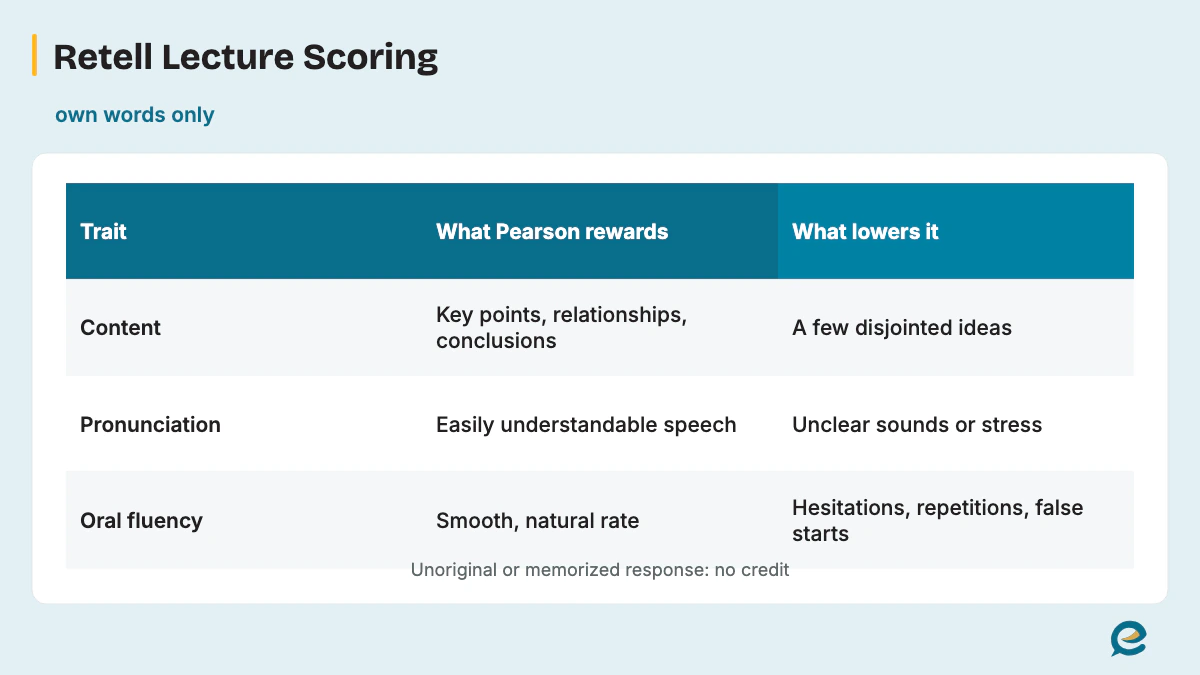
Pearson scores Retell Lecture on Content, Pronunciation and Oral Fluency, with partial credit. Content rewards the situation, characters, aspects, actions and developments, plus their relationships and the conclusions or implications. Each trait has its own way of losing marks.
| Trait | What Pearson rewards | What lowers it |
|---|---|---|
| Content | Key points, how they connect, and the conclusions or implications. | Mentioning a few disjointed ideas. |
| Pronunciation | Speech most regular speakers understand easily. | Unclear sounds or misplaced stress. |
| Oral Fluency | A smooth, natural rate with appropriate phrasing. | Hesitations, repetitions and false starts. |
Pearson's Score Guide scores Content from 0 to 6 and Pronunciation and Oral Fluency from 0 to 5 each, and credits the task to both Listening and Speaking. Pearson gives no credit for no response, an irrelevant response or an unoriginal response, and adds "You must use your own words". All three traits are AI-scored, and Content also gets a human review before the task score is confirmed.
The Score Guide's Content levels show what moves an answer from a 4 to a 6. This summary paraphrases each level.
| Content level | What the Score Guide describes |
|---|---|
| 6 | Main ideas paraphrased smoothly in your own words, important points expanded, and ideas joined with connectives so the answer flows. |
| 5 | Main ideas plus some important details, mostly in your own words, linked in a clear order. |
| 4 | Some main ideas and details, perhaps a few inaccurate points or minor details, and weak links between ideas. |
| 3 | Some ideas with main points and details mixed up, possibly irrelevant information or lecture wording repeated without rephrasing. |
| 2 | Mostly inaccurate or incomplete, leaning heavily on the lecture's own words, and hard to follow. |
| 1 | Isolated words and phrases from the lecture, with no order of importance. |
| 0 | Related to the lecture but too limited for a higher score. |
Is Retell Lecture in PTE Core?
No, Retell Lecture is PTE Academic only. Pearson's PTE Core Speaking & Writing task list covers Read Aloud, Repeat Sentence, Describe Image, Respond to a Situation, Answer Short Question, Summarize Written Text and Write Email, with no Retell Lecture. The Core page does mention Re-tell Lecture once, inside a copied 3-second-rule sentence, which explains why some pages list it for Core. The official task list is the one to trust.
How Do You Take Notes for Retell Lecture?
Write key words, names and numbers with symbols and arrows while the lecture plays, and mark how ideas connect, because Pearson's Content criteria reward relationships, not lists of words. These note-taking habits fit on the erasable noteboard.
- Use the 3-second image preview to predict the lecture's topic.
- Note the main topic in a few words as soon as you hear it.
- Use symbols and arrows such as - = & + to show cause, contrast and sequence, as Pearson's guide suggests.
- Capture key points about characters, actions and developments, not every word.
- Leave space at the bottom for the speaker's conclusion.
How Should You Structure a Retell Lecture Answer?
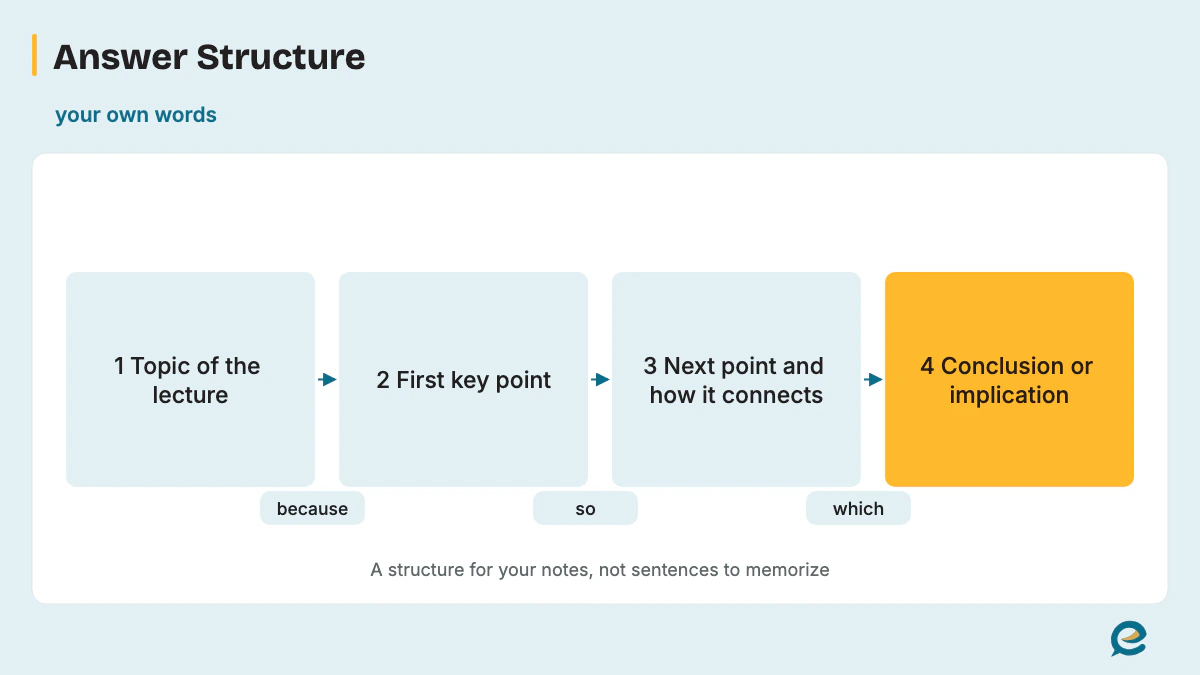
A strong answer structure opens with the topic, gives two or three main points and how they connect, and closes with the conclusion or implication. Pearson's guide advises joining them with linking words and relative clauses. Four parts carry you through 40 seconds.
- State the lecture's topic in one sentence.
- Give the first key point and who or what it concerns.
- Add the next point and show how it relates to the first, using words like because, so, then or which.
- End with the conclusion or implication the speaker drew.
A shared practice kit
Listen and take notes, then retell the main ideas and how they connect in your own words.
Recording voice: UK English.
Original practice recording.
Transcript
Today I will describe how our student club changed the way it prepares a practice kit. The kit contains cards, markers and sample diagrams for group activities. Originally, each organiser packed it from memory. Sometimes everything was ready, but on other occasions a group discovered that the cards needed for its activity were missing. We tried solving the problem by adding more spare materials. That made the box heavier without explaining what should be inside. Our next approach was a contents sheet arranged by activity. Each activity has a short list, and the organiser checks the list while packing. After the session, the same sheet helps us notice what needs replacing. We still keep a few spare materials, since a checklist cannot prevent a marker from running out during use. The useful change was making the purpose of each item clear. For our club, a kit works best when its contents, the activity plan and the return check are connected.
Answer and explanation
The speaker described a student club’s practice kit. Packing it from memory sometimes left out essential cards, and adding spare materials only made the box heavier. The club then organised its contents sheet by activity, using it both before and after sessions. This helped organisers pack the right materials and notice what needed replacing. Spares were still useful because equipment could stop working during an activity. The conclusion was that the kit, the activity plan and the return check should support one another.
This is one possible answer; equivalent accurate paraphrases are valid.
Notes
- Packing from memory omitted materials.
- More spares alone added weight without clarity.
- An activity-based contents sheet supports packing and returns.
- Keep limited spares; connect contents, use and checking.
The model preserves the initial packing problem, unsuccessful first response, improved checklist and the remaining need for spares.
Original lecture and linked model answer; no source recording existed.
Should You Use a Retell Lecture Template?
No fill-in template: Pearson's Speaking Test Tips (V6, January 2026) say not to use memorized responses or templated sentences. Its wording is direct: "If there is a significant amount of pre-memorized content, a score of 0 will be given, and fluency and pronunciation will not be scored". The format page adds that no credit is given for an unoriginal response, so you must use your own words.
Some prep sites still teach a fixed template; Pearson's own guidance says the opposite. The structure above organizes your own notes. A template fills 40 seconds with stock phrases and leaves no room for the lecture's points, which is exactly what Content measures.
What Mistakes Should You Avoid in Retell Lecture?
The mistakes Pearson names are listing key words without connecting them, trying to mention everything, using filler words, and relying on memorized content. Each one costs a specific trait.
- Disconnected key words with no relationships between them cost Content.
- Covering every detail costs Content and Oral Fluency, because you run out of time before the conclusion.
- Filler words unrelated to the lecture cost Content.
- Repeating the lecturer's wording without rephrasing it costs Content; the Score Guide places heavy repetition at levels 2 and 3.
- Self-correction costs Oral Fluency; Pearson says keep talking and ignore any mistakes.
- Long silences of three seconds end the recording under the 3-second rule.
- Memorized content can earn a score of 0.
How Do You Practice Retell Lecture?
Practice with short academic talks: take notes once, prepare for 10 seconds, retell for 40 seconds, record, and check for missing relationships and pauses. That practice loop copies the real timing. Self-recording shows whether your answer linked the points or just listed them, and a quick note review afterwards shows which symbols saved you time. If your notes keep missing the speaker's conclusion, leave the bottom third of the page blank for it.
What Tips Help You Improve Retell Lecture?
The step-by-step practice tips, from note symbols to pacing drills, are collected on the Retell Lecture tips page, so they aren't repeated here. See tips for PTE Retell Lecture practice.
How Many Retell Lectures Are in PTE?
Pearson's PTE Academic Score Guide lists 2-3 Retell Lecture items per test, all in Part 1 Speaking & Writing. The exact item count varies between test versions, and PTE Core has none. See the PTE exam format for the full test format and timings.
What Is the 3-Second Rule in Retell Lecture?
Pearson says that if you stop for three seconds while speaking the recording status changes to completed, and it names Re-tell Lecture among the items this applies to. The rule covers your whole retelling, so a long silence while you search your notes can end your answer early. Read more on the 3-second rule in PTE speaking.
How Do You Keep Speaking for the Full 40 Seconds in Retell Lecture?
Pearson's guide adds that the longer you speak, the more likely you are to cover the content requirements. Its format page tip is to keep talking and ignore mistakes, because repeating ideas, correcting yourself or hesitating uses time and costs points. Every hesitation shortens the 40 seconds you have, leaving less time for your conclusion.
If you missed most of the lecture, don't stop: name the topic, retell the points you did catch and link them, because a three-second silence ends the recording and an empty answer earns nothing. See oral fluency in PTE for how Pearson scores flow.
Is There a Retell Lecture Score Chart?
Pearson doesn't publish a separate score chart for Retell Lecture; it reports PTE scores on the 10-90 scale, and the task's traits feed your skill scores. The Score Guide does describe each trait level, from Content 0-6 to Pronunciation and Oral Fluency 0-5, and the task counts toward Listening and Speaking. The PTE score chart explains the overall scale.
How Does Retell Lecture Fit Into the PTE Speaking Section?
Retell Lecture is the fourth scored speaking task in Part 1 of PTE Academic, after Read Aloud, Repeat Sentence and Describe Image and before Answer Short Question. It shares the 40-second answer time of Describe Image and the 3-second rule that Pearson applies to Read Aloud, Repeat Sentence and Describe Image. See the PTE Speaking section guide for every speaking task in order.
Practice PTE Speaking on EasyEnglish
Try Speaking tasks in a timed, computer-based format like the real test.
Try speaking practice without signing up. A free account is required for full mock tests. Practice scores are estimates, not official Pearson scores.
Written by
EasyEnglish Team
The team behind EasyEnglish's PTE practice and mock tests
EasyEnglish provides PTE practice and independent preparation guides. Official test rules are checked against the sources identified in each guide; practice examples are illustrative, not real exam questions. Practice scores are estimates. Questions or corrections: support@inverseai.com. EasyEnglish is not affiliated with or endorsed by Pearson.
Editorial review completed .