
PTE Respond to a Situation: Format, Sample Answers and Tips
PTE Speaking
You're asked to speak as if you're really in a campus or everyday moment, such as asking a lecturer for help or sorting out a library problem. This situation task describes a short scenario in audio and on screen, gives you a few seconds to prepare, then records an extended response of up to 40 seconds.
Pearson places it in Part 1 Speaking & Writing of both PTE Academic and PTE Core and lists the skill assessed as Speaking, even though some prep pages file it under listening. Preparation time and the scoring traits differ by test, but the winning answer is the same: a polite greeting, an early request and every prompt detail kept accurate.
Table of Contents
What Is Respond to a Situation in PTE?
Respond to a Situation is a Part 1 Speaking & Writing item in which you listen to and read a short everyday scenario, then give an extended response of up to 40 seconds. The situation text runs up to 60 words, the task asks for one response, and you get a short preparation time before you speak. You record once.
Pearson lists the Speaking skill as the only one assessed and says reading and listening are used only to take in the instructions and the prompt. Pearson added the task to PTE Academic in August 2025.
What Are the Respond to a Situation Format and Timings?
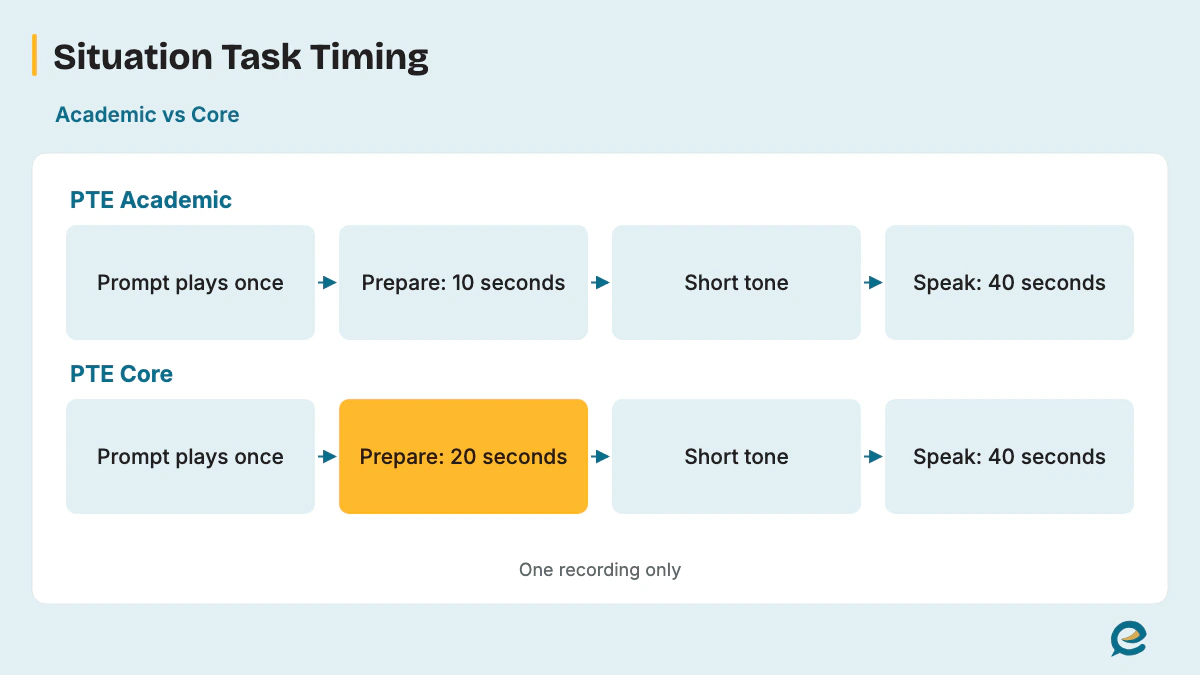
The prompt plays once with the text on screen; PTE Academic gives 10 seconds of preparation time and PTE Core gives 20 seconds, and both then give 40 seconds to speak after a short tone, with one recording. The table sets the two tests side by side.
| Stage | PTE Academic | PTE Core |
|---|---|---|
| Prompt | Audio once plus text up to 60 words | Same as Academic |
| Preparation | 10 seconds | 20 seconds |
| Tone | Short tone | Short tone |
| Speaking | 40 seconds | 40 seconds |
| Recordings | One | One |
| Notes | Erasable whiteboard | Erasable whiteboard |
| Items per test | 2-3 | 2-4 |
The item counts come from Pearson's Score Guides for PTE Academic (2025) and PTE Core (2026). On screen you see the standard instructions at the top, the situation and the task question, an audio box, and the recording status at the bottom, which changes from "Recording" to "Completed".
How Is Respond to a Situation Scored?
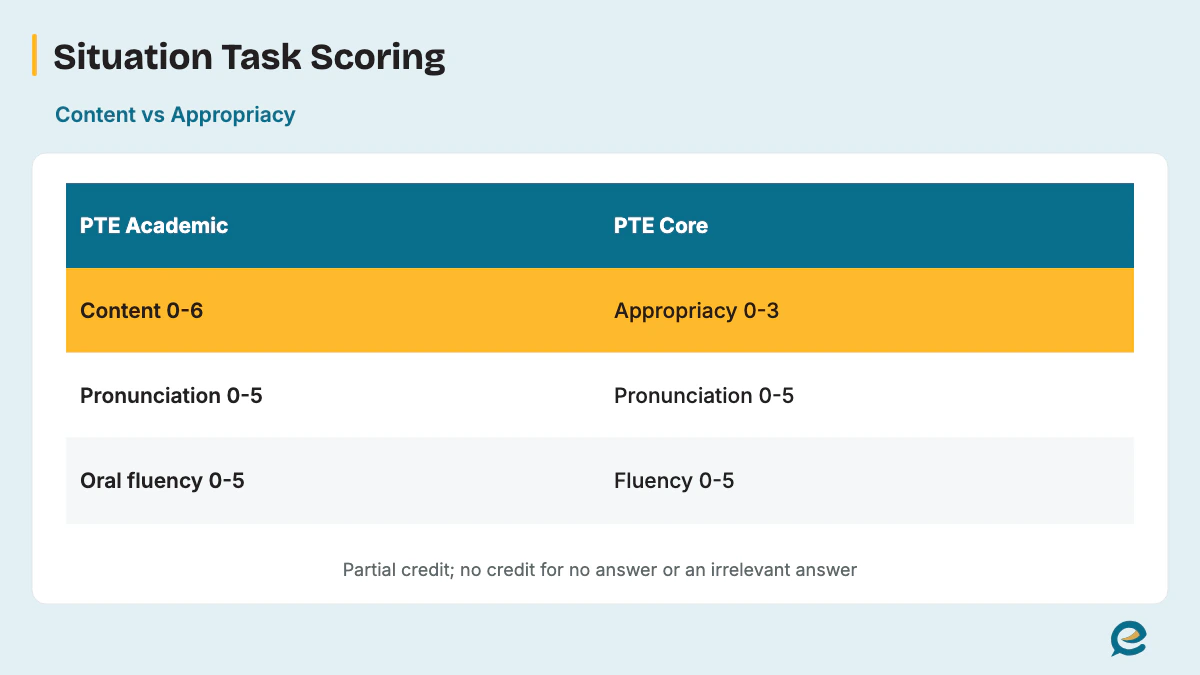
PTE Academic scores Content, Pronunciation and Oral Fluency, while PTE Core scores Appropriacy, Fluency and Pronunciation. Both use partial credit and give no credit for no answer or an irrelevant answer. The table shows where the traits split.
| Trait | PTE Academic | PTE Core |
|---|---|---|
| Content | 0-6: deal with the situation, keep prompt details accurate and fit formal or informal register to the listener. | Not a trait in PTE Core. |
| Appropriacy | Not a trait in PTE Academic. | 0-3: relevant, polite language in the right register. |
| Pronunciation | 0-5. | 0-5. |
| Oral Fluency / Fluency | 0-5, as Oral Fluency. | 0-5, as Fluency. |
The scales come from Pearson's Score Guides. A 6 for Content means you accomplish the goal "with full consideration of the context given in the prompt" and expand beyond the prompt language. Pearson's example of a misinterpretation is saying slides are due on Sunday when the prompt said Friday. In PTE Academic all traits are AI-scored, and Content also gets a human review by an expert. A common claim says both tests score Content and Appropriacy; Pearson's pages give one of each, by test.
How Do You Analyze the Task Description?
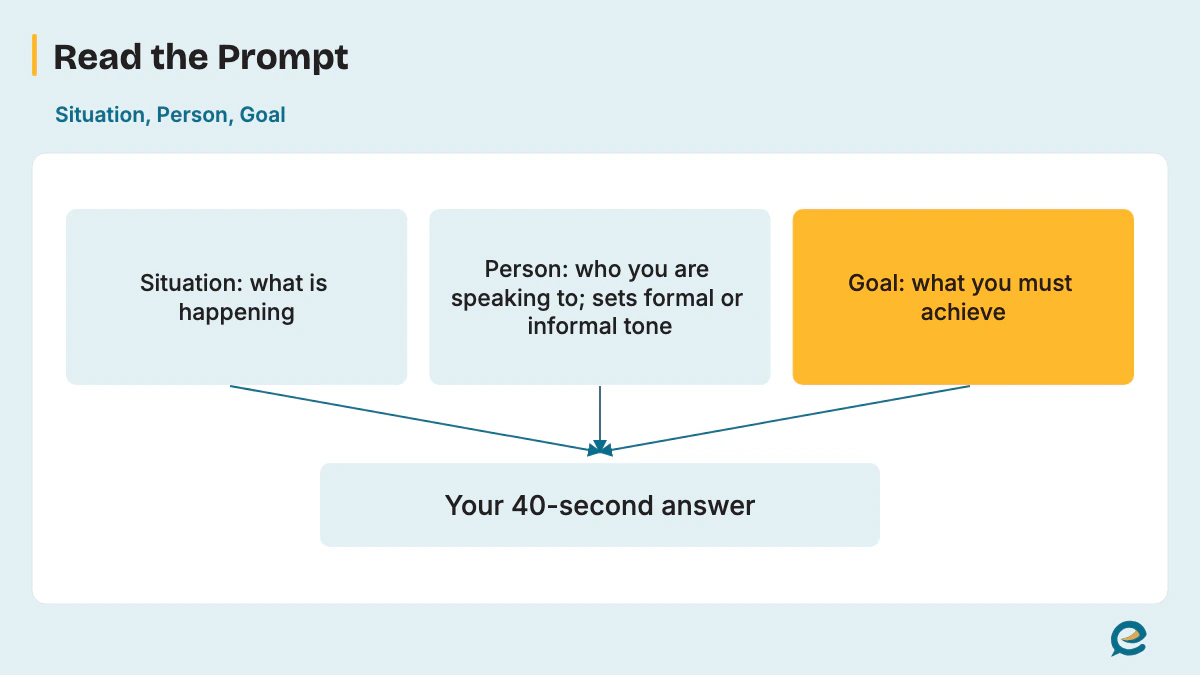
Pearson says every task description has three elements: the Situation, the Person you're speaking to, and the Goal you must achieve. Read for those three before you plan, using the breakdown below.
| Element | What to look for | Why it matters |
|---|---|---|
| Situation | What's happening and every detail given. | You must repeat the details accurately. |
| Person | Who you're speaking to. | The listener sets the tone and formality. |
| Goal | What you need to achieve. | Your request or point depends on it. |
For PTE Academic, Pearson's guide names campus scenarios such as asking a lecturer for clarification, asking another student for help and resolving an issue with library staff. Use the preparation time to fix the Goal in one short phrase, like "swap my shift".
How Do You Answer Respond to a Situation in PTE?
Speak in the first person, open with a greeting that fits the listener, make your request early, explain the situation accurately, cover every prompt detail and use the whole 40 seconds. Each step comes from Pearson's own guidance on the task, which says to state the main goal at the beginning and consider repeating it at the end. The order that follows does exactly that.
- Greet to suit the person: "Excuse me" for formal listeners, "Hi" for casual ones.
- Say who you are, then make your request or suggestion in one clause.
- Explain the situation with the prompt details unchanged, including times, names and places.
- Add one supporting detail that fits the scenario.
- Repeat the request briefly and close politely.
Pearson also suggests imagining you're actually in the moment, speaking directly to the person, so the answer sounds natural.
Pearson's tip is to speak for the whole 40 seconds if you can, since repeating ideas, self-correcting or hesitating uses time and costs points. Some prep sites list the time as 30-35 seconds; Pearson gives 40 seconds and asks you to use all of it.
Is There a Respond to a Situation Template for PTE?
There's an answer structure, not a fixed script. Pearson's guide says Content needs your own ideas and language, "not memorized responses", and that there's no single correct answer. A structure of greeting, request, situation and close organizes what you say, and short phrases fill it.
A memorized paragraph pasted onto any prompt misses the Situation, the Person and the Goal. That loses Content in PTE Academic or Appropriacy in PTE Core, so build the structure during practice and fill it fresh each time. Pearson's own high-scoring sample uses polite modal requests ("Would I be able to…", "Could I…") and natural contractions, and the phrase bank below follows that model.
| Part | Formal (lecturer, manager, librarian) | Informal (classmate, friend, flatmate) |
|---|---|---|
| Greeting | "Excuse me, Dr. Lee." / "Good morning, sorry to interrupt." | "Hey, Sam." / "Hi, have you got a sec?" |
| Request | "Would it be possible to…?" / "Could I ask you to…?" / "Would you mind if I…?" | "Could you…?" / "Any chance you could…?" / "Do you mind if I…?" |
| Explaining | "The reason I'm asking is that…" / "Unfortunately, …" | "The thing is, …" / "I've got a bit of a problem: …" |
| Suggesting | "One option might be to…" / "Perhaps we could…" | "How about we…?" / "Why don't we…?" |
| Apologizing or empathy | "I'm sorry for the inconvenience." / "I understand this is short notice." | "Sorry about this." / "I know it's a pain." |
| Closing | "Thank you very much for your help." / "I'd really appreciate it." | "Thanks a lot." / "Let me know what you think." |
What Does a Respond to a Situation Sample Answer Look Like?
A good sample answer covers the Situation, the Person and the Goal in about 40 seconds of speech. The sample scenario below is an original practice item, not a real exam question.
Sample scenario: You work part-time at a café near your university. Your manager has put you on the Saturday morning shift, but you have a final exam that morning. A coworker has offered to take your shift if you take her Sunday shift. Speak to your manager and ask to swap shifts.
Sample answer: Excuse me, Mark, sorry to interrupt. Would it be possible for me to swap my Saturday morning shift this week? I've just seen the roster, and unfortunately I have my final statistics exam that morning, which I can't move.
Priya has kindly offered to cover Saturday morning, and I'd take her Sunday shift instead, so the café would still be fully staffed. Would that be all right with you? I'd really appreciate it, and I'm happy to confirm the change in writing.
Labelled response: "Excuse me, Mark, sorry to interrupt" is the greeting, and "Would it be possible for me to swap my Saturday morning shift this week?" is the early request. The next sentence gives the situation, the Priya sentence is the detail, and the last two sentences repeat the request and close politely. The shift swap answer runs 82 words. That 80-100 word range is a pacing guide for 40 seconds, not a Pearson rule.
Pearson's own sample has a student asking a professor for an office visit about an essay. It scores well for the same reasons: a polite opening, the main request straight away, a short problem description, relevant detail, and the request repeated as a closing question.
What Are Common Mistakes in Respond to a Situation?
The costly mistakes are changing a prompt detail, using the wrong register for the listener, reciting a memorized script, and pausing or stopping early, and each one costs a specific trait.
- Changing prompt details such as a time, name or place counts as a misinterpretation and costs Content.
- Adding a detail that clashes with the prompt also lowers Content: if the prompt asks you to request a visit to her office, don't ask to meet in the library.
- A wrong register, too casual with a lecturer or too formal with a friend, costs Content in PTE Academic and Appropriacy in PTE Core.
- A memorized script that ignores the Goal costs Content or Appropriacy.
- Long pauses or restarts cost Oral Fluency.
- Finishing well before 40 seconds goes against Pearson's tip to use the whole time.
- A flat, robotic delivery or a reaction out of proportion to the problem; show courtesy or empathy where the situation calls for it.
How Do You Practice Respond to a Situation?
Practice with fresh scenarios under the real preparation time for your test, record a full 40-second answer, and check it against Situation, Person and Goal. A simple practice loop works: read a new scenario, prepare for 10 or 20 seconds, speak for 40, then do a self-review of the recording. Check every recording for one changed detail and for a request that came too late. Role-play the scenarios with a partner who plays the Person, and swap feedback on register and detail.
Use these twelve fresh scenarios, covering campus, workplace and community situations:
- Your group's presentation is tomorrow, and one member has not sent their slides. Speak to them and ask for the slides by tonight.
- The printer in the library has jammed with your assignment inside, due in an hour. Ask the librarian for help.
- You missed a lecture because of a medical appointment. Ask your lecturer whether the recording will be shared.
- Your flatmate plays loud music late on weeknights while you study. Ask them to keep it down after 10 p.m.
- A colleague keeps borrowing the team laptop and returning it with a flat battery. Ask them to charge it before returning it.
- You're invited to a colleague's farewell dinner, and you're vegetarian. Tell the organizer about your dietary needs.
- Your neighbor's dog barks every morning at 6 a.m. Raise it politely with your neighbor.
- Your manager wants a complicated fundraising event, and you think a simple bake sale would raise more. Suggest the simpler plan.
- A classmate has offered to share notes but keeps forgetting. Remind them and suggest a shared online folder.
- The bus you take to campus has changed its timetable, and you'll arrive late to a morning lab. Explain this to your lab supervisor and ask to join a later session.
- You ordered a textbook from the campus bookshop, and the wrong edition arrived. Ask the shop assistant to exchange it.
- A friend has asked you to help them move house on the day of your exam. Decline politely and offer another day.
How Many Respond to a Situation Questions Are in the PTE Exam?
Pearson's Score Guides give an item count of 2-3 Respond to a Situation items in PTE Academic and 2-4 in PTE Core, so any other figure is an estimate. The test format pages don't list counts per task. See the PTE exam format for the parts Pearson does list.
Is Respond to a Situation a Speaking or Listening Task?
It's a Speaking task: Pearson places it in Part 1 Speaking & Writing and lists the skill assessed as Speaking, using reading and listening only to take in the prompt. You still need the details you heard and read, because PTE Academic's Content trait checks that you report them accurately. The PTE speaking format page shows where it sits among the other items.
How Long Should You Speak in Respond to a Situation?
Pearson's advice is to try to speak for the whole 40 seconds if you can, without repeating ideas or correcting yourself, since both use time and cost points. Self-correction eats speaking time and fluency together. Read more on oral fluency in PTE.
Is Respond to a Situation Different in PTE Academic and PTE Core?
Yes, in two ways: PTE Core gives 20 seconds to prepare instead of 10, and it scores Appropriacy where PTE Academic scores Content. Everything else, including the 40-second answer, matches. See PTE Academic vs PTE Core for the wider differences.
How Do You Choose Formal or Informal Language in Respond to a Situation?
Let the Person in the prompt decide: a lecturer, manager or librarian calls for formal language, while a classmate or friend allows a casual tone, and Pearson scores that choice. Informal language with a friendly listener isn't a mistake when the prompt sets it up. More advice sits in our PTE speaking tips.
How Does Respond to a Situation Fit Into PTE Speaking?
Respond to a Situation is one of the speaking question types in Part 1, and its score feeds the Speaking skill score and the overall score. Pearson's Score Guides credit it to Speaking only. The PTE speaking section overview shows the other question types around it.
Practice PTE Speaking on EasyEnglish
Try Speaking tasks in a timed, computer-based format like the real test.
Try speaking practice without signing up. A free account is required for full mock tests. Practice scores are estimates, not official Pearson scores.
Written by
EasyEnglish Team
The team behind EasyEnglish's PTE practice and mock tests
EasyEnglish provides PTE practice and independent preparation guides. Official test rules are checked against the sources identified in each guide; practice examples are illustrative, not real exam questions. Practice scores are estimates. Questions or corrections: support@inverseai.com. EasyEnglish is not affiliated with or endorsed by Pearson.
Editorial review completed .