
PTE Speaking Summarize Group Discussion: Strategies, Tips and Examples
PTE Speaking
Three speakers argue about a topic for up to 3 minutes, the recording plays once, and after 10 seconds to prepare you have up to 2 minutes to explain who said what. Summarize Group Discussion joined PTE Academic and PTE Academic UKVI for tests taken after 7 August 2025, while PTE Core and PTE Home stayed unchanged. Pearson scores this speaking task on what you heard as well as how you say it, so it counts toward both Listening and Speaking.
Table of Contents
What Is the PTE Summarize Group Discussion Task?
Summarize Group Discussion is a PTE Academic Part 1 Speaking & Writing item in which you listen to a discussion between 3 people and summarize it in your own words. The recording runs up to 3 minutes, you get 10 seconds to prepare, and your spoken summary can last up to 2 minutes. It tests listening and speaking, and it's one of two question types added for tests taken after 7 August 2025, alongside Respond to a Situation. Pearson's guide names three usual kinds of academic discussion: lecture discussions where students debate a point, course challenges such as project coordination, and assignment planning with a professor. You take notes on the erasable whiteboard while the audio plays.
What Are the Summarize Group Discussion Format and Timing Rules?
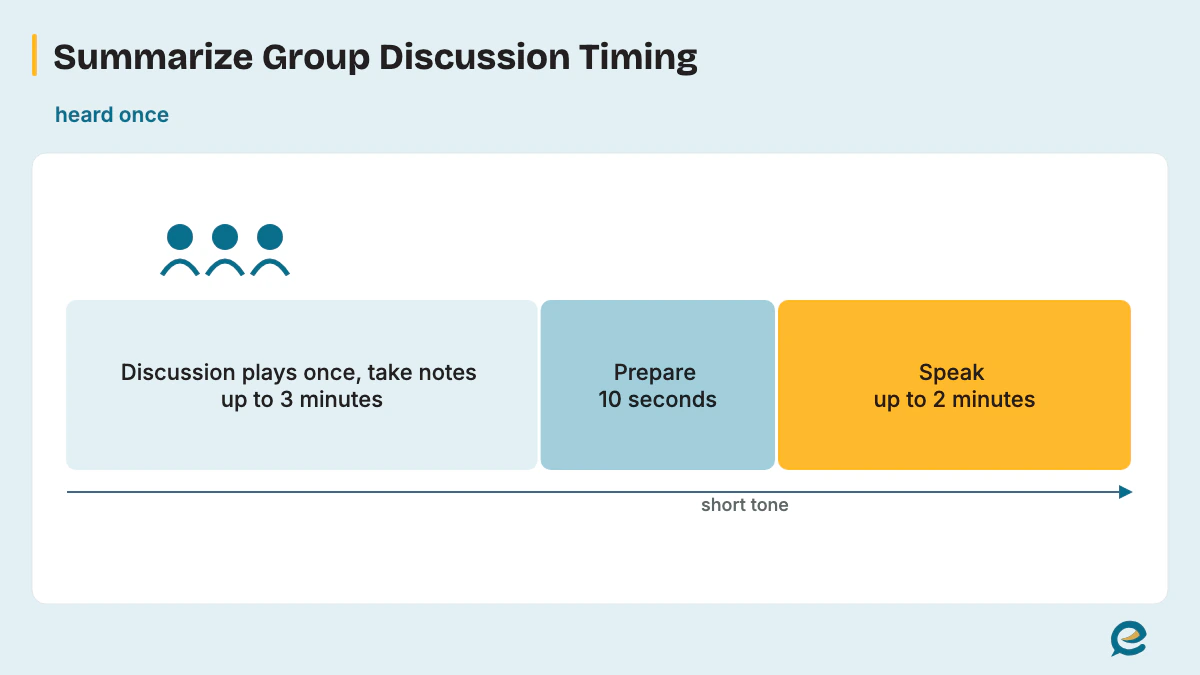
The sequence runs a recording of up to 3 minutes heard once, 10 seconds to prepare, a short tone, up to 2 minutes to speak, and one recording only. The task runs in six stages.
| Stage | What happens | Time or rule |
|---|---|---|
| Discussion plays | Three people discuss one topic. | Up to 3 minutes, heard once. |
| Note-taking | You write on the erasable whiteboard. | While the audio plays. |
| Preparation | You plan your summary from your notes. | 10 seconds to prepare. |
| Microphone opens | A short tone signals the start. | Don't speak before it. |
| Speaking | You summarize the discussion aloud. | Up to 2 minutes to speak. |
| Finishing | The item records once. | Stop before the progress bar ends. |
Pearson's format page says "up to 3 minutes", and its Summarize Group Discussion article gives 2.5 to 3 minutes. Plan for the longer end, because your notes have to hold three people's views.
Is Summarize Group Discussion in PTE Core?
No, Summarize Group Discussion is in PTE Academic and PTE Academic UKVI only, and Pearson's update page says PTE Core and PTE Home tests remain unchanged. The PTE Core Part 1 list covers Personal Introduction, Read Aloud, Repeat Sentence, Describe Image, Respond to a Situation, Answer Short Question, Summarize Written Text and Write Email. If you're taking PTE Core, the variant used for Canadian immigration, you can skip this task.
How Is Summarize Group Discussion Scored?
Pearson scores the response on Content, Pronunciation and Oral Fluency with partial credit, and gives no credit for no response, an irrelevant response or an unoriginal response. Each trait rewards something different.
| Trait | What Pearson looks for | What lowers it |
|---|---|---|
| Content | Paraphrasing each speaker, relationships between them and connected ideas. | Retelling the discussion without paraphrasing. |
| Pronunciation | Speech most regular speakers understand easily. | Unclear vowels, consonants or stress. |
| Oral Fluency | A constant, natural rate with appropriate phrasing. | Hesitations, repetitions and false starts. |
Pearson's format page says retelling the discussion without paraphrasing "will negatively impact your score". Its Score Guide scores Content from 0 to 6 and Pronunciation and Oral Fluency from 0 to 5 each, and credits the task to both Listening and Speaking. All three traits are AI-scored, and Content also gets a human review before the task score is confirmed.
The Score Guide's Content levels reward relationships between speakers, not just a list of who said what. This summary paraphrases each level.
| Content level | What the Score Guide describes |
|---|---|
| 6 | Main ideas paraphrased smoothly, each speaker's contribution detailed, and the views compared and drawn together, with well-linked ideas. |
| 5 | Main ideas and some details from each speaker in your own words; some relationships between views, but the synthesis is partial. |
| 4 | Main ideas and some speaker details, perhaps with a few inaccuracies; more focus on separate views than on how they relate. |
| 3 | Some ideas, but main points and details mixed up, irrelevant information or repeated wording; misses the overall direction of the conversation. |
| 2 | Mostly inaccurate or incomplete, missing main ideas and leaning on the discussion's own words; hard to follow. |
| 1 | Isolated words and phrases from the discussion with no meaningful context or order. |
| 0 | Relevant to the prompt but too limited for a higher score. |
How Do You Take Notes for Summarize Group Discussion?
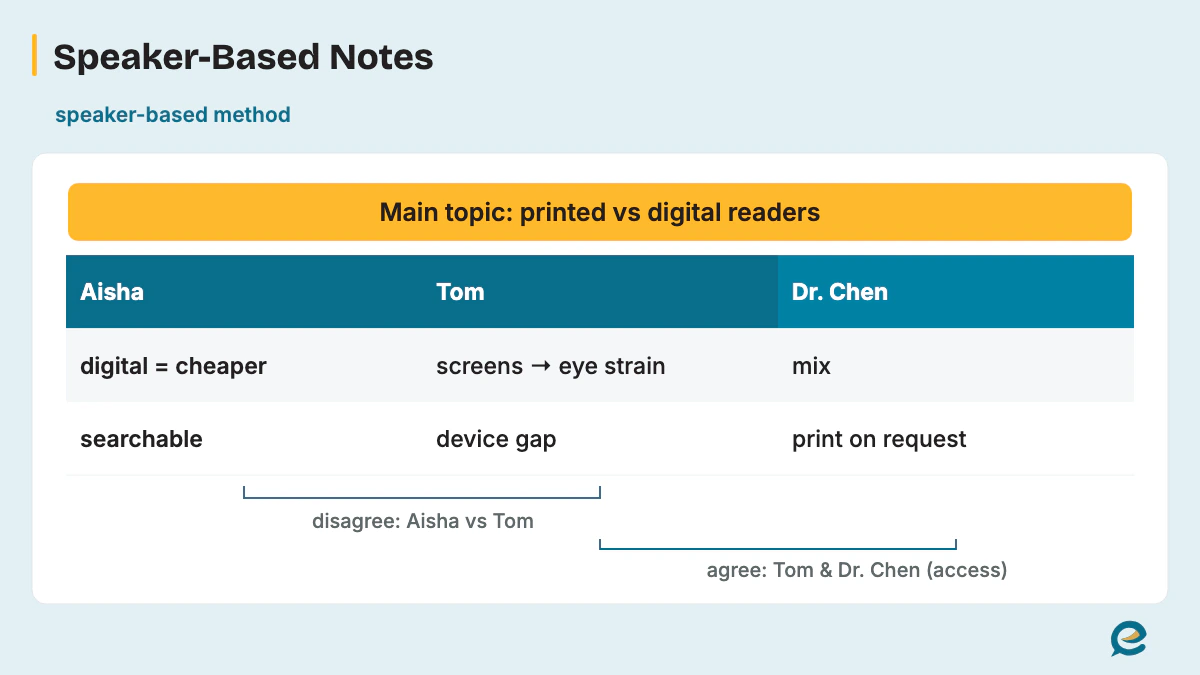
Use Pearson's speaker-based method: split your notes by speaker, write the main topic first, then short points under each speaker and a mark where they agree or disagree. The recording plays once, so keywords beat sentences. Four steps build the page.
- Write the main topic in a few words as soon as you hear it.
- Draw three speaker columns and put each point under the person who made it.
- Keep every point to two or three keywords, such as "digital = cheaper".
- Mark agreement and disagreement between speakers with a tick or a cross.
Pearson's article adds two habits: stay focused for the whole recording, and note supporting details for each speaker, not just their opinion. Its content list asks for what each speaker says, thinks and feels, so add a quick tag such as "worried" or "keen" when a speaker shows a feeling. It also warns that speakers won't take turns in a neat 1-2-3 order, so check who is talking before you write each point. Listen and note while the audio plays, and save the planning for the 10 seconds after it ends.
How Should You Structure a Summarize Group Discussion Response?
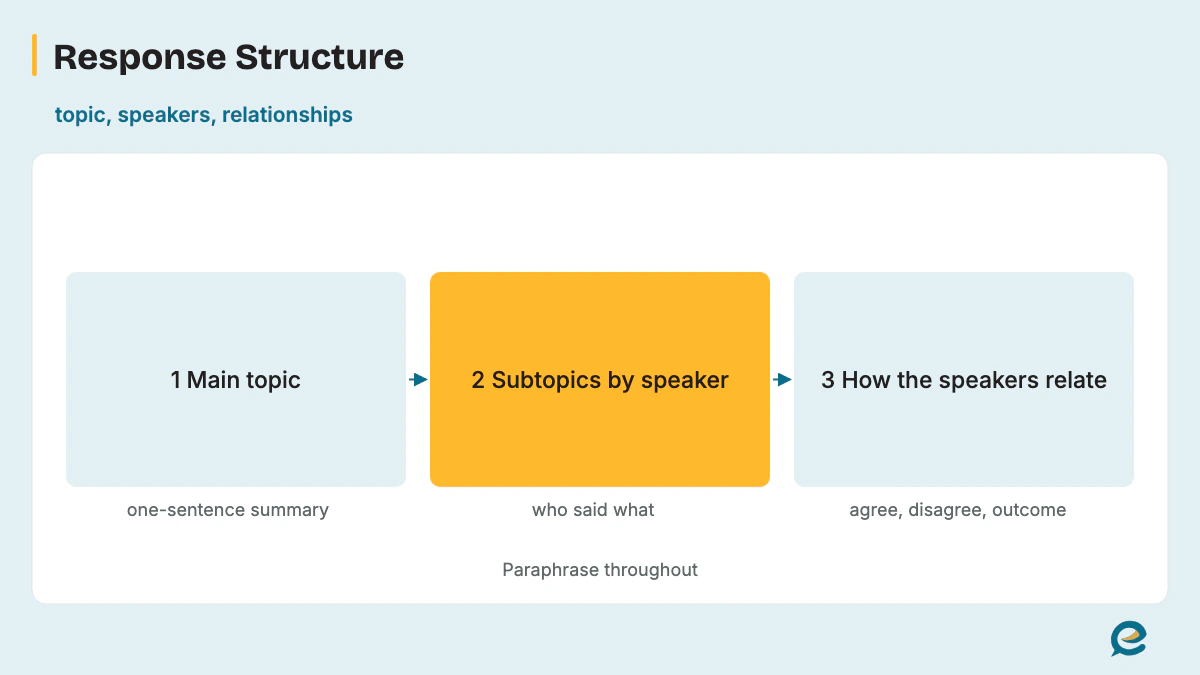
Pearson's best responses start with a main topic summary, introduce subtopics with which speaker said what, and finish with how the speakers relate. That order comes straight from Pearson's Content wording, and it works as a structure rather than a script.
- Main topic: one sentence on what the three people discussed.
- Subtopics: each speaker's point with clear speaker attribution, in your own words.
- Relationships between speakers: who agreed, who disagreed, and why.
- Outcome: the conclusion they reached, or the point left open.
Linking words such as "however", "in response" and "both of them" show the relationships. For attribution, vary phrases such as "The first speaker argued that...", "She added that...", "In response, he pointed out..." and "All three agreed that...". Paraphrase instead of copying long strings of audio, because Pearson lowers Content for plain retelling. Stay neutral: report each speaker's view without adding your own opinion, since the Score Guide lowers Content for irrelevant information. Pearson's article also asks for appropriate academic language throughout, so keep the register semi-formal.
What Does a High-Scoring Summarize Group Discussion Response Look Like?
A high-scoring sample response names the topic first, credits each point to the right speaker in your own words, and ends with how the views relate. The three practice scenarios below are original and aren't real exam items: two end in a compromise, and one ends with no agreement.
Practice scenario 1: Aisha argues the university should replace printed course readers with digital ones, because they cost less and you can search them. Tom disagrees in part, saying long reading on screens tires the eyes and not every student owns a good device. Dr. Chen suggests a mix: digital by default, with printed copies available on request from the library.
Sample summary 1: The three speakers discussed whether printed course readers should become digital. Aisha supported the change, mainly because digital readers save students money and make texts easy to search. Tom was less convinced.
He pointed out that reading for hours on a screen strains the eyes and that not every student owns a suitable device. Dr. Chen took a middle position. She proposed making digital the default while the library prints copies for anyone who asks. Her idea answered Tom's concern about access while keeping most of Aisha's savings.
The annotated answer below shows each scoring move in sample 1.
- Sentence one states the main topic before any detail.
- "Aisha supported", "He pointed out" and "She proposed" give clear attribution.
- "Save students money" and "strains the eyes" paraphrase rather than repeat the audio.
- The last sentence shows how Dr. Chen's view connects the other two.
Practice scenario 2: Lena wants every member of a group project to receive the same mark, because shared marks push students to help each other. Marcus disagrees, saying equal marks reward members who contribute little, and he prefers peer assessment. Professor Diaz warns that peer marks can become a popularity contest and suggests task logs, but both students think logs add paperwork, and the discussion ends without a decision.
Sample summary 2: The discussion was about how group projects should be marked. Lena argued for giving every member the same mark, since shared marks encourage students to support one another. Marcus rejected this, because in his view equal marks reward people who contribute very little, so he favored having students assess each other.
Professor Diaz questioned that idea, warning that peer marks can depend on popularity rather than effort. She proposed that each member keep a log of their tasks instead. However, both students felt logs would create extra paperwork, so the three speakers did not reach an agreement.
Sample 2 reports the outcome honestly: when the speakers don't agree, say so in the last sentence instead of inventing a conclusion.
Practice scenario 3: Priya thinks internships should earn course credit, because they teach workplace skills that lectures can't. Daniel worries that unpaid internships suit only students who can afford to work for free. Dr. Novak accepts both points and suggests giving credit only for paid or university-funded placements, and both students agree.
Sample summary 3: The speakers discussed whether internships should count toward a degree. Priya was in favor, arguing that internships teach workplace skills that lectures cannot.
Daniel raised a concern about fairness, since unpaid placements, in his view, suit only students who can afford to work for free. Dr. Novak accepted both points and proposed giving credit only for placements that are paid or funded by the university. Both students agreed, so the group settled on credit with that condition.
Sample 3 shows feelings and reasons as well as positions: Daniel's concern is about fairness, and the summary says so.
Pearson's article notes that even high-scoring responses can contain some hesitations or filler words such as "um", so one slip won't sink your answer if you keep going.
Should You Use a Summarize Group Discussion Template?
No, a fixed template works against you here. Some prep sites still sell fill-in templates for this task; Pearson's own guidance says to "deliver an original response without memorized templates or pre-prepared phrases". The format page adds that there's no credit for an unoriginal response. Memorized phrases add words without adding any speaker's point, so they do nothing for Content. The four-part structure above replaces a template, and its wording changes with every discussion.
What Are Common Pitfalls in Summarize Group Discussion?
The common pitfalls that cost the most are retelling the audio without paraphrasing, leaving out a speaker, mixing up who said what, and stopping to correct yourself. Each item below names what it costs.
- Retelling the audio without paraphrasing lowers Content.
- Missing a speaker or the main topic leaves gaps in Content.
- Wrong attribution, giving Tom's point to Aisha, costs Content.
- Hesitations and restarts cost Oral Fluency, so "keep talking and ignore any mistakes that you make".
- Spending your time on minor details leaves less room for each speaker's main view, which Content rewards.
- Writing notes as full sentences tempts you to read them aloud; keep keywords and phrase each point yourself.
- Speaking before the microphone opens wastes words, because nothing is recorded.
How Do You Practice Summarize Group Discussion in PTE?
A good practice routine uses three-speaker audio played once: speaker-based notes, 10 seconds to plan, a spoken summary, then a recording review. In the review, check the main topic, the attribution and the relationships, and check attribution first, because a point credited to the wrong speaker costs Content. Use recordings with different English accents, since the three speakers in a real item can sound quite different from each other.
How Many Summarize Group Discussions Are in the PTE Exam?
Pearson's PTE Academic Score Guide lists 2-3 Summarize Group Discussion items per test, all in Part 1 Speaking & Writing. The exact item count varies between test versions, and PTE Core has none. The PTE exam format shows the full test structure.
How Long Should a Summarize Group Discussion Response Be?
You have up to 2 minutes, and Pearson's two pages pull in different directions. The format page says to make good use of the 2 minute speaking time and include all the main points, while the article says you don't need to use the full two minutes.
The safe reading: cover every main point and speaker without padding, then stop. A target of "50 to 80 seconds" circulates online, but Pearson sets no target length, and smooth delivery matters more than filling time, as oral fluency in PTE explains.
Does the 3-Second Rule Apply to Summarize Group Discussion?
Pearson's three-second sentence names Read Aloud, Repeat Sentence, Describe Image and Re-tell Lecture alongside Answer Short Question, and it does not name Summarize Group Discussion. The task's own block says only to finish before the progress bar reaches the end and doesn't mention a cut-off after three seconds of silence.
Pearson's Oral Fluency trait still scores every hesitation, so keep talking anyway, as the 3-second rule in PTE speaking explains.
How Is Summarize Group Discussion Different From Retell Lecture?
Retell Lecture asks you to retell one speaker's lecture in 40 seconds, while Summarize Group Discussion asks you to summarize three speakers in up to 2 minutes and credit each point to the right person. Both give no credit for an unoriginal response, and both score Content, Pronunciation and Oral Fluency. Compare with PTE Retell Lecture.
Which Retell Lecture Tips Work for Group Discussions?
The symbol-based note-taking tips from Retell Lecture are a useful starting point when you have to track more than one speaker. Pearson's Retell Lecture article suggests symbols and arrows such as - = & + plus bullet points, and one mark can replace a whole phrase. For a group discussion, put those symbols under three speaker columns, so every point stays credited to the person who made it.
Which Is the Toughest Module in PTE?
Pearson does not rank its sections or tasks by difficulty, so the toughest module is the one that tests your weakest skill. Summarize Group Discussion feels hard because it tests integrated skills: listening, note-taking and speaking at once. See PTE speaking challenges for the usual trouble spots.
How Does Summarize Group Discussion Fit Into the PTE Speaking Section?
Summarize Group Discussion is the sixth scored task in Part 1 of PTE Academic, after Answer Short Question and before Respond to a Situation. Its 2-minute answer time makes it the longest speaking response among the scored tasks, against 40 seconds for Describe Image, Retell Lecture and Respond to a Situation. See the PTE Speaking section guide for every speaking task in order.
Practice PTE Speaking on EasyEnglish
Try Speaking tasks in a timed, computer-based format like the real test.
Try speaking practice without signing up. A free account is required for full mock tests. Practice scores are estimates, not official Pearson scores.
Written by
EasyEnglish Team
The team behind EasyEnglish's PTE practice and mock tests
EasyEnglish provides PTE practice and independent preparation guides. Official test rules are checked against the sources identified in each guide; practice examples are illustrative, not real exam questions. Practice scores are estimates. Questions or corrections: support@inverseai.com. EasyEnglish is not affiliated with or endorsed by Pearson.
Editorial review completed .