Most Common PTE Question Types with Answers
Understanding PTE
PTE Academic runs 22 question types across three parts: Speaking & Writing (9 types), Reading (5) and Listening (8), and each type asks for one kind of response, from reading a text aloud to typing a dictated sentence.
The type list and timings come from Pearson's PTE Academic task pages, and the item counts and skills scored come from Pearson's PTE Academic Test Taker Score Guide (2025). The sample answers are our own practice examples, not real Pearson items.
Table of Contents
What Are the PTE Question Types in 2026?
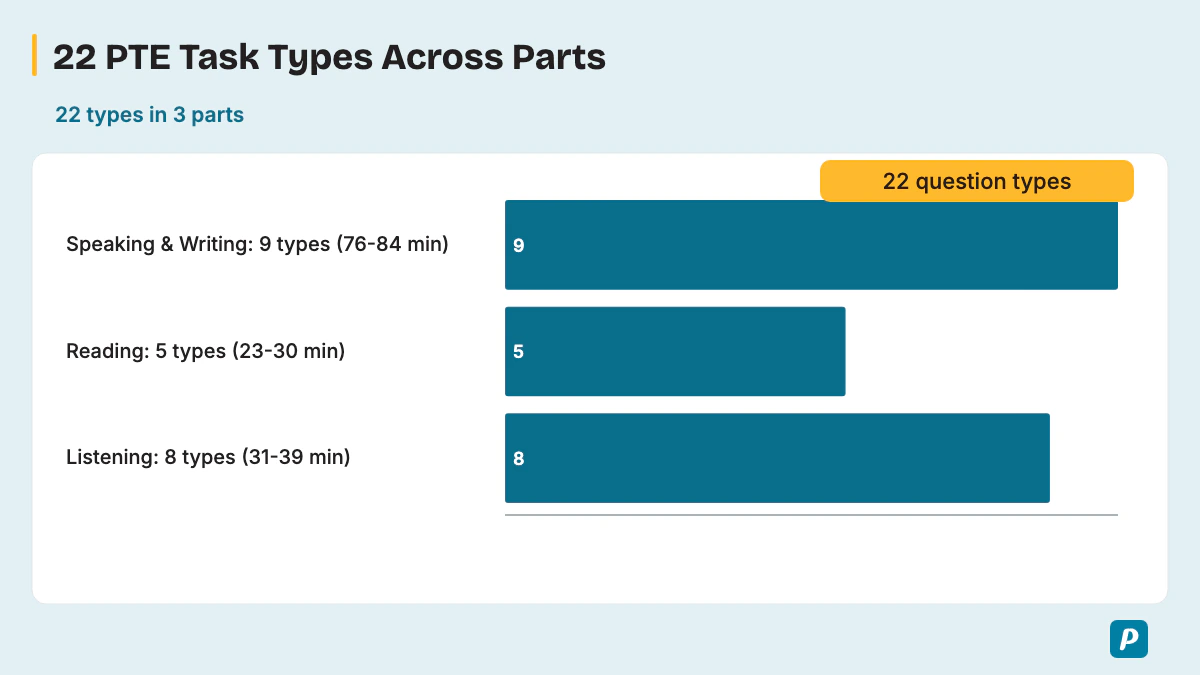
The PTE question types are the 22 task formats Pearson uses across the three parts of PTE Academic: 9 in Speaking & Writing, 5 in Reading and 8 in Listening. Pearson sets all 22 question types in a single computer-based test of about 2 hours. Pearson scores every type by AI, and seven open-response types also get a human review of content. PTE Core shares most of these types but swaps Write Essay for Write Email.
What Are the Key Changes in PTE Question Types for 2026?
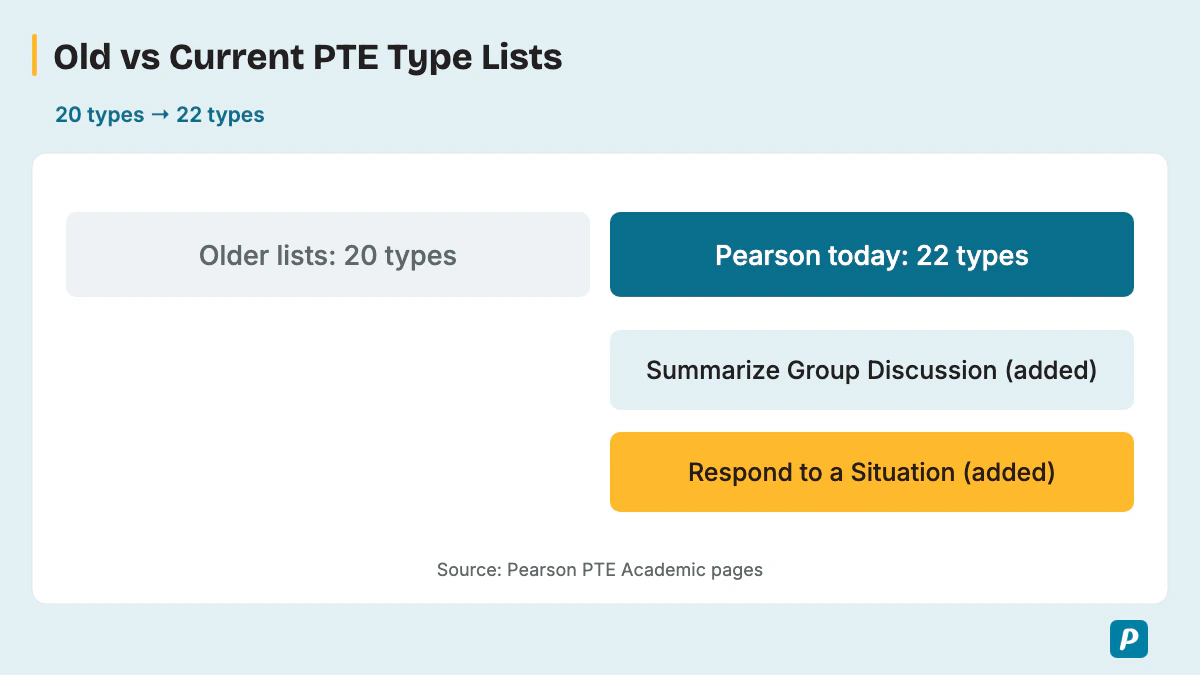
The current list has 22 types because, for any test taken after 7 August 2025, Pearson added Summarize Group Discussion and Respond to a Situation to Speaking & Writing. Pearson kept the original 20 types, and the test is still approximately two hours long. PTE Core and PTE Home did not change. Some prep sites still quote outdated lists of 20 types, older part timings (Part 1 54-67 minutes, Reading 29-30, Listening 30-43) and 3-5 seconds of Repeat Sentence audio; Pearson's current pages say 22 types, 76-84, 23-30 and 31-39 minutes, and 3-9 seconds.
How Many Questions Are in the PTE Exam?
The number of questions varies by test version, and Pearson's PTE Academic Score Guide (2025) publishes a range per test for every scored type. These item ranges also show which skills each type feeds.
| Question type | Part | Questions per test | Skills scored |
|---|---|---|---|
| Personal Introduction (unscored) | Speaking & Writing | 1 recording | Not scored |
| Read Aloud | Speaking & Writing | 6-7 | Speaking |
| Repeat Sentence | Speaking & Writing | 10-12 | Listening, Speaking |
| Describe Image | Speaking & Writing | 5-6 | Speaking |
| Retell Lecture | Speaking & Writing | 2-3 | Listening, Speaking |
| Answer Short Question | Speaking & Writing | 5-6 | Listening |
| Summarize Group Discussion | Speaking & Writing | 2-3 | Listening, Speaking |
| Respond to a Situation | Speaking & Writing | 2-3 | Speaking |
| Summarize Written Text | Speaking & Writing | 2 | Reading, Writing |
| Write Essay | Speaking & Writing | 1 | Writing |
| Reading & Writing Fill in the Blanks (dropdown) | Reading | 5-6 | Reading |
| Multiple Choice, Multiple Answers | Reading | 2-3 | Reading |
| Re-order Paragraphs | Reading | 2-3 | Reading |
| Reading Fill in the Blanks (drag and drop) | Reading | 4-5 | Reading |
| Multiple Choice, Single Answer | Reading | 2-3 | Reading |
| Summarize Spoken Text | Listening | 1 | Listening, Writing |
| Multiple Choice, Multiple Answers | Listening | 2-3 | Listening |
| Fill in the Blanks (type in) | Listening | 2-3 | Listening |
| Highlight Correct Summary | Listening | 2-3 | Listening, Reading |
| Multiple Choice, Single Answer | Listening | 2-3 | Listening |
| Select Missing Word | Listening | 1-2 | Listening |
| Highlight Incorrect Words | Listening | 2-3 | Listening, Reading |
| Write from Dictation | Listening | 3-4 | Listening, Writing |
The current Pearson Score Guide states a total of 65-75 questions per test across 22 types. Independent per-type minima and maxima must not be summed to predict a possible sitting. Repeat Sentence 10-12 is the biggest block, so it repays the most practice. On Pearson's Listening page, the Notes line of the Fill in the Blanks task block says it assesses listening and writing. The Score Guide lists Listening only, and in PTE Core Read Aloud counts toward reading and speaking.
What Are the PTE Speaking Question Types?
Part 1 has eight speaking types: Personal Introduction (unscored), Read Aloud, Repeat Sentence, Describe Image, Retell Lecture, Answer Short Question, Summarize Group Discussion and Respond to a Situation. Pearson sets Speaking & Writing as one combined part of 76-84 minutes with 9 scored question types, including the two Writing types further down.
Every speaking item captures a recorded response through your microphone, and you can record each response only once.
What Is Personal Introduction in PTE Speaking?
Open the exact institution, course or professional regulator’s current requirements page. Confirm the accepted test version, overall and per-skill minimums, test-age window and verification method before booking. A provider’s recognition total or a concordance does not establish your own admission or registration requirements.
Sample answer: "Hello, my name is Priya Sharma, and I'm from Pune in India. I completed a bachelor's degree in computer science and have worked as a software tester for two years. I'm taking PTE to apply for a master's program in data science in Australia."
How Does Read Aloud Work in PTE Speaking?
Read Aloud shows a text of up to 60 words that you read aloud after 30-40 seconds of preparation. Recording time varies by item with the length of the text, and you record once. Pearson sets 6-7 questions, scored with partial credit for Speaking. Use the preparation time to place pause marks at commas and between thought groups. Our PTE Read Aloud guide covers the full method.
Sample text with pause marks: "Urban gardens / are spreading across large cities. // They give residents fresh food, / cleaner air / and a quiet place / to meet their neighbors."
How Does Repeat Sentence Work in PTE Speaking?
Repeat Sentence plays a short sentence that you repeat word for word. The audio lasts 3-9 seconds, you get 15 seconds to respond, and the item counts toward Listening and Speaking across 10-12 questions. Chunking the sentence into groups of three or four words helps you hold it in memory. See our PTE Repeat Sentence page for chunking drills.
Audio and answer, chunks marked: "The library will close early / on Friday / for staff training."
How Does Describe Image Work in PTE Speaking?
Describe Image shows a graph, chart, map or picture that you describe in your own words. You get 25 seconds to prepare and 40 seconds to respond, across 5-6 questions, and a human review of content adds to the AI score. Our PTE Describe Image guide has templates for each image type.
Image: a bar graph of cycling, bus and car use in one city in 2015 and 2025.
Sample answer: "The bar graph compares how people traveled in one city in 2015 and 2025. Cycling rose sharply over the decade. Car use fell, while bus use stayed roughly the same. Overall, the city moved toward cleaner transport."
How Does Retell Lecture Work in PTE Speaking?
Retell Lecture plays a lecture of up to 90 seconds that you retell in your own words. You get 10 seconds to prepare after the audio and 40 seconds to speak, and the item counts toward Listening and Speaking across 2-3 questions with a human review of content. You may also see an image related to the audio. Note-taking during the audio carries the whole answer. Our PTE Retell Lecture page covers note formats.
Notes: bees pollinate crops / numbers falling, pesticides + habitat loss / farms planting wildflower strips.
Sample answer: "The lecture explained that bees pollinate many food crops. Their numbers are falling because of pesticides and habitat loss. Some farms now plant wildflower strips to support them. The speaker concluded that small changes can protect food supplies."
How Does Answer Short Question Work in PTE Speaking?
Answer Short Question asks a spoken question that you answer with a single word or a few words. The question lasts 3-9 seconds, you have 10 seconds to answer, and Pearson uses correct/incorrect scoring across 5-6 questions that count toward Listening. You may also see an image. Our PTE Answer Short Question guide lists common topics.
- "What instrument measures temperature?" Answer: "thermometer."
- "How many sides does a triangle have?" Answer: "three."
- "What do you call a doctor who treats teeth?" Answer: "dentist."
How Does Summarize Group Discussion Work in PTE Speaking?
Summarize Group Discussion plays a discussion between three people that you summarize aloud. The discussion runs up to 3 minutes, you get 10 seconds to prepare and 2 minutes to respond, and Pearson counts it toward Listening and Speaking across 2-3 questions. This new question type also gets a human review of content. Our PTE Summarize Group Discussion page has a full method.
Three speakers on a four-day work week. Speaker A: it raises productivity. Speaker B: customers lose service on the fifth day. Speaker C: try it in one team first.
Sample answer: "The three speakers discussed a four-day work week. The first argued it would raise productivity. The second worried that customers would lose service on the extra day off. The third speaker proposed a trial in one team before a wider decision."
How Does Respond to a Situation Work in PTE Speaking?
Respond to a Situation describes an everyday situation that you respond to as if you were in it. The situation text runs up to 60 words, you get 10 seconds to prepare after the audio and 40 seconds to respond, across 2-3 questions that count toward Speaking, with a human review of content. A good situation response sounds natural and polite. See our PTE Respond to a Situation guide.
Situation: your neighbor plays loud music the night before your exam.
Sample polite response: "Hi, sorry to bother you this late. I have an important exam tomorrow morning and I'm trying to sleep. Would you mind turning the music down a little? Thanks so much, I really appreciate it."
What Are the PTE Writing Questions?
PTE Academic has two writing types inside Part 1: Summarize Written Text and Write Essay. These Writing types sit in the same part as Speaking. PTE Core uses Write Email instead of Write Essay.
How Does Summarize Written Text Work in PTE Writing?
Summarize Written Text gives you a passage that you summarize in one sentence. The text runs up to 300 words, you get 10 minutes, and the summary must be one sentence of 5-75 words. It counts toward Reading and Writing across 2 questions, with a human review of content. Our PTE Summarize Written Text page covers the sentence pattern.
Passage: "Many cities now charge drivers to enter their centers at busy times. Supporters say the fees cut traffic and pollution. Critics argue the charges hit lower-income workers hardest."
Sample summary: "City-center driving charges reduce traffic and pollution, although critics say they unfairly burden lower-income workers."
How Does Write Essay Work in PTE Writing?
Write Essay gives a 2-3 sentence prompt that you answer with an argument essay. You get 20 minutes for 200-300 words, and the task, 1 question per test, counts toward Writing with a human review of content. Our PTE Write Essay page has full sample essays.
Open the exact institution, course or professional regulator’s current requirements page. Confirm the accepted test version, overall and per-skill minimums, test-age window and verification method before booking. A provider’s recognition total or a concordance does not establish your own admission or registration requirements.
Model outline: position (free tuition for undergraduate degrees); reason 1 (wider access for talented students); reason 2 (a more skilled workforce); conclusion (fund it through taxes and graduate contributions).
What Are the PTE Reading Question Types?
Part 2 Reading has five types: Reading & Writing Fill in the Blanks (dropdown), Multiple Choice, Multiple Answers, Re-order Paragraphs, Reading Fill in the Blanks (drag and drop) and Multiple Choice, Single Answer. Pearson sets Part 2 Reading at 23-30 minutes, and all five types count toward Reading in the Academic Score Guide. Two of the five reading types are gap-fill items.
How Does Reading and Writing Fill in the Blanks Work in the Reading Part?
Reading & Writing Fill in the Blanks gives a text with gaps, each with a dropdown list of options. The text runs up to 200 words, Pearson sets 5-6 questions, and each correct blank earns one point. This task uses grammar, collocation and passage meaning to choose the best word. Our PTE Reading & Writing Fill in the Blanks guide covers common word pairs.
"The committee voted to ___ the proposal after a long debate." Options: approve / agree / accept to / consent.
Answer: "approve." In these dropdown blanks grammar decides it: "agree" and "consent" need "to" before an object, and "accept to" is not standard English, so only "approve the proposal" fits.
How Does Multiple Choice, Multiple Answers Work in the Reading Part?
Multiple Choice, Multiple Answers asks a question about a text where more than one option is correct. The text runs up to 350 words across 2-3 questions, and the scoring is +1 per correct option, -1 per incorrect option, minimum 0. That negative marking means you pick more than one answer only when the text supports it. See our PTE Reading Multiple Choice, Multiple Answers page.
Text: "Solar panels are cheaper than a decade ago. They still need sunny weather to work well. Many households now pair them with batteries to store power for the evening."
Question: which statements does the text support? A) panels cost less than before; B) panels work equally well in any weather; C) batteries store power for later; D) panels are banned in some cities; E) panels never need maintenance.
Answer: A and C. B contradicts the text, while D and E are never mentioned.
How Does Re-order Paragraphs Work in the Reading Part?
Re-order Paragraphs gives jumbled text boxes that you drag into the original order. The text runs up to 110 words across 2-3 questions, and each of the correct adjacent pairs earns one point. Find the topic sentence first, then follow linking words and pronouns. Our PTE Re-order Paragraphs guide covers the pairing method.
Jumbled: (A) However, the faster ships also brought new risks. (B) Steam power changed ocean travel in the nineteenth century. (C) These included boiler explosions and coal fires at sea. (D) Crossings that once took weeks could be made in days.
Answer: B, D, A, C. B is the topic sentence, D gives the benefit, "However" in A turns from that benefit to risks, and "These" in C points back to the risks in A.
How Does Reading Fill in the Blanks Work in the Reading Part?
Reading Fill in the Blanks gives a short text with gaps and a box of words to drag into them. The text runs up to 80 words across 4-5 questions in the Reading section, with one point per correct blank. These drag-and-drop blanks draw from a word bank with more words than gaps. Our PTE Reading Fill in the Blanks page explains the elimination method.
"Regular exercise ___ the risk of heart disease and ___ sleep quality." Word bank: reduces / improves / raises / damages / delays.
Answers: "reduces" and "improves."
How Does Multiple Choice, Single Answer Work in the Reading Part?
Multiple Choice, Single Answer asks a question about a short text with only one correct option. The text runs up to 110 words across 2-3 questions, with correct/incorrect scoring. Our PTE Reading Multiple Choice, Single Answer guide covers distractor patterns.
Text: "The museum opened a free evening session on Thursdays. Attendance doubled within three months."
Question: what does the text suggest? A) The museum closed on Thursdays. B) Free evening entry attracted more visitors. C) Ticket prices rose. D) The museum moved buildings.
Answer: B, the one correct option.
What Are the PTE Listening Question Types?
Part 3 Listening has eight types: Summarize Spoken Text, Multiple Choice, Multiple Answers, Fill in the Blanks, Highlight Correct Summary, Multiple Choice, Single Answer, Select Missing Word, Highlight Incorrect Words and Write from Dictation. Pearson sets Part 3 Listening at 31-39 minutes. Each recording plays once, so notes matter in every one of the listening types.
How Does Summarize Spoken Text Work in the Listening Part?
Summarize Spoken Text plays a short lecture that you summarize in writing. The audio runs 60-90 seconds, you get 10 minutes, and the summary must be 50-70 words. It's 1 question per test, counted toward Listening and Writing, with a human review of content. Our PTE Summarize Spoken Text page covers note-to-summary steps.
Lecture notes: ocean plastic, a growing problem / most starts on land, reaches sea via rivers / solution: better waste collection in towns upstream.
Sample summary (58 words): "The lecture described ocean plastic as a growing problem. The speaker explained that most of this plastic starts on land and is carried to the sea by rivers. According to the lecturer, the most effective solution is better waste collection in towns upstream, because it stops plastic before it can reach the water at all."
How Does Multiple Choice, Multiple Answers Work in the Listening Part?
Listening Multiple Choice, Multiple Answers asks a question about a recording where more than one option is correct. In Listening Multiple Answers the audio runs 80-120 seconds across 2-3 questions, with the same negative marking as Reading: +1 per correct option, -1 per incorrect option, minimum 0. Pick only what your notes support. See our PTE Listening Multiple Choice, Multiple Answers guide.
Notes from a talk on remote work: saves commute time / harder to build team trust / needs clear goals.
Options: A) It saves commuting time. B) It always lowers pay. C) It can weaken team trust. D) It removes the need for managers. E) It suits only large companies.
Answer: A and C.
How Does Fill in the Blanks Work in the Listening Part?
Listening Fill in the Blanks shows a transcript with gaps that you type in while the recording plays. The audio runs 30-60 seconds across 2-3 questions in the Listening section, and each correct word spelled correctly earns one point. That makes spelling as important as hearing in these type-in blanks. Our PTE Listening Fill in the Blanks page covers fast typing.
Transcript: "The study found that ___ levels dropped after the new ___ was introduced."
Answers: "pollution" and "regulation."
How Does Highlight Correct Summary Work in the Listening Part?
Highlight Correct Summary plays a recording and asks you to pick the paragraph that best summarizes it. The audio runs 30-90 seconds across 2-3 questions, with correct/incorrect scoring. The best summary matches the main idea, not just one detail. Our PTE Highlight Correct Summary guide has elimination tips.
Recording: a speaker explains that bridges in cold regions are fitted with expansion joints, because steel grows in summer heat and shrinks in winter, and without the joints the deck would crack.
Options: A) Steel bridges should not be built in cold regions. B) Expansion joints let bridges cope with steel growing and shrinking as temperatures change. C) Most bridges are now built from concrete.
Answer: B, because it captures the main idea; A contradicts it and C is never discussed.
How Does Multiple Choice, Single Answer Work in the Listening Part?
Listening Multiple Choice, Single Answer asks one question about a recording with only one correct option. In Listening Single Answer the audio runs 30-60 seconds across 2-3 questions, with correct/incorrect scoring. See our PTE Listening Multiple Choice, Single Answer page.
Notes: new train line / opens next spring / cuts trip to 20 minutes.
Question: what is the main benefit of the new line? A) Cheaper tickets. B) A shorter trip. C) More stations. D) Night service.
Answer: B, the one correct option.
How Does Select Missing Word Work in the Listening Part?
Select Missing Word plays a recording whose last word or words are replaced by a beep, and you pick the option that completes it. The audio runs 20-70 seconds across 1-2 questions, with correct/incorrect scoring. Prediction works best: guess the ending before the beep, then match it to an option. Our PTE Select Missing Word guide covers it.
Recording: "After months of dry weather, farmers were finally relieved when the [beep]."
Options: A) prices rose. B) rain arrived. C) market closed.
Answer: B, the logical ending.
How Does Highlight Incorrect Words Work in the Listening Part?
Highlight Incorrect Words shows a transcript and asks you to click the words that differ from what the speaker says. The audio runs 15-50 seconds across 2-3 questions, it counts toward Listening and Reading, and negative marking applies: +1 per correct word, -1 per incorrect word, minimum 0. See our PTE Highlight Incorrect Words page.
Transcript: "The new bridge will open in early summer and carry thousands of cars daily."
Spoken: "The new bridge will open in late summer and carry thousands of buses daily."
Answer: click "early" and "cars."
How Does Write from Dictation Work in the Listening Part?
Write from Dictation plays a short sentence that you type exactly as you hear it. The audio runs 3-5 seconds across 3-4 questions, and Pearson gives one point per word you type correctly, with nothing for incorrect or misspelled words. Spelling decides most lost points here. Our PTE Write from Dictation guide covers memory tricks.
Answer: "Students must submit their research proposals before the deadline." Words often misspelled: "research", "proposals."
How Are PTE Question Types Scored?
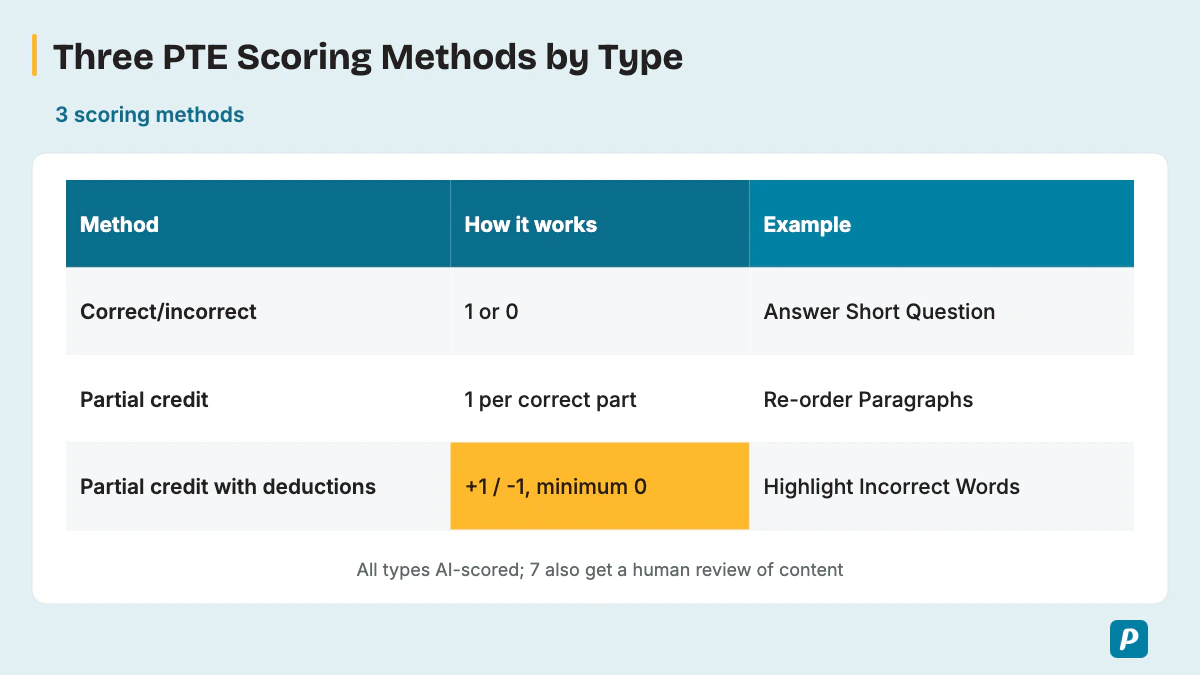
Pearson scores each type in one of three ways: correct/incorrect, partial credit, or partial credit with points deducted for wrong choices. Every type gets AI scoring, with a human review of content for seven open-response types.
| Scoring method | How it works | Example types |
|---|---|---|
| Correct/incorrect | An item earns 1 point or 0. | Answer Short Question, single-answer and summary-choice items. |
| Partial credit | Each correct part earns a point. | Read Aloud, fill-in-the-blank items, Re-order Paragraphs, Write from Dictation. |
| Partial credit with deductions | +1 per correct choice, -1 per wrong one, minimum 0. | Both Multiple Answers types and Highlight Incorrect Words. |
The seven types with human review are Describe Image, Retell Lecture, Respond to a Situation, Summarize Group Discussion, Summarize Written Text, Write Essay and Summarize Spoken Text. In Write Essay the reviewer also checks Development, Structure and Coherence and General Linguistic Range.
Pearson's Score Guide rates Pronunciation and Oral Fluency from 0 to 5 on the speaking types, and Content from 0 to 6 on Describe Image, Retell Lecture, Summarize Group Discussion, Respond to a Situation and Write Essay. Item points roll up into your skill scores and an overall score on the 10-90 scale.
How Do You Practice PTE Question Types and Answers?
The approach that works is practicing each type with its real timing, checking your answer against the scoring method above, and spending most time on high-count types such as Repeat Sentence and Read Aloud. A simple weekly practice rotation covers all four areas.
Spend two days on Speaking, one on Writing, one on Reading, one on Listening, and finish with a timed mixed set of sample questions. Practice Repeat Sentence under real timing and repeat it in chunks of three or four words, not word by word.
Where Can You Find PTE Sample Questions for 2026?
Pearson publishes official practice material, including free sample questions and paid official practice tests on pearsonpte.com. Every type block above also has an original mini-example to check each answer method. See our PTE preparation plan for a week-by-week schedule.
Which PTE Question Types Have Negative Marking?
Three types deduct points for wrong choices: both Multiple Choice, Multiple Answers types and Highlight Incorrect Words. Pearson sets a one-point penalty for each wrong pick, down to zero. Our PTE negative marking page shows worked examples.
How Is the PTE Exam Structure Timed in 2026?
In the exam structure, Pearson lists Speaking & Writing as 76-84 minutes, Reading as 23-30 minutes and Listening as 31-39 minutes, while describing PTE Academic as about 2 hours overall. These are Pearson’s published descriptions; do not add the section ranges to predict an exact sitting length. Our PTE exam format page has the full breakdown.
What Is the 3 Second Rule in PTE?
Pearson sets the 3-second rule in its Answer Short Question guidance: if you wait more than three seconds, the recording stops. If you stop for three seconds while speaking, the microphone status changes to Completed. Pearson adds, "This also applies to speaking item types Read aloud, Repeat Sentence, Describe Image and Re-tell Lecture." Start within three seconds and avoid any silence that long. Our page on the 3-second rule in PTE speaking checks the claim.
Which Question Types Differ in PTE Core?
PTE Core uses Write Email in place of Write Essay and has no Retell Lecture, Summarize Group Discussion or Highlight Correct Summary, so it runs 19 scored types per the PTE Core Score Guide (2026). Its counts also differ, such as Describe Image 3-4, Respond to a Situation 2-4 and Write Email 2-3. Our PTE Academic vs PTE Core page compares the two tests in full.
How should I use this Question Types guide?
Use the task guidance and authored practice examples, then check Pearson’s current instructions for your exact test. Confirm any application, fee, age or ID requirement directly with its owner before booking. Practice estimates are not official scores.
Practice PTE Online on PTE Practice
Try Speaking, Writing, Reading and Listening tasks in a timed, computer-based format.
Try speaking practice without signing up. A free account is required for full mock tests. Practice scores are estimates, not official Pearson scores.
Written by
PTE Practice Team
The team behind PTE Practice's PTE practice and mock tests
We build the PTE practice tasks, mock tests and scoring on PTE Practice, and we oversee every guide on this site. We use official test and government guidance where available, identify authored practice examples and review consequential claims before publication. PTE Practice is not affiliated with Pearson.
Editorial review completed .